Waltey
Obujeni od mrtvih
Tradiciones peruanas
Tradiciones peruanas · Ricardo PalmaO besedilu
Obujeni od mrtvih
- Vir
- Tradiciones peruanas
- Avtor
- Ricardo Palma
- Jezik branja
- English
- Jezik izvirnika
- Español
- Čas branja
- 9 min branja
- Obseg
- 8 strani
- Naslov izvirnika
- 008 El resucitado
O izvirniku
Tradiciones peruanas
Šestindvajset Palmovih avtorskih zgodovinskih tradicij iz konkretnega Gutenbergovega zvezka. Bralni jezik je English, izvirnik pa prihaja iz vira Tradiciones peruanas v jeziku Español.
Besedilo
Obujeni od mrtvih
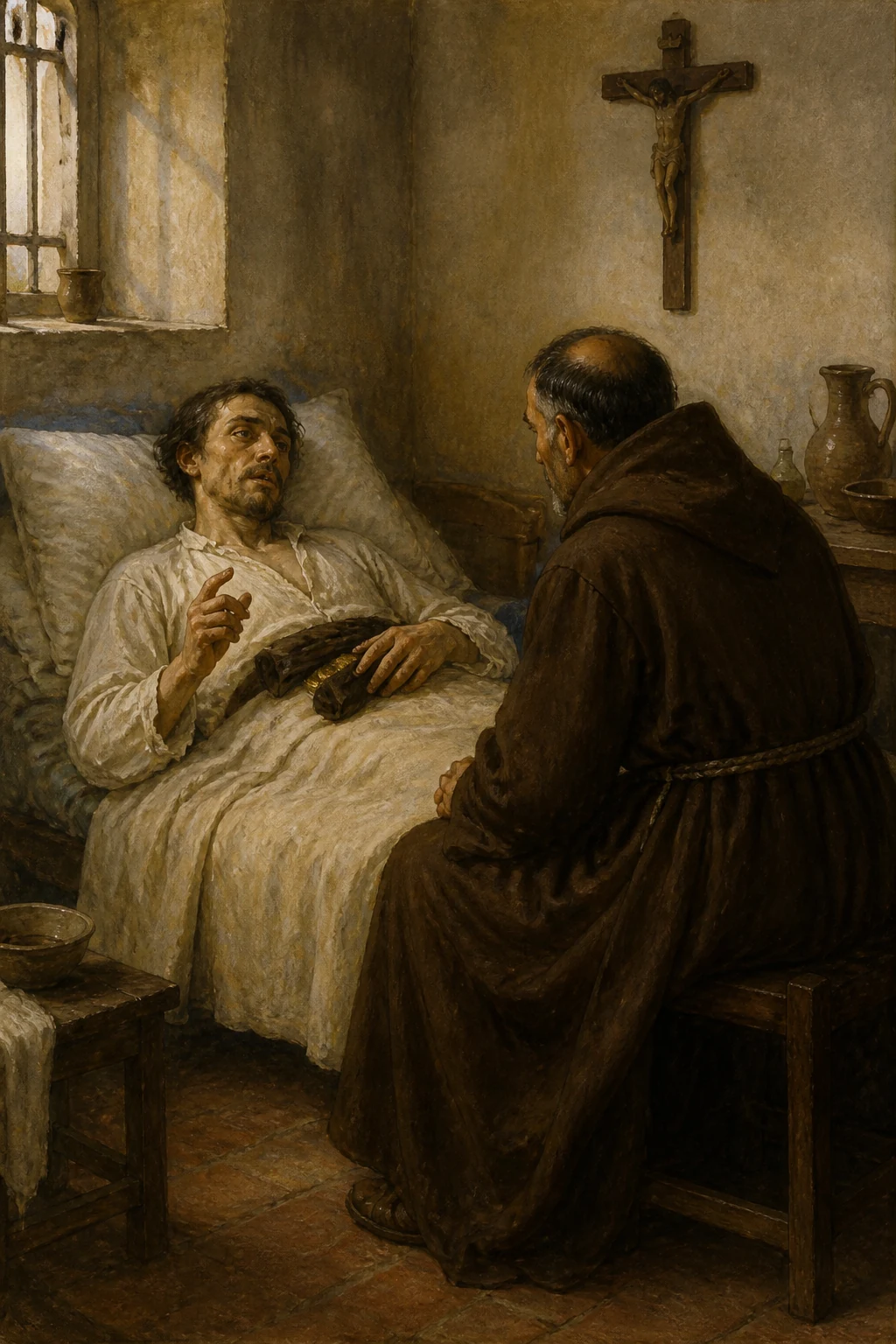
At the beginning of the present century, there lived in the Recollect monastery of the Discalced Friars an octogenarian of austere virtue who wore the habit of a lay brother. The people, who dearly loved the humble monk, knew him only as the Resurrected Man. And here is the authentic and simple tradition concerning him that has come down to us.
I In the year of the three sevens—a number both apocalyptic and famous for the momentous events that took place in America—a man nearing his fortieth summer appeared one day at the hospital of San Andrés, asking to be treated in that holy refuge. From the first, the physicians judged his illness fatal and advised him to pack his bags for a journey to a better world.
Our man heard the fatal verdict without flinching, and after receiving spiritual assistance—or taking the pilot aboard, as a sailor used to say—he summoned Gil Paz, the hospital steward, and spoke to him more or less as follows:
“I came from Spain fifteen years ago, leaving no kin behind, for I am a poor foundling. My life in the Indies has been that of a man honestly seeking his bread through work, but with such contrary fortune that my entire wealth, the fruit of a thousand privations and hardships, amounts to scarcely more than a hundred gold ounces, which you will find in a belt I wear about my body. If, as the physicians believe, and I with them, His Divine Majesty should be pleased to call me into His presence, I bequeath my money to you for your enjoyment, asking only that you clothe my corpse in a good shroud of the seraphic father Saint Francis, and pay for a few Masses for the repose of my sinful soul.”
Don Gil swore by every saint in the calendar that he would faithfully carry out the dying man’s wishes, and that he should have not only his shroud and Masses but a decent funeral as well. Thus comforted, the patient decided that the best thing left for him to do was to die as soon as possible; that very night his extremities began to grow cold, and by five in the morning he was a soul of the next world.
The gold coins passed at once into the pocket of the steward, who was a miser more wretched than avarice itself made flesh. Even his name betrays the man’s meanness: Gil Paz! It would be impossible to be stingier with letters or spend less ink on a signature.
At that time Lima did not yet have its general cemetery, which, as everyone knows, was inaugurated on Tuesday, May 31, 1808; and it is curious to record here that the first body buried in our necropolis, on the following day, was that of a destitute pauper named Matías Isurriaga, who fell from a scaffold where he was working as a mason and was flattened like a pancake in the entrance court of the cemetery itself.
Let us leave the dead man in peace for a while, and, as the gravedigger opens the trench, smoke a cigarette and chat about the government and politics of those days. The dead were buried in a large yard or burial ground attached to each hospital, or in the vaults of churches, at no small risk to public health.
Our Don Gil reflected that the deceased had asked for a great many frills; that he could go into the common grave without holy water, prayers, or Masses for his soul; and that, as for clothing, he was well enough equipped in the threadbare trousers and grimy shirt in which the Grim Reaper had caught him.
“Down in the hole it is not like the world,” Gil Paz philosophized, “where we set such store by outward show and appearances, and many a man cuts a figure thanks to the cloth of his coat. What gall the dead fellow had! I shall certainly never be the one to flatter his vanity by spending the four pesos that Franciscan sackcloth costs. Wanting luxury even to rot in the earth! Was such presumption ever seen? It is a wonder he did not take a fancy to being buried in suede gloves, bell-topped boots, and a lace ruff! Into the hole with the rascal just as he is, and let him thank me for not sending him off in the costume Father Adam wore before he tasted the forbidden delicacy.”
And two black slaves belonging to the hospital picked up the corpse and carried it to the yard that served as a cemetery. II His Excellency Don Manuel Guirior, a native of Navarre and a kinsman of Saint Francis Xavier, knight of the Order of Saint John, lieutenant general of the Royal Navy, gentleman of the bedchamber, and Marquis of Guirior, was serving as viceroy in the New Kingdom of Granada, where he had married Doña María Ventura, a young woman from Bogotá, when Charles III promoted him to the government of Peru.
Accompanied by his wife, Guirior arrived in Lima incognito on July 17, 1776, as Amat’s successor. His public reception took place with great pomp on December 3, four months after he had assumed office. His shrewd judgment and sound administrative abilities soon won him general esteem. He devoted much attention to the conversion of unbelievers and even founded colonies and forts in Chanchamayo, which were later destroyed by the savages. In Lima he established public lighting at a small charge to the residents, and he was the first viceroy to issue proclamations against the deluge known as Carnival water fights. It is true that then, as now, such proclamations remained a dead letter.
Guirior was the only viceroy who gave to the hospitals the ten pesos which, by royal decree, were allotted to His Excellency for sorbets and pastries whenever he honored a theatrical performance with his presence. During his administration the Viceroyalty of Buenos Aires was established, and the demarcation of Peru’s boundaries was completed in accordance with the treaty of 1777 between Spain and Portugal—a treaty that has since brought us some vexations with Brazil and Ecuador.
In that same ill-fated year of the three sevens, the court sent us Don José de Areche, a member of the Council of the Indies, with the title of superintendent and inspector general of the Royal Treasury, and vested with such sweeping powers that they made the viceroy’s authority almost a mockery. The royal envoy’s true mission was to squeeze the orange until not a drop of juice remained. Areche raised the tribute levied on the indigenous people to a million pesos; he created the board of tithes; state monopolies and sales taxes yielded handsome returns; he burdened merchants and miners with taxes and extortions, and tightened the cord so fiercely that serious disturbances broke out in Huaraz, Lambaveque, Huánuco, Pasco, Huancavelica, Moquegua, and other places, where magistrates, tax collectors, and royal officials were put to death by the populace. “Feelings ran so high,” says Lorente, “that in Arequipa the boys at a school killed one of their fellows who had played the part of a customs officer in their games, and on the plain of Santa Marta two thousand Arequipans dared, though unsuccessfully, to give battle to the royal militia.” In Cuzco a vast conspiracy was discovered just in time, led by Don Lorenzo Farfán and an indigenous chief, who were arrested and ended their lives on the scaffold.
Guirior tried hard to convince the superintendent that he was on the wrong path; that discontent was immense, and that the harshness of his measures would not enable him to establish the new taxes but would instead create the danger of the whole country resorting to armed protest—a prediction borne out two years later, under another viceroy, by the bloody rebellion of Tupac-Amaru. But Areche believed the king had sent him to Peru to enrich the royal treasury at the expense of the conquered land, without standing on ceremony, and that Peruvians were serfs whose sweat, turned into gold, must pass into the coffers of Charles III. He therefore informed the sovereign that Guirior was hindering him in fleecing the country, and that another viceroy should be appointed, since His Excellency was damned if he was any use as a ravening, bloodthirsty wolf. After four years in office, and without the slightest formality of courtesy, Don Manuel Guirior, the thirty-second viceroy of Peru, found himself dismissed and summoned to Madrid, where he died a few months after his arrival.
His was a life well lived. Both in the review of his administration and in the secret inquiry conducted against him, the viceroy emerged vindicated, and Areche was severely punished.
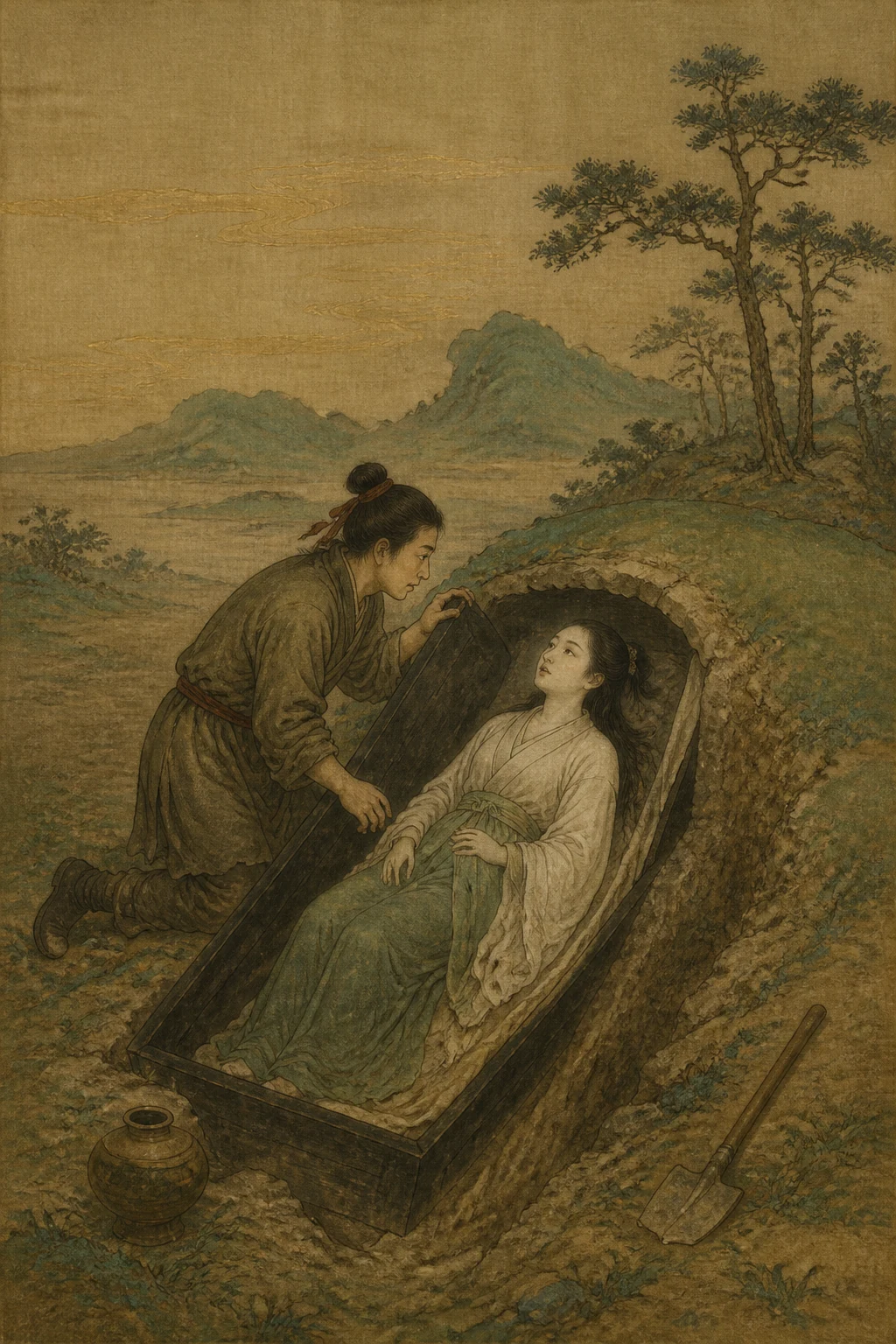
III While the gravedigger was opening the trench, a cool, playful breeze brushed the dead man’s face. He cannot, in truth, have been properly dead, for his muscles began to twitch feebly, then he opened his eyes, and at last, through one of those marvelous instincts of the human organism, grasped his situation. Had our Spaniard taken another couple of minutes to recover from his seizure or cataleptic fit, the shovelfuls of earth would have left him no room to stir and protest.
Absorbed in his familiar, gloomy task, the gravedigger failed to notice the resurrection taking place until the dead man got up on his legs and began walking toward the gate. The graveyard owl fell down in a fit, almost literally fulfilling the words of the song:
The living man fell down dead, and the dead man took to his heels. Don Gil was in the San Ignacio ward, making sure the dispensers did not use too much sugar to sweeten the herbal infusions, when a hand rested familiarly on his shoulder and he heard a sepulchral voice say: “Miser! Where is my shroud?”
Don Gil turned around in terror. Whether it was the fright of seeing a resurrected man of so strange an appearance, or whether the voice of conscience spoke too loudly within him, the fact is that from that instant the wretched fellow lost his reason. His sacrilegious avarice was punished with madness.
As for the Spaniard, a fortnight later he left the hospital fully recovered, and after distributing in alms the gold coins that had caused Don Gil’s misfortune, he took the habit of a lay brother in the monastery of the Discalced Friars. Respectable people who knew him and were acquainted with him assure us that he lived to die in the odor of sanctity, sometime around the year 1812.
Izvirnik
008 El resucitado
Naslednje strani prikazujejo izvirno besedilo za primerjavo.
CRÓNICA DE LA ÉPOCA DEL TRIGÉSIMO SEGUNDO VIRREY
A principios del actual siglo existía en la Recolección de los descalzos un octogenario de austera virtud y que vestía el hábito de hermano lego. El pueblo, que amaba mucho al humilde monje, conocíalo sólo con el nombre de el Resucitado. Y he aquí la auténtica y sencilla tradición que sobre él ha llegado hasta nosotros.
I
En el año de los tres sietes (número apocalíptico y famoso por la importancia de los sucesos que se realizaron en América) presentóse un día en el hospital de San Andrés un hombre que frisaba en los cuarenta agostos, pidiendo ser medicinado en el santo asilo. Desde el primer momento los médicos opinaron que la dolencia del enfermo era mortal, y le previnieron que alistase el bagaje para pasar a mundo mejor.
Sin inmutarse oyó nuestro individuo el fatal dictamen, y después de recibir los auxilios espirituales o de tener el práctico a bordo, como decía un marino, llamó a Gil Paz, ecónomo del hospital, y díjole, sobre poco más o menos:
--Hace quince años que vine de España, donde no dejo deudos, pues soy un pobre expósito. Mi existencia en Indias ha sido la del que honradamente busca el pan por medio del trabajo; pero con tan aviesa fortuna que todo mi caudal, fruto de mil privaciones y fatigas, apenas pasa de cien onzas de oro que encontrará vuesa merced en un cincho que llevo al cuerpo. Si como creen los físicos, y yo con ellos, su Divina Majestad es servida llamarme a su presencia, lego a vuesamerced mi dinero para que lo goce, pidiéndole únicamente que vista mi cadáver con una buena mortaja del seráfico padre San Francisco, y pague algunas misas en sufragio de mi alma pecadora.
Don Gil juró por todos los santos del calendario cumplir religiosamente con los deseos del moribundo, y que no sólo tendría mortaja y misas, sino un decente funeral. Consolado así el enfermo, pensó que lo mejor que le quedaba por hacer era morirse cuanto antes; y aquella misma noche empezaron a enfriársele las extremidades, y a las cinco de la madrugada era alma de la otra vida.
Inmediatamente pasaron las peluconas al bolsillo del ecónomo, que era un avaro más ruin que la encarnación de la avaricia. Hasta su nombre revela lo menguado del sujeto: ¡¡Gil Paz!! No es posible ser más tacaño de letras ni gastar menos tinta para una firma.
Por entonces no existía aún en Lima el cementerio general, que, como es sabido, se inauguró el martes 31 de mayo de 1808; y aquí es curioso consignar que el primer cadáver que se sepultó en nuestra necrópolis al día siguiente fué el de un pobre de solemnidad llamado Matías Isurriaga, quien, cayéndose de un andamio sobre el cual trabajaba como albañil, se hizo tortilla en el atrio.
Dejemos por un rato en reposo al muerto, y mientras el sepulturero abre la zanja fumemos un cigarrillo, charlando sobre el gobierno y la política de aquellos tiempos, mismo del cementerio. Los difuntos se enterraban en un corralón o campo santo que tenía cada hospital, o en las bóvedas de las iglesias, con no poco peligro de la salubridad pública.
Nuestro don Gil reflexionó que el finado le había pedido muchas gollerías; que podía entrar en la fosa común sin asperges, responsos ni sufragios; y que, en cuanto a ropaje, bien aviado iba con el raído pantalón y la mugrienta camisa con que lo había sorprendido la flaca.
--En el hoyo no es como en el mundo--filosofaba Gil Paz--, donde nos pagamos de exterioridades y apariencias, y muchos hacen papel por la tela del vestido. ¡Vaya una pechuga la del difunto! No seré yo, en mis días, quien halague su vanidad, gastando los cuatro pesos que importa la jerga franciscana. ¿Querer lujo hasta para pudrir tierra? ¡Hase visto presunción de la laya! ¡Milagro no le vino en antojo que lo enterrasen con guantes de gamuza, botas de campana y gorguera de encaje! Vaya al agujero como está el muy bellaco, y agradézcame que no lo mande en el traje que usaba el padre Adán antes de la golosina.
Y dos negros esclavos del hospital cogieron el cadáver y lo transportaron al corralón que servía de cementerio.
II
El excelentísimo señor don Manuel Guirior, natural de Navarra y de la familia de San Francisco Javier, caballero de la Orden de San Juan, teniente general de la real armada, gentilhombre de cámara y marqués de Guirior, hallábase como virrey en el nuevo reino de Granada, donde había contraído matrimonio con doña María Ventura, joven bogotana, cuando fué promovido por Carlos III al gobierno del Perú.
Guirior, acompañado de su esposa, llegó a Lima de incógnito el 17 de julio de 1776, como sucesor de Amat. Su recibimiento público se verificó con mucha pompa el 3 de diciembre, es decir, a los cuatro meses de haberse hecho cargo del gobierno. La sagacidad de su carácter y sus buenas dotes administrativas le conquistaron en breve el aprecio general. Atendió mucho a la conversión de infieles, y aun fundó en Chanchamayo colonias y fortalezas, que posteriormente fueron destruidas por los salvajes. En Lima estableció el alumbrado público con pequeño gravamen de los vecinos, y fué el primer virrey que hizo publicar bandos contra el diluvio llamado juego de carnavales. Verdad es que, entonces como ahora, bandos tales fueron letra muerta.
Guirior fué el único, entre los virreyes, que cedió a los hospitales los diez pesos que, para sorbetes y pastas, estaban asignados por real cédula a su excelencia siempre que honraba con su presencia una función de teatro. En su época se erigió el virreinato de Buenos Aires y quedó terminada la demarcación de límites del Perú, según el tratado de 1777 entre España y Portugal, tratado que después nos ha traído algunas desazones con el Brasil y el Ecuador.
En el mismo aciago año de los tres sietes nos envió la corte al consejero de Indias don José de Areche, con el título de superintendente y visitador general de la real Hacienda, y revestido de facultades omnímodas tales, que hacían casi irrisoria la autoridad del virrey. La verdadera misión del enviado regio era la de exprimir la naranja hasta dejarla sin jugo. Areche elevó la contribución de indígenas a un millón de pesos; creó la junta de diezmos; los estancos y alcabalas dieron pingües rendimientos; abrumó de impuestos y socaliñas a los comerciantes y mineros, y tanto ajustó la cuerda que en Huaraz, Lambaveque, Huánuco, Pasco, Huancavelica, Moquegua y otros lugares estallaron serios desórdenes, en los que hubo corregidores, alcabaleros y empleados reales ajusticiados por el pueblo. «La excitación era tan grande--dice Lorente--que en Arequipa los muchachos de una escuela dieron muerte a uno de sus camaradas que, en sus juegos, había hecho el papel de aduanero, y en el llano de Santa Marta dos mil arequipeños osaron, aunque con mal éxito, presentar batalla a las milicias reales.» En el Cuzco se descubrió muy oportunamente una vasta conspiración encabezada por don Lorenzo Farfán y un indio cacique los que, aprehendidos, terminaron su existencia en el cadalso.
Guirior se esforzó en convencer al superintendente de que iba por mal camino; que era mayúsculo el descontento, y que con el rigorismo de sus medidas no lograría establecer los nuevos impuestos, sino crear el peligro de que el país en masa recurriese a la protesta armada, previsión que dos años más tarde y bajo otro virrey, vino a justificar la sangrienta rebelión de Tupac-Amaru. Pero Areche pensaba que el rey lo había enviado al Perú para que, sin pararse en barras, enriqueciese el real tesoro a expensas de la tierra conquistada, y que los peruanos eran siervos cuyo sudor, convertido en oro, debía pasar a las arcas de Carlos III. Por lo tanto, informó al soberano que Guirior lo embarazaba para esquilmar el país y que nombrase otro virrey, pues su excelencia maldito si servía para lobo rapaz y carnicero. Después de cuatro años de gobierno, y sin la más leve fórmula de cortesía, se vió destituido don Manuel Guirior, trigésimo segundo virrey del Perú, y llamado a Madrid, donde murió pocos meses después de su llegada.
Vivió una vida bien vivida.
Así en el juicio de residencia como en el secreto que se le siguió, salió victorioso el virrey y fué castigado Areche severamente.
III
En tanto que el sepulturero abría la zanja, una brisa fresca y retozona oreaba el rostro del muerto, quien ciertamente no debía estarlo en regla, pues sus músculos empezaron a agitarse débilmente, abrió luego los ojos y, al fin, por uno de esos maravillosos instintos del organismo humano, hízose cargo de su situación. Un par de minutos que hubiera tardado nuestro español en volver de su paroxismo o catalepsia, y las paladas de tierra no le habrían dejado campo para rebullirse y protestar.
Distraído el sepulturero con su lúgubre y habitual faena, no observó la resurrección que se estaba verificando hasta que el muerto se puso sobre sus puntales y empezó a marchar con dirección a la puerta. El buho de cementerio cayó accidentado, realizándose casi al pie de la letra aquello que canta la copla:
el vivo se cayó muerto y el muerto partió a correr.
Encontrábase don Gil en la sala de San Ignacio vigilando que los topiqueros no hiciesen mucho gasto de azúcar para endulzar las tisanas cuando una mano se posó familiarmente en su hombro y oyó una voz cavernosa que le dijo: ¡Avariento! ¿Dónde está mi mortaja?
Volvióse aterrorizado don Gil. Sea el espanto de ver un resucitado de tan extraño pelaje, o sea que la voz de la conciencia hubiese hablado en él muy alto, es el hecho que el infeliz perdió desde ese instante la razón. Su sacrílega avaricia tuvo la locura por castigo.
En cuanto al español, quince días más tarde salía del hospital completamente restablecido, y después de repartir en limosnas las peluconas, causa de la desventura de don Gil, tomó el hábito de lego en el convento de los padres descalzos, y personas respetables que lo conocieron y trataron nos afirman que alcanzó a morir en olor de santidad, allá por los años de 1812.
Nadaljuj z branjem