Waltey
Nihče ne umre, dokler Bog ne hoče
Tradiciones peruanas
Tradiciones peruanas · Ricardo PalmaO besedilu
Nihče ne umre, dokler Bog ne hoče
- Vir
- Tradiciones peruanas
- Avtor
- Ricardo Palma
- Jezik branja
- English
- Jezik izvirnika
- Español
- Čas branja
- 11 min branja
- Obseg
- 9 strani
- Naslov izvirnika
- 012 Nadie se muere hasta que Dios quiere
O izvirniku
Tradiciones peruanas
Šestindvajset Palmovih avtorskih zgodovinskih tradicij iz konkretnega Gutenbergovega zvezka. Bralni jezik je English, izvirnik pa prihaja iz vira Tradiciones peruanas v jeziku Español.
Besedilo
Nihče ne umre, dokler Bog ne hoče
They tell of a friar with a touch of the rogue and the philosopher who, while administering the sacrament of marriage, said to the man: There, I give you this woman: treat her like a hired mule—plenty of stick and little to eat.
The man who married the silversmith Román in Lima must have been another of the same stripe, except that he changed tack and said to the woman: There is your husband: treat him like an ox yoked to the plough, and see that he hangs himself out of sheer misery.
There are people still living who knew and dealt with the silversmith, whom we shall call Román, for there is good reason not to set his real name down in print. This tale is exceedingly well known in Lima, and the first octogenarian you happen upon in those streets, dear reader, will tell it to you, down to the last jot and tittle.
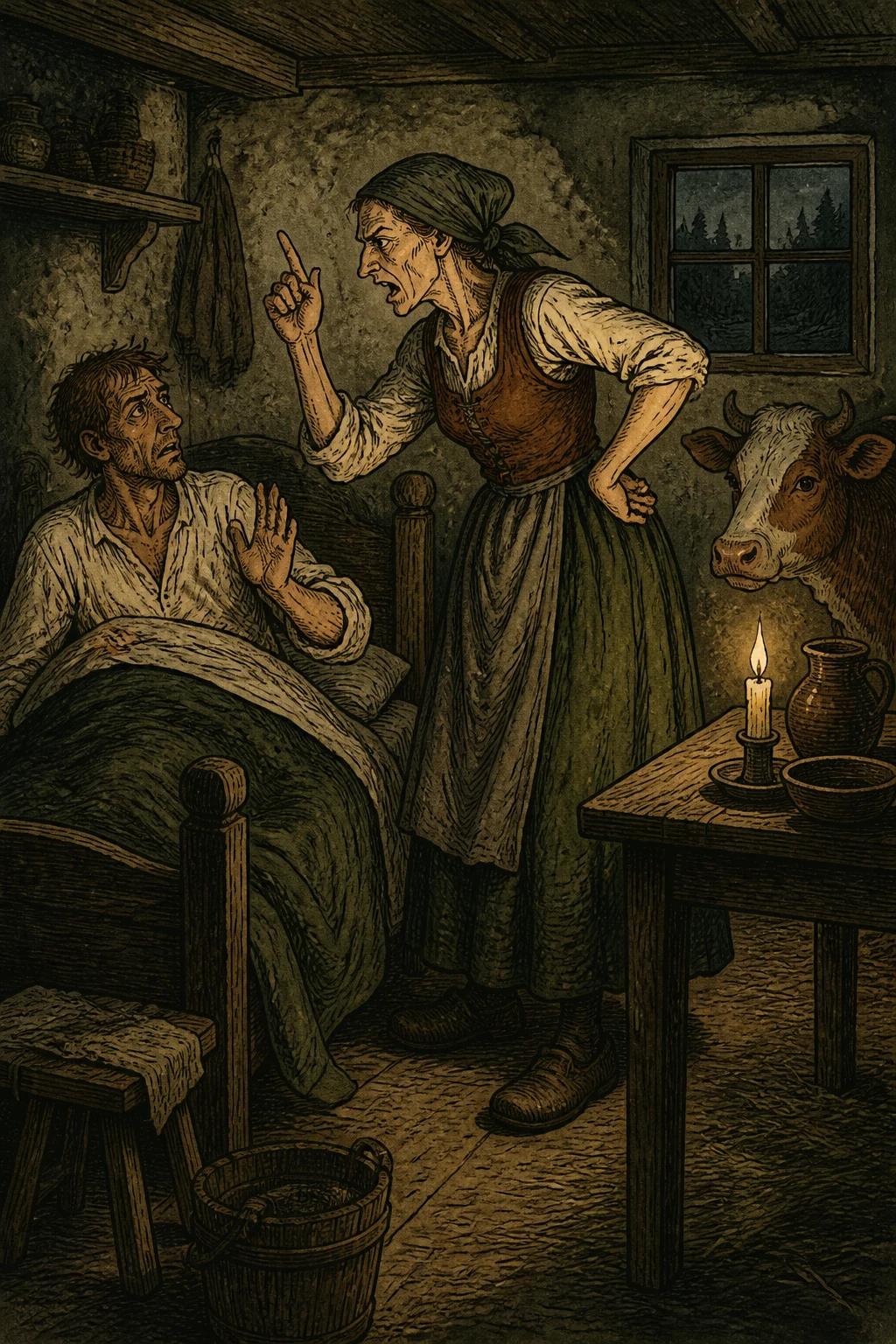
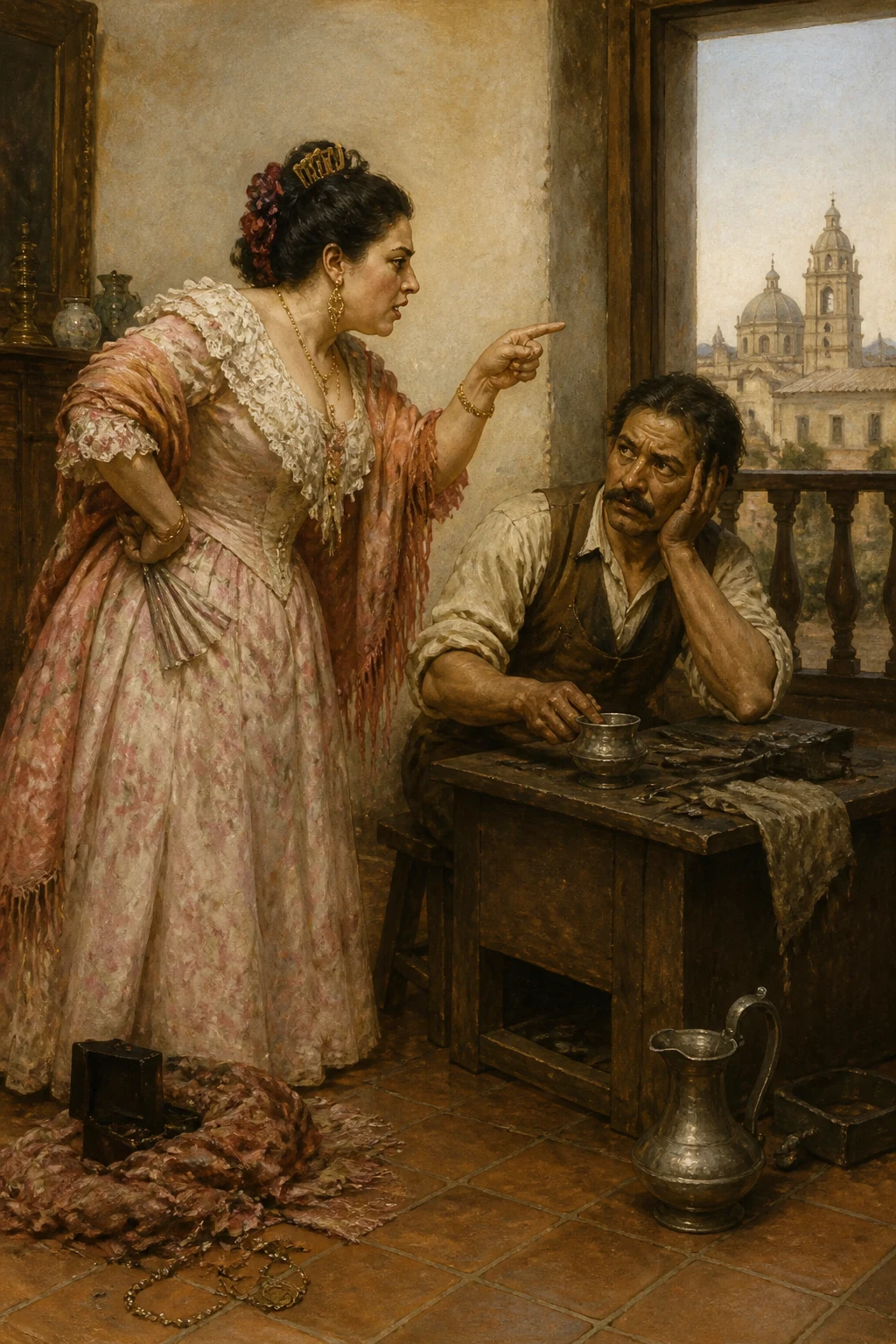
Román’s wife, though a woman of the strictest virtue where marital fidelity was concerned, possessed all the worst qualities one could wish upon a daughter of Eve. Fond of show, extravagant, stubborn, and shrewish, she plagued her poor husband with demands for money; and theirs was neither a house nor a home nor anything Christ ever founded, but a living image of hell. Not a floor was swept, not a sock darned for the poor fellow who paid the bills, not a thought given to the cooking; in short, everything went to rack and ruin. Madam thought of nothing but trinkets and fripperies, drinking parties and outings.
At that rate, the husband’s shop and property vanished in less time than it takes a mad priest to cross himself, and with poverty came civil war in that practical republic known as marriage. The couple were forever at each other’s throats. Over the merest trifle they would hurl crockery at one another’s heads, at the risk of cracking them open, and not a chair had a sound stick left in it. At best, the good-natured husband emerged bearing on his face mementoes of his better half’s fingernails.
This marriage brings to mind a sonnet we wrote in the merry days of our youth; and since the temptation to foist it upon you is irresistible, here it comes, like the knight of cups:
I wed, to my undoing, a shameless little thing, fresh as a bergamot pear; she brought a mother-in-law and a great sprawling clan, with her lovely face for dowry. At a brisk trot my fortune hastens to founder on an unknown shoal; soon she will bankrupt me, unless I find a thriving mine. A begging devil walks beside me; “Give me!” is her endless refrain, and so I am reduced to skin and bone, dear friend. What say you? Does my plight distress you? —I tell you, Don Peruétano, and I mean what I say: that creature is no woman… she is a leech.
I cannot remember whom I heard say that a married woman’s commandments, like those of God’s law, are ten: The first, to love her husband above all things.
The second, not to swear love to him in vain. The third, to lavish affection on him. The fourth, to love him more than father and mother. The fifth, not to torment him with jealousy and grumbling.
The sixth, not to betray him. The seventh, not to spend his money on finery. The eighth, not to feign fits of nerves or flirt with her cousins.
The ninth, to desire no neighbour but her husband. The tenth, not to covet the luxuries of others. These ten commandments are to be kept in the rice-powder box and read each day until learned by heart.
The trick is not to break any of them, as we Christians do with several of those in the Decalogue. Let us return to the silversmith. One morning, after one of those daily battles of Moors and Christians, with all their hurly-burly and hullabaloo, Román said to himself:
—Well, sir, this cannot go on any longer, for His Divine Majesty cannot have worse torments in store for me in the next world than those I suffer with my rib of a wife. Whoever said that if the sea married it would lose its fury and turn into a halfwit spoke truly. It is settled: today I shall hang myself.
And with the one pillar-stamped peseta remaining in his pocket, he went to the little corner shop and bought four yards of strong new rope—a very pardonable luxury in a man who intended never to indulge in another.
II —And which viceroy was ruling then?—I fancy I hear this question, so customary when people listen to a story whose accuracy they doubt.
Well, my readers, the ruler was His Excellency Don Gabriel de Avilés y Fierro, Marquis of Avilés, lieutenant general of the royal armies, who, after serving as president of Chile and viceroy of Buenos Aires, came in November 1801 to take command of this blessed land.
Avilés had arrived in Peru in the time of Viceroy Amat; and when the famous revolt of Tupac-Amaru broke out in 1780, he was sent with troops to suppress it. Excessive was the severity Avilés employed in that campaign.
During his government the bishopric of Maynas was established and Guayaquil was incorporated into the viceroyalty. The Refugio hospital for women was founded in Lima at the expense of Avilés and his wife, the Lima-born Doña Mercedes Risco, and work began on the fort of Santa Catalina as an artillery barracks, under the direction of Don Joaquín de la Pezuela, then a colonel and later viceroy.
The arrival of the smallpox vaccine was celebrated with great festivities. Peru received a visit from the learned Humboldt, and one night Lima experienced the alarming phenomenon of many clearly audible peals of thunder. It was in this period that the trees of the Alameda de Acho were planted.
Since Spain and France had made common cause against England, and the disaster of Trafalgar had just occurred, two English brigs attacked the Spanish war frigate Astrea at Arica, severely damaging her and forcing her to seek shelter in the bay.
In attempting to carry out a royal order for the sale of Church property, Avilés encountered serious resistance, which the prudent viceroy calmed by dragging the matter out and sending inquiries and memorials to the Crown. This was not the first time the viceroy had resorted to letting time take its course to extricate himself from a difficult position. In 1804 the city was pressing him to issue a certain decree; but believing either that it was impracticable or that it lay beyond his authority, he decided to consult the monarch. The people, unaware of this, began to grumble openly, and the following lampoon appeared on the palace door:
Avilés! Avilés! What are you doing, that you cannot see what goes on in the city? The viceroy took no offence, and ordered this reply to be written beneath it: To satisfy your wishes, I have sent all the way to Spain for spectacles.
This answer soothed their spirits, for the townspeople saw that their request awaited the king’s decision. Avilés devoted much of his time to religious observances. The people summed him up in this phrase: Able at prayer, unable at government.
In July 1806 he handed over command to Abascal. Old, ill, and downcast by the recent death of his wife, Avilés wished to return to Spain. The ship carrying him put in at Valparaíso, and a few days later the devout viceroy, as the mischievous ladies of Lima called him, died in that port.
III Equipped with his rope, and without troubling to write farewell notes beforehand, as has been the fashion since the invention of nerves and romanticism, our man made his way to the pond at Santa Beatriz, then a most delightful spot, surrounded by orange trees and other trees that seemed positively to invite a fellow to hang himself from them and make an end of misery and sorrow.
Román began by inspecting the trees, and found some fault with every one. This one was not tall enough; that one lacked the strength to bear as its fruit the body of a great lout like himself; another had too little foliage, and the one beyond leaned a little. When a man hangs himself, he ought at least to have the consolation of doing it entirely to his own liking. At last he found a tree that met the requirements of the case and, climbing into it, tied the rope to one of its sturdiest branches.
While making these preparations, he reflected that, to avoid being interrupted and left half dead, perhaps obliged to begin the job all over again, he had best wait until the road was deserted. Indigenous fisherwomen coming from Chorrillos, herb sellers from Surco, yanacona tenant labourers from Miraflores, runaway slaves from San Juan, and labourers from the estates were passing at that hour a short distance from the pond. There was simply no way for a man to kill himself in peace.
—It would be a fine business if, just at the best part of the performance, some ill-timed passer-by were to cut me down! Since it must come to this in the end, there is no harm in waiting a little: he who arrives is never too late.
Román was hidden among the tree’s thick branches, occupied with these and other reflections, when he saw a little man approaching at a slow pace, glancing suspiciously in every direction and wrapped in a cloak covered with patches.
This was an old Spaniard who lived on public charity and was known in Lima by the nickname of Ovillitos. The nickname came from his having once gone from house to house selling little balls of thread, until one day he decided to change trades and enlist in the ranks of the beggars.
After casting searching glances at the walls and the road, Ovillitos sat down beneath the tree that sheltered Román and, taking out a pair of scissors, unstitched two of the countless patches that adorned his filthy cloak of coarse wool.
Imagine the surprise of Román, perched above, when he saw Ovillitos take a gold ounce from each patch and, after spending a long while gazing lovingly at the coins, bury them at the foot of the tree!
—Suicide, my foot!—exclaimed Román, scrambling down from his tree as soon as the beggar had gone.—Since God has come to visit me, let us make the most of the occasion and seize bald Opportunity by her one remaining hair. Happy the tree that has such fertiliser!
And he set to work and dug up a little over a hundred peluconas, those gold coins bearing, beneath the words Indiae et Hispaniarum Rex, the bewigged bust of Charles III or Charles IV.
IV Román stocked his shop again, and his silversmith’s business sailed along with a fair wind. Taught by the days of hardship, he curbed his wife’s extravagance, and her disposition improved remarkably, doubtless through a miracle of Divine Providence, to whom nothing is impossible.
Ovillitos fell gravely ill when he discovered that his treasure had turned into a bird and flown its cage. The unfortunate fellow did not know that money is no Carthusian monk, content to remain shut away and gather mould, but a libertine who longs to be out in the open, passing from hand to hand. There have been beggars in every age who left a respectable fortune at their death.
Román died after the republic had been established, leaving his heirs a fortune estimated at more than fifty thousand pesos. One clause of his will, which we have read, sets aside thirty pesos a month for twenty-five years for Masses for the repose of Ovillitos’s soul.
Izvirnik
012 Nadie se muere hasta que Dios quiere
Naslednje strani prikazujejo izvirno besedilo za primerjavo.
CRÓNICA DE LA ÉPOCA DEL TRIGÉSIMO SÉPTIMO VIRREY DEL PERÚ
I
Cuentan que un fraile con ribetes de tuno y de filósofo, administrando el sacramento del matrimonio, le dijo al varón:
Ahí te entrego esa mujer: trátala como a mula de alquiler, mucho garrote y poco de comer.
Otro que tal debió ser el que casó en Lima al platero Román, sólo que cambió de frenos y dijo a la mujer:
Ahí tienes ese marido: trátalo como a buey al yugo uncido y procura que se ahorque de aburrido.
Viven aún personas que conocieron y trataron al platero, a quien llamaremos Román; pues causa existe para no estampar en letras de molde su nombre verdadero. El presente sucedido es popularísimo en Lima y te lo referirá, lector, con puntos y comas, el primer octogenario con quien tropieces por esas calles.
La mujer de Román, si bien honradísima hembra en punto a fidelidad conyugal, tenía las peores cualidades apetecibles en una hija de Eva. Amiga del boato, manirrota, terca y regañona, atosigaba al pobrete del marido con exigencias de dinero; y aquello no era casa, ni hogar, ni Cristo que lo fundó, sino trasunto vivo del infierno. Ni se daba escobada, ni se zurcían las calcetas del pagano, ni se cuidaba del puchero, y todo, en fin, andaba a la bolina. Madama no pensaba sino en dijes y faralares, en bebendurrias y paseos.
A ese andar, la tienda y los haberes del marido se evaporaron en menos de lo que se persigna un cura loco, y con la pobreza estalló la guerra civil en esa república práctica que se llama matrimonio. Los cónyuges andaban siempre a pícame Pedro que picarte quiero. Por quítame allá esta paja se tiraban los cacharros a la cabeza, a riesgo de descalabrarse, y no quedaba silla con palo sano. A bien librar salía siempre el bonachón del marido llevando en el rostro reminiscencias de las uñas de su conjunta persona.
Este matrimonio nos trae al magín un soneto que escribimos, allá por los alegres tiempos de nuestra mocedad, y que, pues la ocasión es tentadora para endilgarlo, ahí va como el caballo de copas:
Caséme por mi mal con una indina, fresca como la pera bergamota; trájome suegra y larga familiota y por dote su cara peregrina. A trote largo mi caudal camina a sumergirse en una sirte ignota; pronto he de hacer con ella bancarrota, salvo que encuentre una boyante mina. Un diablo pedigüeño anda conmigo; es ¡dame! su perenne cantinela, y así estoy en los huesos, caro amigo. ¿Qué me dices? ¿Mi afán te desconsuela? --Dígote, don Peruétano, que digo, que aquella no es mujer... es sanguijuela.
No recuerdo a quién oí decir que los mandamientos de la mujer casada son, como los de la ley de Dios, diez:
El primero, amar a su marido sobre todas las cosas.
El segundo, no jurarle amor en vano.
El tercero, hacerle fiestas.
El cuarto, quererlo más que a padre y madre.
El quinto, no atormentarlo con celos y refunfuños.
El sexto, no traicionarlo.
El séptimo, no gastarle la plata en perifollos.
El octavo, no fingir ataque de nervios ni hacer mimos a los primos.
El noveno, no desear más prójimo que su marido.
El décimo, no codiciar el lujo ajeno.
Estos diez mandamientos se encierran en la cajita de los polvos de arroz, y se leen cada día hasta aprenderlos de memoria.
El quid está en no quebrantar ninguno, como hacemos los cristianos con varios de los del Decálogo. Sigamos con el platero.
Una mañana, después de haber tenido Román una de esas cotidianas zambras de moros y cristianos, gutibambas y muziferreras, se dijo:
--Pues, señor, esto no puede durar más tiempo, que penas más negras que las que paso con mi costilla no me ha de deparar su Divina Majestad en el otro mundo. Bien dijo el que dijo que si el mar se casase había de perder su braveza, y embobalicarse. Decididamente, hoy me ahorco.
Y con la única peseta columnaria que le quedaba en el bolsillo, se dirigió al ventorrillo o pulpería de la esquina y compró cuatro varas de cuerda fuerte y nueva, lujo muy excusable en quien se prometía no tener ya otros en la vida.
II
--¿Y qué virrey gobernaba entonces?--Paréceme oír esta pregunta, que es de estilo cuando se escucha contar algo de cuya exactitud dudan los oyentes.
Pues, lectores míos, gobernaba el excelentísimo señor don Gabriel de Avilés y Fierro, marqués de Avilés, teniente general de los reales ejércitos y que, después de haber servido la presidencia de Chile y el virreinato de Buenos Aires, vino en noviembre de 1801 a hacerse cargo del mando de esta bendita tierra.
Avilés había llegado al Perú en la época del virrey Amat; y cuando estalló en 1780 la famosa revolución de Tupac-Amaru fué mandado con tropas para sofocarla. Excesivo fué el rigor que empleó Avilés en esa campaña.
Durante su gobierno se erigió el obispado de Maynas y se incorporó Guayaquil al virreinato. Se estableció en Lima el hospital del Refugio para mujeres, a expensas de Avilés y de su esposa la limeña doña Mercedes Risco, y se principió la fábrica del fuerte de Santa Catalina para cuartel de artillería, bajo la dirección del entonces coronel, y más tarde virrey, don Joaquín de la Pezuela.
Con grandes fiestas se celebró la llegada del flúido vacuno. Tuvo el Perú la visita del sabio Humboldt, y en Lima se experimentó una noche el alarmante fenómeno de haberse oído con claridad muchos truenos. En esa época se plantaron los árboles de la Alameda de Acho.
Como España y Francia hacían causa común contra Inglaterra y acababa de realizarse el desastre de Trafalgar, dos bergantines ingleses atacaron en Arica a la fragata de guerra española Astrea, ocasionándola fuertes averías y forzándola a buscar abrigo en la bahía.
Tratando de dar cumplimiento a una real orden sobre desamortización de bienes eclesiásticos, tropezó Avilés con serias resistencias, que el prudente virrey calmó dando largas al asunto y enviando consultas y memoriales a la corona. No fué ésta la primera vez en que el virrey apeló al expediente de dar tiempo al tiempo para libertarse de compromisos. En 1804 interesábase la ciudad porque el virrey dictase cierta providencia; mas él, creyendo que la cosa no era hacedera o que no entraba en sus atribuciones, decidió consultar al monarca. El pueblo, que lo ignoraba, se echó a murmurar sin embozo, y en la puerta de palacio apareció este pasquín:
¡Avilés! ¡Avilés! ¿Qué haces que por la ciudad no ves?
El virrey no lo tomó a enojo, y mandó escribir debajo:
Para dar gusto a antojos he mandado hasta España por anteojos.
Respuesta que tranquilizó los ánimos, pues vieron los vecinos que su empeño estaba sujeto a la decisión del rey.
Avilés consagraba gran parte de su tiempo a las prácticas religiosas. El pueblo lo pintaba con esta frase. En la oración hábil es y en gobierno inhábil es.
En julio de 1806 entregó el mando a Abascal.
Anciano, enfermo y abatido de ánimo, por la reciente muerte de su esposa, quiso Avilés regresar a España. La nave que lo conducía arribó a Valparaíso, y a los pocos días falleció en este puerto el virrey devoto, como lo llamaban las picarescas limeñas.
III
Provisto de cuerda y sin cuidarse de escribir previamente esquelas de despedida, como es de moda desde la invención de los nervios y del romanticismo, se dirigió nuestro hombre al estanque de Santa Beatriz, lugar amenisimo entonces y rodeado de naranjos y otros árboles, que no parecía sino que estaban convidando al prójimo para colgarse de ellos y dar al traste con el aburrimiento y pesadumbres.
Principió Román por pasar revista a los árboles, y a todos hallaba algún pero que ponerles. Este no era bastante elevado; aquél no ofrecía consistencia para soportar por fruto el cuerpo de un tagarote como él; el otro era poco frondoso, y el de más allá un tanto encorvado. Cuando uno se ahorca debe siquiera llevar el consuelo de haberlo hecho a su regalado gusto. Al fin encontró árbol con las condiciones que el caso requería y, encaramándose en él, ató la cuerda en una de las ramas más vigorosas.
En estos preparativos reflexionó que, para no ser interrumpido y quedarse a medio morir y tener tal vez que empezar de nuevo la faena, lo mejor era esperar a que el camino estuviese desierto. Indias pescadoras que venían de Chorrillos, hierbateros de Surco, yanaconas de Miraflores, cimarrones de San Juan y peones de las haciendas, traficaban a esa hora a pequeña distancia del estanque. No había forma de que un hombre pudiera matarse en paz.
--¡Pues sería andrómina que, a lo mejor de la función, me descolgase un transeúnte inoportuno! Si ello, al fin, ha de ser, nada se pierde con esperar un rato, que no llega tarde quien llega.
En estas y otras cavilaciones hallábase Román escondido entre el espeso ramaje del árbol, cuando vió llegar con tardo paso, y mirando a todas partes con faz recelosa, un hombrecillo envuelto en un capote lleno de remiendos.
Era éste un vejete español que vivía de la caridad pública, y a quien en Lima conocían con el apodo de Ovillitos. El apodo le venía de que en una época entraba de casa en casa vendiendo ovillos de hilo, hasta que un día resolvió cambiar de oficio sentando plaza de mendigo.
Ovillitos, después de dirigir miradas escudriñadoras a las tapias y al camino, se sentó bajo el árbol que cobijaba a Román, y sacando una tijera, descosió dos de los infinitos parches que esmaltaban su mugriento capote de barragán.
¿Cuál sería la sorpresa del encaramado Román al ver que de cada parche sacó Ovillitos una onza de oro y que luego las enterró al pie del árbol, después de haber permanecido gran espacio de tiempo contemplándolas amorosamente?
--¡Qué suicidio ni qué ocho cuartos!--exclamó Román, descendiendo listamente de su árbol apenas se alejó el mendigo--. Pues Dios me ha venido a ver, aprovechemos la ocasión y empuñémosla por el único pelo de la calva. ¡Arbol feliz el que tal abono tiene!
Y se puso a la obra, y desenterró poco más de cien peluconas, de esas que bajo el Indiae et Hispaniarum Rex lucían el busto de Carlos III o Carlos IV.
IV
Román volvió a habilitar la tienda, y su comercio de platería marchó viento en popa. Aleccionado por los días de penuria, puso coto a los derroches de su mujer, cuyo carácter, por milagro sin duda de la Divina Providencia, para quien no hay imposibles, mejoró notablemente.
Ovillitos enfermó de gravedad al descubrir que su tesoro se había convertido en pájaro y volado del encierro. El infeliz ignoraba que el dinero no es monje cartujo que gusta de estar guardado y criar moho, y que es un libertino que se desvive por andar al aire libre y de mano en mano. Mendigos ha habido, en todos los tiempos, que a su muerte han dejado un caudal decente.
Román murió, ya en los tiempos de la república, repartiéndose entre sus herederos una fortuna que se estimó en más de cincuenta mil pesos.
Una de las cláusulas de su testamento, que hemos leído, señala durante veinticinco años la suma de treinta pesos al mes para misas en sufragio del alma de Ovillitos.
Nadaljuj z branjem