O besedilu
Nes, Dejanejra in Herkulova smrt
- Vir
- Ovidove preobrazbe
- Avtor
- Ovid
- Jezik branja
- English
- Jezik izvirnika
- Latin
- Čas branja
- 10 min branja
- Obseg
- 8 strani
- Naslov izvirnika
- Nessus, Deianira, and the Death of Hercules
O izvirniku
Ovidove preobrazbe
Pesniški tok antičnih preobrazb, kjer bogovi, ljudje in narava stalno menjavajo obliko. Bralni jezik je English, izvirnik pa prihaja iz vira Ovidove preobrazbe v jeziku Latin.
Besedilo
Nes, Dejanejra in Herkulova smrt
He had finished speaking, and a nymph, her dress tucked up in Diana’s fashion, one of his attendants, her hair flowing over either shoulder, came forward, bearing in a lavish horn all autumn’s bounty, ripe fruit for the second course. Dawn came, and as the first sunlight struck the peaks, the young men departed: they would not wait for the rivers to grow peaceful, their currents to run calmly, and all the floodwaters to subside. Achelous hid his rugged face and his head, shorn of a horn, beneath the waves.
Yet only the loss of that stolen glory had humbled him; in all else he was unharmed. Even the damage to his head was hidden by willow leaves or reeds laid over it. But you, fierce Nessus, passion for that same maiden had destroyed, a flying arrow piercing your back. For, returning to his native city with his new bride, the son of Jove had reached the rushing waters of the Euenus.
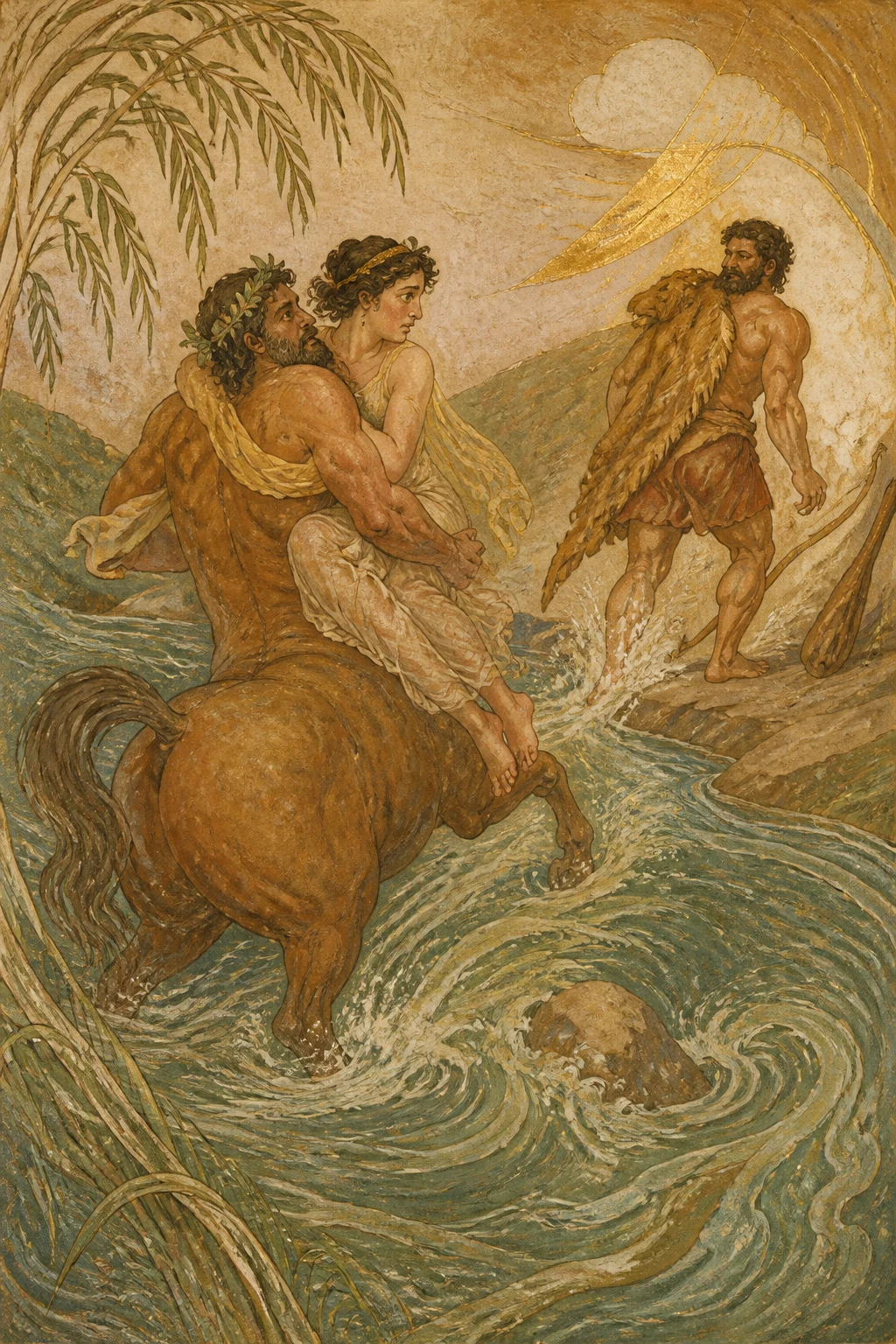
Swollen beyond its usual bounds by winter rains, the river seethed with whirlpools and could not be crossed. Fearless for himself, but anxious for his wife, he was approached by Nessus, strong of limb and familiar with the fords. “By my service this lady shall be set upon that farther bank,” he said, “Alcides. Use your strength to swim across!” And the Aonian hero entrusted the frightened Calydonian maiden to Nessus, pale with terror, afraid of both the river and her bearer.
Then, just as he was, weighed down by his quiver and lion’s hide (for he had thrown his club and curved bow to the farther bank), he said, “Since I have begun, let this river too be conquered!” Without hesitation, without seeking where the stream was gentlest, he scorned to yield and be carried downstream. He had reached the bank and was picking up the bow he had thrown when he recognized his wife’s voice. As Nessus prepared to betray his trust, he shouted, “Where is your vain confidence in your speed carrying you, brute? You, two-shaped Nessus, I am speaking to you! Listen, and do not steal what is mine!
If no respect for me restrains you, at least your father’s whirling wheel might have checked this forbidden lust. Yet you will not escape, however much you trust your horse’s strength: with a wound, not with my feet, I shall overtake you.” His last words were proved by the deed: he loosed an arrow through the fleeing back, and its barbed point stood out from the chest.
As soon as it was pulled free, blood spurted from both wounds, mingled with the deadly poison of Lerna. Nessus caught it. “For I shall not die unavenged,” he said to himself, and gave the woman he had seized a garment soaked in his warm blood, pretending it would kindle love. A long stretch of time passed, and the deeds of mighty Hercules had filled the earth and satisfied his stepmother’s hatred.
Victorious over Oechalia, he was preparing to fulfil his vows with sacrifice to Cenaean Jove, when Rumour reached your ears first, Deianira—chattering Rumour, who delights in adding falsehood to truth, and swells from the smallest beginnings through her own lies— saying that Amphitryon’s son was captive to his passion for Iole. She believed it, for she loved him, and, terrified by the news of this new love, at first gave way to tears, and the wretched woman poured out her grief in weeping. But soon she said, “Why, though, am I weeping? My rival will delight in these tears.
Since she is coming, I must act quickly and devise some plan, while I still can, before another woman occupies my marriage bed. Shall I complain or keep silent? Return to Calydon or remain? Shall I leave this house, or, if nothing else, stand in her way? What if, remembering, Meleager, that I am your sister, I dare some dreadful deed, and, by slaughtering my rival, show what an injured woman’s grief can do?”
Her mind ran down many paths. Above all these choices she preferred to send the garment steeped in Nessus’ blood, to restore the strength of a failing love. Not knowing what she gave, she entrusted to unsuspecting Lichas the cause of her own sorrow, and with tender words—poor woman!— charged him to deliver that gift to her husband. Unknowing, the hero took it and clothed his shoulders in the venom of the Lernaean serpent.
He was offering incense and prayers to the newly kindled flames, pouring wine from a bowl upon the marble altars, when the deadly power grew warm and, released by the heat, spread far and wide through Hercules’ limbs. As long as he could, he stifled his groans with his accustomed courage; but when agony overcame his endurance, he thrust the altars away and filled wooded Oeta with his cries.
At once he tried to tear apart the death-dealing garment: wherever he pulled it, it pulled away his skin, and—horrible to tell— either clung to his limbs, defying his attempts to wrench it free, or laid bare his mangled flesh and mighty bones. His very blood hissed, as a white-hot sheet of metal does when plunged into cold water, and seethed with the burning poison.
Nor was there any limit: ravenous flames devoured his vitals, dark sweat streamed from his whole body, and his scorched sinews crackled. His marrow dissolved in that hidden corruption, and, lifting his hands to the stars, he cried, “Feast on my ruin, daughter of Saturn, feast, cruel one, and look down from on high upon this torment, and glut your savage heart! Or if even an enemy might pity me— if even you might—take away this life, sick with dreadful anguish, hated by you and born for toil.
That will be a gift to me; such gifts become a stepmother. Was it for this I subdued Busiris, who defiled his temples with strangers’ blood, and robbed Antaeus of the nourishment his cruel mother gave him? Did the Spanish herdsman’s triple form not daunt me, nor your triple form, Cerberus? Was it you, my hands, that crushed the mighty bull’s horns? Does Elis hold the work you did, and the Stymphalian waters, and the woods of Parthenius? Was it by your strength that I brought back the belt embossed with gold from the Thermodon, and the apples guarded by the sleepless dragon?
Could neither the Centaurs withstand me, nor the boar that ravaged Arcadia? Did it avail the hydra nothing to grow through injury and regain twice its strength? What then? I saw the Thracian’s horses fattened on human blood, and their mangers filled with mangled bodies; I saw and overthrew them, killing both the horses and their master. The monstrous Nemean lion lies strangled by these arms; upon this neck I bore the heavens. Jove’s cruel wife grew weary of commanding labours; I never wearied of performing them.
But now a new affliction is upon me, which neither courage nor weapons nor strength of arms can withstand. Deep in my lungs a ravenous fire wanders, feeding on every limb. Yet Eurystheus thrives! And there are those who can believe that gods exist!” He spoke, and, stricken, roamed the heights of Oeta, like a bull carrying hunting spears lodged in its body, after the man who struck the blows has fled.
You might have seen him groaning again and again, and roaring, again and again trying to tear all his clothing apart, felling trees, raging against the mountains, or stretching his arms towards his father’s heaven. Then he caught sight of trembling Lichas, hiding in a hollow rock, and, his pain having gathered all his fury, he said, “Was it you, Lichas, who brought this fatal gift?
Are you to be the author of my death?” The man trembled, pale with terror, and falteringly spoke words of excuse. As he spoke and tried to clasp the hero’s knees, Alcides seized him, whirled him three or four times, and hurled him into the Euboean waters harder than a catapult. As he hung in the airy sky, he hardened. Just as rain, they say, congeals in freezing winds and turns to snow, and the snowflakes, whirled together, lose their softness, binding into compact hailstones, so, hurled through empty air by those powerful arms, bloodless with fear and drained of all moisture, he turned to rigid stone, as ancient times have told.
Even now a little rock rises from the deep waters of the Euboean sea, preserving traces of a human shape. Sailors fear to tread upon it, as though it could feel, and call it Lichas. But you, illustrious son of Jove, having felled the trees that grew on lofty Oeta and piled them into a pyre, commanded the son of Poeas to take your bow, your ample quiver, and the arrows destined to see the kingdom of Troy once more. He kindled the flames beneath; and as the hungry fire caught the pile, you spread the Nemean lion’s skin over the heaped wood and lay down, your neck resting on your club, with a face as calm as though you reclined at a feast,
garlanded with flowers among brimming cups of wine. Now the fire roared mightily, spreading on every side, and assailed those fearless limbs and the man who scorned its power. The gods feared for earth’s defender. Jupiter, Saturn’s son, perceived their fear, and addressed them with a smiling face: “Your fear is my delight, you gods, and with all my heart I gladly congratulate myself that I am called the ruler and father of a grateful people, and that my son is protected by your favour too.
For though you grant him this for his own mighty deeds, I too am in your debt. But let no groundless fear alarm your faithful hearts: scorn the flames of Oeta! He who has conquered all will conquer the fire you see, and feel the power of Vulcan only in the part he took from his mother. What he drew from me is eternal, free and secure from death, and no flame can subdue it.
When its earthly life is done, I shall receive that part in heaven’s realm, and I trust that all the gods will rejoice in what I do. Yet if anyone should grieve at Hercules becoming a god, and begrudge him his reward, that god shall still know he earned it, and approve against their will.” The gods assented. His royal wife too seemed to receive the rest of Jove’s words without displeasure, but his last words with a hardened look, resenting that he had singled her out.
Meanwhile Mulciber had consumed all that flames could ravage, and no recognizable image of Hercules remained. He retained nothing drawn from his mother’s likeness, and bore the traces of Jove alone. And as a snake, renewed after shedding its old skin, revels in life and gleams with fresh scales, so, when the Tirynthian cast off his mortal limbs, he flourished in his better part, began to seem greater, and became awe-inspiring in his august majesty.
His almighty father swept him up among the hollow clouds and bore him in a four-horse chariot to the radiant stars.
Izvirnik
Nessus, Deianira, and the Death of Hercules
Naslednje strani prikazujejo izvirno besedilo za primerjavo.
Source ID: ovid_metamorphoses_story_061 Citation: Ovid, Metamorphoses 9.89-9.272 Original language: Latin Source: PerseusDL canonical-latinLit Source URL: https://github.com/PerseusDL/canonical-latinLit/blob/master/data/phi0959/phi006/phi0959.phi006.perseus-lat2.xml Segmentation certainty: medium 89: Dixerat, et nymphe ritu succincta Dianae, 90: una ministrarum, fusis utrimque capillis, 91: incessit totumque tulit praedivite cornu 92: autumnum et mensas, felicia poma, secundas.
93: Lux subit, et primo feriente cacumina sole 94: discedunt iuvenes: neque enim dum flumina pacem 95: et placidos habeant lapsus totaeque residant, 96: opperiuntur, aquae. Vultus Achelous agrestes 97: et lacerum cornu mediis caput abdidit undis. 98: Hunc tamen ablati domuit iactura decoris, 99: cetera sospes habet; capitis quoque fronde saligna 100: aut super inposita celatur harundine damnum.
101: At te, Nesse ferox, eiusdem virginis ardor 102: perdiderat volucri traiectum terga sagitta. 103: Namque nova repetens patrios cum coniuge muros 104: venerat Eueni rapidas Iove natus ad undas. 105: Uberior solito, nimbis hiemalibus auctus 106: verticibusque frequens erat atque inpervius amnis. 107: Intrepidum pro se, curam de coniuge agentem 108: Nessus adit, membrisque valens scitusque vadorum, 109: “officio” que “meo ripa sistetur in illa 110: haec,” ait “Alcide. Tu viribus utere nando!”
111: pallentemque metu fluviumque ipsumque timentem 112: tradidit Aonius pavidam Calydonida Nesso. 113: Mox, ut erat, pharetraque gravis spolioque leonis 114: (nam clavam et curvos trans ripam miserat arcus), 115: “quandoquidem coepi, superentur flumina!” dixit, 116: nec dubitat nec, qua sit clementissimus amnis, 117: quaerit et obsequio deferri spernit aquarum. 118: Iamque tenens ripam, missos cum tolleret arcus, 119: coniugis agnovit vocem: Nessoque paranti 120: fallere depositum “quo te fiducia” clamat 121: “vana pedum, violente, rapit? Tibi, Nesse biformis, 122: dicimus. Exaudi nec res intercipe nostras!
123: Si te nulla mei reverentia movit, at orbes 124: concubitus vetitos poterant inhibere paterni. 125: Haud tamen effugies, quamvis ope fidis equina: 126: vulnere, non pedibus te consequar.” Ultima dicta 127: res probat, et missa fugientia terga sagitta 128: traicit: exstabat ferrum de pectore aduncum. 129: Quod simul evulsum est, sanguis per utrumque foramen 130: emicuit mixtus Lernaei tabe veneni.
131: Excipit hunc Nessus “neque enim moriemur inulti” 132: secum ait et calido velamina tincta cruore 133: dat munus raptae velut inritamen amoris. 134: Longa fuit medii mora temporis, actaque magni 135: Herculis inplerant terras odiumque novercae. 136: Victor ab Oechalia Cenaeo sacra parabat 137: vota Iovi, cum Fama loquax praecessit ad aures, 138: Deianira, tuas, quae veris addere falsa 139: gaudet et e minimo sua per mendacia crescit, 140: Amphitryoniaden Ioles ardore teneri.
141: Credit amans, venerisque novae perterrita fama 142: indulsit primo lacrimis flendoque dolorem 143: diffudit miseranda suum; mox deinde “quid autem 144: flemus?” ait “paelex lacrimis laetabitur istis. 145: Quae quoniam adveniet, properandum aliquidque novandum est, 146: dum licet et nondum thalamos tenet altera nostros. 147: Conquerar an sileam? Repetam Calydona morerne?
148: Excedam tectis an, si nihil amplius, obstem? 149: Quid si me, Meleagre, tuam memor esse sororem 150: forte paro facinus, quantumque iniuria possit 151: femineusque dolor, iugulata paelice testor?” 152: In cursus animus varios abit: omnibus illis 153: praetulit inbutam Nesseo sanguine vestem 154: mittere, quae vires defecto reddat amori. 155: Ignaroque Lichae, quid tradat, nescia, luctus 156: ipsa suos tradit blandisque (miserrima!) verbis, 157: dona det illa viro, mandat. Capit inscius heros 158: induiturque umeris Lernaeae virus echidnae.
159: Tura dabat primis et verba precantia flammis 160: vinaque marmoreas patera fundebat in aras: 161: incaluit vis illa mali resolutaque flammis 162: Herculeos abiit late dilapsa per artus. 163: Dum potuit, solita gemitum virtute repressit; 164: victa malis postquam est patientia, reppulit aras 165: inplevitque suis nemorosam vocibus Oeten. 166: Nec mora, letiferam conatur scindere vestem: 167: qua trahitur, trahit illa cutem, foedumque relatu, 168: aut haeret membris frustra temptata revelli, 169: aut laceros artus et grandia detegit ossa.
170: Ipse cruor, gelido ceu quondam lamina candens 171: tincta lacu, stridit coquiturque ardente veneno. 172: Nec modus est: sorbent avidae praecordia flammae, 173: caeruleusque fluit toto de corpore sudor, 174: ambustique sonant nervi: caecaque medullis 175: tabe liquefactis tollens ad sidera palmas 176: “cladibus,” exclamat “Saturnia, pascere nostris, 177: pascere et hanc pestem specta, crudelis, ab alto 178: corque ferum satia. Vel si miserandus et hosti, 179: hoc est, si tibi sum, diris cruciatibus aegram 180: invisamque animam natamque laboribus aufer: 181: hoc mihi munus erit; decet haec dare dona novercam.
182: Ergo ego foedantem peregrino templa cruore 183: Busirin domui saevoque alimenta parentis 184: Antaeo eripui? Nec me pastoris Hiberi 185: forma triplex, nec forma triplex tua, Cerbere, movit? 186: Vosne, manus, validi pressistis cornua tauri? 187: Vestrum opus Elis habet, vestrum Stymphalides undae 188: Partheniumque nemus? Vestra virtute relatus 189: Thermodontiaco caelatus balteus auro 190: pomaque ab insomni concustodita dracone?
191: Nec mihi Centauri potuere resistere, nec mi 192: Arcadiae vastator aper? Nec profuit hydrae 193: crescere per damnum geminasque resumere vires? 194: Quid tum? Thracis equos humano sanguine pingues 195: plenaque corporibus laceris praesepia vidi 196: visaque deieci dominumque ipsosque peremi. 197: His elisa iacet moles Nemeaea lacertis, 198: hac caelum cervice tuli. Defessa iubendo est 199: saeva Iovis coniunx: ego sum indefessus agendo.
200: Sed nova pestis adest, cui nec virtute resisti 201: nec telis armisque potest. Pulmonibus errat 202: ignis edax imis perque omnes pascitur artus. 203: At valet Eurystheus!—et sunt qui credere possint 204: esse deos!” Dixit, perque altam saucius Oeten 205: haud aliter graditur, quam si venabula taurus 206: corpore fixa gerat, factique refugerit auctor. 207: Saepe illum gemitus edentem, saepe frementem, 208: saepe retemptantem totas infringere vestes 209: sternentemque trabes irascentemque videres 210: montibus aut patrio tendentem bracchia caelo.
211: Ecce Lichan trepidum latitantem rupe cavata 212: adspicit, utque dolor rabiem conlegerat omnem, 213: “tune, Licha,” dixit “feralia dona dedisti? 214: Tune meae necis auctor eris?” Tremit ille pavetque 215: pallidus et timide verba excusantia dicit. 216: Dicentem genibusque manus adhibere parantem 217: corripit Alcides et terque quaterque rotatum 218: mittit in Euboicas tormento fortius undas.
219: Ille per aerias pendens induruit auras, 220: utque ferunt imbres gelidis concrescere ventis, 221: inde nives fieri, nivibus quoque molle rotatis 222: adstringi et spissa glomerari grandine corpus: 223: sic illum validis iactum per inane lacertis 224: exsanguemque metu nec quicquam umoris habentem 225: in rigidos versum silices prior edidit aetas. 226: Nunc quoque in Euboico scopulus brevis eminet alto 227: gurgite et humanae servat vestigia formae; 228: quem, quasi sensurum, nautae calcare verentur 229: appellantque Lichan.—At tu, Iovis inclita proles, 230: arboribus caesis, quas ardua gesserat Oete,
231: inque pyram structis, arcum pharetramque capacem 232: regnaque visuras iterum Troiana sagittas 233: ferre iubes Poeante satum. Quo flamma ministro est 234: subdita; dumque avidis comprenditur ignibus agger, 235: congeriem silvae Nemeaeo vellere summam 236: sternis et inposita clavae cervice recumbis, 237: haud alio vultu, quam si conviva iaceres 238: inter plena meri redimitus pocula sertis.
239: Iamque valens et in omne latus diffusa sonabat 240: securosque artus contemptoremque petebat 241: flamma suum; timuere dei pro vindice terrae. 242: Quos ita (sensit enim) laeto Saturnius ore 243: Iuppiter adloquitur: “Nostra est timor iste voluptas, 244: o superi, totoque libens mihi pectore grator, 245: quod memoris populi dicor rectorque paterque, 246: et mea progenies vestro quoque tuta favore est.
247: Nam quamquam ipsius datis hoc inmanibus actis, 248: obligor ipse tamen. Sed enim ne pectora vano 249: fida metu paveant: Oetaeas spernite flammas! 250: Omnia qui vicit, vincet, quos cernitis, ignes 251: nec nisi materna Vulcanum parte potentem 252: sentiet: aeternum est a me quod traxit et expers 253: atque inmune necis nullaque domabile flamma. 254: Idque ego defunctum terra caelestibus oris 255: accipiam, cunctisque meum laetabile factum 256: dis fore confido. Siquis tamen Hercule, siquis 257: forte deo doliturus erit, data praemia nolet, 258: sed meruisse dari sciet invitusque probabit.”
259: Adsensere dei: coniunx quoque regia visa est 260: cetera non duro, duro tamen ultima vultu 261: dicta tulisse Iovis seque indoluisse notatam. 262: Interea quodcumque fuit populabile flammae 263: Mulciber abstulerat, nec cognoscenda remansit 264: Herculis effigies; nec quicquam ab imagine ductum 265: matris habet, tantumque Iovis vestigia servat. 266: Utque novus serpens posita cum pelle senecta 267: luxuriare solet squamaque nitere recenti, 268: sic, ubi mortales Tirynthius exuit artus, 269: parte sui meliore viget maiorque videri 270: coepit et augusta fieri gravitate verendus.
271: Quem pater omnipotens inter cava nubila raptum 272: quadriiugo curru radiantibus intulit astris.
Nadaljuj z branjem