Prevod
So noble, long-suffering Odysseus slept there, overcome by sleep and weariness. Meanwhile Athena went to the land and city of the Phaeacians, who once had lived in spacious Hypereia, near the overbearing Cyclopes. These had harried them, being stronger and more violent.
From there godlike Nausithous had led his people away and settled them in Scheria, far from men who live by bread. He had drawn a wall around the city, built houses and temples for the gods, and divided up the fields.
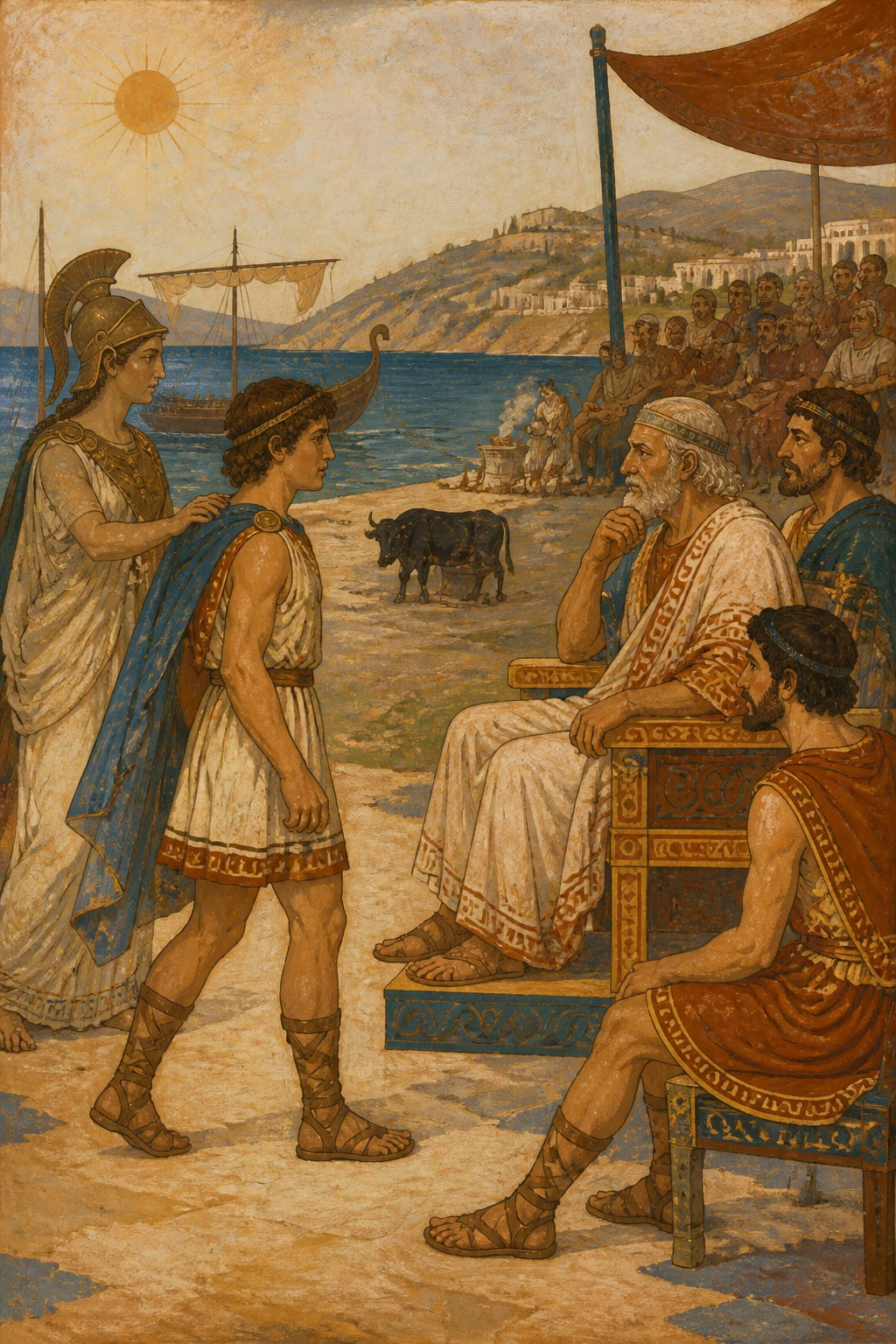
But he had long since yielded to death and gone down to Hades. Alcinous now ruled, his wisdom a gift from the gods. To his house went the goddess, gray-eyed Athena, devising a homecoming for great-hearted Odysseus.
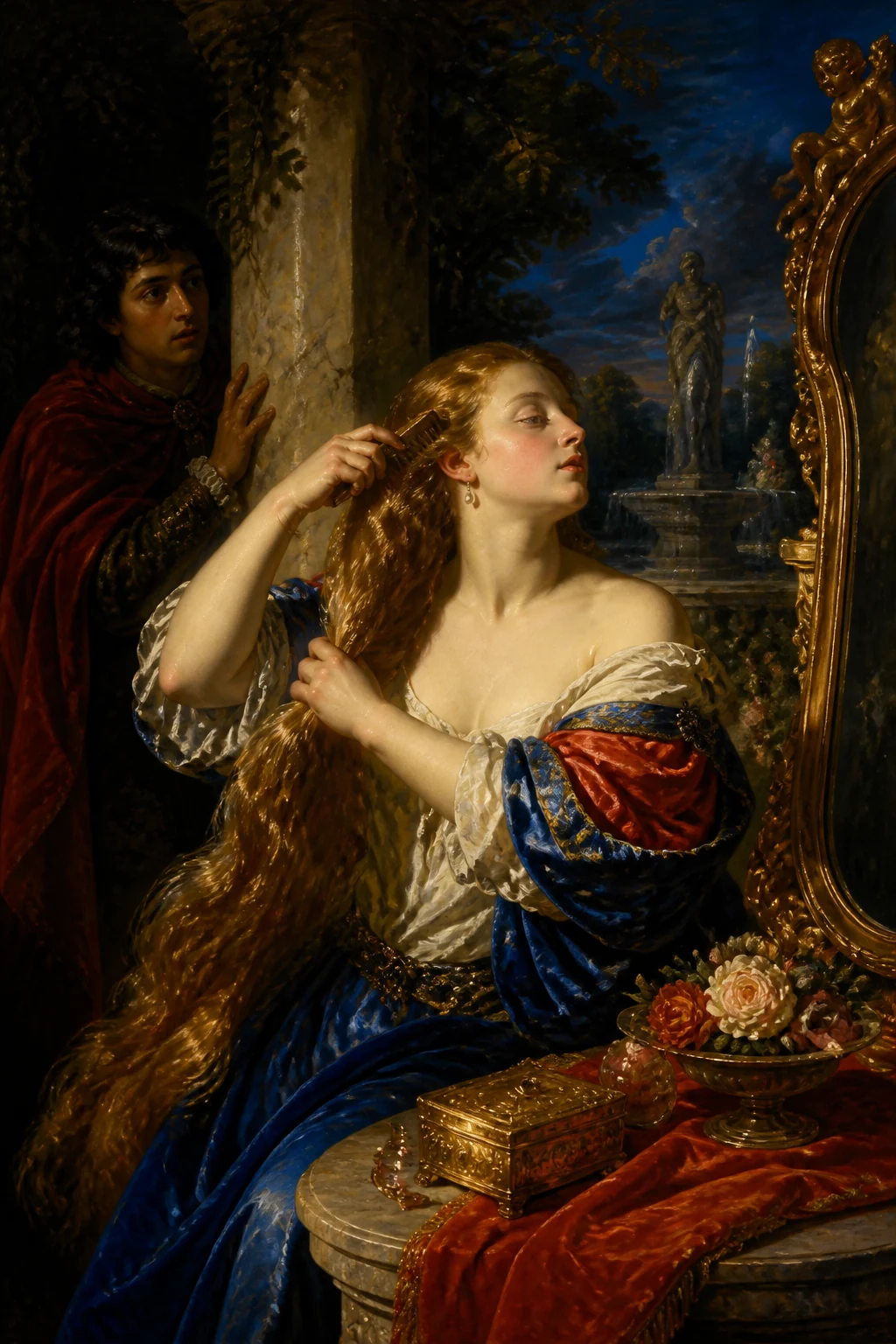
She entered a richly fashioned chamber where a girl lay sleeping, like an immortal goddess in form and beauty: Nausicaa, daughter of great-hearted Alcinous. Beside her slept two handmaids, gifted with beauty by the Graces, one on either side of the doorway. The shining doors were shut.
Like a breath of wind, the goddess swept to the girl’s bed, stood above her head, and spoke to her, taking the likeness of the daughter of Dymas, famed for his ships—a girl of her own age, dear to her heart.
In her likeness gray-eyed Athena said, “Nausicaa, how did your mother come to have so heedless a daughter? Your fine clothes lie neglected, yet your wedding is drawing near, when you must be beautifully dressed yourself and provide clothes for those who escort you.
“Such things bring a good name among people and gladden your father and honored mother. Come, let us go washing at the first light of dawn. I will come along to help you, so you can have everything ready quickly, for you will not remain unmarried much longer. Already the noblest men among all the Phaeacians are courting you, and you yourself are of their people.
“Come, then: at daybreak ask your renowned father to have mules and a wagon made ready to carry the girdles, robes, and splendid coverings. It will be far better for you, too, to ride than to go on foot, for the washing pools are a long way from the city.”
With these words gray-eyed Athena departed for Olympus, where, they say, the gods have their dwelling, secure forever. No wind shakes it, no rain ever drenches it, no snow draws near; cloudless air spreads clear above it, and a white radiance bathes it. There the blessed gods delight themselves day after day.
There the gray-eyed goddess went, when she had given the girl her counsel. Soon Dawn came on her lovely throne and woke Nausicaa in her beautiful robes. At once she wondered at the dream, then went through the house to tell her parents, her dear father and mother. She found them both indoors. Her mother sat at the hearth among her serving women, spinning wool dyed sea-purple. Her father she met as he was going out to join the illustrious kings in council, where the proud Phaeacians had summoned him.
Standing close beside her dear father, she said, “Dear Papa, could you have a high, well-wheeled wagon made ready for me, so I can take my fine clothes to the river to wash them? They are lying there dirty.
“And you yourself, as one of the leading men, ought to wear clean clothes when you deliberate in council. Besides, you have five dear sons at home, two married and three unmarried in the flower of youth. They always want freshly washed clothes to wear to the dance, and all these things fall to me.”
So she spoke, for she was ashamed to mention her own happy marriage to her dear father. But he understood everything and answered, “I would not deny you mules, my child, or anything else. Go along; the servants will make ready a high, well-wheeled wagon for you, fitted with a frame above.”
With that he called to the servants, and they obeyed. Outside they prepared the smooth-running mule wagon, brought the mules up, and harnessed them, while the girl carried the bright clothing from her chamber.
She laid it in the polished wagon, while her mother packed a basket with all kinds of satisfying food, adding delicacies, and poured wine into a goatskin. Then the girl climbed into the wagon.
Her mother also gave her olive oil in a golden flask, so that she and her handmaids could anoint themselves after bathing. Nausicaa took the whip and shining reins and lashed the mules into motion; their hooves clattered as they went.
They pulled steadily, carrying the clothing and the girl, who did not go alone: her handmaids went with her. When they reached the river’s lovely stream, where washing pools held water all year round and abundant clear water flowed through, enough to cleanse even the dirtiest clothes, they unhitched the mules from the wagon.
They drove them beside the swirling river to graze on sweet grass, then lifted the clothes from the wagon and carried them into the dark water. They trod them briskly in the pools, vying with one another.
When they had washed them and cleansed away all the dirt, they spread them in rows along the seashore, where the sea washed the pebbles cleanest as it swept up onto the land. Then they bathed, rubbed themselves with rich olive oil, and ate beside the riverbank, waiting for the clothes to dry in the sunlight.
When the handmaids and their mistress had eaten their fill, they threw off their veils and played at ball, and white-armed Nausicaa led them in song. As Artemis the archer roams the mountains, along the towering ridges of Taygetus or Erymanthus, delighting in boars and swift deer, while the nymphs of the wild, daughters of aegis-bearing Zeus, play about her, and Leto’s heart rejoices—high above them all she holds her head and brow, easily known among them, though all are beautiful—so the unwedded maiden shone among her handmaids.
But when she was about to harness the mules, fold the beautiful clothes, and return home, the goddess, gray-eyed Athena, devised another plan: Odysseus should wake and see the lovely girl, who would guide him to the Phaeacians’ city.
The princess threw the ball to one of her handmaids, but missed her and sent it into a deep eddy. The girls gave a piercing cry, and noble Odysseus woke. Sitting up, he pondered in his heart and mind: “Ah, what people’s land have I come to now?
“Are they violent and wild, with no regard for justice, or kind to strangers, with reverence for the gods? A cry of girls has reached my ears—perhaps of nymphs who haunt the steep mountain heights, the springs of rivers, and the grassy meadows.
“Or am I somewhere near people with human voices? Come, I will go and find out for myself.” With that, noble Odysseus emerged from beneath the bushes, and with his strong hand broke a leafy branch from the thick growth to cover his nakedness.
He went forward like a mountain lion trusting in his strength, who strides through wind and rain with blazing eyes, hunting cattle or sheep or the wild deer; hunger drives him even into a stoutly fenced fold to make an attempt upon the flocks. So Odysseus was about to approach the girls with lovely hair, naked though he was, for need compelled him.
To them he looked a fearful sight, ravaged by the brine, and they fled in different directions along the jutting spits of shore. Only Alcinous’ daughter stood her ground, for Athena put courage in her heart and drove the fear from her limbs.
She stood facing him, holding firm, while Odysseus considered whether to clasp the lovely girl’s knees in supplication, or stay where he was and beg her with gentle words to show him the city and give him clothes.
As he considered, it seemed wiser to remain at a distance and plead with gentle words, lest the girl take offense if he clasped her knees. At once he spoke with courtesy and skill.
“I beseech you, lady: are you a goddess or a mortal? If you are one of the gods who hold the broad heavens, then in beauty, stature, and bearing I judge you most like Artemis, daughter of mighty Zeus. But if you are one of the mortals who live upon the earth, three times blessed are your father and honored mother, and three times blessed your brothers. Surely their hearts are always warmed with joy because of you, as they watch so lovely a young flower enter the dance.
“But happiest of all, beyond all others, will be the man who prevails with his marriage gifts and takes you home. Never have my eyes beheld such a mortal, man or woman. Awe holds me as I look at you.
“Once, on Delos, beside Apollo’s altar, I saw a young palm shoot springing up, just such a thing as you. For I went there too, and many men followed me on that journey which was to bring me bitter sorrows.
“Then too I gazed for a long time in wonder, for never had such a tree sprung from the earth. So now, lady, I gaze at you in wonder and amazement, and am terribly afraid to touch your knees. Yet grievous suffering weighs upon me.
“Yesterday, on the twentieth day, I escaped the wine-dark sea. All that time the waves and rushing storms had carried me from the island of Ogygia. Now some god has cast me here, perhaps to suffer further troubles in this place. For I do not think my sufferings will end: the gods will bring many more upon me yet.
“But have pity, lady. After all my hardships, you are the first person I have met, and I know no one else who lives in this city and this land. Show me the town, and give me a scrap of cloth to wrap around myself, if you brought any covering for the clothes when you came here.
“May the gods grant you all your heart desires: a husband and a home, and the blessing of true accord. For nothing is stronger or better than this, when husband and wife keep house with their hearts and minds at one—a great grief to their enemies, a joy to their friends, and they themselves know its worth best of all.”
Then white-armed Nausicaa answered him: “Stranger, you seem neither a wicked man nor a foolish one. Olympian Zeus himself apportions happiness to people, good and bad, to each as he chooses. These troubles he has given you, and you must endure them nonetheless.
“But now that you have come to our city and our land, you shall not lack clothing or anything else that a sorely tried suppliant ought to receive from those he meets. I will show you the town and tell you the name of its people.
“The Phaeacians possess this city and this land, and I am the daughter of great-hearted Alcinous, who holds power and authority among them.” Then she called to her lovely-haired handmaids: “Stand still, girls! Where are you running at the sight of a man?
“Surely you do not think he is an enemy? There is no man alive, nor will there ever be, who could come to the Phaeacians’ land bringing war, for we are very dear to the immortals.
“We live far away in the surging sea, at the world’s edge, and no other mortals have dealings with us. This is some unhappy wanderer who has come here, and we must care for him. All strangers and beggars come under Zeus’s protection, and even a small gift is welcome.
“Come, girls, give the stranger food and drink, and bathe him in the river, somewhere sheltered from the wind.” So she spoke, and they stopped and called to one another. They led Odysseus to a sheltered place and had him sit down, as Nausicaa, daughter of great-hearted Alcinous, had commanded. Beside him they laid a cloak and tunic, gave him olive oil in a golden flask, and invited him to bathe in the river’s stream.
Then noble Odysseus said to the handmaids, “Girls, stand back over there, so that I can wash the brine from my shoulders myself and rub myself with oil. It has been a long time since oil touched my skin.
“I will not bathe before your eyes, for I am ashamed to be naked among girls with such lovely hair.” So he spoke, and they withdrew and told their mistress.
Then noble Odysseus washed from his skin in the river the brine that coated his back and broad shoulders, and scrubbed the salt crust of the barren sea from his head. When he had washed himself all over and rubbed himself richly with oil, he put on the clothes the unwedded girl had given him. Athena, daughter of Zeus, made him seem taller and broader, and sent curling locks flowing down from his head, like the hyacinth flower.
As a skilled craftsman overlays silver with gold, a man whom Hephaestus and Pallas Athena have taught every art, so that he creates works full of beauty, so she poured grace over his head and shoulders.
Then he went apart and sat down on the seashore, radiant with beauty and grace, and the girl gazed at him in wonder. At last she said to her lovely-haired handmaids, “Listen, white-armed girls, to what I have to say.
“It is not against the will of all the gods who dwell on Olympus that this man has come among the godlike Phaeacians. Before, he seemed to me a sorry sight; now he looks like the gods who hold the broad heavens.
“If only such a man might be called my husband, living here, and be content to stay! But come, girls, give the stranger food and drink.” So she spoke, and they readily heard and obeyed her, setting food and drink before Odysseus.
Then noble, long-suffering Odysseus ate and drank eagerly, for it was long since he had tasted food. Meanwhile white-armed Nausicaa turned her thoughts to their departure. She folded the clothes and laid them in the handsome wagon, harnessed the sturdy-hoofed mules, and climbed aboard herself. Then she urged Odysseus to come, speaking to him directly: “Get up now, stranger, and let us go to the city, so I can send you to my wise father’s house. There, I promise you, you will meet all the noblest Phaeacians.
“But do exactly as I tell you—you seem to me a man of good sense. As long as we are passing through the countryside and the cultivated fields, walk briskly with the handmaids behind the mules and wagon, and I will lead the way.
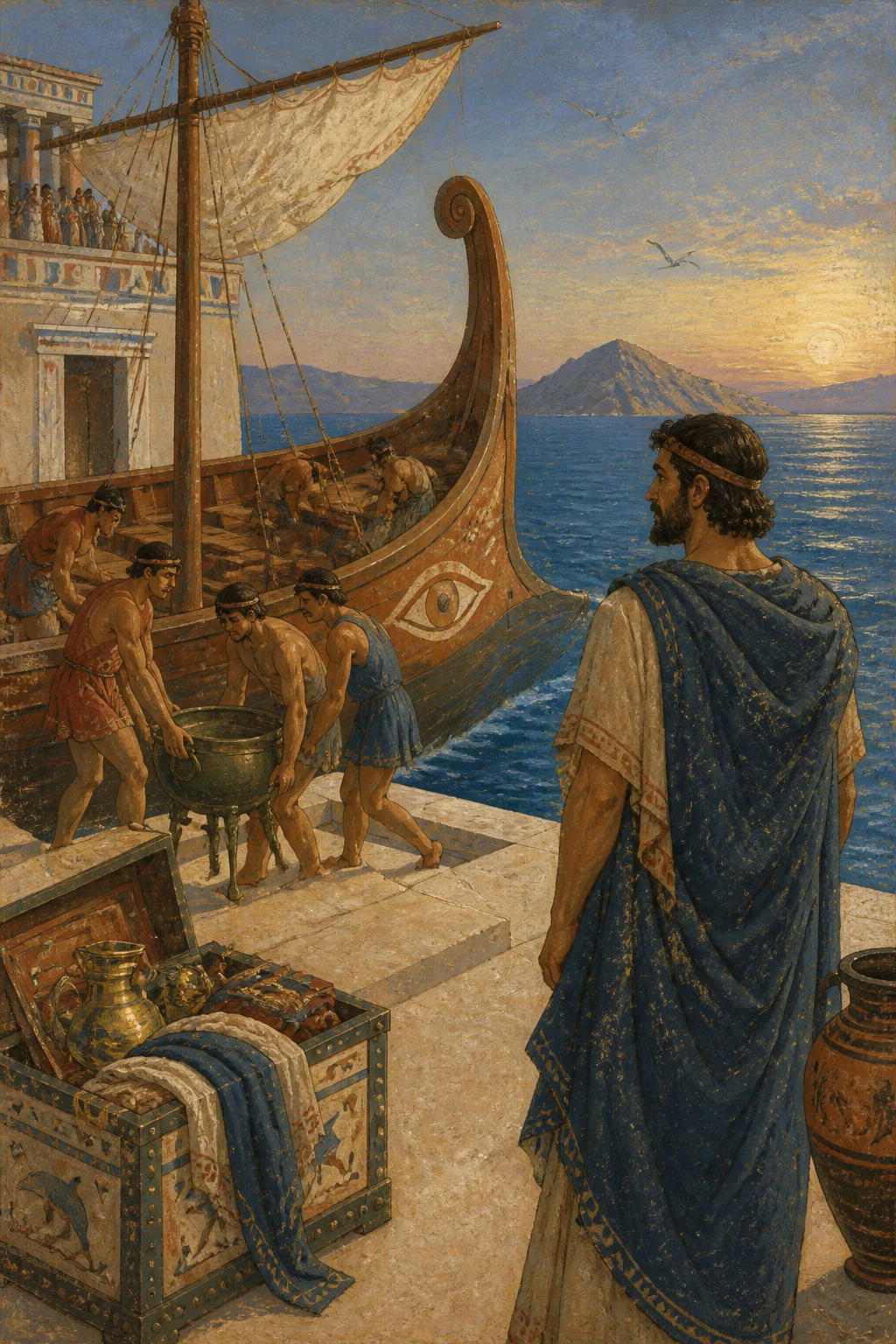
“But when we reach the city, ringed by its lofty wall, with a fine harbor on either side and a narrow approach between them, you will see curved ships drawn up along the road, for each man has his own berth.
“There is their meeting place, around the beautiful temple of Poseidon, laid with great stones sunk deep in the earth. There they attend to the gear of their black ships, the cables and sails, and taper their oars.
“For the Phaeacians care nothing for bow or quiver, but for masts and oars and well-balanced ships, in which they delight to cross the gray sea. I wish to avoid their bitter gossip, lest someone speak ill of me behind my back, for there are very insolent people in the town. Some ill-natured fellow might meet us and say, ‘Who is this handsome, tall stranger following Nausicaa? Where did she find him? He will be her husband, no doubt.
“‘Perhaps she has taken in some wanderer from a ship, a man from far away, for there are no peoples living close to us. Or perhaps some god has come down from heaven in answer to her prayers, her longed-for husband, and she will keep him all her days.
“‘Better so, if she has gone and found herself a husband elsewhere! Clearly she despises the Phaeacians here at home, though many fine men are courting her.’ That is what they will say, and it would bring disgrace upon me.
“Indeed, I myself would blame another girl who behaved like that—who, while her dear father and mother were still alive, consorted with men against their will before her public wedding. But you, stranger, attend closely to my words, so that you may soon obtain from my father an escort on your journey home.
“Near the road you will find a lovely grove of poplars sacred to Athena. A spring flows within it, and a meadow lies all around. There my father has his estate and flourishing orchard, as far from the city as a shout will carry.
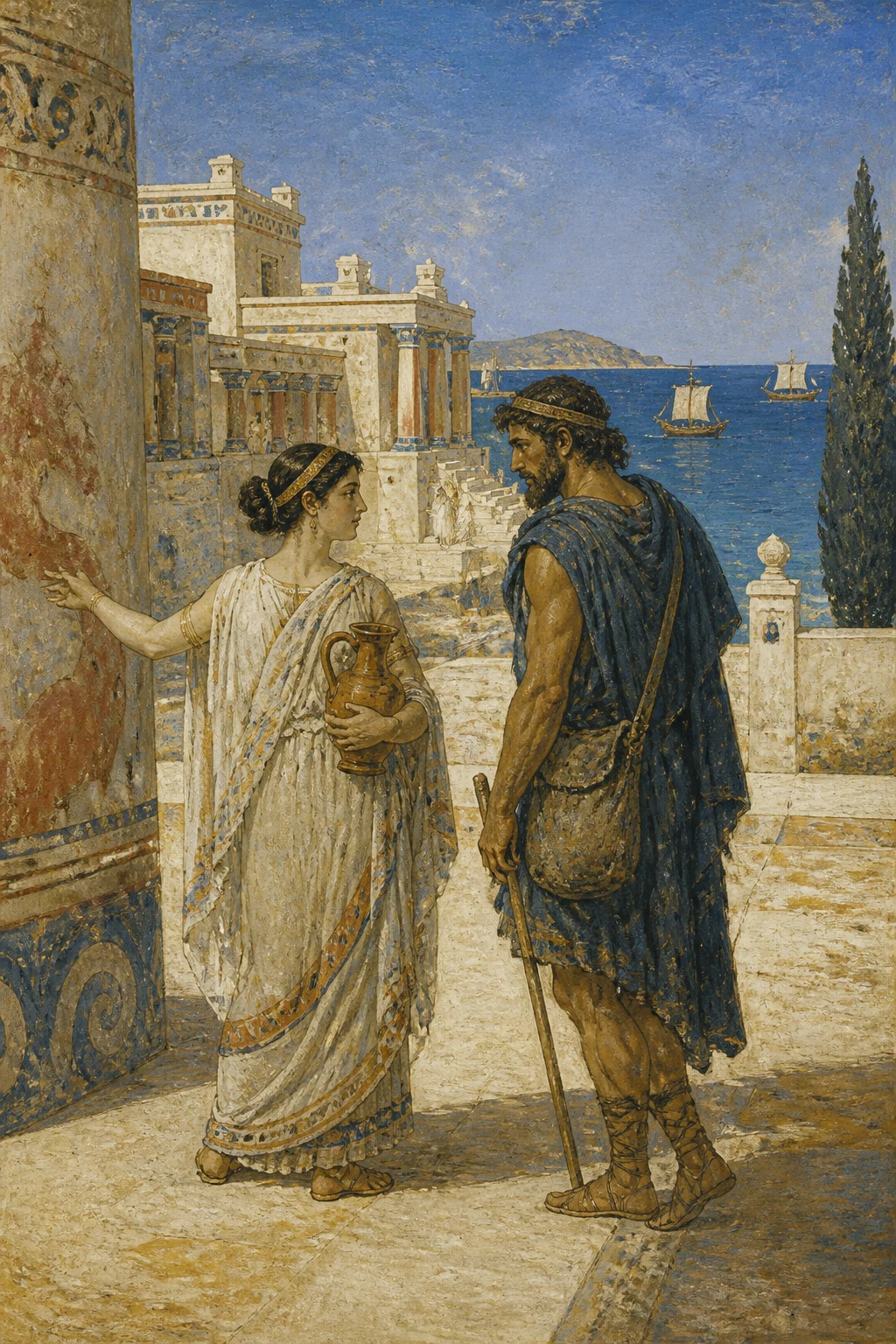
“Sit down there and wait a while, until we have gone into the town and reached my father’s house. When you think we have arrived, enter the Phaeacians’ city and ask for the house of my father, great-hearted Alcinous.
“It is easy to recognize: even a little child could guide you there, for none of the Phaeacians’ houses is built like the house of lord Alcinous. Once the courtyard and the house have received you, pass quickly through the hall until you reach my mother. She sits beside the hearth in the firelight, spinning sea-purple wool, a marvel to behold, leaning against a pillar, with her serving women seated behind her.
“Beside her stands my father’s throne, where he sits drinking his wine like an immortal. Pass him by and throw your arms around my mother’s knees, so that you may soon see the joyful day of your return, even though your home is very far away.
“If she looks kindly on you in her heart, then you may hope to see your loved ones and reach your well-built house and your native land.” With these words she struck the mules with the shining whip, and they quickly left the river’s streams behind.
They trotted well, their feet moving briskly, but she held them in check so that the handmaids and Odysseus could follow on foot, and used the whip with judgment.
The sun was setting when they reached the lovely grove sacred to Athena, and there noble Odysseus sat down. At once he prayed to the daughter of mighty Zeus: “Hear me, tireless daughter of aegis-bearing Zeus! Listen to me now at last, since before you did not hear me in my distress, when the renowned Earth-shaker battered me.
“Grant that I may come among the Phaeacians and find kindness and compassion.” So he prayed, and Pallas Athena heard him. But she did not yet appear before him openly, for she was mindful of her father’s brother, who raged fiercely against godlike Odysseus until he reached his own land.