Prevod
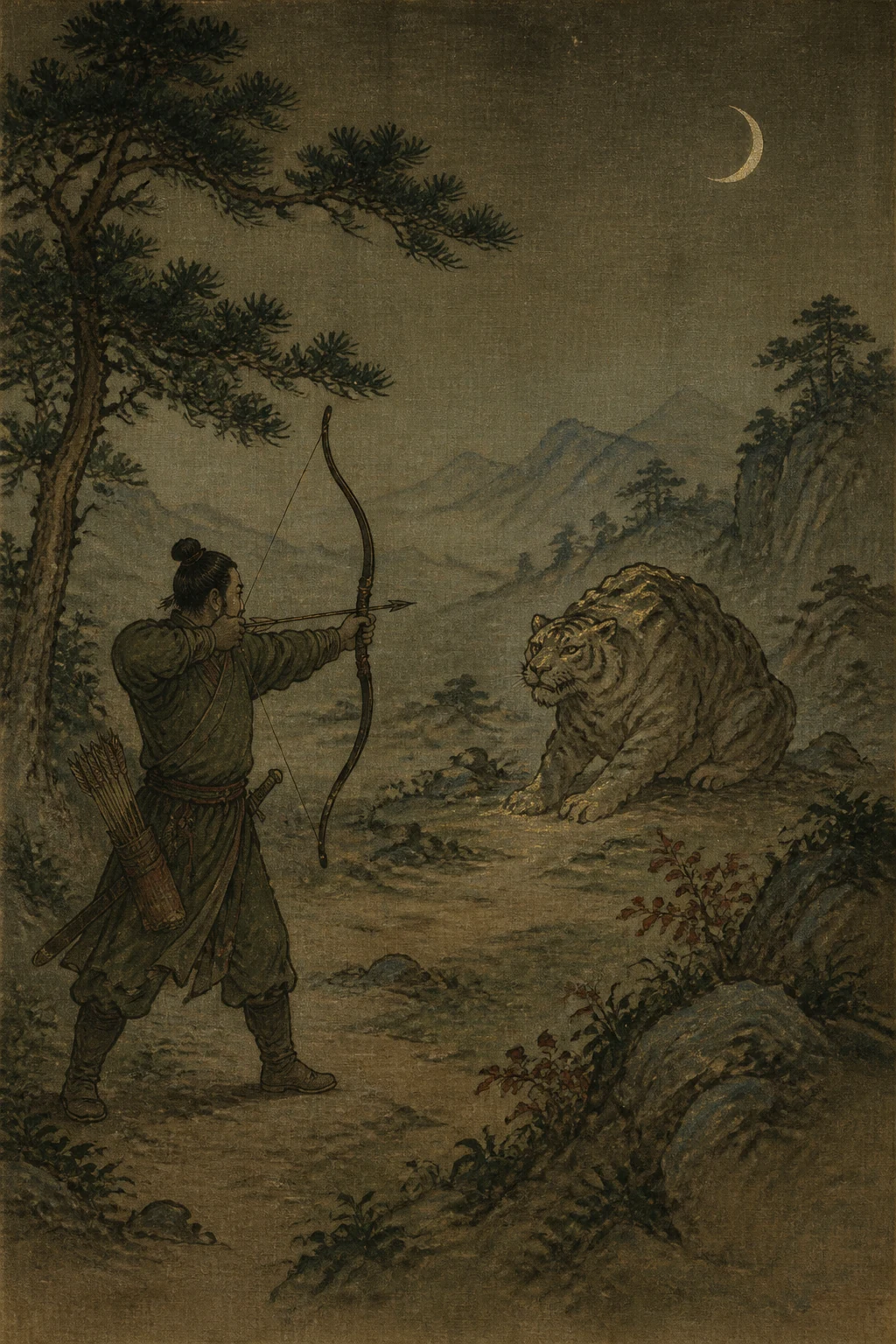
Long ago, a retainer of Muneyuki, Governor of Iki, incurred his lord’s wrath over some trifling matter and was about to be put to death. He fled in a small boat, crossed to the kingdom of Silla, and lived there in hiding. One day, in a place called Gimhae, he heard a tremendous uproar. When he asked what was happening, he was told, “A tiger comes into the settlement and devours people.” “How many tigers are there?” he asked. “Only one. It suddenly appears, eats someone, and runs away again.” Hearing this, the man said, “I should like to face that tiger and loose an arrow at it, even if I die. If the beast is so formidable, then we can die together. But why should I let it eat me without doing anything? The people of this country must be sadly wanting in the arts of war.” Someone who heard him went to the governor and reported what the Japanese had said. “What a bold thing to say! Summon him,” said the governor. A messenger came to tell the man he had been summoned, and he duly presented himself. “Is it true,” the governor asked, “that you claim you could easily shoot this man-eating tiger?” “That is indeed what I said,” he replied. “How can you say such a thing?” asked the governor. The man answered, “The people of this country hope to destroy their enemy while keeping themselves unharmed. Since a fierce beast like this is likely to injure them unless they possess uncommon skill, I suppose they will not venture to face it. But the Japanese go into combat already counting themselves as dead, and so things sometimes turn out well for them. Why should anyone who takes up the bow and arrow be concerned for his own life?” “Then can you be sure of shooting the tiger dead?” the governor asked. “Whether I shall live or die, I cannot say, but I shall certainly bring it down.” “That is splendid—truly admirable!” said the governor. “Then take every care and shoot it. I shall reward you handsomely.” The man asked, “Where is it, then? And how does it go about eating people?” The governor replied, “At some moment of its choosing, it comes into the settlement, seizes a person by the head in its jaws, throws the body over its shoulder, and goes away.” “But how exactly does it seize them?” the man asked. Someone explained, “When the tiger is about to take a person, it first crouches flat, like a cat watching a mouse. It stays like that for a little while, then opens its jaws wide and springs, catches the person by the head, flings the body over its shoulder, and runs off.” “Whatever it does, I shall loose an arrow before it eats me,” said the man. “Show me where it lies.” “Twenty-odd chō west of here there is a field of ramie,” they told him. “That is where it lies. Everyone is frightened, and no one dares go near the place.” “Even if I do not know the exact spot, I can at least make my way in that direction,” he said, and set out with his bow and arrows. The people of Silla gathered and jeered. “What a fool this Japanese is! The tiger will eat him.” The man asked his way to the tiger’s lair, and when he reached it, he found a broad expanse of ramie, growing four or five feet high. He pushed his way through it and, sure enough, there lay the tiger. He nocked a pointed arrow and settled down with one knee raised. Catching his scent, the tiger flattened itself against the ground, just like a cat stalking a mouse. The man waited without a sound, his arrow on the string. Then the tiger opened its great jaws and sprang upon him. He drew his bow with all his strength and, just as the beast came over him, let fly. The pointed arrow entered beneath its lower jaw and came out seven or eight inches through the back of its neck. The tiger fell over backward and lay writhing. Taking fork-headed arrows, the man shot it twice in the belly. Both arrows pinned it to the earth, and at last it died. Leaving the arrows where they were, he returned to the provincial seat and told the governor how he had killed the beast. The governor exclaimed in admiration and went with a great crowd to see it. Sure enough, all three arrows had pierced the tiger through. It was an astonishing sight. “Truly,” they said, “even if a hundred or a thousand tigers rose up and attacked, what could they do against ten Japanese horsemen who rode out to meet them with their bows? The people of our country use arrows only a foot long, with heads like awls, and smear them with poison. Though the poison eventually kills the beast, they cannot bring it down on the spot. But this Japanese, caring not a whit whether he lived or died, shot it with great arrows and killed it then and there. In the arts of war, we cannot begin to match the Japanese. All the more reason to regard theirs as a truly fearsome country.” And they were afraid. They wished to keep the man among them and treated him with great kindness, but he longed for his wife and children and returned to Tsukushi. He went to Muneyuki and told him what had happened. “You have brought honor to Japan,” said Muneyuki, and pardoned him. The man had received many gifts as his reward, and he gave some of them to Muneyuki. Many merchants, too, heard the people of Silla tell the story and brought back their accounts, so that in Tsukushi as well the martial prowess of their countrymen came to be held in great esteem, or so the tale is told.