Prevod
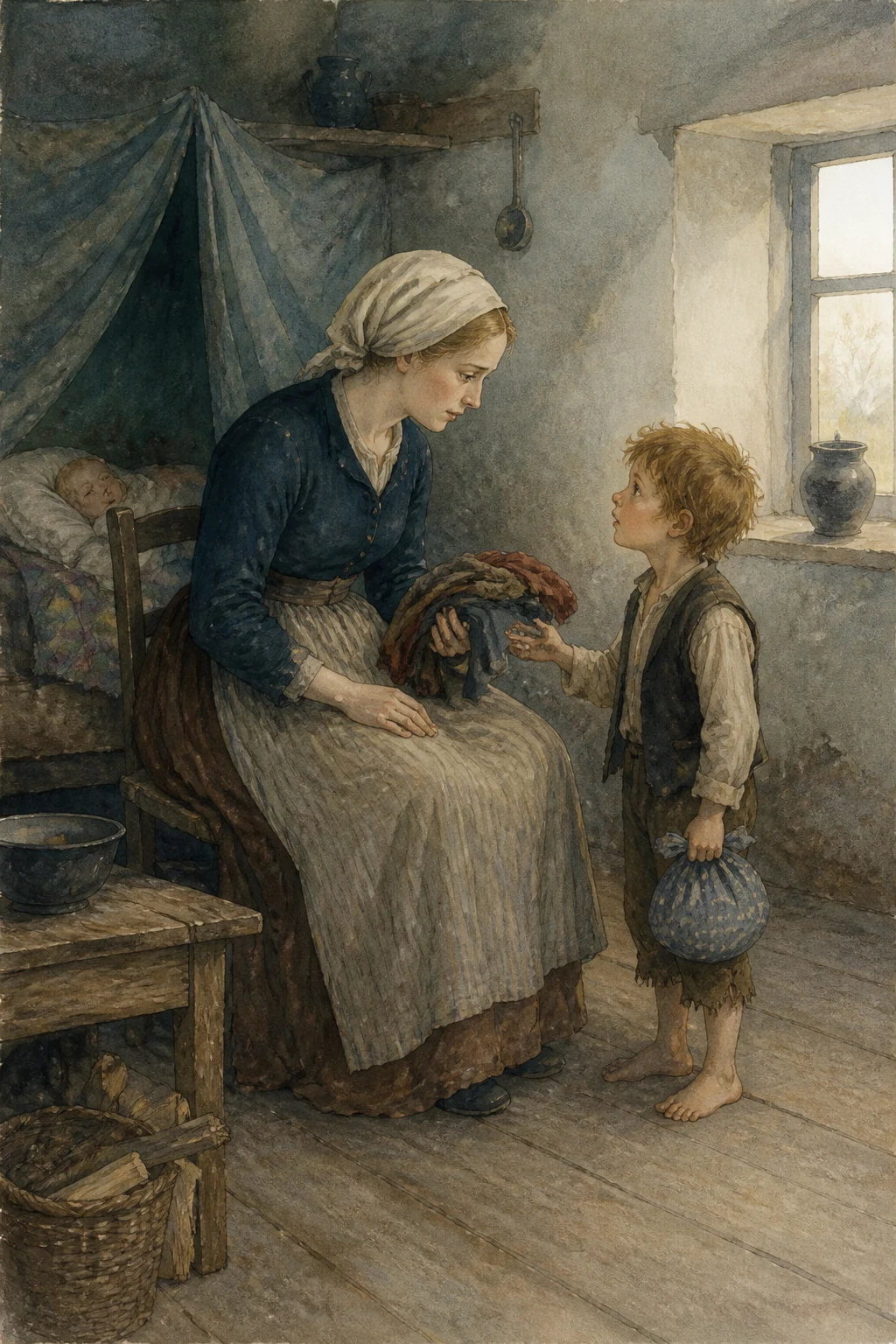
Once upon a time there was a poor woman who had been out begging in the country. She had a little boy with her. When she had filled her bag, she set off northward over the ridge to return to her own village. A little way up the hillside, they came upon a small blue garter lying in the packhorse track.
The boy asked if he might pick it up. “No,” said his mother, “there may be some mischief in it,” and she threatened him until he followed her. When they had gone a little farther, the boy said he needed to step off the path.
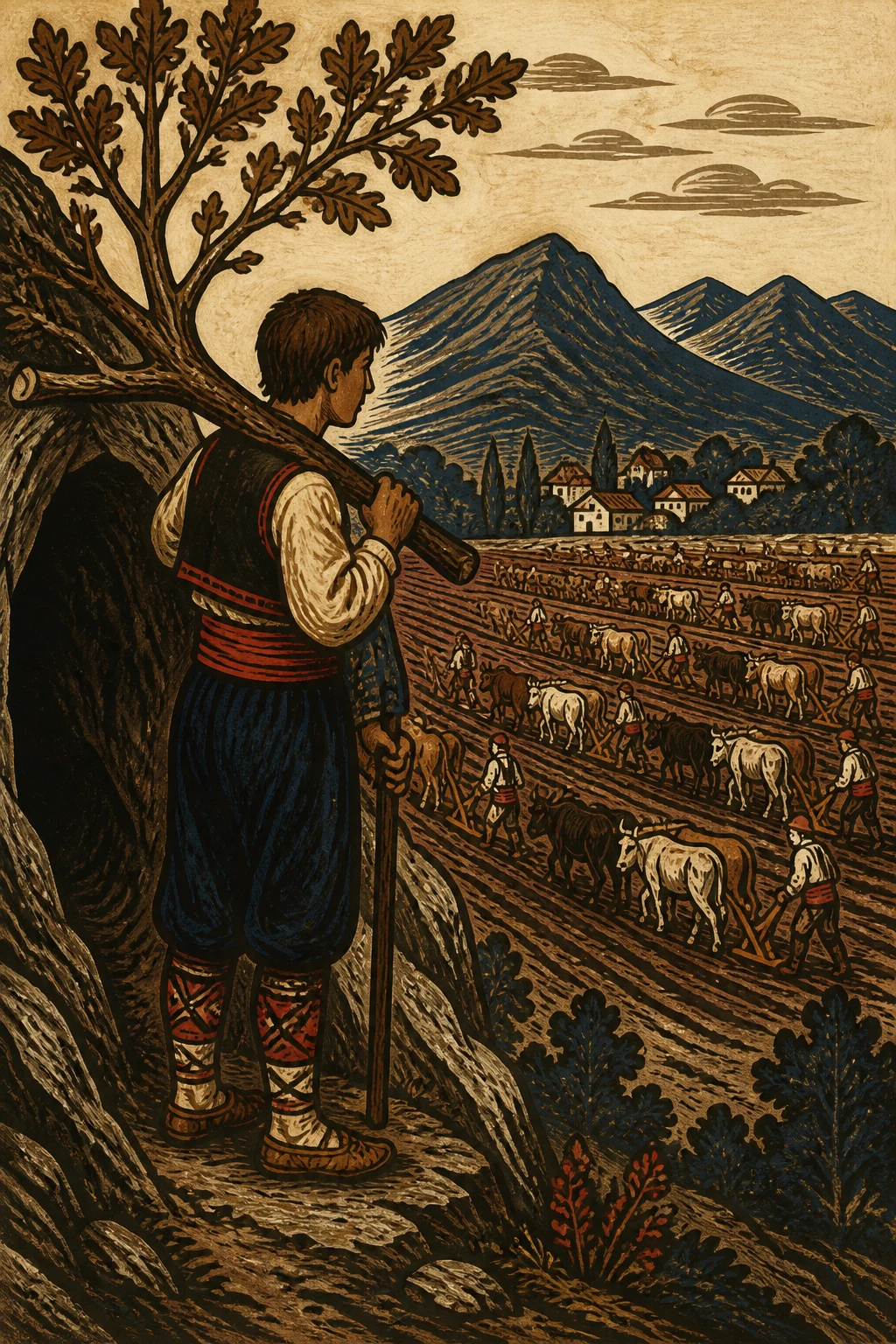
Meanwhile, the woman sat down on the top of a felled tree. But the boy was gone a long time, for when he had gone far enough into the woods for his mother not to see him, he ran back to where the garter lay, picked it up, and tied it round his waist. At once he became so strong that he felt he could lift the whole ridge.
When he came back, his mother was furious and asked what he had been doing all that time. “Time means nothing to you,” she said, “though evening is coming on. You know we must get over the ridge before dark.” They walked on for a while, but when they were well past the middle of the ridge, the woman grew tired and wanted to lie down beneath a bush.
“Dear Mother,” said the boy, “may I climb this high crag while you rest and see if I can spy any houses ahead?” She gave him leave, and when he reached the top, he saw a light just to the north. The boy ran back and said to his mother, “We must be off, Mother. There are people not far away; I can see such a fine light just north of here.” She got up, took her beggar’s bag, and went along to see; but they had not gone far before they came up against a sheer rock face.
“Just as I thought,” said the woman. “Now we can go no farther. We might as well lie down here.” But the boy tucked the bag under one arm and his mother under the other, and bounded up the rock with them.
“Now you see there are people close by. Look how brightly the light shines,” said the boy. But his mother said they were not people; they must be mountain trolls, for she knew the whole of Bjørneskoven, and she knew there were no people anywhere until you reached the northern foot of the ridge on the other side. When they had gone a little farther, they came to a large farmstead painted red.
“We dare not go in here,” said the woman, “for mountain trolls live here.” “Oh yes, we’ll go in. We can see a light, so there must be people inside,” said the boy. He went in first and his mother followed, but the moment he opened the door she fainted, for she saw an enormous man sitting on the bench.
“Good evening, Grandfather,” said the boy. “I have sat here for three hundred years, but no one has ever come and called me Grandfather,” said the man on the bench. The boy sat down beside him and began talking as though they were old friends.
“But what has happened to your mother?” said the man when they had talked for a while. “I believe she fainted. You had better see to her.” The boy went over, took hold of his mother, and dragged her in across the floor. She came to, crawled away, and huddled deep in the wood corner, so frightened she scarcely dared look out. After a little while, the boy asked whether they might have shelter for the night. Yes, they might, said the man. They talked for a while longer, but before long the boy grew hungry and asked whether they could have something for supper. Yes, the man thought that could be managed. After they had sat a little longer, he got up and put six cartloads of dry spruce on the fire. The woman grew more frightened still. “Now he means to burn us up as well,” she said from her corner. When the wood had burned down to embers, the man got up and went out.
“Heaven help me, you are far too bold! Can’t you see you are in a troll’s house?” said the woman. “Oh, nonsense, there’s nothing to worry about,” said the boy.
Presently the man came in with an ox so huge and fat that the boy had never seen its like. He struck it beneath the ear with his fist, and it fell dead on the floor. Then he took it by all four legs, laid it on the heap of embers, and turned and rolled it until it was browned all over. He went to a cupboard, brought out a silver platter, and laid the ox on it; the platter was so large that no part of the beast hung over the edge. He set it on the table, went down into the cellar, and brought up a cask of wine. He knocked out one end, set it on the table, and laid out two knives, each three ells long. Then he invited them to come to the table and eat. The boy went first and told his mother to follow. She began moaning to herself, wondering how she could ever manage such knives.
But the boy seized one and began cutting pieces from the ox’s haunch and setting them before his mother. When they had eaten for a while, he took the wine cask in both hands and lifted it down to the floor. Then he called his mother over to have a drink. It was so tall that she could not reach the top, but the boy lifted her to the rim and held her there. He himself climbed up and hung over the edge like a cat while he drank.
When he had quenched his thirst, he put the cask back on the table, thanked their host for the meal, and told his mother to come and give her thanks too. Frightened as she was, she dared do nothing but go over and thank the man for the food. The boy sat down beside him on the bench and began talking again. After a little while, the man said, “I had better go and get myself a bite of supper.” He went to the table and ate the whole ox, horns and bones and all, drank from the wine cask, and sat down on the bench again. “I don’t know what we shall do about beds,” he said. “I have nothing here but a cradle. You might manage to sleep in that, and your mother could sleep over in the bed.” “Yes, thank you, that will do very well,” said the boy. He stripped off his clothes and climbed into the cradle, which was quite as large as a great bedstead. His mother had to follow the man and get into bed, terrified though she was.
It would not be wise to fall asleep here, the boy thought. I had better stay awake and listen to what happens as the night wears on. After a while, the man began talking to the woman. “We could live very well and happily here if only we were rid of that son of yours,” he said.
“Can you think of a way to deal with him?” said the woman. Oh yes, he would try, he said. He would pretend he wanted the woman to keep house for him for a few days, and then he would take the boy into the mountains to quarry foundation stones and topple a mountainside down on him. The boy lay listening to all this.
The next day the troll—for a troll he was, as was plain enough—asked whether the woman would keep house for him for a few days. Later in the day he took a great iron crowbar and asked the boy whether he would come into the mountains to quarry foundation stones. Yes, he would gladly come, said the boy, and went with him. When they had quarried a few stones, the troll told him to go down below and look for cracks in the rock. While the boy was doing this, the troll pried and heaved with the crowbar until he loosened a whole mountainside, which came tumbling down on the boy. But the boy braced himself against it until he could get clear, then let it fall.
“Now I see what you have in mind for me,” said the boy to the troll. “You mean to kill me. Now you go down below and look for cracks, and I shall stand up here.” The troll dared do nothing but obey, and the boy pried loose another enormous mass of rock, which fell on the troll and broke one of his thighbones.
“Oh, you poor fellow,” said the boy. He climbed down, lifted the rock, and pulled the man out from under it. Then he had to take him on his back and carry him home. He galloped along like a horse, jolting the troll until he screamed as though a knife were sticking in him. When they reached home, they had to put the troll to bed, and there he lay, ailing.
When night came round again, the troll began talking to the woman, wondering how he might get rid of the boy. “If you can’t think of a way to be rid of him, then neither can I,” said the woman.
Well, he had twelve lions in an enclosure, said the troll. If only they could get the boy in there, the lions would tear him to pieces. The woman thought that would be easy enough. She would take to her bed and say she was so ill that she could never recover unless she had lion’s milk. The boy lay listening to all this. When he got up in the morning, his mother said she was sicker than anyone knew, and she believed she would never get well unless she had lion’s milk.
“Then you will have to stay ill for a long time, Mother,” said the boy, “for I don’t know where to get any.” Oh, the troll thought lion’s milk was easy enough to come by, if only someone would go and fetch it. His brothers had an enclosure with twelve lions in it, and the boy could have the key, said the troll, if he cared to milk them.
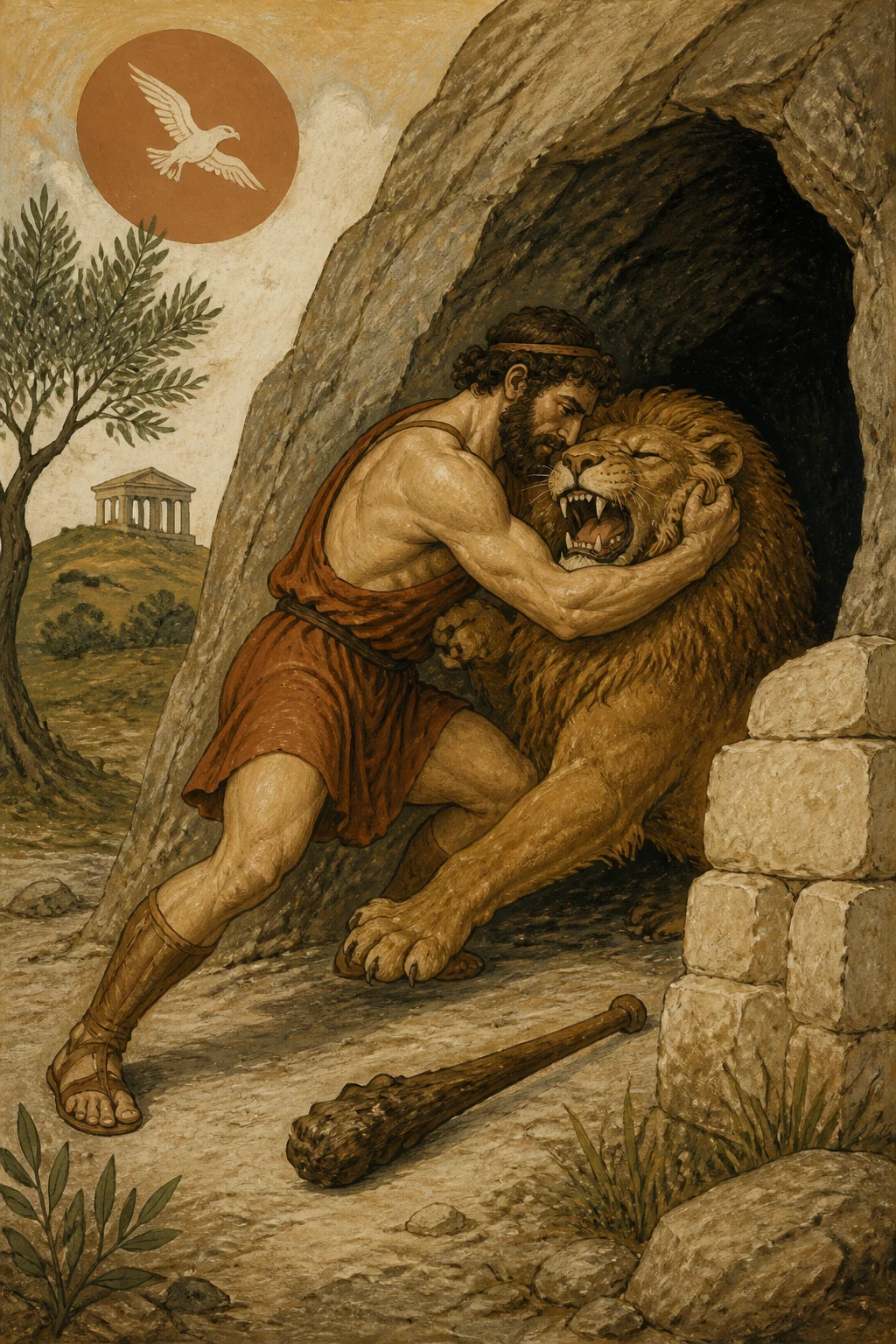
The boy took the key and a milk bowl and set off. When he unlocked the gate and entered the enclosure, all twelve lions rose on their hind legs to face him. The boy picked out the largest, seized it by the forelegs, and beat it against trees and stones until nothing was left of it but the paws. When the others saw this, they were so frightened that they crept up and lay at his feet like shamefaced dogs. After that they followed wherever he went, and when he came home, they lay outside with their forepaws on the threshold.
“Now you are sure to get well, Mother, for here is lion’s milk,” said the boy as he came in. He had milked a little into the bowl. But the troll lay in bed and swore it was not true. It would take a better man than him to milk a lion, he said. When the boy heard this, he threatened the troll out of bed and flung open the door. The lions sprang up at the troll and seized him, so that the boy had to step between them and make them let go.
When night came, the troll began talking to the woman again. “I don’t know how we are to kill this boy,” he said. “He is far too strong. Can’t you think of something?” “No, if you can’t think of a way to deal with him, then neither can I,” said the woman.
“Well, I have two brothers in a castle,” said the troll. “They are twelve times stronger than I am, which is why I was cast out and given the farm, while they have the castle. There is an orchard there with apples that make anyone who eats them sleep for three days and nights. If we could get the boy to go there for fruit, he could never keep from tasting the apples, and once he was asleep, my brothers would tear him to pieces.” The woman said she would pretend to be ill and say she could not recover until she had some of those apples; then he would surely go and fetch them.
The boy lay listening to all this. In the morning his mother was so ill that she cried out and moaned, and she could never get well unless she had apples from the orchard beside the castle that belonged to the man’s brothers, but she had no one to send there. The boy was ready at once to go, and the eleven lions went with him. When he reached the orchard, he climbed an apple tree and ate as many apples as he could manage. Before he could climb down again, he fell asleep, and the lions lay in a ring around him. On the third day the troll’s brothers came, but they did not come like ordinary folk. They came bellowing like savage bulls, wondering who it was that had lain down there, and saying they would tear him into such tiny pieces that not a scrap would remain. But the lions sprang up and tore the trolls to shreds, scattering them about as though a heap of rubbish had been overturned. When they had finished, they lay down around him again.
The boy did not wake until late in the afternoon. When he rose to his knees and rubbed the sleep from his eyes, he began to wonder what had been happening, for he saw the marks of the struggle. But when he went over to the castle, he found a maiden who had seen it all, and she said, “You may thank God you were not in that fight, or you would have lost your life.” “What! Me lose my life?” said the boy. He thought there was little danger of that. She asked him to come inside so she could talk to him, for she had not seen a Christian soul since she had been brought there. When she opened the gate, the lions wanted to come in too, but she was so frightened that she screamed, so the boy made them lie down outside. They talked of many things, and the boy asked why she, who was so beautiful, would have anything to do with such ugly trolls. She had never wanted them, she said, and she was not there of her own free will, for they had carried her off. She was the King of Arabia’s daughter. As they talked, she asked him what he wished: should she go home, or would he have her for his own?
Why, of course he would have her, and she should not go home again. Then they walked about the castle, looking around, and came to a great hall where two enormous swords the trolls had owned hung high on the wall. “If only you were man enough to wield one of those!” said the princess.
“Who, me?” said the boy. “Shouldn’t I be able to wield one of those? That would be no trouble at all!” He piled two or three chairs on top of one another, jumped up, and caught hold of the larger sword. He tossed it into the air, caught it again by the hilt, and drove it into the floor so that the whole hall shook. When he came down, he tucked it under his arm and carried it away. After they had lived together in the castle for a time, the princess felt she must go home to her parents and tell them what had become of her. They loaded a ship, and she set sail.
After she had gone and the boy had idled about for a while, he remembered that he had come there on an errand: he was meant to fetch something to make his mother well. But then he thought she had not been so ill that she would not be well again by now. All the same, he would go down and see how they were getting on. The man had recovered, and his mother had been well again for a long time.
“What a wretched pair you are, sitting here in this miserable hut! Come up to my castle, and you shall see what a man I have become,” said the boy. Both the man and his mother went with him, and on the way she spoke sweetly to him and asked how he had become so strong.
It was all because of the blue garter that had lain on the ridge when they were out begging in the country, said the boy. “Have you still got it, then?” asked his mother. Yes, he had it still, beneath his waistband, he said. His mother asked if she might see it. The boy opened his jacket and waistcoat to show her. Then she snatched at it with both hands, tore it from him, and wound it round her fist. “What should I do to a scoundrel like you?” she said. “I ought to strike you so hard that your brains spatter!” “That would be far too easy a death for such a wretch,” said the troll. “We ought instead to burn out his eyes and send him out to sea in a little boat.” And that was what they did, for all his cries and lamenting. But as the boat drifted away, the lions swam after it, and at last they caught hold of it, towed it to an island, and set the boy beneath a pine tree. They caught game for him and plucked birds until they had made him a whole bed of down. But he had to eat his food raw, and he was blind. Then one day the largest lion chased a hare, and the hare was blind, for it kept running into trees and stones. At last it dashed against a pine trunk and went tumbling head over heels across the ground, straight into a little pool. But when it came out of the water, it could find its way perfectly well, and so escaped with its life. “Well, well!” thought the lion. It dragged the boy to the pool and dipped him in. When his sight was restored, he went down to the shore and motioned to the lions to lie side by side like a raft. He stood on their backs while they swam to the mainland with him. Once ashore, he went into a birch grove and made the lions lie down there. Then he crept towards the castle like a thief, hoping to get hold of his garter. When he reached the door, he peered through the keyhole and saw it hanging over a door in the kitchen. He tiptoed across the floor, for no one was inside; but once he had the garter, he began stamping his heels and kicking his legs about as though he were mad.
At once his mother came flying out. “My dearest little boy, let me have that garter!” she said. “No, thank you. Now you shall have the sentence you meant for me,” said the boy, and he carried it out then and there. When the troll heard the noise, he came in and begged most humbly to be spared his life. “Yes, you shall live, but you shall have the same punishment you gave me,” said the boy. He burned out the troll’s eyes and sent him out to sea in a boat, but the troll had no lions to follow him.
Now the boy was alone, and he wandered about longing for the princess. At last he could bear it no longer; his yearning for her grew so strong that he had to set out. He loaded four ships and prepared to sail to Arabia to fetch her. For a while they had fine, calm weather, but then contrary winds held them off a rocky islet. The sailors went ashore and wandered about to pass the time. There they found an enormous egg, almost as large as a little house. They began striking and battering it with great stones, but could not break it. The boy came after them with his sword to see what all the noise was about. When he saw the egg, he thought it would be no trouble to break it. He struck it with his sword, splitting it open, and out came a chick as large as an elephant.
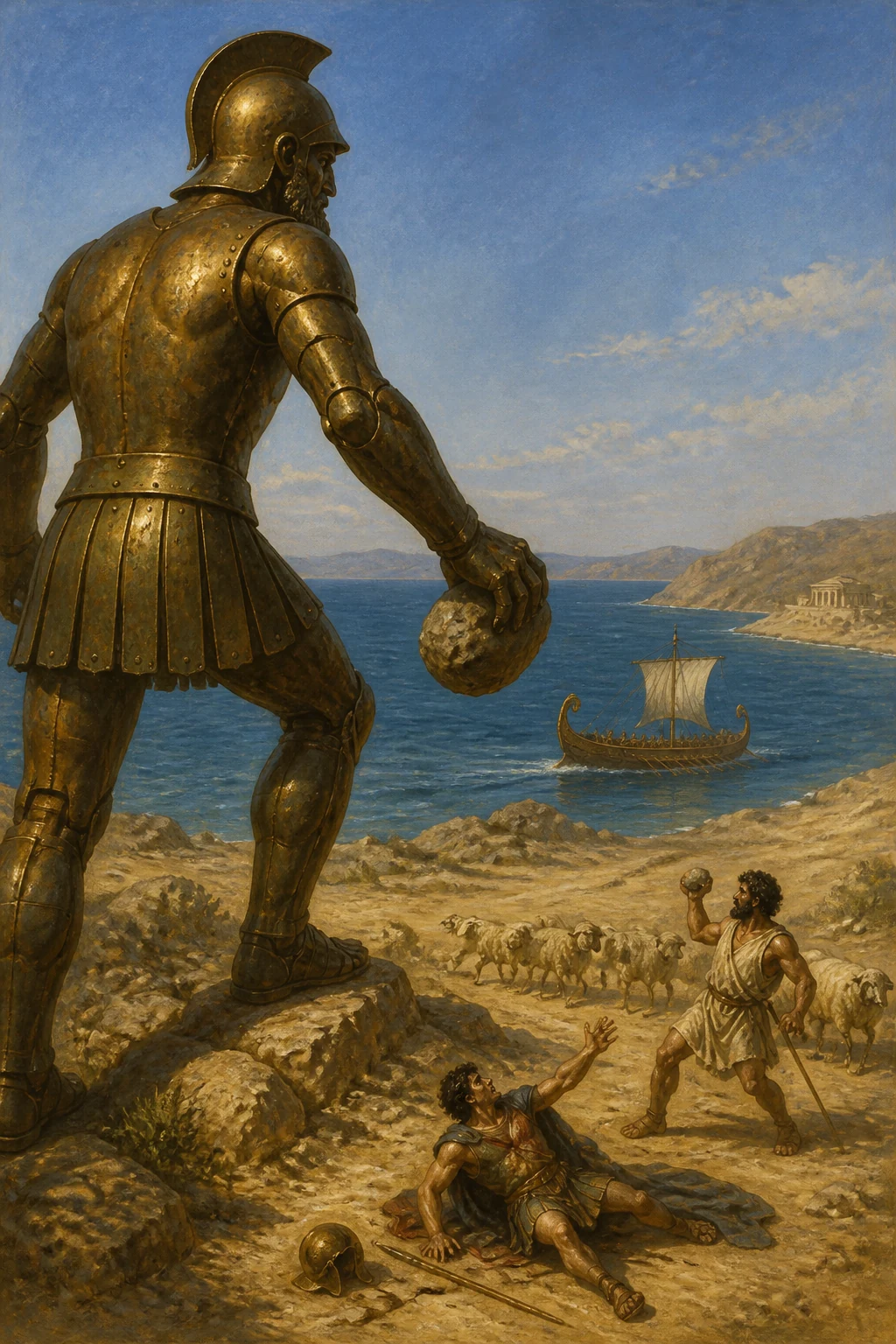
“Now I fear we have done wrong,” said the boy. “This may cost us our lives.” He asked the sailors whether they could sail to Arabia in twenty-four hours if they had a fair wind. Yes, they thought they could manage that. A fair wind sprang up, and they sailed away, reaching Arabia in twenty-three hours. At once the boy ordered the sailors ashore to bury themselves in a sandbank, leaving just enough of their heads out to see the ships. The captain and the boy climbed a high crag and sat beneath a pine tree. An hour later the bird came with the rocky islet in its claws and dropped it on the fleet, sinking the ships. Then it flew to the sandbank and beat its wings so fiercely that it nearly swept the sailors’ heads off. It swooped beneath the pine so swiftly that the boy was spun right round. But he had his sword ready and struck the bird dead. Then he went into the city, where there was great rejoicing because the king had got his daughter back. But now the king himself had hidden her away and promised that whoever could find her should have her, even though she was already betrothed. As the boy went along, he met a man selling polar-bear skins. He bought one and put it on. One of the captains had to lead him by an iron chain, and he went about the city performing tricks. At last word reached the king that no one had ever seen such a performance;
the polar bear danced in every possible fashion, just as it was told. A message came summoning it to perform before the king, for he wished to see it.
When it came in, everyone was frightened, for they had never seen such a beast. But the captain said it was quite harmless unless they laughed at it; that they must not do, or it would kill them. When the king heard this, he warned everyone and told the courtiers not to laugh. But after a while one of the king’s serving maids came in and began putting on airs and laughing. The polar bear struck her such a blow that she flew to pieces. The courtiers began lamenting, and the captain loudest of all. “Oh, never mind,” said the king. “It is only a serving maid. That is my concern, not yours!” By the time the performance ended, it was late in the evening. “There is no point in taking it out now, so late at night,” said the king;
“it can sleep here tonight.” “Perhaps it could lie behind the stove?” said the captain. “No, it shall have featherbeds and pillows to lie on,” said the king, and brought out a whole heap.
The captain was given a room next door. Around midnight the king came with a lantern and a great bunch of keys and led the polar bear away. He went down passage after passage, through doors and rooms, up stairs and down stairs. At last he came out onto a pier that ran straight out to sea.
There the king began shaking and rattling levers and pegs, pulling one up and pushing another down, until a little house rose from the water. He kept his daughter there, for he loved her so dearly that he had hidden her where no one could find her.
He left the polar bear outside the door while he went in and told her about the bear, its dancing, and its tricks. She said she was afraid and dared not look at it. But the king persuaded her, saying there was no danger so long as she did not laugh. Then he let the bear in, and it danced and performed its tricks. But all at once the princess’s maid began to laugh. The boy struck her such a blow that she flew to pieces. The princess wept and lamented bitterly.
“Oh, never mind!” said the king. “It is only a maid, and I shall find you another just as good. But now the bear had better stay here,” he said, “for I have no wish to go tramping along all those passages with it in the middle of the night.” No, then she dared not stay there, said the princess.
But the bear curled up and lay behind the stove, and in the end that was how matters were settled. The princess went to bed and left the light burning. When the king was well away and all was quiet, the polar bear came over and asked her to undo its chin strap. The princess was so frightened that she nearly fainted, but she felt about until she found it. No sooner had she undone it than he pulled off the bear’s head. Then she knew him and was beside herself with joy. She wanted to announce at once that he was the one who had rescued her. But he would not allow it; he wished to win her once more. When they heard the king begin to rattle the levers in the morning, the boy put on the bearskin and lay down behind the stove. “Well, has it kept quiet?” asked the king.
“Yes, goodness me,” said the princess. “It has not so much as stirred.” Back at the castle, the captain took charge of it again. Then the boy went to a master tailor and ordered a prince’s clothes. When they were ready, he went to the king and said he wished to find the princess. “Many have wished to do that,” said the king, “but they have lost their lives, for anyone who fails to find her within twenty-four hours forfeits his life.” The boy thought there was nothing to worry about. He would search, and if he did not find her, that would be his affair. But there were musicians playing in the castle and maidens to dance with, and the boy danced. After twelve hours the king came and said:
“I pity you. You are so poor at searching that you will lose your life.” “Oh, nonsense! There’s no fear for the corpse while it still has breath. We have time enough!” said the boy, and he danced until only one hour remained. Then he was ready to begin searching. “Oh, it is no use,” said the king. “Your time is up now.” “Light your lantern and bring that great bunch of keys!” said the boy. “Come with me wherever I choose to go! There is still a whole hour left.” Then the boy took the same way the king had gone the night before, ordering him to unlock the doors, until he reached the pier that ran straight out to sea.
“It’s no use now; your time is up, and straight into the sea you go,” said the King. “There are still five minutes left,” said the lad, tugging and tearing at the sticks and poles until the house floated up. “Now your time is up!” cried the King. “Come, my fencing master, and cut off his head.” “No, wait, wait!” said the lad. “There are still three minutes left! Bring me the key so I can get in.” But the King stood fumbling for the key and said he could not find it, to drag out the time. “If you haven’t got one, I have one of my own,” said the lad, and he gave the door such a kick that it flew to pieces across the floor inside. The Princess met him in the doorway and said that he was her rescuer and she would have him for her husband. So the King had to let her have him, and the lad married the King of Arabia’s daughter.