O besedilu
Medeja pomladi Ajzona
- Vir
- Ovidove preobrazbe
- Avtor
- Ovid
- Jezik branja
- English
- Jezik izvirnika
- Latin
- Čas branja
- 7 min branja
- Obseg
- 6 strani
- Naslov izvirnika
- Medea Rejuvenates Aeson
O izvirniku
Ovidove preobrazbe
Pesniški tok antičnih preobrazb, kjer bogovi, ljudje in narava stalno menjavajo obliko. Bralni jezik je English, izvirnik pa prihaja iz vira Ovidove preobrazbe v jeziku Latin.
Besedilo
Medeja pomladi Ajzona
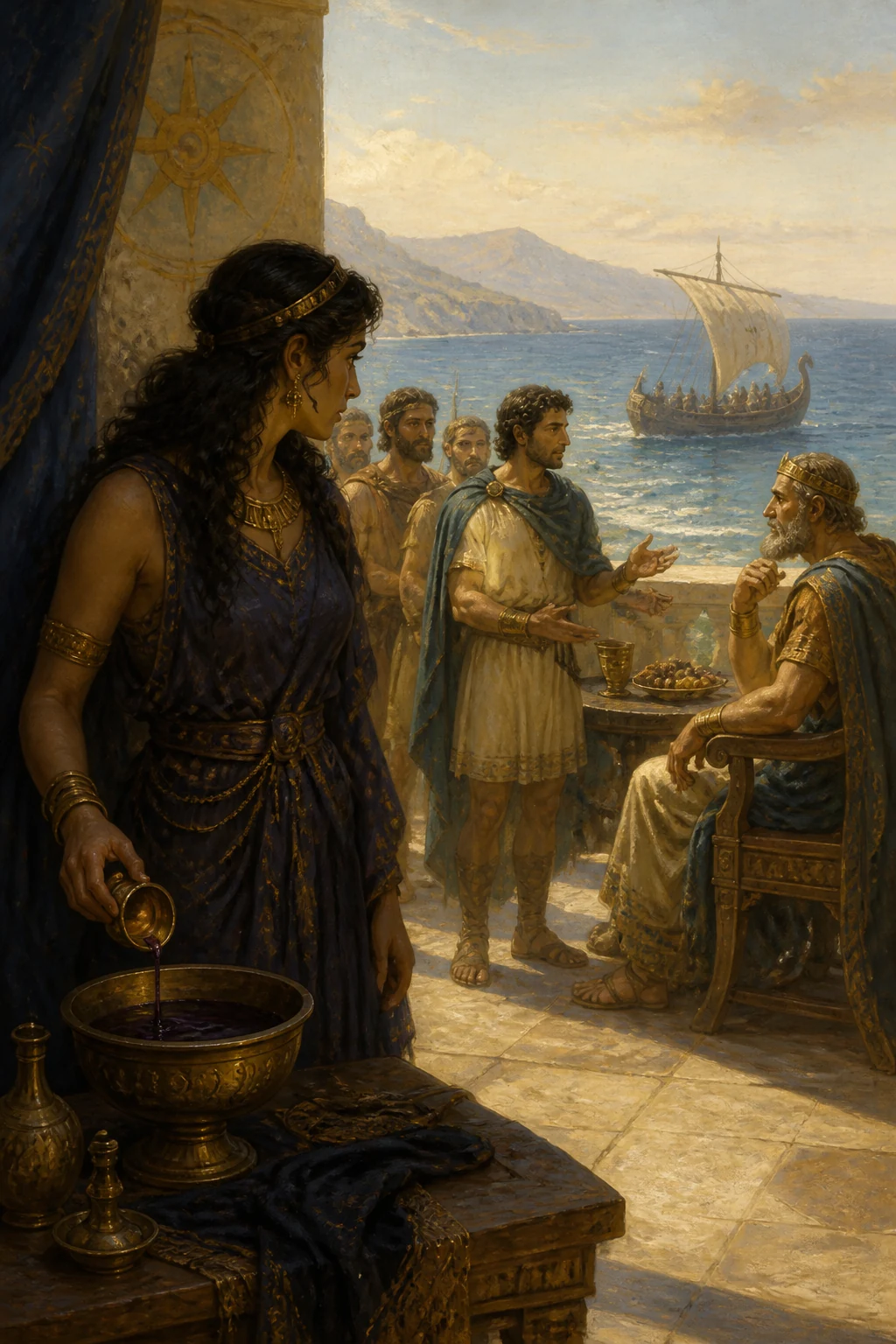
The mothers of Haemonia bring gifts for their sons restored, and aged fathers too; heaped incense melts in the flames, and the promised victim falls, its horns overlaid with gold. But Aeson is absent from the rejoicing, now nearer death and weary with the weight of years. Then Aeson’s son spoke: “Wife, to whom I acknowledge I owe my life, though you have given me everything, and the sum of your kindness passes all belief, if your spells can do this—for what can spells not do?— take years from my life and add them to my father’s.”
He could not hold back his tears. His filial love moved her, and she thought of Aeetes, whom she had left with feelings so unlike his. Yet she did not confess such thoughts. “What wicked words,” she said, “have fallen from your lips, my husband? Do you think I could transfer a portion of your life to anyone? May Hecate forbid it! Nor is your request just. But I shall try to give you a greater gift than the one you ask, Jason.
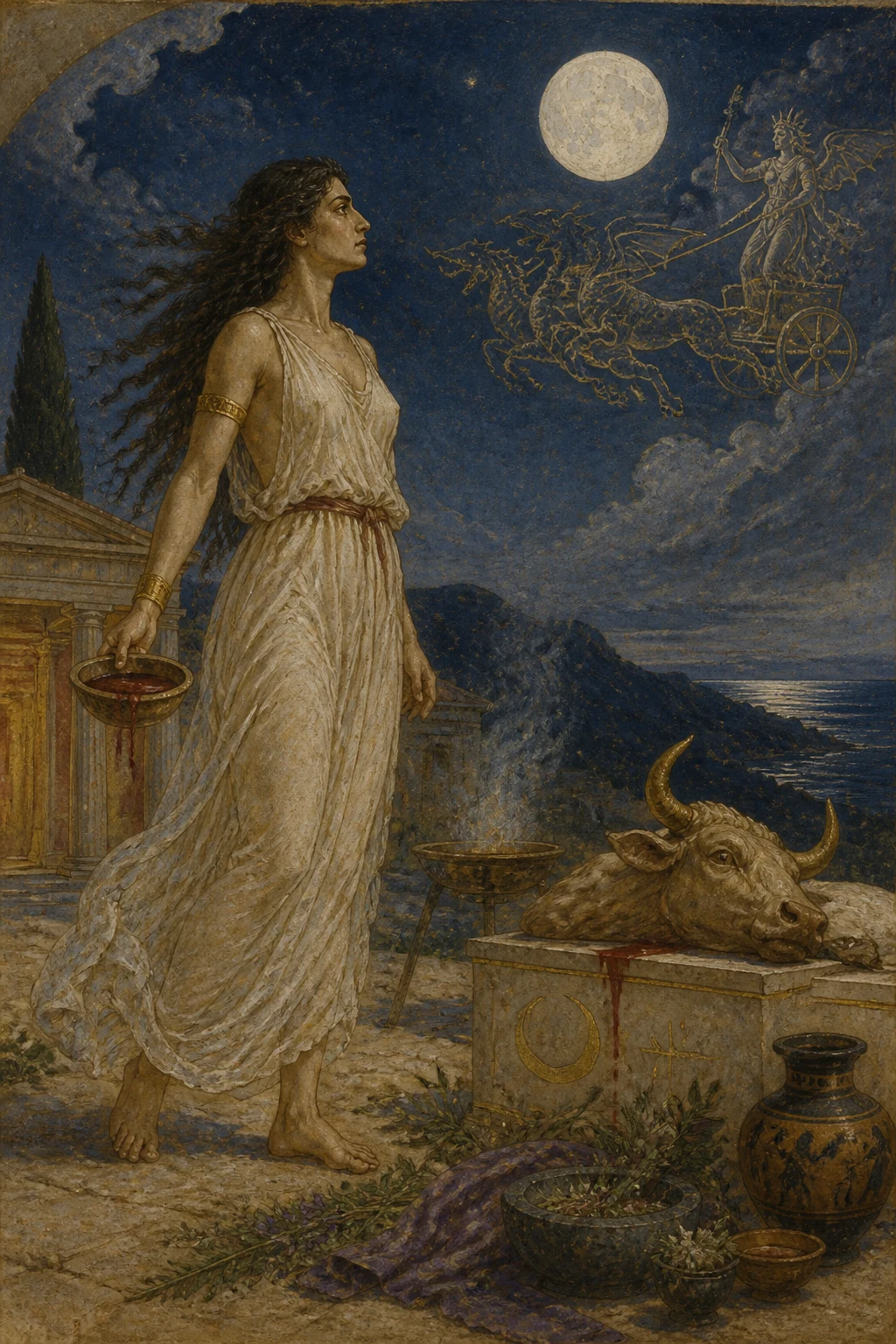
By my art I shall attempt to renew your father’s long life, not at the cost of your years—if only the threefold goddess will help me and lend her presence and favor to this mighty undertaking.” Three nights remained before the moon’s horns would meet and form a perfect circle. When she shone at her fullest and looked upon the earth with her rounded face, Medea left the house in unbelted robes, barefoot, her loose hair flowing over her shoulders, and wandered alone through the hushed silence of midnight. Deep sleep had released humans, birds, and beasts from care: no murmur stirred the hedges, the motionless leaves were silent, silent the moist air;
only the stars glittered. Stretching her arms toward them, she turned three times, three times sprinkled her hair with water drawn from a river, and opened her mouth in three piercing cries. Then, kneeling on the hard earth, she said: “Night, most faithful guardian of secrets; you golden stars who, with the moon, succeed the fires of day; and you, three-headed Hecate, who know my undertakings and come to aid the spells and arts of sorcerers; and you, Earth, who furnish sorcerers with potent herbs; you breezes and winds, mountains, rivers, and lakes, all gods of the woods and all gods of night, be here!
With your help, whenever I have wished, rivers have flowed back to their sources, their banks amazed; by my spells I still the troubled seas and trouble the still; I scatter clouds and gather clouds, drive winds away and summon them; with words and spells I burst the throats of vipers; I move living rock, oaks torn from their native soil, and forests; I command the mountains to tremble, the earth to groan, and ghosts to rise from their tombs.
You too, Moon, I draw down, though the bronze of Temesa eases your travail; my spells turn pale my grandfather’s chariot, and my potions pale the Dawn. You blunted the bulls’ flames for me and bowed their necks, unused to burdens, beneath the curved plow; you turned the serpent-born to savage warfare against themselves, lulled the sleepless guardian into sleep, and sent the gold to the cities of Greece, its defender deceived.
Now I need juices through which old age may be renewed, return to its flowering, and regain its earliest years. And you will grant them. For not in vain have the stars flashed, nor is it in vain that this chariot has come, drawn by the necks of winged dragons.” There stood the chariot, sent down from heaven. As soon as she had mounted, stroked the dragons’ bridled necks, and shaken the light reins in her hands, she was swept aloft. She looked down on Thessalian Tempe beneath her and steered her serpents toward the lands of Thrace.
She examined the herbs that Ossa bore, and lofty Pelion, Othrys and Pindus, and Olympus, higher than Pindus; some that pleased her she tore out by the roots, others she cut with the curved blade of a bronze sickle. Many plants along the banks of the Apidanus pleased her, many along the Amphrysus; nor did you escape your tribute, Enipeus. The Peneus too, and the waters of the Spercheus, contributed their share, as did the reed-grown shores of Boebe.
At Anthedon in Euboea she also gathered the life-giving grass, not yet made famous by the transformation of Glaucus. And now the ninth day and the ninth night had seen her scouring all the countryside in her chariot on dragon wings before she returned. The dragons had touched only the herbs’ scent, yet even so they shed the skin of their ancient age. On her arrival she stopped outside the threshold and doors, with only the sky for shelter, and shunned all contact with men. She built two altars of turf, the right one to Hecate, the left to Youth.
When she had wreathed them with sacred boughs and woodland greenery, she dug two trenches in the earth nearby, performed the sacrifice, and plunged her knives into the throat of a black-fleeced sheep, drenching the open pits with blood. Then, pouring over it a goblet of pure wine and another goblet of warm milk, she uttered her spells, invoked the powers below the earth, and begged the king of shades and his abducted wife not to hasten to rob the old man’s limbs of life.
When she had appeased them with prayers and a long murmured chant, she ordered Aeson’s worn-out body brought into the open air, and, sunk by her spell into a profound sleep, she stretched him, like a corpse, on a bed of herbs. Then she ordered Jason away, and the attendants too, warning them to keep profane eyes from her mysteries. They scattered at her command. With streaming hair, Medea circled the blazing altars like a Bacchante, dipped split torches into the dark trench of blood, lit them, blood-soaked, at the twin altars, and purified the old man three times with flame, three with water, three with sulfur.
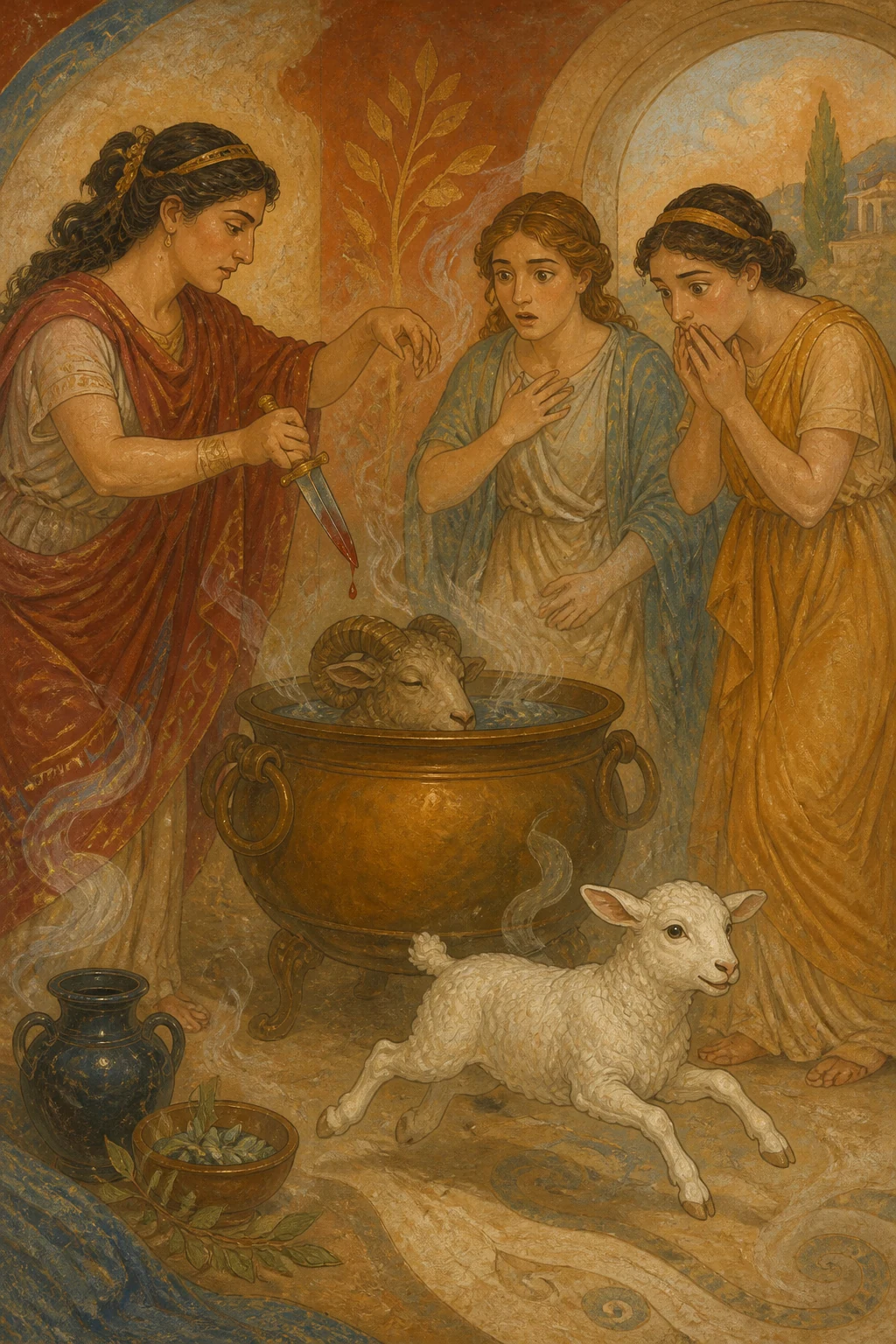
Meanwhile, in a bronze cauldron set upon the fire, a potent potion boiled and seethed, whitening with swollen foam. In it she cooked roots cut in a Haemonian valley, seeds and flowers and dark juices. She added stones fetched from the farthest East and sand washed by the ebbing tides of Ocean; she added frost gathered beneath the all-night moon, the ill-omened wings of a screech owl, with their flesh, and entrails from the shape-shifting wolf that could change its bestial features to a man’s. Nor did the mixture lack the thin, scaly skin of a Cinyphian water snake or the liver of a long-lived stag; to these she added
the head and beak of a crow that had lived nine lifetimes. When, with these and a thousand other nameless things, the foreign sorceress had prepared her gift, beyond mortal power, she took a long-dried branch of cultivated olive and stirred it all together, blending the bottom with the top. And behold, the old stick, turned in the hot bronze pot, first grew green, then before long put forth leaves, and suddenly was laden with heavy olives.
And wherever the fire flung foam from the hollow cauldron and hot drops fell upon the ground, the earth grew green, and flowers and tender grasses sprang up. As soon as Medea saw this, she drew her sword and opened the old man’s throat; letting the aged blood flow out, she filled his veins with the juices. When Aeson had absorbed them, whether through his mouth or through the wound, his beard and hair shed their whiteness and took on a deep black hue.
His leanness vanished, his pallor and decay were gone, his hollow wrinkles filled with fresh-grown flesh, and his limbs flourished. Aeson marveled, remembering that this was how he had been forty years before.
Izvirnik
Medea Rejuvenates Aeson
Naslednje strani prikazujejo izvirno besedilo za primerjavo.
Source ID: ovid_metamorphoses_story_046 Citation: Ovid, Metamorphoses 7.159-7.293 Original language: Latin Source: PerseusDL canonical-latinLit Source URL: https://github.com/PerseusDL/canonical-latinLit/blob/master/data/phi0959/phi006/phi0959.phi006.perseus-lat2.xml Segmentation certainty: medium 159: Haemoniae matres pro gnatis dona receptis 160: grandaevique ferunt patres congestaque flamma 161: tura liquefaciunt, inductaque cornibus aurum 162: victima vota cadit. Sed abest gratantibus Aeson, 163: iam propior leto fessusque senilibus annis.
164: Cum sic Aesonides: “O cui debere salutem 165: confiteor, coniunx, quamquam mihi cuncta dedisti 166: excessitque fidem meritorum summa tuorum, 167: si tamen hoc possunt (quid enim non carmina possunt?), 168: deme meis annis et demptos adde parenti.” 169: Nec tenuit lacrimas. Mota est pietate rogantis, 170: dissimilemque animum subiit Aeeta relictus. 171: Nec tamen adfectus tales confessa “quod” inquit 172: “excidit ore tuo, coniunx, scelus? ergo ego cuiquam 173: posse tuae videor spatium transcribere vitae?
174: Nec sinat hoc Hecate, nec tu petis aequa. Sed isto, 175: quod petis, experiar maius dare munus Iason. 176: Arte mea soceri longum temptabimus aevum, 177: non annis renovare tuis: modo diva triformis 178: adiuvet et praesens ingentibus adnuat ausis.” 179: Tres aberant noctes, ut cornua tota coirent 180: efficerentque orbem. Postquam plenissima fulsit 181: et solida terras spectavit imagine luna, 182: egreditur tectis vestes induta recinctas, 183: nuda pedem, nudos umeris infusa capillos, 184: fertque vagos mediae per muta silentia noctis 185: incomitata gradus. Homines volucresque ferasque
186: solverat alta quies: nullo cum murmure saepes, 187: inmotaeque silent frondes, silet umidus aer; 188: sidera sola micant. Ad quae sua bracchia tendens 189: ter se convertit, ter sumptis flumine crinem 190: inroravit aquis ternisque ululatibus ora 191: solvit et, in dura submisso poplite terra, 192: “Nox” ait “arcanis fidissima, quaeque diurnis 193: aurea cum luna succeditis ignibus astra, 194: tuque triceps Hecate, quae coeptis conscia nostris 195: adiutrixque venis cantusque artisque magorum, 196: quaeque magos, Tellus, pollentibus instruis herbis, 197: auraeque et venti montesque amnesque lacusque
198: dique omnes nemorum, dique omnes noctis adeste. 199: Quorum ope, cum volui, ripis mirantibus amnes 200: in fontes rediere suos, concussaque sisto, 201: stantia concutio cantu freta, nubila pello 202: nubilaque induco, ventos abigoque vocoque, 203: vipereas rumpo verbis et carmine fauces, 204: vivaque saxa sua convulsaque robora terra 205: et silvas moveo, iubeoque tremescere montes 206: et mugire solum manesque exire sepulcris.
207: Te quoque, Luna, traho, quamvis Temesaea labores 208: aera tuos minuant; currus quoque carmine nostro 209: pallet avi, pallet nostris Aurora venenis. 210: Vos mihi taurorum flammas hebetastis et unco 211: impatiens oneris collum pressistis aratro, 212: vos serpentigenis in se fera bella dedistis 213: custodemque rudem somno sopistis et aurum 214: vindice decepto Graias misistis in urbes.
215: Nunc opus est sucis, per quos renovata senectus 216: in florem redeat primosque reconligat annos. 217: Et dabitis. Neque enim micuerunt sidera frustra, 218: nec frustra volucrum tractus cervice draconum 219: currus adest.” Aderat demissus ab aethere currus. 220: Quo simul adscendit frenataque colla draconum 221: permulsit manibusque leves agitavit habenas, 222: sublimis rapitur subiectaque Thessala Tempe 223: despicit et Threces regionibus applicat angues: 224: et quasque Ossa tulit quasque altus Pelion herbas 225: Othrysque Pindusque et Pindo maior Olympus 226: perspicit, et placitas partim radice revellit,
227: partim succidit curvamine falcis aenae. 228: Multa quoque Apidani placuerunt gramina ripis, 229: multa quoque Amphrysi neque eras inmunis, Enipeu; 230: nec non Peneos, nec non Spercheides undae 231: contribuere aliquid iuncosaque litora Boebes. 232: Carpsit et Euboica vivax Anthedone gramen, 233: nondum mutato vulgatum corpore Glauci. 234: Et iam nona dies curru pennisque draconum 235: nonaque nox omnes lustrantem viderat agros, 236: cum rediit. Neque erant tacti, nisi odore, dracones, 237: et tamen annosae pellem posuere senectae.
238: Constitit adveniens citra limenque foresque 239: et tantum caelo tegitur refugitque viriles 240: contactus statuitque aras de caespite binas, 241: dexteriore Hecates, ast laeva parte Iuventae. 242: Has ubi verbenis silvaque incinxit agresti. 243: haud procul egesta scrobibus tellure duabus 244: sacra facit cultrosque in guttura velleris atri 245: conicit et patulas perfundit sanguine fossas.
246: Tum super invergens liquidi carchesia vini 247: alteraque invergens tepidi carchesia lactis 248: verba simul fudit terrenaque numina civit 249: umbrarumque rogat rapta cum coniuge regem, 250: ne properent artus anima fraudare senili. 251: Quos ubi placavit precibusque et murmure longo, 252: Aesonis effetum proferri corpus ad auras 253: iussit et in plenos resolutum carmine somnos, 254: exanimi similem, stratis porrexit in herbis.
255: Hinc procul Aesoniden, procul hinc iubet ire ministros 256: et monet arcanis oculos removere profanos. 257: Diffugiunt iussi. Passis Medea capillis 258: bacchantum ritu, flagrantes circuit aras 259: multifidasque faces in fossa sanguinis atra 260: tingit et infectas geminis accendit in aris 261: terque senem flamma, ter aqua, ter sulphure lustrat. 262: Interea validum posito medicamen aeno 263: fervet et exsultat spumisque tumentibus albet.
264: Illic Haemonia radices valle resectas 265: seminaque floresque et sucos incoquit atros. 266: Adicit extremo lapides oriente petitos 267: et quas Oceani refluum mare lavit harenas, 268: addit et exceptas luna pernocte pruinas 269: et strigis infames ipsis cum carnibus alas 270: inque virum soliti vultus mutare ferinos 271: ambigui prosecta lupi; nec defuit illis 272: squamea Cinyphii tenuis membrana chelydri 273: vivacisque iecur cervi; quibus insuper addit 274: ora caputque novem cornicis saecula passae.
275: His et mille aliis postquam sine nomine rebus 276: propositum instruxit mortali barbara maius 277: arenti ramo iampridem mitis olivae 278: omnia confudit summisque inmiscuit ima. 279: Ecce vetus calido versatus stipes aeno 280: fit viridis primo, nec longo tempore frondes 281: induit et subito gravidis oneratur olivis. 282: At quacumque cavis spumas eiecit aenis 283: ignis et in terram guttae cecidere calentes, 284: vernat humus, floresque et mollia pabula surgunt.
285: Quae simul ac vidit, stricto Medea recludit 286: ense senis iugulum, veteremque exire cruorem 287: passa, replet sucis. Quos postquam combibit Aeson 288: aut ore acceptos aut vulnere, barba comaeque 289: canitie posita nigrum rapuere colorem, 290: pulsa fugit macies, abeunt pallorque situsque, 291: adiectoque cavae supplentur corpore rugae, 292: membraque luxuriant. Aeson miratur et olim 293: ante quater denos hunc se reminiscitur annos.
Nadaljuj z branjem