Prevod
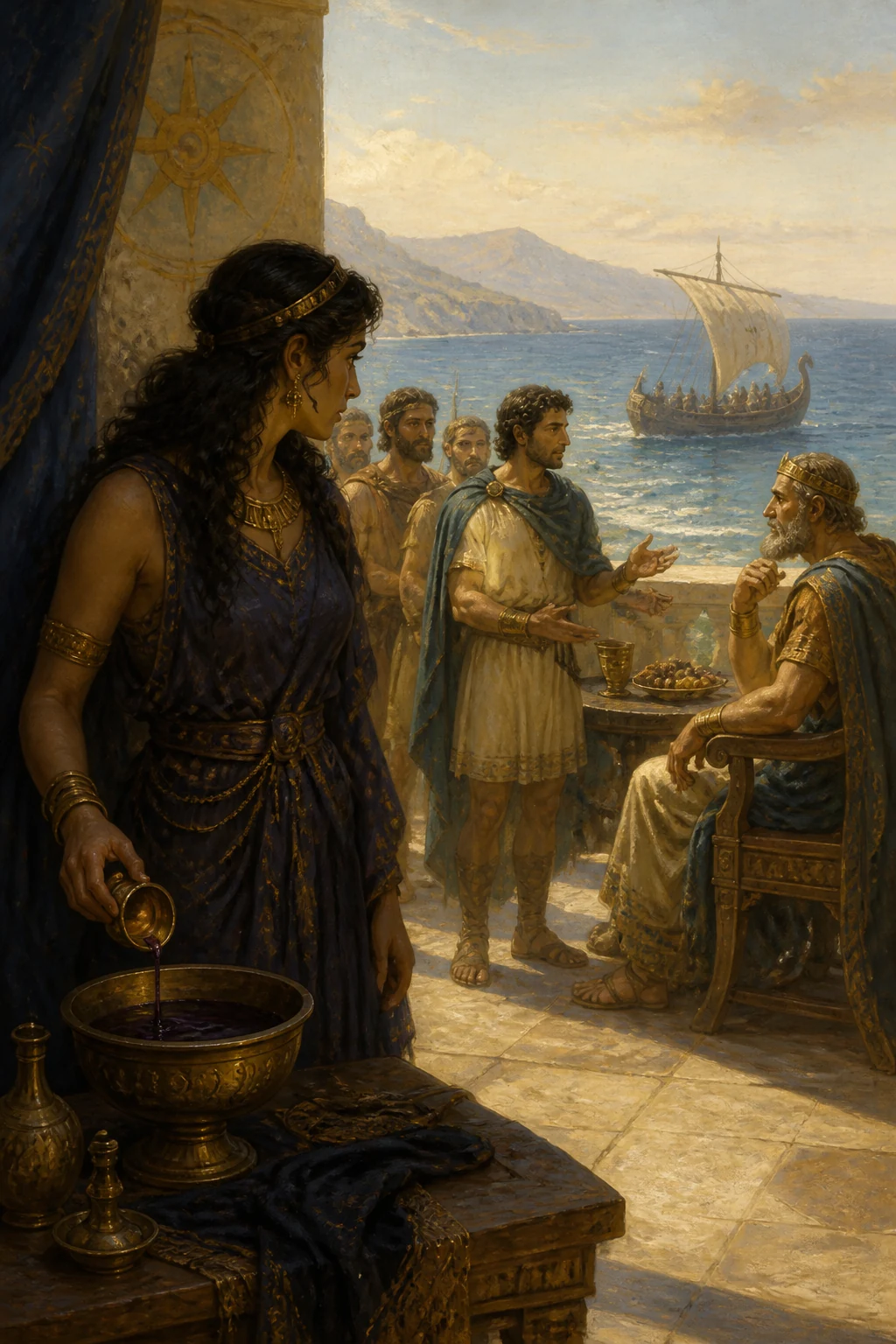
The mothers of Haemonia bring gifts for their sons restored, and aged fathers too; heaped incense melts in the flames, and the promised victim falls, its horns overlaid with gold. But Aeson is absent from the rejoicing, now nearer death and weary with the weight of years. Then Aeson’s son spoke: “Wife, to whom I acknowledge I owe my life, though you have given me everything, and the sum of your kindness passes all belief, if your spells can do this—for what can spells not do?— take years from my life and add them to my father’s.”
He could not hold back his tears. His filial love moved her, and she thought of Aeetes, whom she had left with feelings so unlike his. Yet she did not confess such thoughts. “What wicked words,” she said, “have fallen from your lips, my husband? Do you think I could transfer a portion of your life to anyone? May Hecate forbid it! Nor is your request just. But I shall try to give you a greater gift than the one you ask, Jason.
By my art I shall attempt to renew your father’s long life, not at the cost of your years—if only the threefold goddess will help me and lend her presence and favor to this mighty undertaking.” Three nights remained before the moon’s horns would meet and form a perfect circle. When she shone at her fullest and looked upon the earth with her rounded face, Medea left the house in unbelted robes, barefoot, her loose hair flowing over her shoulders, and wandered alone through the hushed silence of midnight. Deep sleep had released humans, birds, and beasts from care: no murmur stirred the hedges, the motionless leaves were silent, silent the moist air;
only the stars glittered. Stretching her arms toward them, she turned three times, three times sprinkled her hair with water drawn from a river, and opened her mouth in three piercing cries. Then, kneeling on the hard earth, she said: “Night, most faithful guardian of secrets; you golden stars who, with the moon, succeed the fires of day; and you, three-headed Hecate, who know my undertakings and come to aid the spells and arts of sorcerers; and you, Earth, who furnish sorcerers with potent herbs; you breezes and winds, mountains, rivers, and lakes, all gods of the woods and all gods of night, be here!
With your help, whenever I have wished, rivers have flowed back to their sources, their banks amazed; by my spells I still the troubled seas and trouble the still; I scatter clouds and gather clouds, drive winds away and summon them; with words and spells I burst the throats of vipers; I move living rock, oaks torn from their native soil, and forests; I command the mountains to tremble, the earth to groan, and ghosts to rise from their tombs.
You too, Moon, I draw down, though the bronze of Temesa eases your travail; my spells turn pale my grandfather’s chariot, and my potions pale the Dawn. You blunted the bulls’ flames for me and bowed their necks, unused to burdens, beneath the curved plow; you turned the serpent-born to savage warfare against themselves, lulled the sleepless guardian into sleep, and sent the gold to the cities of Greece, its defender deceived.
Now I need juices through which old age may be renewed, return to its flowering, and regain its earliest years. And you will grant them. For not in vain have the stars flashed, nor is it in vain that this chariot has come, drawn by the necks of winged dragons.” There stood the chariot, sent down from heaven. As soon as she had mounted, stroked the dragons’ bridled necks, and shaken the light reins in her hands, she was swept aloft. She looked down on Thessalian Tempe beneath her and steered her serpents toward the lands of Thrace.
She examined the herbs that Ossa bore, and lofty Pelion, Othrys and Pindus, and Olympus, higher than Pindus; some that pleased her she tore out by the roots, others she cut with the curved blade of a bronze sickle. Many plants along the banks of the Apidanus pleased her, many along the Amphrysus; nor did you escape your tribute, Enipeus. The Peneus too, and the waters of the Spercheus, contributed their share, as did the reed-grown shores of Boebe.
At Anthedon in Euboea she also gathered the life-giving grass, not yet made famous by the transformation of Glaucus. And now the ninth day and the ninth night had seen her scouring all the countryside in her chariot on dragon wings before she returned. The dragons had touched only the herbs’ scent, yet even so they shed the skin of their ancient age. On her arrival she stopped outside the threshold and doors, with only the sky for shelter, and shunned all contact with men. She built two altars of turf, the right one to Hecate, the left to Youth.
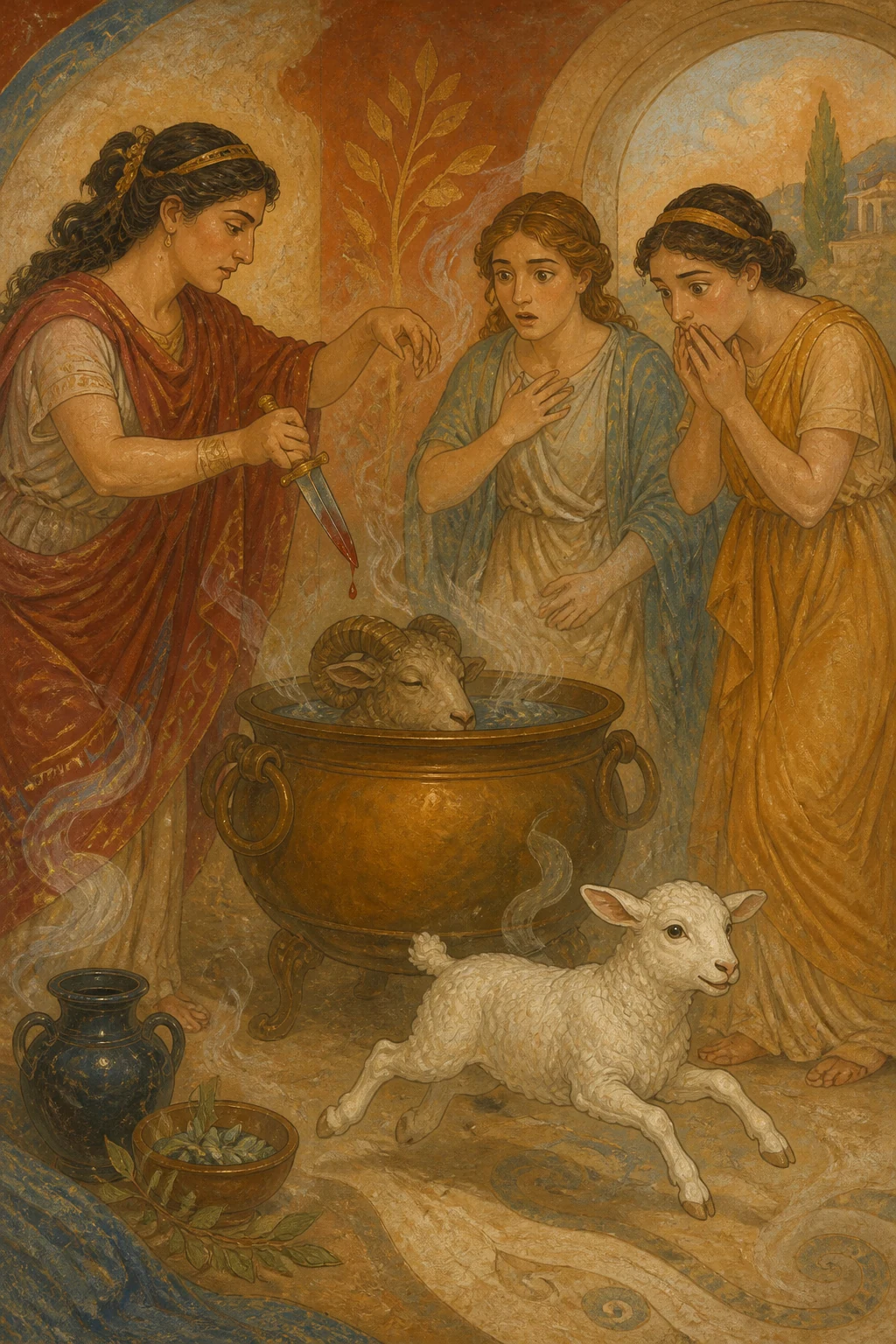
When she had wreathed them with sacred boughs and woodland greenery, she dug two trenches in the earth nearby, performed the sacrifice, and plunged her knives into the throat of a black-fleeced sheep, drenching the open pits with blood. Then, pouring over it a goblet of pure wine and another goblet of warm milk, she uttered her spells, invoked the powers below the earth, and begged the king of shades and his abducted wife not to hasten to rob the old man’s limbs of life.
When she had appeased them with prayers and a long murmured chant, she ordered Aeson’s worn-out body brought into the open air, and, sunk by her spell into a profound sleep, she stretched him, like a corpse, on a bed of herbs. Then she ordered Jason away, and the attendants too, warning them to keep profane eyes from her mysteries. They scattered at her command. With streaming hair, Medea circled the blazing altars like a Bacchante, dipped split torches into the dark trench of blood, lit them, blood-soaked, at the twin altars, and purified the old man three times with flame, three with water, three with sulfur.
Meanwhile, in a bronze cauldron set upon the fire, a potent potion boiled and seethed, whitening with swollen foam. In it she cooked roots cut in a Haemonian valley, seeds and flowers and dark juices. She added stones fetched from the farthest East and sand washed by the ebbing tides of Ocean; she added frost gathered beneath the all-night moon, the ill-omened wings of a screech owl, with their flesh, and entrails from the shape-shifting wolf that could change its bestial features to a man’s. Nor did the mixture lack the thin, scaly skin of a Cinyphian water snake or the liver of a long-lived stag; to these she added
the head and beak of a crow that had lived nine lifetimes. When, with these and a thousand other nameless things, the foreign sorceress had prepared her gift, beyond mortal power, she took a long-dried branch of cultivated olive and stirred it all together, blending the bottom with the top. And behold, the old stick, turned in the hot bronze pot, first grew green, then before long put forth leaves, and suddenly was laden with heavy olives.
And wherever the fire flung foam from the hollow cauldron and hot drops fell upon the ground, the earth grew green, and flowers and tender grasses sprang up. As soon as Medea saw this, she drew her sword and opened the old man’s throat; letting the aged blood flow out, she filled his veins with the juices. When Aeson had absorbed them, whether through his mouth or through the wound, his beard and hair shed their whiteness and took on a deep black hue.
His leanness vanished, his pallor and decay were gone, his hollow wrinkles filled with fresh-grown flesh, and his limbs flourished. Aeson marveled, remembering that this was how he had been forty years before.