Prevod
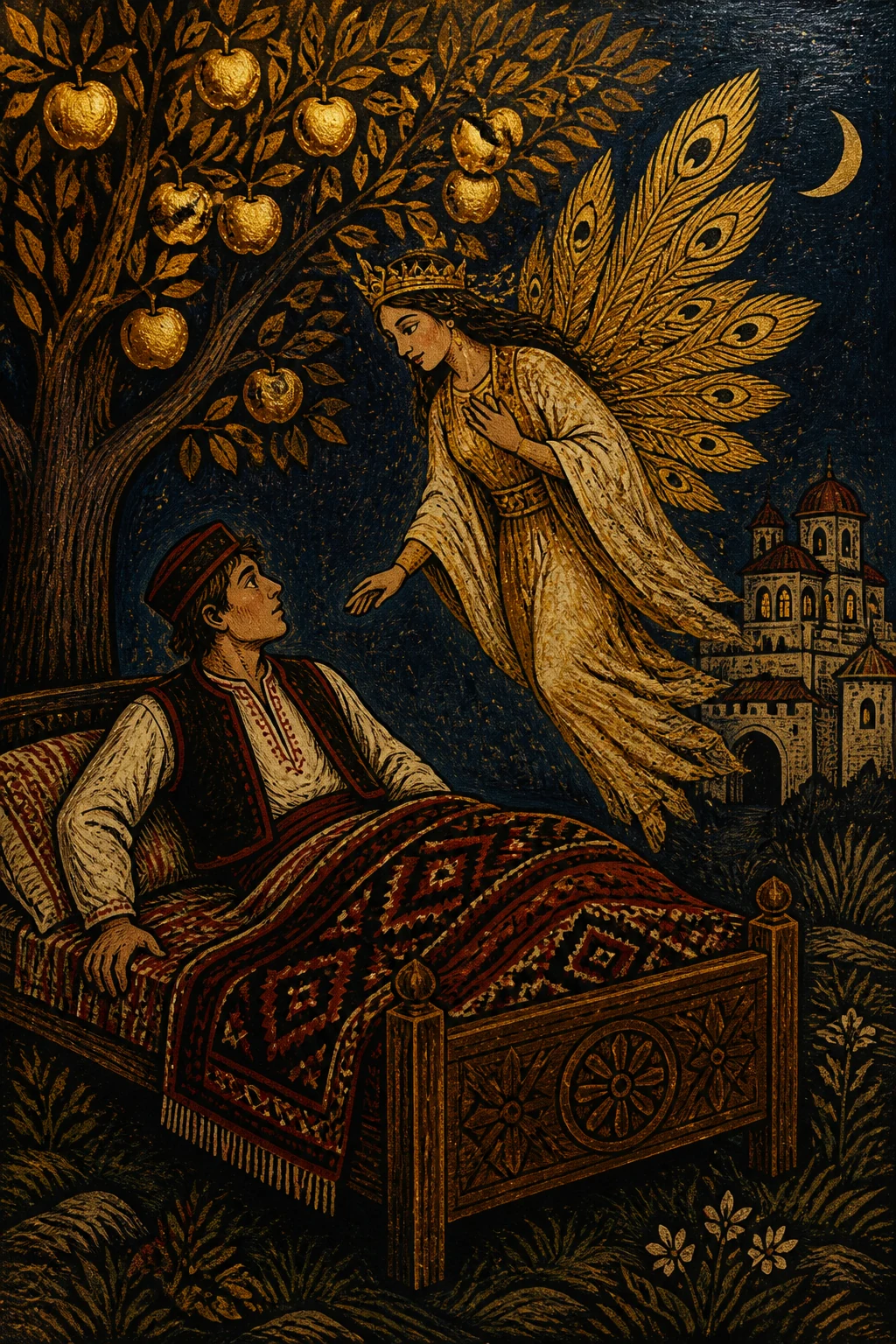
Once upon a time, as never before, and so on. There was once a man who had grown weary of the vanities of cities and had become a hermit. You see, he had come to understand that all was vanity in this blind world, and that was why he had withdrawn into the wilderness. There his neighbours were the beasts of the forest, and so dear was he to God that all the creatures bowed before him and licked his feet whenever they met him. One day, going down to the river that flowed through the forest to wash himself, he saw a little chest, tightly shut and well sealed with pitch, floating towards him. It came to rest against the bank where he stood, and at once he heard something crying inside it, like a little baby. He stood a moment and wondered what this could be. But after praying a little that Satan’s temptation might be driven away from him, if temptation it was, and finding that the crying only grew louder instead of vanishing from before him, he set about drawing the chest ashore. When he opened it, he found a tiny child within, scarcely two weeks old. As soon as he took it in his arms, the child fell silent. Then the hermit thanked God for sending him a human soul to ease his loneliness in that deep, tangled forest. Around the child’s neck he found a little charm, on which he read that the baby was the son of an emperor’s daughter. The hermit would gladly have brought him up, but the trouble was, what could he feed him? Then he fell upon his knees and prayed fervently to the Lord, and at once a great fig tree sprang up as though from beneath the earth, amid the green grass. Some of its fruit was only budding, some was in blossom, some beginning to ripen, and some fully ripe and ready to eat. He gave the child the juice squeezed from a fig, and the little one fed on it, much to the hermit’s wonder. Thus he raised him there until he had grown a little, had begun to walk, and could eat other things the hermit gave him. When he grew older still, the hermit taught his adopted son to read and to gather roots and other green things for food. So they lived there in peace, with no one to trouble them, the old man teaching the boy all he knew of the world and its ways, and the boy listening and taking to heart everything taught him by the father Heaven had given him. Several years passed in this way. Then one day the old man told his son that he was going to God. “Do not be frightened, my dear boy, for a fearsome lion will come to dig my grave. You must lay me in it and cover me with earth. Then climb into the loft of my hut, take the bridle you find there, and shake it.” While he was still speaking, the hermit lay down and fell into the sleep that knows no waking. The boy wept bitterly to find himself alone. And then, my friends, there came the terrible lion, roaring. The boy’s hair stood on end with fright; but remembering the old man’s words, he grew calm and watched the beast dig the grave. In it he laid his father and covered him with earth. When the boy had done as the old man had told him, the lion went about its business and never returned. Left alone, the boy wandered through the forest thickets, weeping and lamenting so pitifully that it would have broken your heart to hear him. Then, remembering the words of the old man, his father, he climbed into the loft of the hut, found the bridle, took it, and came down with it. I forgot to tell you: after the old man’s death, the fig tree had withered away entirely, leaving nothing but a scorched trunk standing in the ground. Once he had climbed down with the bridle, the boy shook it, and behold, a stallion with six wings appeared and said, “What are your commands, master?” “What should I command?” answered the boy. “Just stay here with me, for I am lonely all by myself.” “No, master. You must go out into the world and do as I tell you, and things will turn out very well for you.” The boy marvelled at the horse’s words. You see, he knew nothing of the ways of the world. He marvelled again when the horse told him that he must be properly clothed. Following its advice, he put his hand into its left ear and drew out a suit of clothes, which he put on. Then he mounted, and the horse carried him to a town, where he took lodgings at an inn. He wondered at everything he saw and carefully watched what other people did. After a few days, during which the boy had grown somewhat accustomed to the world, the horse told him that he too must acquire some means of his own. To that end, it told him to bind his eyes, and when he had mounted, it flew away with him until they reached a hill, where it stopped. Then it said, “Master, dismount, and keeping the bridle in your hand, bend down and pick up whatever comes to hand from the ground. Fill the folds of your shirt.” “What on earth am I to pick up blindly like this? I should do better to take the blindfold off,” answered the boy. “Heaven forbid that you should do such a thing!” the horse told him. “The instant you open your eyes, you will surely die.” The boy obeyed. He dismounted, but did not let go of the bridle. He bent down and with his other hand gathered whatever he could feel, filled the folds of his shirt, mounted, and set off home. When he reached his lodgings and uncovered his eyes, what do you think he saw, good people? Nothing but precious stones, each lovelier and larger than the next. He did not know what they were and played with them as children play with pebbles. But the horse taught him what to do with them. He took just a few to the merchants and exchanged them for money. He paid his bill at the inn, bought everything he needed, and still had money left. Now the horse taught him what to do next: he was to choose a few of the largest and finest stones and take them as a gift to the emperor of that country. And so he did. When he went to the emperor with his gift and saw how honourably he was received and how highly the emperor prized it, he said that he had many more. The emperor himself was astonished at the boy’s great wealth and took a liking to him. There was no court ceremony to which he was not invited. There was no parade, procession, or celebration at which he was not present. Day after day it went on like this, until he made friends with the sons of princes and noblemen. Merely by watching and listening, he learned all their accomplishments: how to wield a sword, how to whirl a mace, how to bend a bow and take aim. Indeed, he even surpassed them, for he was a clever lad, skilful and quick-witted, a true Romanian, straight as a fir and proud as an oak. All was well. Only one thing he could not understand: why the emperor was always sad and seemed to pine away. One day, he scarcely knew how, he found the courage to ask him. “Your Majesty,” he said, “you have every blessing in the world, and everyone bows before you as before a mighty emperor. What weighs upon your soul that you are always so downcast and sorrowful?” “Ah, my dear boy, what troubles me? It was my lot, by God’s will, to suffer in this world, and now I have come to the end of my strength. I had a daughter and two sons, but I was not granted the joy of them. A foul zmeu stole my daughter, and I cannot find the slightest trace of her anywhere. I sent two armies, together with my sons, and all were utterly destroyed. My wife, the empress, died of grief for her children, and it will not be long before I go to join her. Look, I feel myself growing weaker day by day, and I no longer have the heart to rejoice.” The boy fell silent, sorry that he had brought up matters so painful to the emperor’s soul. When he returned to his lodgings, he told his horse what he had learned and asked whether there was any way to rescue the girl from the zmei. The horse answered, “What is impossible in this world? Yet to save the girl from the zmeu’s clutches will be a difficult business, on account of his mother, that she-monster, who is also a witch powerful enough to freeze the waters.” That was all the boy needed to hear. He cared nothing for whether the task was difficult or not, but went straight to the emperor. Once more he brought up the subject of the lost children, inquired about them more closely, then said, “I will go and bring them back to you, mighty Emperor.” “Put that thought out of your head, brave lad,” the emperor answered. “Do not throw your youth away in vain. My giant could do nothing; my Moor could do nothing. What hope have you, a mere boy untried in war? My giant had the power to sweep a whole army to the ground with one backward stroke of his hand, heaping it into a mound as high as the army was great, and then he would sit on top of it. My Moor had the power to swallow an army, however vast, with a single breath, then spew it out as though it had been digested. Yet even they perished when they went to war with my sons.” “I too will try, mighty Emperor, if you will give me leave.” “Go, my boy, if fate is drawing you to your death.” Taking his leave of the emperor, the young hero went to his horse and told it everything he had heard and all that he had resolved to do. “Let us go,” answered the horse, “but let us keep all our thoughts upon God, and He will not let us perish.” You see, I cannot tell you why, but the young man felt as though the emperor’s daughter were destined for him, and he could find no rest. He made ready and set out. And he travelled and travelled and travelled, through a summer’s day until evening, as the tale goes—and from this point onward it grows lovelier still—until they reached a green and pleasant glade. Here they halted to rest and began to take counsel about what they should do and how to do it. The horse, being a creature of magic, told him how to proceed so that he might win the day and reach the gentle maiden he longed for. They travelled a little farther and came to the she-monster’s palace. This palace was made entirely of glass and shone so brightly that you could sooner look at the sun than at its walls. Before entering the palace grounds, they stopped to watch and discover how matters stood within. For three days and three nights they prowled about the palace, and by making careful inquiries learned that neither the she-monster nor the zmeu was at home. Then Făt-Frumos rode boldly into the courtyard and stopped at the foot of the steps. As soon as the girl saw him, she came outside. She spoke to Făt-Frumos as he sat on horseback, and they came to an understanding. Seeing that she had a brave man to deal with, the girl went into her chamber, took a whetstone, a kerchief with a border around its edges, and a brush, hurried out of the house, mounted Făt-Frumos’s horse, and away they fled. As soon as they crossed the gateway, the courtyards and palace began to roar and thunder—God preserve us! The she-monster heard the noise from wherever she had gone and returned home in an instant. When she arrived and saw that the girl had been carried off, she set out after them. On and on she chased them, until, just as she was about to lay hands on them, the girl threw the brush into her path. At once a great, dense forest sprang up, so thick that not even a little bird could pass through it. The she-monster struggled as best she could, gnawing through trees, scrambling from branch to branch, and squeezing through the undergrowth until she reached the other side. Then how she flew after them! The horse sped like the wind, but the she-monster followed swift as thought. When she was about to seize them, the girl threw the kerchief behind her. At once a vast stretch of water appeared, so vast that its farther shore could scarcely be seen, and it was ringed all about with fire. The she-monster left no means untried and made her way across. Through fire and water she went, and still she pursued them, never once slackening her pace. The horse had scarcely gained any distance worth speaking of when there she was, almost upon them again. Then, as they galloped, the girl threw down the whetstone too. At once a mountain rose between them and the she-monster, a mountain made of nothing but stone. The she-monster was bursting with rage and so furious that she could scarcely see before her. She began to climb the mountain—but no, it was not to be scaled so easily! Its sides were sheer and its stone polished smooth, just as you would expect of a whetstone. There was nowhere to set her foot and gain a purchase. Whenever she touched a jutting edge, her flesh bled, for the stone was sharp enough to cut like a knife. In the end, clambering from rock to rock, crawling on all fours and clinging like a leech, she strained every nerve and managed to reach the mountaintop. Făt-Frumos was at its foot with his bow in his hand. As soon as the she-monster found herself on the summit, she took a breath, then whirled down the slope like a tempest. Seeing this, Făt-Frumos quickly bent his bow, fitted an arrow, and took aim. When the moment was right, he loosed the string and struck her straight in the eye. The she-monster gave a shriek that shook the mountain and came tumbling down, groaning. When she reached the bottom, she curled into a knot with pain. Făt-Frumos approached her, mace in hand, and dealt her several heavy blows, for she was not yet dead. She had just enough breath left to say, “You’ve done for me, you son of a jade!” Then she gaped three times, and as her soul left her body, such a stench spread abroad that no one could bear to stand near her. So foul a creature was she! Făt-Frumos and the emperor’s daughter were beside themselves with joy. They wished to return home to the emperor, who was waiting for them with great impatience. But the horse told them, “Those who make haste get burnt. First we must kill the zmeu, the she-monster’s son, for as long as he remains above ground, you will have no peace from him. Then we must raise the emperor’s sons from their graves, together with all those whom the she-monster destroyed with her spells. After that we can return home with all the zmei’s wealth.” Eager to fight the zmeu, Făt-Frumos set out once more for the she-monster’s palace. The zmeu was waiting there, armed, to see how his mother had fared in destroying Făt-Frumos and the girl. But when he saw Făt-Frumos riding towards him like a true hero, with the girl beside him on the horse, his hands and feet went numb. The zmeu very nearly died of grief at the thought that his mother had perished. Yet he gathered his courage and stood his ground, ready to wrestle with Făt-Frumos. This was just what the young man had been waiting for. You see, the horse had taught him how to enter the struggle and what to do. So they grappled. They wrestled and wrestled, through a summer’s day until evening, yet neither could overcome the other. Seeing that night was drawing near, Făt-Frumos suddenly summoned all his strength, hoisted the zmeu into the air, and slammed him down so hard that he drove him into the earth up to his neck. Holding him there beneath his foot, with his naked sword raised above him, he questioned him about the girl’s brothers and the armies sent against him. Believing that his life would be spared if he told, the zmeu answered, “The mounds of earth you passed on your way here are the emperor’s sons and his armies. The scrolls that bind them by enchantment are in a silver box kept on the shelf behind the stove in my mother’s chamber. Whoever takes them and reads them over those mounds to undo the spells will break the enchantment, and they will all return to life as though they had never been bewitched.” That was all Făt-Frumos needed to know. He cut off the zmeu’s head and left him there for the ravens to eat. Then they entered the she-monster’s palace, and the girl, who had already noticed the box in question, went straight to it and took it. When they opened it, what should they see? There were as many scrolls as there were mounds. Now there was another difficulty: how were they to tell which scroll belonged to which mound? They decided to go to each mound in turn and read all the binding scrolls until they came to the one that belonged to it. Only now did Făt-Frumos understand. He had noticed those little heaps of earth trembling as he passed them, but had been unable to make out what it meant.
So they turned back and stopped at the first little mound they came to. He read one scroll, then another—nothing! He read another, and yet another. This last must have been the scroll that bound the mound before them, for, would you believe it, the earth began to tremble, then to sway as though it meant to tear itself from the ground. At last the mound vanished, and in its place stood a young emperor’s son, alive and unharmed. As soon as he opened his eyes, he looked about him and said, “Oh, sister, what a heavy sleep I have slept!” “Heavy indeed, brother, and you would have slept a long while yet if this man, sent by God, had not come to deliver us from bondage.” Then, turning to Făt-Frumos, the prince said, “Whoever you may be, let us be brothers.” “Brothers until death,” answered Făt-Frumos. They embraced, then went on to the other mounds and did the same at each of them. They restored the other brother to life, and the giant and the Moor, together with all their armies. Such joy arose among them as words cannot describe. Poor Făt-Frumos was passed from one pair of arms to another, for everyone wanted to embrace him in gratitude. Returning once more to the she-monster’s palace, he took a whip that hung on a peg behind the door and struck the four sides of the courtyard with it. The whole place turned into a golden apple, which Făt-Frumos picked up and tucked into his shirt. Then he and the girl seated themselves in the she-monster’s carriage, which was made entirely of glass, glass through and through, and returned to the emperor with a splendid retinue. When the couriers arrived and told the emperor that all his children were coming home, armies and all, he nearly died of joy. Yet he mastered himself and went out to meet them, a day’s journey away. And when they saw one another! The poor emperor did not know whom to embrace first, and whenever he clasped one of them, he seemed unable to let go. As they entered the imperial city, the procession was arranged like this: first came the foot soldiers, then Făt-Frumos’s horse, followed by Făt-Frumos and the emperor’s daughter in the she-monster’s glass carriage. On either side rode the emperor’s sons, and behind them came the cavalry, with the giant and the Moor at its head. The crowds pressed forward, jostling one another in their eagerness to see the deliverer of the emperor’s children, and all cried out with one voice that he should be their emperor. After Făt-Frumos had married the emperor’s daughter, the old emperor stepped down from his throne, and Făt-Frumos took his place. And they ruled in peace and tranquillity, praised by their people, down to this very day, unless they have died since then. And I mounted a saddle, and so on.