O besedilu
Kuga na Ajgini in Mirmidonci
- Vir
- Ovidove preobrazbe
- Avtor
- Ovid
- Jezik branja
- English
- Jezik izvirnika
- Latin
- Čas branja
- 11 min branja
- Obseg
- 9 strani
- Naslov izvirnika
- The Plague of Aegina and the Myrmidons
O izvirniku
Ovidove preobrazbe
Pesniški tok antičnih preobrazb, kjer bogovi, ljudje in narava stalno menjavajo obliko. Bralni jezik je English, izvirnik pa prihaja iz vira Ovidove preobrazbe v jeziku Latin.
Besedilo
Kuga na Ajgini in Mirmidonci
Yet Aegeus—for no pleasure is ever pure, and some anxiety always intrudes upon joy— could not rejoice untroubled in his son’s return. Minos was preparing war. Strong though he was in soldiers, strong in ships, his greatest strength was a father’s anger, and he took up righteous arms to avenge Androgeus’ death. First, however, he gathered allies to strengthen him for war, and ranged the seas with his swift fleet, the source of his renown.
He won Anaphe to his side, and the kingdom of Astypalaea: Anaphe by promises, Astypalaea by war; then low-lying Myconos and the chalky fields of Cimolos, Cythnos flowering with thyme, little Seriphos, marble-rich Paros, and the island that impious Arne, the Sithonian woman, betrayed. Having received the gold she greedily demanded, she was changed into a bird that still delights in gold, the jackdaw, black of foot and clad in black feathers.
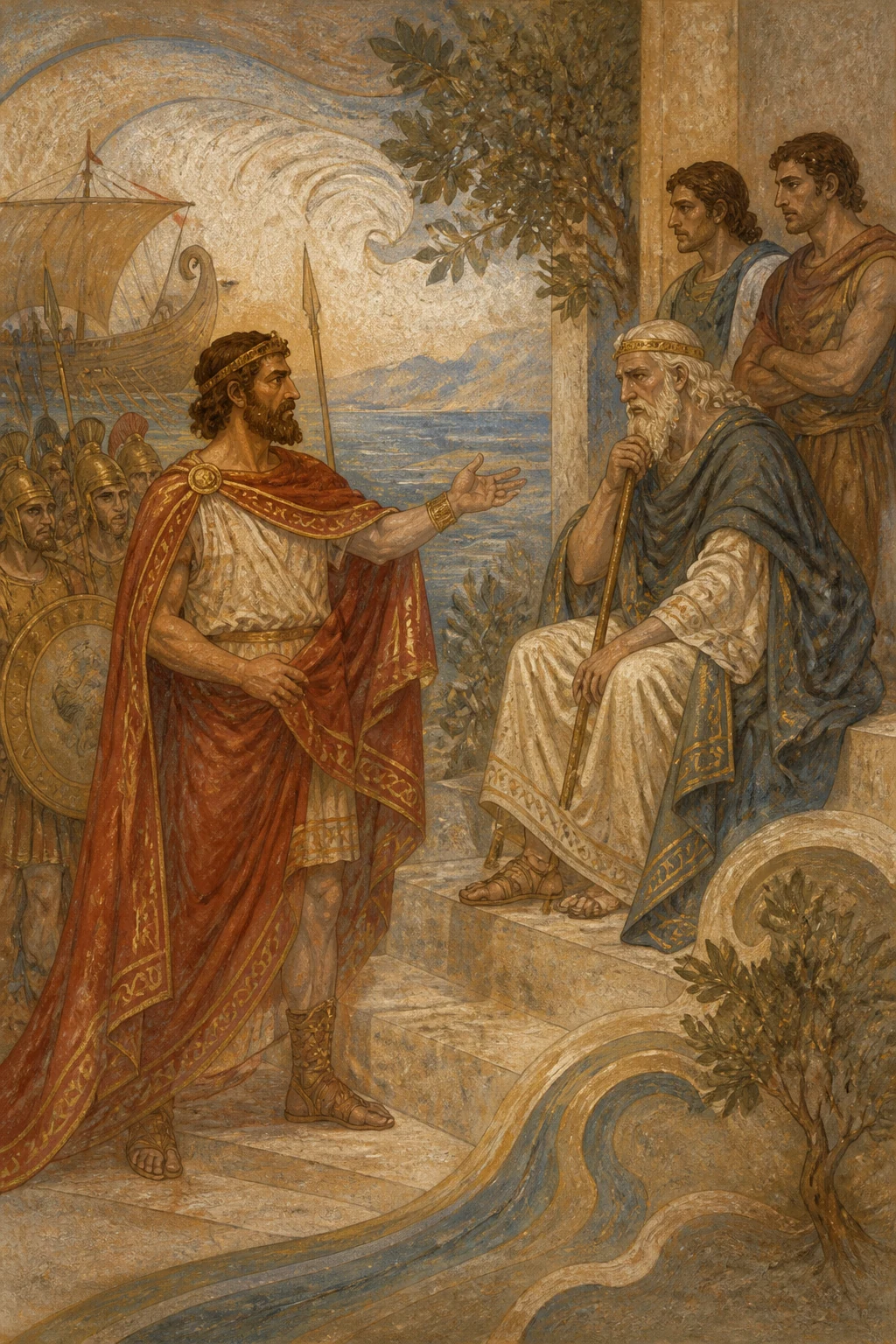
But Oliaros, Didymae, Tenos, Andros, Gyaros, and Peparethos, rich in shining olives, gave no help to the Cretan ships. Turning to the left, Minos made for Oenopia, the kingdom of Aeacus. Oenopia was its ancient name, but Aeacus himself had called it Aegina after his mother. A crowd rushed out, eager to see a man of such renown. Telamon came to meet him, with Peleus, younger than Telamon, and the third son, Phocus.
Aeacus himself came out as well, moving slowly under the burden of old age, and asked what brought him there. Reminded of his grief as a father, the ruler of a hundred peoples sighed and answered: “Help me, I beg you, in the war I have undertaken for my son; share in this righteous campaign. I ask solace for his tomb.” The grandson of Asopus replied, “Your request is vain: my city cannot grant it. No land is bound more closely to the people of Athens than this one: such is our treaty.”
Minos departed in anger. “Your treaty will cost you dear,” he said, thinking it wiser to threaten war than to wage it and waste his strength there beforehand. The Cretan fleet could still be seen from Oenopia’s walls when an Attic ship, speeding under full sail, arrived and entered the friendly harbour, bearing Cephalus and a message from his country. Though they had not seen him for many years, Aeacus’ young sons recognized Cephalus, clasped his hand, and led him to their father’s house. The distinguished hero, still bearing traces of his former beauty, entered with a branch of his country’s olive in his hand,
flanked on either side by two younger men, Clytus and Butes, sons of Pallas. When the first words of greeting had been exchanged, Cephalus delivered the Athenians’ message and asked for help, recalling their treaty and their fathers’ bonds, and adding that all Greece’s sovereignty was at stake. When his eloquence had thus supported the cause entrusted to him, Aeacus, his left hand resting on the sceptre’s hilt, said, “Athens, do not ask for help: take it.
Count without hesitation all this island’s strength your own. It has all you need—such is my kingdom’s condition. Strength is not lacking: I have soldiers enough for my enemy and to spare. Thanks be to the gods, these are happy times, leaving no excuse to refuse.” “May it indeed be so,” said Cephalus. “May your city grow in citizens! Only now, as I arrived, I rejoiced to see such handsome young men, so alike in age, coming out to meet me. Yet I miss many among them whom I saw when your city welcomed me before.”
Aeacus groaned and answered in a sorrowful voice: “A happier fortune followed a beginning steeped in tears. If only I could tell you of the one without the other! Now I shall recount it all in order. To spare you a long preamble: those whom you remember and ask after lie as bones and ashes. And how small a part they were of all I lost! A dreadful plague fell upon my people through cruel Juno’s anger: she hated this land because it bore her rival’s name.
While the sickness seemed a natural one, and the deadly cause of such destruction remained hidden, we fought it with the physician’s art. Death overwhelmed our remedies, which lay defeated. First, the sky pressed down upon the earth in a thick haze, trapping a stifling heat beneath the clouds; and while the moon four times joined her horns into a circle and four times waned, unweaving her full orb, hot south winds breathed their deadly blasts.
It is certain, too, that the springs and pools were poisoned, and many thousands of snakes wandered through the untilled fields, tainting the rivers with their venom. The sudden sickness first revealed its power in the slaughter of dogs, birds, sheep, and cattle, and among the wild beasts. The wretched ploughman watched in wonder as his sturdy oxen collapsed at their work and sank down halfway through the furrow; the woolly flocks gave feeble bleats, their fleeces fell away unbidden, and their bodies wasted.
The horse, once spirited and famous on the dusty course, betrayed his victories; forgetful of his former honours, he groaned beside his manger, doomed to an inglorious death. The boar forgot his fury, the hind her trust in speed, and bears no longer charged the sturdy herds. Weakness possessed them all. In woods and fields and roads foul carcasses lay, corrupting the air with their stench.
Strange to tell, no dogs or hungry birds, no grey wolves touched them. They dissolved into putrid slime, their reek spreading harm and carrying infection far and wide. The plague reached the wretched farmers with yet heavier losses, and ruled within the walls of the great city. First the inward organs burned; a flush betrayed the hidden fire, and breath came deep and laboured.
The tongue grew rough and swollen; parched mouths gaped in the warm winds, gasping for the oppressive air. They could bear neither bedding nor any covering, but laid their chests against the hard earth. Their bodies were not cooled by the ground: the ground grew hot from them. No one could check it. The savage scourge broke out against the healers themselves; their art brought them harm.
The nearer anyone came, the more faithfully he served the sick, the sooner he shared their death. When hope of recovery was gone, and they saw that only death could end the sickness, they indulged their desires, caring nothing for what might help: nothing could help. Everywhere, abandoning shame, they clung to springs and rivers and deep wells, and drinking quenched their lives before it quenched their thirst.
Many, too weak to rise, died there in the water itself; yet others drank that water too. So unbearable to the sufferers was the hateful bed that they sprang from it, or, if too weak to stand, rolled their bodies to the ground. Each fled his own home, each thought his own house fatal, and, since the cause was hidden, blamed the narrowness of the place. You might have seen them wandering half-dead through the streets, while they could stand; others wept, or lay upon the ground, turning their weary eyes in one last movement.
They stretched their arms towards the stars of the overarching sky, breathing out their lives here and there, wherever death overtook them. What were my feelings then? What should they have been, but to loathe life and long to share my people’s fate? Wherever I turned my gaze, there lay my people, like rotten apples falling from shaken branches, or acorns from a jolted oak.
You see the temple opposite, raised high on its long flight of steps: it belongs to Jupiter. Who did not offer fruitless incense on those altars? How often, while husband prayed for wife, or father for his son, did the suppliant breathe his last upon the unrelenting altar, with a portion of unburnt incense still found in his hand! How often, when bulls were brought to the temple, while the priest formed his prayer and poured pure wine between their horns, did they fall before the blow could strike!
I myself was sacrificing to Jupiter for me, my country, and my three sons, when the victim gave a dreadful bellow and suddenly collapsed without a stroke, staining the knives beneath it with a scant flow of blood. Even the diseased entrails had lost the signs of truth and the gods’ warnings: the cruel sickness pierced to their very depths. I saw corpses cast before the sacred doors, even before the altars, as though to make death more hateful still.
Some ended their lives with a noose, escaping the fear of death through death, and willingly summoned their approaching fate. The bodies of the dead were no longer carried out with customary rites: the gates could not hold so many funeral trains. Some lay upon the earth unburied; others were given to towering pyres without their funeral gifts. All reverence was gone: people fought over pyres, and burned upon another’s fire.
There were none left to mourn. Unwept, the souls of mothers, brides, young men, and old wandered abroad; there was no room for graves, no wood enough for fires. Stunned by this terrible whirlwind of disaster, I cried, ‘O Jupiter, if the story is not false that you lay in the arms of Aegina, daughter of Asopus, and if, great father, you are not ashamed to be my parent, either restore my people to me, or bury me as well.’ He gave a sign with lightning and a favourable peal of thunder.
‘I accept it,’ I said. ‘Let these be happy signs, I pray, of your purpose. I claim the omen you have given me.’ Nearby there happened to stand an oak with widely spreading branches, sacred to Jupiter, sprung from Dodona’s stock. There I saw grain-gathering ants in a long procession, carrying great burdens in their tiny mouths, keeping to their pathway over the rugged bark.
Marvelling at their numbers, I said, ‘Most gracious father, give me as many citizens, and fill my empty city.’ The tall oak trembled, and its branches rustled though no wind stirred them. My limbs shuddered with fear, and my hair stood on end. Yet I kissed the earth and the oak, and would not admit to hope; still I hoped, and cherished my prayer within my heart. Night came, and sleep took hold of my body, worn out with cares. Before my eyes the same oak seemed to stand, bearing as many branches, and on those branches as many creatures as before. It trembled with the same motion, scattering the grain-bearing column over the fields below.
Suddenly they seemed to grow, becoming larger and larger, rising from the ground and standing with their bodies upright, shedding their leanness, their many legs, their black colour, and clothing their limbs in human shape. Sleep left me. Awake, I condemned my vision and complained that there was no help in heaven. Yet a great murmur filled the house, and I seemed to hear human voices, a sound now strange to me. While I suspected these too were part of my dream, Telamon hurried in, threw open the doors, and cried, ‘Father, you will see something beyond hope or belief. Come out!’ I went out, and there, just as I had seemed to see them in my dream, stood men
in ordered ranks. I looked and knew them. They approached and hailed me king. I paid my vows to Jupiter, and shared among my new people the city and the fields their former farmers had left empty. I called them Myrmidons, giving their name its rightful origin. You have seen their bodies; the habits they had before they still retain: they are thrifty, enduring in toil, tenacious of what they gain, and careful to preserve it.
These men, alike in age and courage, will follow you to war as soon as the east wind that brought you safely here” —for an east wind had brought him—“has changed to a southerly.”
Izvirnik
The Plague of Aegina and the Myrmidons
Naslednje strani prikazujejo izvirno besedilo za primerjavo.
Source ID: ovid_metamorphoses_story_050 Citation: Ovid, Metamorphoses 7.453-7.660 Original language: Latin Source: PerseusDL canonical-latinLit Source URL: https://github.com/PerseusDL/canonical-latinLit/blob/master/data/phi0959/phi006/phi0959.phi006.perseus-lat2.xml Segmentation certainty: medium 453: Nec tamen (usque adeo nulla est sincera voluptas, 454: sollicitumque aliquid laetis intervenit) Aegeus 455: gaudia percepit nato secura recepto.
456: Bella parat Minos. Qui quamquam milite, quamquam 457: classe valet, patria tamen est firmissimus ira 458: Androgeique necem iustis ulciscitur armis. 459: Ante tamen bello vires adquirit amicas, 460: quaque potens habitus, volucri freta classe pererrat. 461: Hinc Anaphen sibi iungit et Astypaleia regna, 462: promissis Anaphen, regna Astypaleia bello; 463: hinc humilem Myconum cretosaque rura Cimoli 464: florentemque thymo Cythnum parvamque Seriphon 465: marmoreamque Paron, quaque impia prodidit Arnen 466: Sithonis (accepto, quod avara poposcerat, auro 467: mutata est in avem, quae nunc quoque diligit aurum,
468: nigra pedes, nigris velata monedula pennis). 469: At non Oliaros Didymaeque et Tenos et Andros 470: et Gyaros nitidaeque ferax Peparethos olivae 471: Gnosiacas iuvere rates. Latere inde sinistro 472: Oenopiam Minos petit, Aeacideia regna: 473: Oenopiam veteres appellavere, sed ipse 474: Aeacus Aeginam genetricis nomine dixit. 475: Turba ruit tantaeque virum cognoscere famae 476: expetit. Occurrunt illi Telamonque, minorque 477: quam Telamon Peleus, et proles tertia Phocus.
478: Ipse quoque egreditur tardus gravitate senili 479: Aeacus, et quae sit veniendi causa requirit. 480: Admonitus patrii luctus suspirat et illi 481: dicta refert rector populorum talia centum: 482: “Arma iuves oro pro gnato sumpta piaeque 483: pars sis militiae; tumulo solacia posco.” 484: Huic Asopiades “petis inrita” dixit “et urbi 485: non facienda meae: neque enim coniunctior ulla 486: Cecropidis hac est tellus: ea foedera nobis.”
487: Tristis abit “stabunt” que “tibi tua foedera magno” 488: dixit et utilius bellum putat esse minari 489: quam gerere atque suas ibi praeconsumere vires. 490: Classis ab Oenopiis etiamnum Lyctia muris 491: spectari poterat, cum pleno concita velo 492: Attica puppis adest in portusque intrat amicos, 493: quae Cephalum patriaeque simul mandata ferebat. 494: Aeacidae longo iuvenes post tempore visum 495: agnovere tamen Cephalum dextrasque dedere 496: inque patris duxere domum. Spectabilis heros 497: et veteris retinens etiamnum pignera formae 498: ingreditur ramumque tenens popularis olivae
499: a dextra laevaque duos aetate minores 500: maior habet, Clyton et Buten, Pallante creatos. 501: Postquam congressus primi sua verba tulerunt, 502: Cecropidae Cephalus peragit mandata rogatque 503: auxilium foedusque refert et iura parentum 504: imperiumque peti totius Achaidos addit. 505: Sic ubi mandatam iuvit facundia causam, 506: Aeacus, in capulo sceptri nitente sinistra, 507: “ne petite auxilium, sed sumite”, dixit “Athenae; 508: nec dubie vires, quas haec habet insula, vestras 509: ducite; et omnia habet (rerum status iste mearum).
510: Robora non desunt, superat mihi miles et hosti: 511: gratia dis, felix et inexcusabile tempus.” 512: “Immo ita sit,” Cephalus, ”crescat tua civibus opto 513: urbs!” ait. “Adveniens equidem modo gaudia cepi, 514: cum tam pulchra mihi, tam par aetate iuventus 515: obvia processit. Multos tamen inde requiro, 516: quos quondam vidi vestra prius urbe receptus.” 517: Aeacus ingemuit tristique ita voce locutus: 518: ”Flebile principium melior fortuna secuta est.
519: Hanc utinam possem vobis memorare sine illo! 520: Ordine nunc repetam. Neu longa ambage morer vos: 521: ossa cinisque iacent, memori quos mente requiris. 522: Et quota pars illi rerum periere mearum! 523: Dira lues ira populis Iunonis iniquae 524: incidit exosae dictas a paelice terras. 525: Dum visum mortale malum tantaeque latebat 526: causa nocens cladis, pugnatum est arte medendi: 527: exitium superabat opem, quae victa iacebat.
528: Principio caelum spissa caligine terras 529: pressit et ignavos inclusit nubibus aestus; 530: dumque quater iunctis explevit cornibus orbem 531: luna, quater plenum tenuata retexuit orbem, 532: letiferis calidi spirarunt aestibus austri. 533: Constat et in fontes vitium venisse lacusque, 534: miliaque incultos serpentum multa per agros 535: errasse atque suis fluvios temerasse venenis.
536: Strage canum primo volucrumque oviumque boumque, 537: inque feris subiti deprensa potentia morbi. 538: Concidere infelix validos miratur arator 539: inter opus tauros medioque recumbere sulco; 540: lanigeris gregibus balatus dantibus aegros 541: sponte sua lanaeque cadunt et corpora tabent. 542: Acer equus quondam magnaeque in pulvere famae 543: degenerat palmas veterumque oblitus honorum 544: ad praesepe gemit leto moriturus inerti.
545: Non aper irasci meminit, non fidere cursu 546: cerva, nec armentis incurrere fortibus ursi. 547: Omnia languor habet; silvisque agrisque viisque 548: corpora foeda iacent, vitiantur odoribus aurae. 549: Mira loquar: non illa canes avidaeque volucres, 550: non cani tetigere lupi; dilapsa liquescunt 551: adflatuque nocent et agunt contagia late. 552: Pervenit ad miseros damno graviore colonos 553: pestis et in magnae dominatur moenibus urbis.
554: Viscera torrentur primo, flammaeque latentis 555: indicium rubor est et ductus anhelitus ingens. 556: Aspera lingua tumet, tepidisque arentia ventis 557: ora patent, auraeque graves captantur hiatu. 558: Non stratum, non ulla pati velamina possunt, 559: dura sed in terra ponunt praecordia; nec fit 560: corpus humo gelidum, sed humus de corpore fervet. 561: Nec moderator adest, inque ipsos saeva medentes 562: erumpit clades, obsuntque auctoribus artes: 563: quo propior quisque est servitque fidelius aegro, 564: in partem leti citius venit. Utque salutis 565: spes abiit finemque vident in funere morbi,
566: indulgent animis et nulla, quid utile, cura est: 567: utile enim nihil est. Passim positoque pudore 568: fontibus et fluviis puteisque capacibus haerent, 569: nec sitis est exstincta prius quam vita bibendo. 570: Inde graves multi nequeunt consurgere et ipsis 571: inmoriuntur aquis: aliquis tamen haurit et illas. 572: Tantaque sunt miseris invisi taedia lecti: 573: prosiliunt, aut si prohibent consistere vires, 574: corpora devolvunt in humum: fugiuntque penates 575: quisque suos, sua cuique domus funesta videtur, 576: et quia causa latet, locus est in crimine parvus 577: Semianimes errare viis, dum stare valebant,
578: adspiceres, flentes alios terraque iacentes 579: lassaque versantes supremo lumina motu: 580: membraque pendentis tendunt ad sidera caeli, 581: hic illic, ubi mors deprenderat, exhalantes. 582: Quid mihi tunc animi fuit? an quod debuit esse, 583: ut vitam odissem et cuperem pars esse meorum? 584: Quo se cumque acies oculorum flexerat, illic 585: vulgus erat stratum, veluti cum putria motis 586: poma cadunt ramis agitataque ilice glandes.
587: Templa vides contra gradibus sublimia longis: 588: Iuppiter illa tenet. Quis non altaribus illis 589: inrita tura dedit? Quotiens pro coniuge coniunx, 590: pro gnato genitor dum verba precantia dicit, 591: non exoratis animam finivit in aris, 592: inque manu turis pars inconsumpta reperta est! 593: Admoti quotiens templis, dum vota sacerdos 594: concipit et fundit purum inter cornua vinum, 595: haud exspectato ceciderunt vulnere tauri!
596: Ipse ego sacra Iovi pro me patriaque tribusque 597: cum facerem natis, mugitus victima diros 598: edidit et subito conlapsa sine ictibus ullis 599: exiguo tinxit subiectos sanguine cultros. 600: Exta quoque aegra notas veri monitusque deorum 601: perdiderant: tristes penetrant ad viscera morbi. 602: Ante sacros vidi proiecta cadavera postes, 603: ante ipsas, quo mors foret invidiosior, aras.
604: Pars animam laqueo claudunt mortisque timorem 605: morte fugant ultroque vocant venientia fata. 606: Corpora missa neci nullis de more feruntur 607: funeribus: neque enim capiebant funera portae. 608: Aut inhumata premunt terras aut dantur in altos 609: indotata rogos. Et iam reverentia nulla est, 610: deque rogis pugnant alienisque ignibus ardent. 611: Qui lacriment, desunt; indefletaeque vagantur 612: matrumque nuruumque animae iuvenumque senumque: 613: nec locus in tumulos, nec sufficit arbor in ignes.
614: Attonitus tanto miserarum turbine rerum, 615: “Iuppiter o!” dixi “si te non falsa loquuntur 616: dicta sub amplexus Aeginae Asopidos isse, 617: nec te, magne pater, nostri pudet esse parentem, 618: aut mihi redde meos aut me quoque conde sepulcro.” 619: Ille notam fulgore dedit tonitruque secundo. 620: “Accipio, sintque ista, precor, felicia mentis 621: signa tuae” dixi. “Quod das mihi, pigneror omen.”
622: Forte fuit iuxta patulis rarissima ramis 623: sacra Iovi quercus de semine Dodonaeo: 624: hic nos frugilegas adspeximus agmine longo 625: grande onus exiguo formicas ore gerentes 626: rugosoque suum servantes cortice callem. 627: Dum numerum miror, “totidem, pater optime” dixi, 628: “tu mihi da cives et inania moenia supple.” 629: Intremuit ramisque sonum sine flamine motis 630: alta dedit quercus. Pavido mihi membra timore 631: horruerant, stabantque comae. Tamen oscula terrae 632: roboribusque dedi; nec me sperare fatebar: 633: sperabam tamen atque animo mea vota fovebam.
634: Nox subit, et curis exercita corpora somnus 635: occupat: ante oculos eadem mihi quercus adesse 636: et ramos totidem totidemque animalia ramis 637: ferre suis visa est pariterque tremiscere motu 638: graniferumque agmen subiectis spargere in arvis; 639: crescere quod subito et maius maiusque videri 640: ac se tollere humo rectoque adsistere trunco 641: et maciem numerumque pedum nigrumque colorem 642: ponere et humanam membris inducere formam.
643: Somnus abit: damno vigilans mea visa querorque 644: in superis opis esse nihil. At in aedibus ingens 645: murmur erat, vocesque hominum exaudire videbar 646: iam mihi desuetas. Dum suspicor has quoque somni 647: esse, venit Telamon properus, foribusque reclusis 648: “speque fideque, pater” dixit, “maiora videbis: 649: egredere!” Egredior, qualesque in imagine somni 650: visus eram vidisse viros, ex ordine tales 651: adspicio noscoque. Adeunt regemque salutant.
652: Vota Iovi solvo populisque recentibus urbem 653: partior et vacuos priscis cultoribus agros, 654: Myrmidonasque voco, nec origine nomina fraudo. 655: Corpora vidisti; mores quos ante gerebant, 656: nunc quoque habent: parcum genus est patiensque laborum 657: quaesitique tenax et quod quaesita reservet. 658: Hi te ad bella pares annis animisque sequentur, 659: cum primum qui te feliciter attulit, eurus” 660: (eurus enim attulerat) “fuerit mutatus in austros.”
Nadaljuj z branjem