Waltey
Kaplja voska
Cuentos antiguos
Cuentos de Navidad, de la patria y antiguos · Emilia Pardo BazánO besedilu
Kaplja voska
- Vir
- Cuentos de Navidad, de la patria y antiguos
- Avtor
- Emilia Pardo Bazán
- Jezik branja
- English
- Jezik izvirnika
- Español
- Čas branja
- 8 min branja
- Obseg
- 7 strani
- Naslov izvirnika
- 032 La gota de cera
O izvirniku
Cuentos de Navidad, de la patria y antiguos
Sedemintrideset avtorskih zgodb v treh zgodovinskih knjižnih skupinah. Bralni jezik je English, izvirnik pa prihaja iz vira Cuentos de Navidad, de la patria y antiguos v jeziku Español.
Besedilo
Kaplja voska
Though historians scarcely mention him, Higinio was one of Alexander the Great’s closest friends. Perhaps Higinio goes unmentioned because he did not meet the tragic fate of Philotas, of Parmenion, or of that Cleitus whom Alexander loved so dearly and yet, in a drunken revel, ran clean through. And yet—unless the documents discovered by the learned Julius Tiefenlehrer are false—Higinio enjoyed the utmost intimacy with the conqueror of Persia, as the events I am about to relate will show, relying, of course, on the most venerable authority of the German scholar just named.
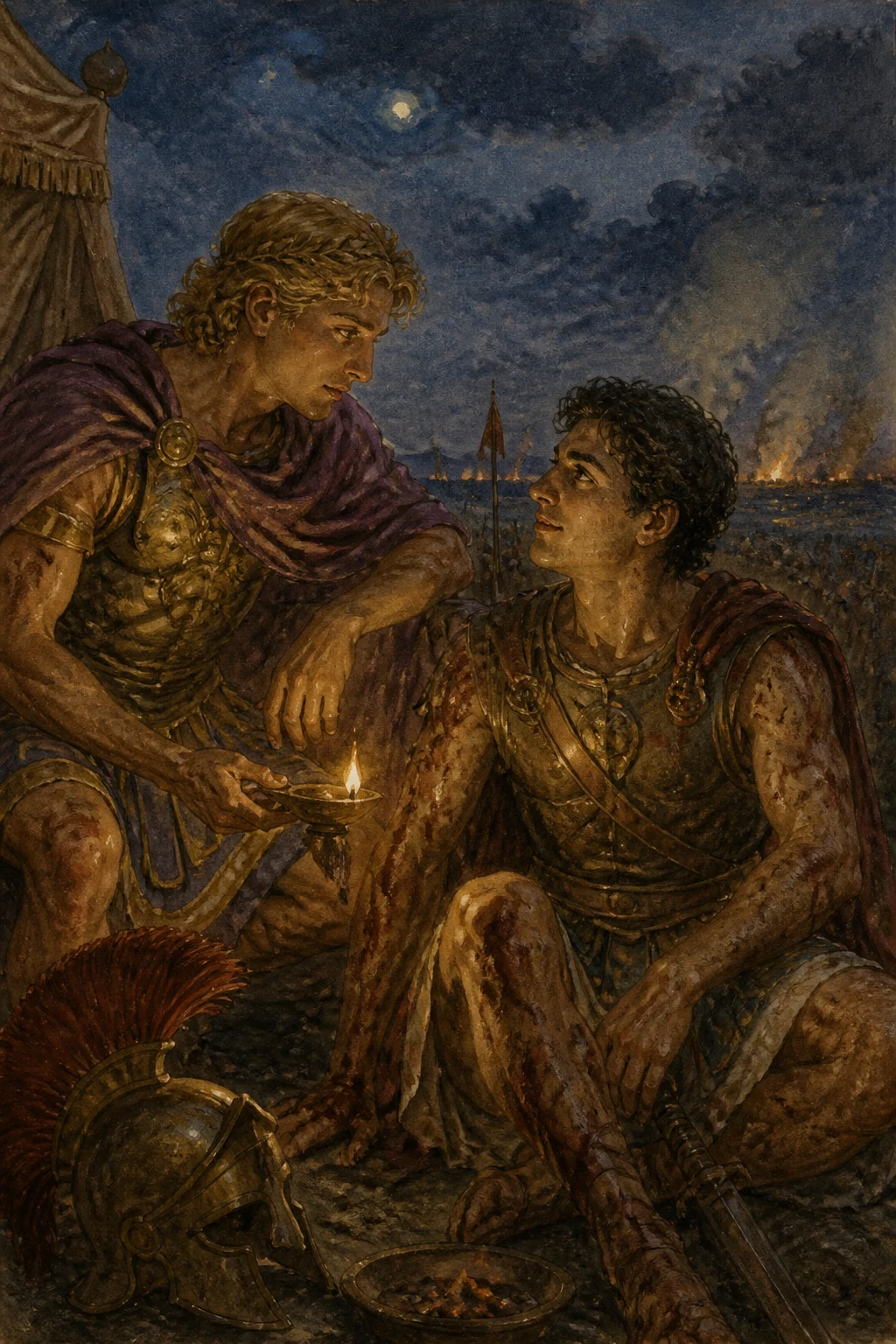
Alexander’s childhood companion, Higinio grew up alongside the hero. Together they played and bathed at Pella, in the pools of Olympias’s garden, and together they listened to Aristotle’s lessons. They tasted the milk and honey of wisdom, one might say, from the same dish; and from the same chalice they drank the nectar of love when they scattered the petals of their first garland of roses and myrtle at Corinth, in the house of the charming courtesan Ismeria. Their affection was more deeply sealed when they fought side by side on the memorable day of Chaeronea, which left all Greece in the hands of Philip, Alexander’s father. The two friends, then nearing nineteen, commanded the army’s left wing and utterly destroyed the renowned Sacred Band of Thebes. On the night following that splendid victory, Higinio might have become a general: Alexander offered him the rank, with lavish praise for his courage. But Higinio, still covered in blood, sweat, and dust, gently answered the offers of his friend and prince:
“I will not accept a general’s command, for, having acquitted myself well today, such a reward and so lofty a rank would bind me in conscience to do still better on whatever occasions might follow, and I cannot undertake to wake each morning with greater courage and better fortune. Besides, what I gather from the teachings of our master Aristotle is that a man should ordinarily live in peace, not war. I have proved that I am no coward. A man who has fought at your side at Chaeronea has earned the right to plant a laurel in the sacred grove of Mars. Spare me battles and give me some other place near you, Alexander, for I love you well and will serve you faithfully.”
Alexander, whose blood seethed with a thirst for battles and glory, reluctantly yielded to Higinio’s wishes and appointed him his chief cupbearer. It was an exceedingly easy post and one of great trust, for its duties consisted in guarding and serving the golden cup reserved for the prince, so that no one could put poison into it. Higinio’s office allowed him constant intercourse with Alexander, and when the latter ascended the throne, succeeding his father, who had been murdered by Pausanias, the courtiers predicted a brilliant career for Higinio. Those forecasts were soon disproved: Higinio continued to present, retrieve, and guard the now royal cup, neither meddling in intrigues nor aspiring to greater honors.
Meanwhile, Alexander astonished the world with his campaigns and victories, offering Greece, in compensation for her lost freedom, radiant pages for her history.
Holding the barbarians at bay and subjugating the vast empire of Asia, Alexander soon found himself master of the world. After laying out the site of Alexandria and entering Babylon and Ecbatana in triumph, Philip’s son proclaimed himself the son of Jupiter and decreed his own apotheosis. Higinio—who had long ceased to converse with his king, confining himself to serving him his cup in silence—was awakened late one night at Alexander’s command and summoned to his bedside. The newly minted deity could not sleep and was calling for care and comfort...
“My lord,” said Higinio, “I am glad to be able to speak to you without witnesses, as in the old days. Indeed, I had been wishing to ask your leave to quit your service and retire to my little house in Attica, where I have olive trees and beehives.”
“A fine moment you choose to abandon me!” Alexander exclaimed furiously. “For the very thought, you deserve to be crucified at my command! Do you want riches? Ask for whatever you please... But leave me? Do not dream of it! And where does this fancy come from?”
“Since you ask,” replied Higinio, “you shall know. I was the friend and servant of a man, but now it seems that man has become a god. I have no calling to the priesthood. Since you rose to become the son of Jupiter Ammon and brother of Apollo, you fill me with fear and chill my affection. The Alexander I loved no longer exists. He has ascended to Olympus. He is immortal; I am mortal. We no longer understand one another. Besides, the conception I have formed of a god, according to Aristotle’s sublime doctrine...”
“Aristotle again!” interrupted the conqueror. “If I get my hands on him, I certainly will crucify him! And high up, so everyone can see!” “Crucify him, but listen. Let us leave Aristotle aside and suppose that you are indeed a god. Well, if you are a god, I cannot commit sacrilege; I cannot go on poisoning you.”
“You, poisoning me?” cried Alexander, jerking upright on his ivory bed inlaid with gold. “Now I understand why a constant fire scorches my veins; now I understand why my only rest is a dreadful stupor; now I can account for the visions and nightmares that assail me at night and drench my temples in cold sweat! You, poisoning me!” And with a sudden rush of tenderness, he sighed. “And why do you wish me dead—you, my childhood friend, my brother in arms at Chaeronea?”
Deeply moved, Higinio threw himself at Alexander’s feet, and Alexander opened his arms. The two friends pressed their faces together, their hair mingling, and the cupbearer spoke in a very different tone from before:
“My lord, my dear beloved, if I poison you, it is against my will and at your command... Those visions, those torments you complain of, spring from the double drunkenness in which you live: you are drunk on power and aged wine... Once you asked me for the cup only two or three times at each meal; since Asia infected you with its luxury and vices, my hands ache from taking back the empty cup and holding it out to you brimming... Your soul has grown troubled, madness hovers about you, you are becoming accustomed to cruelty, you wound those loyal to you, and you will die young, with no one needing to stab you as they did your father. I will not be an accomplice, and I am leaving.”
Alexander, deep in thought, went on clasping his friend’s neck and head to his breast. “You are right, my beloved,” he murmured at last with generous sincerity. “But the habit of drinking has taken root in me, and if I do not drink, I fall to pieces. What am I to do? Advise me.”
“I cannot,” Higinio declared, “cure your drunkenness with power, but I shall try to save you from the other kind without depriving you of your pleasure. Trust me, and you shall see.”
And indeed, in the days following this conversation, Alexander went on drinking as many brimming cups as ever. Nevertheless, little by little, he noticed with pleasure a great improvement. Gradually his head cleared, his nerves grew calm, strength returned to his limbs and joy to his spirit. Vast plans ripened in his mind; superhuman enterprises teemed in his heroic imagination. Amazed and overjoyed, he asked Higinio for the secret, but Higinio would not reveal it. A certain Arsotas, however, a Persian jester, flattering and effeminate, who greatly amused the king, gave him the key to the mystery.
“Your chief cupbearer, O divine Alexander, puts a drop of wax into the bottom of your cup every day. Thus, imperceptibly, he reduces its capacity and curtails your libations. Each day you drink one drop less. The brazen Higinio dares to deceive his sovereign and diminish his pleasures!”
Alexander was astonished; then his astonishment turned to anger. To treat him like a little boy! To dupe him with such a trick! Ah, he would not stand for it. Who did Higinio think he was? And one morning he ordered the cup inspected and cleaned, and that afternoon he instituted his famous contests in intemperance, wagering on his drinking against the greatest wine-soaks in his army. Higinio then disappeared; he probably retired to Attica. As for Alexander, everyone knows the occasion and manner of his death: after draining, with boastful bravado, not his own cup but the enormous one called the Cup of Hercules, he gave a cry and collapsed. The fever that seized him then and there carried him out of this world at thirty-two years of age, in the fullness of life and glory.
Izvirnik
032 La gota de cera
Naslednje strani prikazujejo izvirno besedilo za primerjavo.
Aunque los historiadores apenas le nombran, Higinio fue de los más íntimos amigos de Alejandro Magno. No se menciona á Higinio, tal vez porque no tuvo la trágica suerte de Filotas, de Parmenion, y de aquel Clitos á quien Alejandro amaba entrañablemente, y á quien así y todo, en una orgía, atravesó de parte á parte; y sin embargo--si no mienten documentos descubiertos por el erudito Julius Tiefenlehrer--Higinio gozó de tanta privanza con el conquistador de Persia, como demostrarán los hechos que voy á referir, apoyándome, por supuesto, en la respetabilísima autoridad del sabio alemán antes citado.
Compañero de infancia de Alejandro, Higinio se crió con el héroe. Juntos jugaron y se bañaron en Pela, en los estanques del jardín de Olimpias, y juntos oyeron las lecciones de Aristóteles. La leche y la miel de la sabiduría la gustaron, así puede decirse, en un mismo plato; y en un mismo cáliz libaron el néctar del amor, cuando deshojaron la primer guirnalda de rosas y mirto en Corinto, en casa de la gentil hétera Ismeria. Grabó su afecto con sello más hondo el batirse juntos en la memorable jornada de Queronea, en la cual quedó toda Grecia por Filipo, padre de Alejandro. Los dos amigos, que frisaban en los diez y nueve años entonces, mandaron el ala izquierda del ejército, y destruyeron por completo la famosa legión sagrada de los tebanos. La noche que siguió á tan magnífica victoria, Higinio pudo haber conseguido el generalato; Alejandro se lo brindaba, con hartos elogios á su valor. Pero Higinio, cubierto aún de sangre, sudor y polvo, respondió dulcemente á los ofrecimientos de su amigo y príncipe:
--No acepto el generalato, porque habiéndome portado bien hoy, tal recompensa y tan alta dignidad me obligarían en conciencia á portarme todavía mejor en otras ocasiones que sobreviniesen, y no puedo comprometerme á amanecer cada día con más valor y más fortuna. Además, de las enseñanzas de nuestro maestro Aristóteles saco yo en limpio que el hombre, habitualmente, debe vivir en paz y no en guerra. Queda demostrado que no soy ningún medroso. El que ha combatido á tu lado en Queronea, ya tiene derecho á plantar un laurel en el sagrado bosque de Marte. Déjame de batallas y dame otro puesto cerca de ti, Alejandro, porque te quiero bien y te serviré fielmente.
Alejandro, cuya sangre hervía pidiendo luchas y glorias, se conformó mal de su grado á los deseos de Higinio, y le nombró su gran copero. Era cargo en extremo descansado y de alta confianza, pues sus funciones consistían en custodiar y servir la copa de oro reservada al príncipe, á fin de que nadie pudiese depositar en ella ponzoña. El oficio de Higinio le permitía vivir en constante comunicación con Alejandro, y cuando éste subió al trono, sucediendo á su padre, asesinado por Pausanias, los cortesanos auguraron á Higinio brillante carrera. Poco tardaron en verse desmentidos tales pronósticos: Higinio continuó presentando, recogiendo y custodiando la ya regia copa, sin mezclarse en intrigas ni aspirar á otras grandezas.
Mientras tanto, Alejandro asombraba al universo con sus campañas y triunfos, y ofrecía á Grecia, en compensación de la perdida libertad, páginas de luz para la historia.
Conteniendo á los bárbaros y sojuzgando el inmenso imperio del Asia, bien pronto se vió dueño del mundo Alejandro. Cuando, después de dejar trazado el emplazamiento de Alejandría, y de entrar vencedor en Babilonia y Ecbtana, el hijo de Filipo se declaró hijo de Júpiter y decretó su propia apoteosis, Higinio--que hacía mucho tiempo no departía con su rey, limitándose á servirle la copa en silencio--fue despertado á las altas horas de la noche de orden de Alejandro, que le llamaba á su cabecera. La recién hecha deidad no podía dormir, y reclamaba cuidados y consuelos...
--Señor--dijo Higinio,--celebro poder hablarte sin testigos, como antaño. Justamente deseaba rogarte que me consientas dejar tu servicio y retirarme á mi casita del Atica, donde poseo olivos y colmenas.
--¡Bonita ocasión escoges para abandonarme!--exclamó furioso Alejandro.--¡Por el intento merecerías que te mandase crucificar! ¿Deseas riquezas? Pide cuanto se te antoje... ¿Pero marcharte? Ni lo sueñes, ¿Y de dónde nace esa manía?
--Ya que lo preguntas--contestó Higinio,--lo vas á saber. Yo fuí amigo y servidor de un hombre, pero ahora parece que ese hombre se ha vuelto Dios. No tengo vocación al sacerdocio. Desde que has ascendido á hijo de Júpiter Hamnon, hermano de Apolo, me inspiras temor y frialdad. El Alejandro que yo amaba no existe. Ha ascendido al Olimpo. Él es inmortal, yo mortal. No nos entendemos. Por otra parte, la idea que me he formado de un Dios, según la sublime doctrina de Aristóteles...
--¡Dale con Aristóteles!--interrumpió el conquistador.--¡Como le atrape, á ese sí que le crucifico! ¡Y alto, para que todos le vean!
--Crucifica, pero escucha. Prescindamos de Aristóteles y supongamos que, en efecto, eres Dios. Pues si eres Dios, yo no puedo cometer sacrilegio; yo no puedo seguir envenenándote.
--¿Envenenarme tú?--gritó Alejandro incorporándose convulso sobre su lecho de marfil incrustado de oro.--¡Ahora comprendo por qué un fuego constante abrasa mis venas; ahora comprendo por qué no descanso sino en horrible modorra; ahora me explico las visiones y las pesadillas que de noche me asaltan y empapan mis sienes en sudor frío! ¡Envenenarme tú!--Y con súbito acceso de ternura suspiró.--¿Y por qué quieres mi muerte, tú, mi amigo de la niñez, mi hermano de armas en Queronea?
Higinio, conmovido, se arrojó á los pies de Alejandro, y éste abrió los brazos; los dos amigos juntaron sus rostros y mezclaron sus cabelleras, y el copero declaró en tono muy diverso del de antes:
--Señor, dulce amado mío, si te enveneno, es contra mi voluntad y por orden tuya... Esas visiones, esas torturas de que te quejas, proceden de la doble embriaguez en que vives: estás ebrio de poder y de vino añejo... Antes sólo me pedías la copa dos ó tres veces en cada comida; desde que el Asia te ha inoculado su molicie y sus vicios, me duelen las manos de tanto recoger la copa vacía y extendértela colmada... Tu alma se ha turbado, la demencia te ronda, te habitúas á la crueldad, hieres á tus leales y morirás joven, sin que nadie necesite pegarte una puñalada como á tu padre. No quiero ser cómplice, y me voy.
Alejandro, pensativo, seguía estrechando el cuello y la cabeza de su amigo contra el pecho.
--Tienes razón, amado--murmuró al fin con sinceridad generosa.--Pero el hábito de beber se ha arraigado en mí, y si no bebo, me caigo á pedazos. ¿Qué haré? Aconséjame.
--No puedo--declaró Higinio--curarte la borrachera del poder, pero trataré de salvarte de la otra sin que te prives de tu gusto. Fíate en mí y verás.
En efecto, los días que siguieron á esta conversación, Alejandro continuó bebiendo copas tan rebosantes y tantas en número como siempre. No obstante, poco á poco, notó con placer gran mejoría. Gradualmente se despejaba su cabeza, se tranquilizaban sus nervios, volvía á sus miembros el vigor y la alegría á su espíritu. Vastos planes maduraban en su cerebro, sobrehumanas empresas bullían en su imaginación heroica. Pasmado y enajenado preguntó á Higinio el secreto, sin que éste se prestase á revelarlo. Pero un cierto Arsotas, juglar persa, adulador y afeminado, que divertía mucho al rey, le dió la clave del enigma.
--Tu gran copero ¡oh divino Alejandro! echa cada día una gota de cera en el fondo de tu copa. Así, insensiblemente, reduce su cabida y acorta tus libaciones. Bebes cada día una gota menos. ¡El osado Higinio se atreve á engañar á su soberano y á cercenar sus deleites!
Quedó Alejandro sorprendido: después su sorpresa se convirtió en enojo. ¡Tratarle como á un chiquillo! ¡Embaucarle con un artificio así! ¡Ah! No lo consentiría. ¿Qué se figuraba Higinio? Y una mañana mandó registrar y limpiar la copa, y á la tarde estableció sus famosos certámenes de intemperancia, apostando á beber con los más pellejos de su ejército. Higinio entonces desapareció: probablemente se retiraría al Atica. En cuanto á Alejandro, nadie ignora la ocasión y modo de su muerte: después de vaciar, con alarde jactancioso, no su propia copa, sino la enorme llamada de Hércules, cayó redondo dando un grito. La fiebre que allí mismo se apoderó de él, le arrebató del mundo á los treinta y dos años de edad, en la plenitud de la vida y de la gloria.
Nadaljuj z branjem