Prevod
(He who resorts to unjust means to discredit another often discredits himself.) There was once a Canary who, having taken great pains to improve his singing, succeeded in delighting a number of music lovers and began to win applause. A foreign Nightingale of established reputation praised him warmly, encouraging him with his approval.
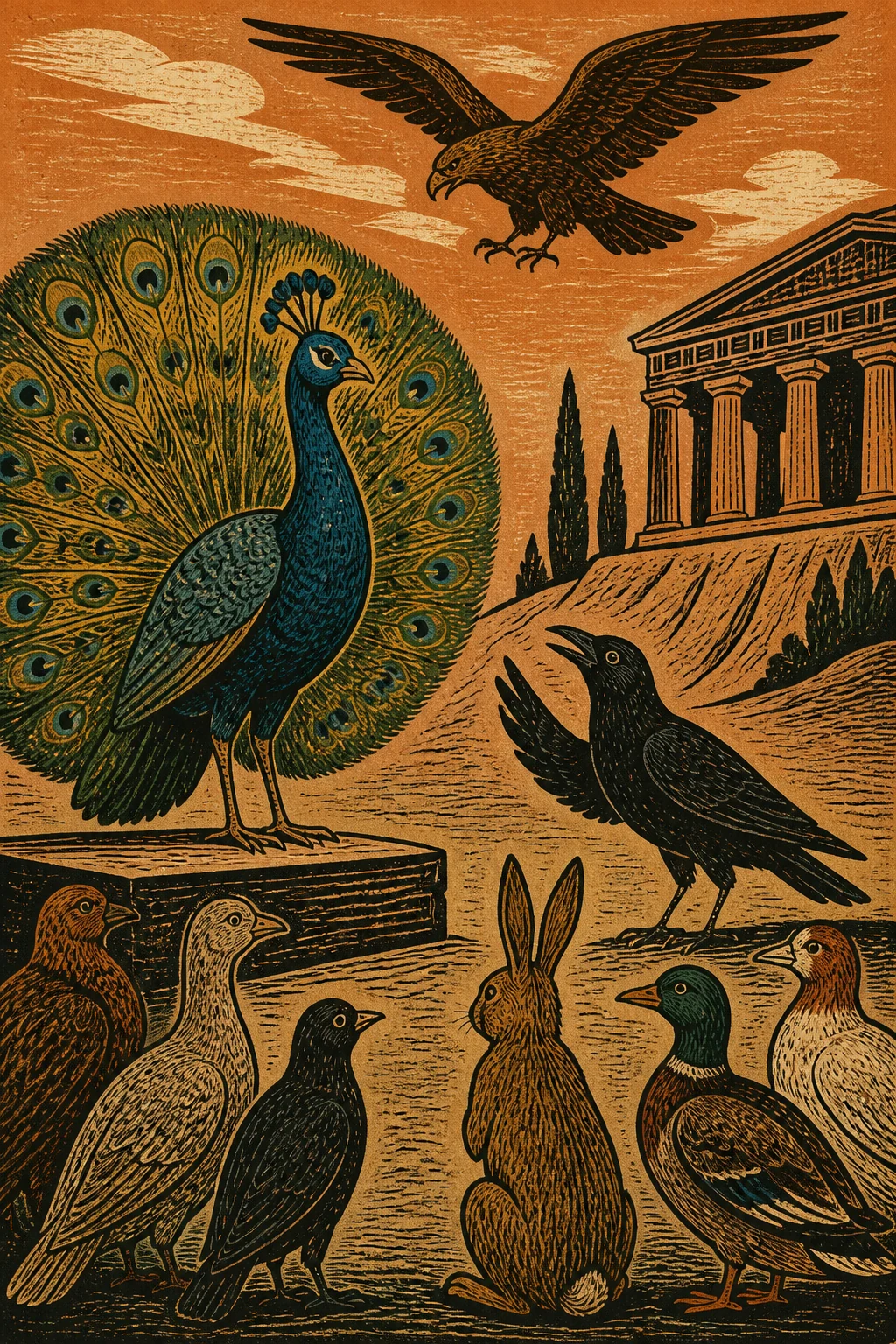
The standing the Canary gained, both through this favorable judgment and through the study he undertook to make himself worthy of it, aroused the envy of certain birds. Some of these also sang, well or ill, and persecuted him for that very reason. Others did not sing at all, and hated him on that account. At last a Rook, unable to distinguish himself by his own merits, sought fame by publicly railing against the Canary among the birds. He could not say what was faulty in the Canary’s singing, but thought it enough to discredit him by ridiculing the color of his feathers, the land of his birth, and so forth, accusing him without proof of things that had nothing to do with whether his singing was good or bad. A few ill-intentioned birds approved of what the Rook said and took up his cry.
The Rook set about proving to everyone that the bird they had hitherto regarded as a skillful Canary was nothing but a little donkey, and that what had passed for true music was in fact one long bray. “How extraordinary!” some said. “The Canary brays; the Canary is a donkey.” Word of this strange new marvel spread among the animals, who came to see how a Canary had turned into an ass. The Canary, weary of it all, no longer wished to sing, until the Eagle, queen of the birds, ordered him to do so, to discover whether he really brayed or not; for if he did indeed bray, she wished to exclude him from the ranks of her feathered subjects. The Canary opened his beak and sang to the delight of most of those present. Then the Eagle, indignant at the Rook’s slander, begged her lord, the god Jupiter, to punish him. The god granted her request and told the Eagle to order the Rook to sing. But when he tried to raise his voice, by divine decree he began to bray hideously. All the animals laughed and said: Justly has he turned into an ass who tried to make an ass of the Canary.
Izvirnik
(El que para desacreditar a otro recurre a medios injustos, suele desacreditarse a sí propio.)
Hubo un Canario que, habiéndose esmerado en adelantar en su canto, logró divertir con él a varios aficionados y empezó a tener aplauso. Un Ruiseñor extranjero, generalmente acreditado, hizo particulares elogios de él, animándole con su aprobación.
Lo que el Canario ganó, así con este favorable voto, como con lo que procuró estudiar para hacerse digno de él, excitó la envidia de algunos pájaros. Entre éstos había unos que también cantaban, bien o mal, y justamente por ello le perseguían. Otros nada cantaban, y por lo mismo le cobraron odio. Al fin un Grajo, que no podía lucir por sí, quiso hacerse famoso con empezar a chillar públicamente entre las aves contra el Canario. No acertó a decir en qué cosa era defectuoso su canto; pero le pareció que para desacreditarle bastaba ridiculizarle el color de la pluma, la tierra en que había nacido, etc., acusándole, sin pruebas, de cosas que nada tenían que ver con lo bueno o malo de su canto. Hubo algunos pájaros de mala intención que aprobaron y siguieron lo que dijo el Grajo.
Empeñóse éste en demostrar a todos que el que habían tenido hasta entonces por un Canario diestro en el canto, no era sino un borrico, y que lo que en él había pasado por verdadera música era en la realidad un continuado rebuzno. "¡Cosa rara! decían algunos; el Canario rebuzna; el Canario es un borrico." Extendióse entre los animales la fama de tan nueva maravilla, y vinieron a ver cómo un Canario se había vuelto burro. El Canario, aburrido, no quería ya cantar; hasta que el Águila, reina de las aves, le mandó que cantase para ver si en efecto rebuznaba o no; porque, si acaso era verdad que rebuznaba, quería excluirle del número de sus vasallos los pájaros. Abrió el pico el Canario, y cantó a gusto de la mayor parte de los circunstantes. Entonces el Águila, indignada de la calumnia que había levantado el Grajo, suplicó a su señor, el dios Júpiter, que le castigase. Condescendió el dios, y dijo al Águila que mandase cantar al Grajo. Pero cuando éste quiso echar la voz, empezó, por soberana permisión, a rebuznar horrorosamente. Riéronse todos los animales y dijeron: Con razón se ha vuelto asno el que quiso hacer asno al Canario.