Prevod
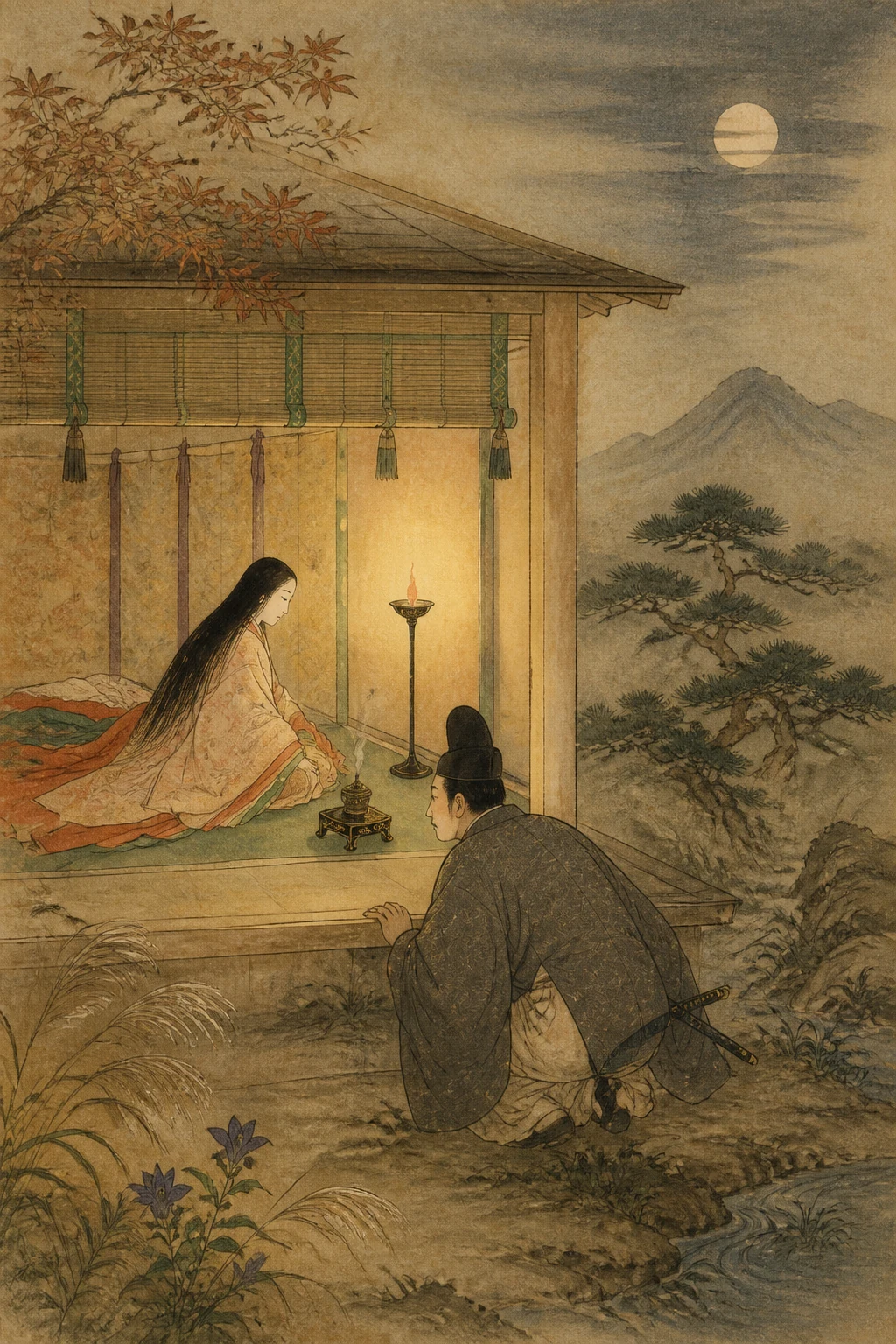
Long ago there lived a man who was an assistant captain of the Palace Guards. The chin cords of his cap were so long that people called him Akeo no Nushi, the Lord of the Long Cords. Among the fields near Nishi-Hachijō and Kyōgoku stood a single wretched little house. As he was passing it one day, a sudden shower broke over him, so he dismounted and went inside. He found a woman there alone. Bringing his horse in with him to wait out the rain, he sat down on a flat stone shaped rather like a small storage chest. As he sat idly tapping it with a pebble, he noticed that a hollow he had chipped into it shone gold. “What an extraordinary thing!” he thought. He smeared earth over the chipped place to hide it, then asked the woman, “What sort of stone is this?” “I could not say, sir,” she replied. “It has been here for years. A rich man’s house once stood here, and this hut is on the site of his storehouses.” Indeed, when he looked, he could see great foundation stones lying about. “As for the stone you are sitting on, sir, it was dug out of the ground when they were making ridges for a field where one of the storehouses had stood. Since it takes up room in the house, I have wanted to move it out of the way, but a woman has little strength, and there is no way I can shift it. So here it stays, much as I dislike it.” Hearing this, he thought, “I shall take this stone. If I leave it, someone with a sharp eye may discover what it is.” He said to the woman, “Then I will take it away for you.” “That would be a blessing, sir,” she answered. He sent to borrow an empty cart from a servant he knew in the neighborhood. Just as they were about to load the stone and carry it off, he took off his padded robe and gave it to the woman, feeling it would be sinful to take the stone for nothing. Fearing she might guess his purpose, he made a great bustle and said, “You women may think this stone is useless, but I have a use for it at home. Still, it would weigh on my conscience to take it without payment, so I am giving you this robe.” “Who could have dreamed of such a thing!” she exclaimed. “To receive so precious a robe, with such splendid padding, in exchange for a stone I have no use for—oh, it is too much!” She hung it on a pole and bowed before it with her hands together. He had the stone loaded onto the cart and went home. There he chipped pieces off it, little by little, and sold them to buy what he needed, obtaining great quantities of rice, money, figured silk, and other goods, until he became an exceedingly wealthy man. Now, north of the western stretch of Shijō and west of Kōkamon Gate, there was a broad, waterlogged tract, about a city block in extent, where no one lived. Thinking it would cost little to buy, he purchased it for a trifling sum. Its owner considered it a worthless marsh: no fields could be cultivated there, nor could a house be built. He thought anyone willing to pay even a little for it must be a most eccentric fellow, and gladly sold it. Having bought the marsh, Akeo no Nushi went to the province of Tsu, taking four or five boats with him, and made his way to the neighborhood of Naniwa. There he laid in a great supply of sake and rice gruel, and provided plenty of sickles as well. He called the passersby together and said, “Come and have some sake and gruel. In return, cut me a few of these reeds.” Delighted, they gathered round and cut reeds for him, some bringing four or five bundles, some ten, and others twenty or thirty. After three or four days of this, he had a mountain of reeds. He loaded them onto about ten boats and set out for the capital. Having laid in plenty of sake, he said to his men as they went upriver, “Rather than travel empty-handed, pull on the towropes.” Drinking the sake as they worked, they hauled the boats along and soon brought them to the mouth of the Kamo River. From there he hired carts, paying for their use, and had the reeds spread over the marsh. Then he hired laborers to heap earth on top, and built himself a house just as he wished. The block to the south belonged to a Grand Counselor named Minamoto no Sadamu; the northern block was the land Akeo no Nushi had filled in and built upon. This Grand Counselor Sadamu later bought it and joined the two properties into a single estate. That is the place now known as Nishinomiya. Thus the house was built with wealth founded upon the stone of gold that he had taken from the woman’s home.