Prevod
There was a young man who was studying to be a poet. He meant to become one by Easter, get married, and make his living by poetry, and that, he knew, was simply a matter of thinking things up—but he could not think of anything. He had been born too late; everything had been taken up before he came into the world, everything had been made into poetry and written about.
"Happy the people who were born a thousand years ago!" he said. "They could easily become immortal! Happy even those who were born a hundred years ago, when there was still something left to write poetry about. Now all the poetry has been written out of the world; what can I possibly write into it?"
He pondered this until he grew sick and poorly, the wretched fellow. No doctor could help him, but perhaps the wise woman could. She lived in the little house by the field gate, which she opened for people in carriages and on horseback; but she could open much more than the gate. She was wiser than the doctor who drove his own carriage and paid a tax on his rank.
"I must go out and see her!" said the young man. The house she lived in was small and neat, but dull to look at; there was not a tree, not a flower. A beehive stood outside the door—very useful! There was a little potato patch—very useful! And there was a ditch lined with blackthorn bushes, whose blossoms had fallen and given way to berries that pucker your mouth if you taste them before the frost has touched them.
"Here is a perfect picture of our unpoetic age!" thought the young man; and that, at least, was a thought, a grain of gold he had found at the wise woman's door.
"Write it down!" she said. "Crumbs are bread too! I know why you have come: you cannot think of anything, and yet you mean to be a poet by Easter!" "Everything has been written down!" he said. "Our times are not like the old days!"
"No!" said the woman. "In the old days wise women were burned, and poets went about with empty bellies and holes at their elbows. These are good times, the very best! But you have not the right eye for things, you have not sharpened your hearing, and I dare say you never say your Lord's Prayer at night. There is plenty here of every kind to make poetry and tell stories about, if you know how to tell them. You can draw it out of the plants and crops of the earth, scoop it up from running water and from still water; but you must know how, know how to catch a sunbeam. Now try on my spectacles, put my ear trumpet to your ear, then pray to Our Lord and stop thinking about yourself!"
That last was very difficult indeed, more than a wise woman could reasonably ask. He was given the spectacles and the ear trumpet, then placed in the middle of the potato patch. She put a large potato into his hand; a sound rang out from it, and there came a song with words, the history of the potatoes—interesting! An everyday story in ten parts; ten lines were enough.
And what did the potato sing? It sang of itself and its family: the arrival of the potatoes in Europe, the misunderstanding they had endured and suffered before they came to be acknowledged, as they were now, as a greater blessing than a lump of gold.
"By royal command we were handed out at the town hall in every town; proclamations were issued about our great importance, but people did not believe them and did not even understand how to plant us. One man dug a hole and threw his whole bushel of potatoes into it; another stuck one potato here and another there in the ground, expecting each to shoot up into a whole tree from which he could shake potatoes. There was growth, to be sure, and flowers and watery fruit, but it all withered away. No one thought of what lay underneath, the blessing: the potatoes. Yes, we have endured and suffered—that is to say, our forefathers have; they and we, it all comes to the same thing! What stories!"
"Yes, that will do for now!" said the woman. "Look at the blackthorns!" "We too," said the blackthorns, "have close relations in the potatoes' homeland, farther north than they grew. Norsemen came from Norway, steering westward through fog and storms to an unknown land, where, beyond the ice and snow, they found herbs and greenery, bushes bearing the blue-black berries of the vine: blackthorns! The frost ripened them into grapes, as it does us. And the land was named 'Vinland—that is, Greenland—that is, Sloeland!'"
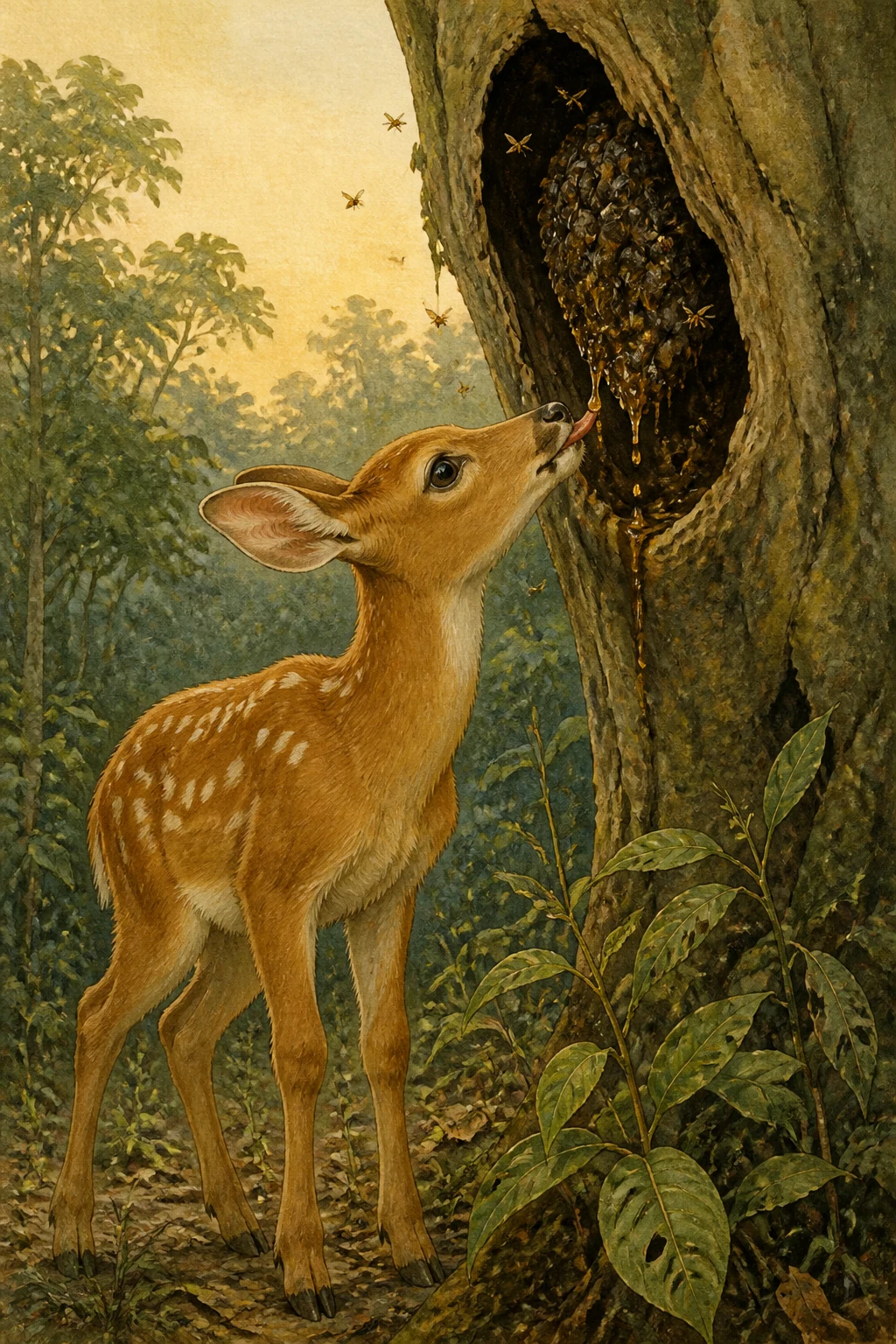
"That is quite a romantic tale!" said the young man. "Yes, now come along!" said the wise woman, and led him over to the beehive. He looked inside. What life and bustle! In every passage bees stood fanning their wings to keep a healthy draught of air flowing through the whole great factory; that was their job. Now bees came in from outside, born with baskets on their legs; they brought pollen, which was shaken out, sorted, and made into honey and wax. They came and went; the queen bee wanted to fly too, but then they would all have to go with her! It was not the time for that; still, she insisted on flying, so they bit off Her Majesty's wings, and then she had to stay.
"Now climb up onto the bank!" said the wise woman. "Come and look out over the highway, where there are good folk to be seen!" "What a teeming crowd!" said the young man. "Story upon story! What a whirring and buzzing! It is all a bewildering jumble! I am falling backwards!"
"No, go straight ahead!" said the woman. "Go straight into the throng of people, keep your eyes and ears open to them, and put your heart into it! Then you will soon think of something! But before you go, I must have my spectacles and my ear trumpet!" And she took them both.
"Now I cannot see a thing!" said the young man. "Now I cannot hear anything either!" "Well, then you cannot become a poet by Easter!" said the wise woman.
"But when, then?" he asked. "Neither by Easter nor by Whitsuntide! You will never learn to think things up." "Then what am I to do to make a living out of poetry?"
"You can manage that by Shrovetide! Knock the poets out of the barrel! Strike at their writings—that is the same as striking at them. Just do not let yourself be daunted; strike away, and you will get buns enough to feed both yourself and your wife!"
"The things one can think up!" said the young man, and so he knocked every other poet out of the barrel, since he could not become a poet himself. We have it from the wise woman; she knows what one can think up.