Waltey
Ileana Simziana
Legende sau basmele românilor · Petre IspirescuO besedilu
Ileana Simziana
- Vir
- Legende sau basmele românilor
- Avtor
- Petre Ispirescu
- Jezik branja
- English
- Jezik izvirnika
- Română
- Čas branja
- 36 min branja
- Obseg
- 29 strani
- Naslov izvirnika
- 002 Ileana Simziana
O izvirniku
Legende sau basmele românilor
Romunske ljudske pravljice o začaranih kraljestvih, preizkušnjah in junakih, zapisane iz ustnega izročila. Bralni jezik je English, izvirnik pa prihaja iz vira Legende sau basmele românilor v jeziku Română.
Besedilo
Ileana Simziana
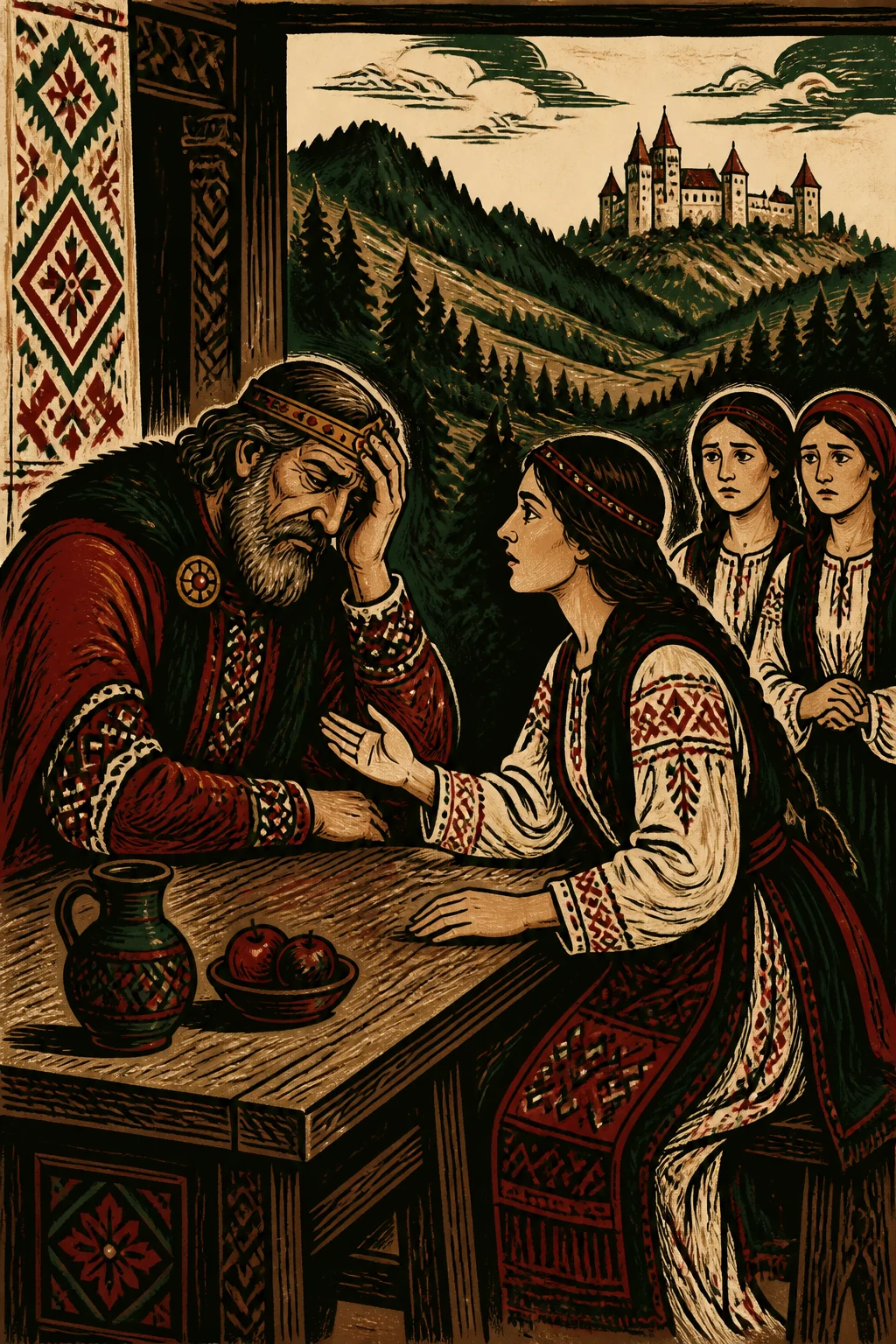
Once upon a time, as never before, there was an emperor. This great and mighty emperor had defeated all the emperors round about and brought them under his rule, until the borders of his empire stretched to where the devil weaned his children. Every emperor he conquered was obliged to send him one of his sons to serve him for ten years. On the borders of his realm lived another emperor who, while he was young, had never let himself be beaten. Whenever calamity descended upon his country, he moved heaven and earth to save it from danger; but when old age overtook him, he too submitted to the great and mighty emperor, for he had no choice. He did not know which way to turn or what to do to fulfil that emperor’s demand that he send one of his sons to serve him, for he had no sons, only three daughters. And so he sat brooding. His greatest fear was that the emperor would think him spiteful and stubbornly unwilling to send a son, and would therefore come and seize his kingdom, leaving him and his daughters to die in misery, poverty, and disgrace. Seeing their father so troubled, the girls grew anxious too, and could not think what pleasure they might give him to cheer him. When they saw, day after day, that nothing pleased him, the eldest daughter took her courage in both hands and asked him one day at table why he was so unhappy. “Does our conduct displease you?” she said. “Or are Your Majesty’s subjects wicked and quarrelsome, and is that what causes you so much sorrow? Tell us too, Father, who is this viper that gives you no peace and poisons your old age? We promise to sacrifice even ourselves if that might ease your sorrow a little. For you alone, Father, are our comfort, as you know very well, and we have never disobeyed your word.” “That is true enough; I have nothing to complain of. You have never disobeyed me. But you, my dears, cannot soothe the grief that pierces my soul. You are girls, and only a son can deliver me from the trouble I am in.” “I do not understand,” said the eldest daughter, “why you hide the source of your sorrow from us. Tell us, Father, for I am ready to give my life for you.” “What could you do, my dears? Ever since you came into this world, you have handled the distaff, the needle, and the loom: you know how to spin, sew, and weave. Only a brave warrior can save me, one who knows how to swing a mace, wield a sword with might, and ride like a dragon.” “Father, tell us too, for surely no hole will open in the sky if we also know what is troubling you.” When the emperor saw how his daughters pressed him with their entreaties, he said, “Here, my children, is why I am always sad. You know that while I was young no one could lay hands on my kingdom without risking his head and going back in shame to wherever he had come from. Now this accursed old age has drained all my strength; my arm has grown feeble and can no longer brandish the broadsword so as to make the enemy tremble. My horse, whom I all but lost my life to win, has grown old too. He is a mangy creature now, barely dragging out his days. In former times, I had only to mount my brave Șoimulean and show myself before the enemy, and then you should have seen them! They quailed before my face. But today, what more can I tell you? You know that I have submitted to the greatest and mightiest emperor on the face of the earth. Now, in his kingdom it is the custom for all his vassals to send him a son to serve for ten years, and I have only you.” “I shall go, Father,” said the eldest daughter, “and I shall strive with all my strength to please you.” “I fear you will return without accomplishing anything. Who knows what trouble you may get into there, such that no one will ever be able to put it right again!” “All I know, Father, and all I promise, is that I shall not bring shame upon you.” “If that is so, make ready and go.” When the girl heard that her father was giving her leave to set out, she was beside herself with joy. She put everything in order for the journey, turning on her heel as she gave commands and arranged her travelling gear. She chose the finest horse in the imperial stables, the most splendid and costly clothes, and enough provisions to last her a whole year. When her father saw her ready to leave, he gave her fatherly advice on how to behave and how to keep anyone from discovering that she was a girl. He taught her everything a brave young man entering such exalted service ought to know, and how to keep clear of gossip and intrigue, lest the other emperors’ sons should dislike and slight her. Then he said, “Go with God, my daughter, and remember my counsel.” The girl shot out of the courtyard like lightning; her joy scarcely let her feet touch the ground, and in a moment she was out of sight. Had she not stopped farther on to wait for her boyars and the carts of provisions, they would have lost their way, for they could not keep up with her. Meanwhile, the emperor went ahead of her by another road, towards the edge of his kingdom, without her knowing. He at once set a copper bridge in place, turned himself into a wolf, and hid beneath it. Just as his daughter was about to cross, he suddenly sprang out from under the bridge, baring his teeth and snapping them so fearfully that the sight chilled the blood. He stared straight at her with eyes that blazed like two torches, and rushed at her to tear her to pieces. The girl, whose blood had frozen with fright, lost her wits, and had her horse not leapt aside, the wolf would have sunk his claws into her. She took to her heels and fled home. Her father, who had returned before her, came out to meet her and said, “Did I not tell you, my daughter, that not every fly makes honey?” “That is true, Father, but I did not know that in going to serve an emperor I should also have to fight wild and rabid beasts.” “If that is so,” said the emperor, “stay at home and tend your spindles and bobbins, and may God have mercy on me and not let me die in disgrace.” Not long afterwards, the middle daughter also asked to go, pledging to put all her strength into fulfilling the service she was taking upon herself. After many entreaties and promises, her father relented and let her go too. But she fared just as her elder sister had, and when her father met her on her return, he said, “Well, my daughter, did I not tell you that not everything that flies is fit to eat?” “Indeed you did, Father, but that wolf was so dreadful! How he opened his jaws, as if to swallow me in a single gulp! And how he stared at me, with eyes that seemed to shoot arrows straight into my heart!” “Then stay at home,” replied the emperor, “and see to the broom handle and the vegetables in the kitchen.” More time passed, and one day, as they sat at table, the youngest daughter said to her father, “Father, let me try too. Please let me go and try my luck.” “Since your elder sisters could not manage it, I wonder how you can even think of offering yourself, when you scarcely know how to eat your maize porridge.” And he tried every means he could to put her off going, but in vain. “For love of you, Father,” she said again, “I shall move heaven and earth to succeed. But if God stands against me, I shall come back to you, and without shame.” Her father still objected and hesitated, but his daughter overcame him with her entreaties. At last the emperor said, “If that is how it must be, then I give you leave as well. Let us see what good you will do me. How I shall laugh to see you come back with your head hanging!” “You will laugh, Father, as you laughed at my sisters, without their being any the less worthy of honour.” Once the emperor’s daughter saw that her father had given her permission, she first considered which of the old boyars she should take as her counsellor. In the meantime, she remembered her father’s brave deeds in his youth, and his horse. So she went to the stables to choose a horse for herself. She looked at one, then another; she looked at all the horses in the stables, but none caught her fancy, though they were the finest stallions and horses in the whole empire. At last she came upon the horse her father had ridden in his youth, mangy, covered in sores, and lying on his side. As soon as she saw him, she gazed at him with pity and seemed unable to bring herself to leave him. Seeing this, the horse said to her, “It must be your love for the emperor, my mistress, that makes you look at me so tenderly. What a brave young fellow he was in his youth! Many were the victories we won together. But since he grew old, no one else has ridden me. And if you see me so wasted away, it is because there is no one to feed me as he did. Why, if someone were to tend me as I need, in ten days I should be such a horse that I would not trade places with ten like these.” Then the girl said, “And how must you be tended?” “I must be washed every day in freshly drawn water, fed barley boiled in fresh milk so that I can chew it, and given a bushel of glowing embers each day.” “If I knew you would help me accomplish what I have set my heart on, I would almost be willing to do as you say.” “Mistress,” said the horse, “put it to the test, and you will not be sorry.” For the horse was enchanted. The emperor’s daughter tended him exactly as he had told her. On the tenth day, the horse gave himself a single shake and became handsome, round and sleek as a melon, and nimble as a roe deer. Then, looking joyfully at the emperor’s daughter, he said, “May God grant you good fortune and victory, my mistress, for you have cared for me and made me once more what I longed to be. Tell me what troubles you, and command me what I must do.” “I wish to go and serve the great and mighty emperor, our neighbour, and I need someone to advise me. Tell me which of the boyars I should choose.” “If you go with me,” the horse told her, “you need not worry: you need no one else. I shall serve you as I served your father. Only heed what I say.” “If that is so, we shall leave three days from today.” “This very moment, if you command it,” the horse replied. When the emperor’s daughter heard this, she put everything in order for the journey. She chose clean clothes, but without finery, and, coming before her father, said, “God be with you, Father, and may I find you in good health when I return!” “A safe journey, my daughter,” her father said. “Whatever else may happen, never forget the counsel I have given you. And in every difficulty, let your thoughts remain fixed on God, from whom all goodness and all help come to us.” After promising to do so, the girl set off. As he had done with the other girls, her father took another road and went ahead of her, set the copper bridge in place once more, and waited there for her. On the way, the horse told the girl what tricks her father was using to test her courage, and advised her what to do to come through with honour. When she reached the bridge, he rushed at her.
a wolf with wild, bulging eyes that sent a chill through her bones, a great maw and a tongue like a rabid beast’s, baring and snapping its fangs as though it had not eaten for a month. Just as it was about to sink in its tearing claws, the girl dug her heels into her horse and charged at the wolf, sword in hand, to hack it to pieces. Had the wolf not leapt aside, she would have cleaved it in two, for she was in deadly earnest: she had put her faith in God and meant, come what might, to carry out the task she had undertaken. She crossed the bridge as proudly as any warrior. Her father marvelled at her courage, then took another way and hurried far ahead of her, set up a silver bridge, turned himself into a lion, and waited there. The horse told the girl what lay ahead and taught her how to overcome this trial too. As soon as she reached the silver bridge, the lion sprang out before her, its jaws gaping wide enough to swallow her, horse and all, its fangs like ivory tusks and its claws like sickles. It roared so loudly that the forests shook and the plains rang with the sound. The mere sight of its head, as big as a bushel measure, and its bristling, upstanding mane would have frozen anyone with fear. But the emperor’s daughter, heartened by her horse, charged straight at it with her naked sword in her hand, and had the lion not fled beneath the bridge, she would have quartered it. Then she crossed the bridge, thanking God and little knowing what else awaited her. The emperor’s daughter, who had not been beyond the house since the day her mother bore her, marvelled at the beauty of the countryside and would stop in wonder to gaze at it. Now she longed to dismount and gather a handful of flowers from the multitude that covered the valleys and hills, flowers she had never seen before; now she wished to rest in the shade of some tall, leafy tree, where thousands of birds sang songs so tender they could have lulled you to sleep; and then she wanted to go to a spring of water clear as a tear, welling from a rocky crag on a hillside. The murmur of these springs made her gaze at them dreamily, and she loved to watch their winding courses slipping over the earth among countless little flowers and the fresh green of spring. But through it all the horse encouraged her and urged her onward, telling her to mind her journey. Warriors, he said, did not pause over such things until they had brought their business to a successful end. He also told her that her father had one more trap in store for her, and taught her how to emerge victorious this time too. The girl listened with all her ears and did as the horse advised, for she had seen that all his counsel served her well, and she never strayed from his word. As before, her father took another way and went ahead of her, set up a golden bridge, turned himself into a great twelve-headed dragon, and hid beneath it. When the girl came to cross, he sprang out before her, lashing his tail and coiling his body. Flames poured from his mouths, and his tongues darted like burning arrows. At the sight of so dreadful a creature, a shudder seized the girl and her hair stood on end with fright. The horse, sensing at once that her courage was failing, heartened her again and reminded her of what he had taught her. The emperor’s daughter took heart, gathered the reins in her left hand, dug in her heels, and charged at the dragon with her sword in her right. For an hour the battle lasted. The horse kept manoeuvring so that she could strike from the side and cut off one of the heads, but her enemy defended himself well. At last the girl succeeded in wounding the dragon. Then he turned three somersaults and became a man. The girl could scarcely believe her eyes when she saw her father standing before her. He took her in his arms, kissed her forehead, and said, “I see you are brave, my daughter, and you did well to take this horse, for without him you would have turned back like your sisters. I have every hope that you will successfully carry out the task you have freely undertaken. Only remember my advice, and never disregard the words of the horse you have chosen. May we meet again in good health!” “May God hear you, Father,” the girl replied, “and may I find you well.” Then she kissed her father’s hand, and they parted. After travelling a long, long way, she came to some great, lofty mountains. Among them she found two ogres who had been fighting for nine years, neither able to overcome the other. It was a struggle to the death. As soon as they saw her, taking her for a young warrior, one cried, “Făt-Frumos, Făt-Frumos, come and rid me of this enemy of mine, and perhaps one day I too may be of service to you!” The other cried in his turn, “Făt-Frumos, Făt-Frumos, come and save me from this loathsome enemy, and I shall give you a horse without equal for swiftness, whose name is Galben-de-Soare.” The girl asked her horse which of the two she should save. He told her to save the one who had promised Galben-de-Soare, for that horse was even more capable than he was, being his younger brother. At once the girl charged the other ogre with her sword and cut him in two with a single blow. Seeing himself delivered, the ogre embraced his rescuer and thanked her. Then they went to his home, so that he could give Făt-Frumos Galben-de-Soare, as he had promised. The ogre’s mother was beside herself with joy when she saw her son alive, and could not do enough to thank Făt-Frumos for saving her child from death. The emperor’s daughter said that she wished to rest after her wearisome journey. They gave her a chamber and left her alone. Pretending that she wished to tend her horse, she asked him whether anything was likely to happen to her, and the horse told her what she must do. The ogre’s mother suspected some trick was afoot. She told her son that the warrior who had saved him from danger must be a girl, and that he could do no better than marry so brave a maiden. Her son said he could never believe such a thing, for no woman’s hand could wield a sword as skilfully as Făt-Frumos did. Then the ogre’s mother said she would put the matter to the test. That evening she placed a bunch of flowers at the head of each of their beds: the one whose flowers withered would be a man, while the one whose flowers stayed fresh would be a woman. Following her horse’s advice, the emperor’s daughter rose in the night, towards dawn, when sleep is sweetest, and crept on tiptoe into the ogre’s chamber. She left her bunch of flowers there, took his, and, placing it at the head of her own bed, lay down and slept soundly. In the morning, as soon as the ogre’s mother rose, she hurried to her son’s room and saw the withered flowers. When the emperor’s daughter had risen too, she went to her room; but though she saw that those flowers had also withered, she still would not believe the stranger was a young man. She told her son that he could not possibly be a man: words flowed from his lips like honey, his figure was so delicate you could have drunk him in a little cup of water, his fine, thick hair fell in waves over his shoulders, and his face had an irresistible charm. Those great, beautiful, lively eyes that could make you lovesick, that tiny hand, that little foot like a fairy’s—in short, everything about him could belong only to a girl, however she might hide beneath a warrior’s clothes. So they decided to make another trial. After they had exchanged their morning greetings, as was the custom, the ogre took the girl into the garden. There he showed her all the kinds of flowers he had and invited her to smell them. The emperor’s daughter remembered the horse’s advice and, seeing through the trick, said rather sharply that he had brought her into the garden first thing in the morning as though she were a woman, to waste empty words praising his flowers, when they ought first to have gone to the stables to see how the horses were cared for. The ogre reported this to his mother, but even now she could not believe the stranger was a young man. At last she agreed with her son that they should make one more trial. She told him to take Făt-Frumos into the armoury and invite him to choose something there. If he chose one of the weapons set with precious stones, they would know for certain that he was a girl. After dinner the ogre took Făt-Frumos into the armoury. Weapons of every kind were skilfully arranged there, some adorned with jewels and others plain and unadorned. The emperor’s daughter looked over and tested almost all of them, then chose a rather rusty sword whose blade could bend into a ring. Afterwards she told the ogre and his mother that she wished to leave the following day. When the ogre’s mother heard what sort of weapon she had chosen, she was beside herself at being unable to discover the truth. She told her son that, though the stranger’s behaviour made him seem a young man, he was a girl all the same, and an exceedingly cunning one at that. Seeing that there was nothing else to be done, they went to the stable and gave her Galben-de-Soare. The emperor’s daughter took her leave and went on her way. While they were still on the road, pressing onward, her horse said, “Master, until now you have listened to me in everything, and all has gone well. Listen to me this time too, and you will not go wrong. I am growing old, and I fear I may stumble. Take my brother Galben-de-Soare and continue your journey with him. Trust him as you have trusted me, and you will not regret it. He is much younger and nimbler than I, and, like me, he will teach you what to do in times of need.” “It is true that I have succeeded whenever I have listened to you. Yet if I did not know how faithfully you served my father, I would not listen to you now. Still, I shall trust your brother as I trust you, once he has shown me that he wishes me well.” “Trust me, master,” said Galben-de-Soare, “for I shall be proud to carry so brave a maiden as you. I shall do my utmost to keep you from feeling my brother’s absence, and at the same time spare the poor fellow, old as he is, the hardships and dangers of the journey you mean to make. For I must tell you, whether you wish to know it or not, that you will meet with many trials and face many dangers. But with God’s help, and if you listen to me, you will overcome them all and bring everything to a happy end.” Then the emperor’s daughter mounted Galben-de-Soare and parted from her horse in tears. On and on they travelled, a long, long way, until the emperor’s daughter caught sight of a golden tress of hair. She stopped the horse and asked whether she should take it or leave it where it lay. The horse replied, “If you take it, you will regret it; if you do not take it, you will regret that too. But you had better take it.” The girl picked it up, tucked it into her bosom, and rode on. They crossed hills, mountains, and valleys, leaving behind them thick green forests, fields of flowers such as the girl had never seen, and springs of clear, cold water, until they reached the court of the great and mighty emperor. The other emperors’ sons who served there came out to meet her. They could scarcely tear themselves away, so charming were both her speech and her face. The next day she appeared before the emperor and told him why she had come. The emperor was overjoyed that so handsome and gracious a young warrior had arrived. He was greatly pleased with the answers to his questions; it was plain to see that the young man spoke with wisdom and respect. Finding him so sensible, the emperor grew fond of him and kept him close at hand. The emperor’s daughter could not make friends with all the other emperors’ sons, for most of them were arrogant, idle, and dissolute. They resented her for this, and because they saw that the emperor looked kindly on her, they bore her a bitter grudge. One day she had cooked her own food and was sitting at table when two of the other emperors’ sons came to visit. They all sat down and ate together. The two princes enjoyed the dishes so much that they licked their fingers as they ate. They praised her skill in cooking and said that never in their lives had they eaten such good food. When they met the other emperors’ sons, they told them that they had dined with the newly arrived prince, that they had eaten better than the emperor himself, and that their host had cooked everything with his own hands. Then all the emperors’ sons pressed her to cook for them one day. As it happened, that very day the court cooks had got drunk, or done goodness knows what, for there was not even a fire lit on the hearth. So, after much urging, she set to work and prepared some marvellous dishes. When they were served at the emperor’s table, he could not eat his fill. The next time he called for the cook and ordered him to prepare the same sort of food, the cook told him who had cooked that day. The emperor fell into thought. Then the emperors’ sons came and told him that, at a feast they had all held together, the newly arrived prince had boasted that he knew where to find Ileana Simziana, she of the golden tress, at whose coming the fields grow green and the flowers bloom, and that he had a lock of her hair. On hearing this, the emperor ordered him to be summoned and said at once, “You knew of Ileana Simziana and told me nothing, although I have shown you affection and honoured you above all the others.” He asked for the lock of hair, and after examining it said, “Know that it is my imperial command that you bring me the owner of this tress. If not, your head shall lie where your feet now stand.” The poor emperor’s daughter tried to say something in her defence, but the emperor cut her short. Then she went and told her horse what had happened. “Do not be afraid, mistress,” the horse told her. “Only last night my brother brought me word that the owner of the tress has been carried off by an ogre. She will not hear of loving him until he brings her herd of mares, and the ogre is racking his brains over how to fulfil her wish. She is now in the marshes by the seas. Go to the emperor and ask him to give you twenty ships, and load them with the finest merchandise.” The emperor’s daughter did not wait to be told twice, but went straight to the emperor. “Long life to you, illustrious emperor, and honour to your face! I have come to tell you that I shall carry out the task you have given me if you will provide twenty ships and money to buy the finest and costliest merchandise to load aboard them.” “Let it be as you say, only bring me Ileana Simziana,” the emperor replied. As soon as the ships were ready, they loaded them with goods. The emperor’s daughter and Galben-de-Soare boarded the finest of them and set sail. Neither winds nor waves could stand in their way, and after a voyage of several weeks they reached the marshes by the seas. There they stopped. The emperor’s daughter and Galben-de-Soare went ashore and wandered along the coast, taking with them from the ship a pair of slippers embroidered with fine thread and adorned with precious stones. As they walked, they caught sight of a palace that turned with the sun, and made their way towards it. On the road they met three of the ogre’s serving women, who watched over Ileana Simziana. The moment the women saw the slippers, they could not take their eyes off them. The emperor’s daughter told them she was a merchant who had lost his way at sea. The women returned and told their mistress what they had seen. She herself had glimpsed the merchant from the window, and the instant she saw him her heart began to beat faster, though she did not know why. She would have been only too glad to escape the ogre, especially as he was away just then, having been sent to fetch her herd of mares. After listening to the serving women, she went to the merchant, who was waiting at the gate, to see the slippers for herself. But when she heard that he had still finer and costlier wares aboard his ship, she yielded to his entreaties and agreed to go and look at them. Once aboard, she was so busy choosing among the goods that she did not notice the oarsmen pulling away from shore. God granted them a favourable wind, and the ships sped like arrows. When she found herself out in the middle of the sea, Ileana Simziana pretended to be distressed and began reproaching the merchant for having deceived her, while in her heart she prayed to God to help her escape that monstrous ogre. They reached the shore safely, but what should they see! The ogre’s she-devil of a mother, having heard from the serving women that a merchant had stolen Ileana and was carrying her away in his ships, had set off in pursuit. As they reached land, they saw her coming after them like a lioness, with one jaw in the heavens and the other on the earth, and flames pouring from her mouth as from a furnace. The moment Ileana Simziana saw her, she knew it was the ogre’s dreadful mother. She told the merchant, with whom she was riding on Galben-de-Soare, and began to weep bitterly. The emperor’s daughter asked Galben-de-Soare what she should do, for the flames from the ogress’s mouth were scorching her. He replied, “Put your hand into my left ear, take the whetstone you find there, and throw it behind you.” The emperor’s daughter did so. Then they galloped away, while behind them a mountain of stone suddenly rose as high as the sky. The ogre’s mother contrived to cross it, clambering from crag to crag, and then how she came after them! Seeing that she was about to catch them, Ileana Simziana told the merchant. After consulting the horse, the merchant took a brush from his right ear and threw it behind them. At once a great forest sprang up, so dense that not even a young wild beast could have passed through it. The ogre’s mother gnawed through the trees, clung to the branches, leapt from treetop to treetop, and forced her way through, still pursuing them like a whirlwind. When they saw that once again she was catching up, the emperor’s daughter asked the horse what to do. He told her to take the betrothal ring from Ileana Simziana’s finger and throw it behind them. The instant she threw it, a wall of flint rose to the sky. Leaving the carcass to the crows and magpies, they travelled on until they reached the place where the herd was kept. There the horse told the emperor’s daughter to climb a nearby tree and watch their battle. Once she was in the tree, Galben-de-Soare neighed three times, and the whole herd of mares gathered around him. Then, all at once, the mares’ stallion appeared, covered in foam and snorting with rage. Seeing Galben-de-Soare among the mares, he charged furiously at him, and such a battle began as God preserve you from witnessing! Whenever the stallion attacked Galben-de-Soare, he bit into buffalo hides; but whenever Galben-de-Soare attacked the stallion, he bit into living flesh. They fought and fought until the stallion, torn and mangled from head to hoof and streaming with blood, was overcome and defeated. Galben-de-Soare, meanwhile, had escaped unharmed, for it was the buffalo hides that had been torn to shreds. Then the girl climbed down from the tree, mounted, and drove the herd before her, while the stallion could barely drag himself along behind. After bringing the herd into the emperor’s courtyard, she went to tell him. Ileana Simziana came out and called them by name. The moment the stallion heard her voice, he shook himself and became as he had been before, without a trace of a wound. Ileana Simziana told the emperor to have someone milk her mares, so that the two of them could bathe. But who could go near them? They lashed out with their hooves, smashing whatever they struck. When no one could do it, the emperor once again ordered the emperor’s daughter to milk them. Her heart was crushed with sorrow and resentment at always being given the hardest tasks. Yet, being pure in her thoughts, she prayed faithfully to God to help her bring this task too to a happy end. Then such a downpour began that it seemed as though water were being poured from buckets. Soon it reached the mares’ knees, and then a frost came and froze them fast, so that they could no longer stir. Seeing this miracle, the emperor’s daughter first thanked God for the help he had given her, then went and milked the mares.
The emperor was melting with love for Ileana Simziana and gazed at her as though she were a tree laden with ripe cherries. But she scarcely took any notice of him, and with one excuse after another kept putting off the wedding from day to day. At last she said, “Illustrious emperor, everything I have asked for has been granted. We need only one thing more, and then, you may be certain, we shall be married.” “My little dove,” the emperor replied, “my empire and I are the obedient servants of your wishes. Ask whatever else you desire, and quickly, for I am wasting away with love for you. I have become like a madman; I dream with my eyes open and no longer know what I am doing when I gaze into those beautiful, languishing eyes of yours.” “If that is so,” Ileana Simziana went on, “bring me the vessel of baptismal water kept in a little church beyond the River Jordan, and then we shall be married.” As soon as the emperor heard this, he summoned the emperor’s daughter once again and ordered her, by whatever means she could devise, to bring him what Ileana Simziana had demanded. The emperor’s daughter went straight to Galben-de-Soare and told him. He replied, “This is the last and hardest task you have left to do. But put your hope in God, mistress, for the emperor’s measure too is full.” They made ready and set out. The horse knew all about these things, for his wondrous powers were no mere trifle. He told the emperor’s daughter, “That vessel of baptismal water stands on a table in the middle of a little church, guarded by nuns. They sleep neither by day nor by night. From time to time, however, a hermit comes to instruct them in the holy things of the Lord. While they are listening to his teaching, only one remains on watch. If we can arrive at just that moment, all will be well; otherwise, who knows how long we may have to wait, for there is no other way.”
So they went on, crossed the River Jordan, and came to the little church. Luckily, the hermit had just arrived and summoned all the nuns to their devotions. Only one had remained on guard, and, weary from her long vigil, she had fallen asleep. Yet lest anything untoward should happen, she had lain down across the doorway, thinking that no one could enter without her knowing. Galben-de-Soare told the emperor’s daughter how to get hold of the baptismal vessel. The maiden crept softly along the wall on tiptoe until she reached the door. There she sprang over the threshold as lightly as a cat, without so much as touching the sleeping nun; then she seized the vessel, slipped out the way she had come, mounted her horse, and away she went. The nun stirred, leapt to her feet, and, seeing that the vessel was gone, began to wail so bitterly that it would have wrung your heart to hear her. At once the other nuns gathered round and lamented the calamity that had befallen them. When the hermit saw that the baptismal vessel was lost to him, he looked after the emperor’s daughter as she sped away on Galben-de-Soare, raised his hands to heaven, and, falling to his knees, cursed her, saying, “Lord, holy Lord! Grant that the evildoer who dared lay an unclean hand upon the sacred baptismal vessel may become a woman if he is a man, and a man if she is a woman!” The hermit’s prayer was answered at once. The emperor’s daughter became a young man so handsome that it was a joy merely to look at him. When he reached the emperor, the emperor marvelled and scarcely knew what to believe, for he noticed the change: the youth seemed different from when he had set out, more handsome now and more stately. As he handed over the vessel, he said, “Great Emperor, I have carried out the tasks you entrusted to me. I believe my work is now done. May you reign in peace for as long as the Lord in His mercy wills.” “I am pleased with your service,” said the emperor. “May all go well with you! By bringing me this vessel, you have gladdened my eyes. Know that after my death you shall ascend the throne of my empire, for as yet I have no heir. And if God grants me a son, you shall be his right hand.” All the counsellors and princes were present when the emperor spoke these words. When Ileana Simziana saw this wish of hers fulfilled as well, she resolved to take revenge upon the emperor for sending her handsome youth on all those perilous errands, any one of which might have cost him his life. She had thought that the emperor himself would go to fetch her the baptismal vessel, since he could have done so more easily, with everyone bound to obey his commands. She ordered the bath to be heated, so that she and the emperor might bathe together in the milk of her mares. Once she had entered the bath, she commanded that her stallion be brought to breathe cool air upon them. When he came, the stallion breathed coolness towards her through one nostril, but through the other he blew scorching air towards the emperor, until the very marrow boiled in his bones and he fell dead on the spot. There was a great stir throughout the empire when news spread of the mighty emperor’s death. People gathered from every quarter and gave him a funeral befitting an emperor. Afterwards Ileana Simziana said to Făt-Frumos, “You brought me here, you brought me my herd of horses, you killed the dragon who had carried me away, and you brought me the baptismal vessel. You shall be my husband. Come, let us bathe and be wed.” “I shall marry you, if you choose me,” answered Făt-Frumos, “but you must know that in our house I mean the cock to crow, not the hen.” They agreed and went into the bath. Ileana called her stallion to warm the milk in which they were to bathe. The new emperor also called Galben-de-Soare. And so the two horses vied with one another to make the bath just warm enough for their master and mistress, neither too hot nor too cool. After they had bathed, they were married the very next day, and then ascended the imperial throne. The festivities lasted three weeks, and everyone rejoiced that God had given them so valiant an emperor, who had performed so many great deeds. He ruled justly and in the fear of God, protecting the poor and oppressing no one; and they are reigning still to this very day, unless they have died. I was there too, gaping from outside at all the festivities, for there was never any question of inviting me; and, as everyone knows, an uninvited guest has no seat. Then I mounted a saddle, and told you the tale just so.
Izvirnik
002 Ileana Simziana
Naslednje strani prikazujejo izvirno besedilo za primerjavo.
fostfl o-data ca nici o data, etc. A. fostii o data unit imperat. Ace! imperat mare si puternicii batuse pe totl imp6rafil de prin pregiurulii si--I supusese, incat is1 intinsese, hotarele imperatieI sale pe unde a intarcatil draculit copiii, si tort 'miterata cei haul): era indatoratI a-1 da eke unil flu d'ai se): ca se-1 slujesca cate dece an!. La marginea imperafiei lui mai era unit altu imperatu carele, catit a fostii tiara', nu se lasase sa-lii bats : cand cadea cate unit parjolii asupra terei sale, elf se facea luntre si punte seapa tera de nevoig ; era dupg ce ajunse la betranete, se supusese si elf imperatului celui mare si tare, fiind-ca n'avea incotro. Elu nu scia cum sa faca, cum sä drega, ca sa implinesca voia acelul imperat de a-1 trimite pe unulit din fiii sei, ca sa -1 slujeseg: fiind-ca u'avea Merl, ci numal trei fete. Dinteacesta elf sta pe ganduri. Grijea luI e,ea mare era ca sa nu creda acelf imperatti ca el este zacas si se indgretniceste a-1 trimite vre-unil fiu, din care pricing sa ving as -I iea imperatia, era elf cp fetele luI sä moth in ticalosie, in saracie si cu rusine. Veclendf fetele pe tata-seti tau superatii, se luase si ele de gandurI, si nu sciati ce voie sa-I fug ca sa -lii ma! inveselescg. Daca vedura si vedura ca nimicu nu-1 este pe plat, lui gi-11
fata cea mai mare isi lud inima in ding intreba intro di la masa, ca de ce este superatil : Au purtarea nostrA nu-ti place? ii dise ea. AU supusil Mariei Tale sunt rei si artagosi de-IT pricinuesce atata mahnire ? Spune si nod, tats, tine este vipera aceea care nu-ti da pace si-ti otravesce betranetele si ne fagaduimii chiar a ne jertfi, deed acesta va putea sa-ti aline ore alma mahnirile : cad numai tu, tatd, esti mangaerea nOstrA, dupd curnii prea bine scii; era not nice °data esitii din cuventulii teir. De asta, asa este ; n'amii a me plange de nimicu. Nu mi-ati calcat porunca nici o data. Dard voi, dragele mele, nu puteti sa -mi alinati durerea care-nil pdtrunde sufletulft. Vol sunteti fete, si numai un scete din nevoia in care me ann. Eu nu intelegii, dise fata cea mare, de ce ascundi de not isvorulu mahnirilor tale, tats, spune, ca eil eta suntil data a-mi da viata pentru tine. Ce sa sciti voi face, dragele mele De cand sunteti pe lumea asta aLba, vol ati amblatil cu furca, cu aculii, cu re- : sciti torte, case, tese. Numai unit vitezil me p6te mantui, care sä scie sa resucesca buzduganulii, sa radianiasca sabia cu virtute si sa caldrescd ca unit smeii parker. tats, spune-ne si nod, ca doll nu s'o face gaurd in ceru, dacA vorml sci si not ce lucru to amdrasce. Daca veclu imperatulil ca -14 intetescil fetele cu rugaciunele, dise : Iata copilele mele, de ce sunt totil tristii. Vol sciti ca nimeni nu s'a pututii atinge de imperAtia mea cAtii amu fostil tinerfr, capete alageoa si fard sä se ducd rusinatii de unde a venit. Acurna pArdalnicele de betranete secatil Vita' virtu tea ; bratulii met e slabanog,it, nu mai pOte sa Invertesca palosulii de sd se cutremure vrasmasulii. met, pentru care p'aci-p'aci era sa -mi perdu viela pand l'amii dobanditil, a imbatranitii si el: e3te unit' rdpcigosii ; abia isi tirie .si eau vieta de adi pe maine. Alta data abia baiatu marl fart sd-si mi -au Soimulenull si-lt r ea t - Ort-cumil,
me aretamit Inaintea vresmasului si, se te tii *leo 1 ii sferaia din naintea feta mele ; dare adi, ce se ye mai spuiu ? voi sciti ca m'amd supus celui mai mare si mai tare imperat de pe fata pdmentului. Ins& la densuld este obiceiuld ca toff supusii imperetiei se' -i tramita rate unit flit, 944 slujescd qece an!, si eft ye amd numai pe voi. Me ducd eti, tats, dise fata cea mare, si me void sill din tote puterile mele se te multumesa. Me temti se' nu te intorci Vera nici o isprava. Cine scie, ce incurceture ye! face p'acolo, de se' nu -i mai dea nimeni de cepataiii, cat heu! Tot ce seal tats, si me fegAduescia, este ce nu te-oiii da de rusine. Daca este asa, pregetesce-te si te du. Gaud audi feta a tata-sed if cid voe se merge', nu mai putea de bucurie. Punea la cale tote pentru drum ; si se intorcea numai intr'un calceid, cAnd poruncea si aseda lucrurile de caletorie. Isi alese calul cel mai de frunte din grajdurile imperAtesci, hainele cele mai mendre si mai bogate, si merinde ca se.-1 ajunge und anti de dile. Dupe ce tats -sed o vedu gate de plecare, ii dete povetile pArintesci de cum se se porte, cum sä feed ca se' nu se descopere ca e fate. 0 MOta totii ce trebuea se' scie and vitez care merge la asa slujba inalte, si cum se se feresce de barfeli si devote, ca se nu fie uratA si nebagata de serna de eell-alti flu de imperati. Apoi ii clise : Pasa, cu Dumneded film mea, si adu-ti a-minte de invetaturile mele. Fate esi din curie ca fulgerul; n'o mai tinea pamentul de bucurie ; intr'o clipe nu se mai vedu. $i dace n'ar fi stet mai incolo se' -si astepte boieril si cardle cu merinde, acestea s'ar fi perdutd, Iiind-ce nu puteaft se se tine dupd. dense. Imperatulii /I esi pe de alta parte inainte, mai la marginea imperetiei, fere scie ea ; asede indate anti podd de amnia, se fecu unit lupd si se ascunse sub podd. Gaud era se' treca filca-sa de o datA esi de sub aceld podd, cu dintii calcaele sa
ranjiti si clAntanindil de to lua g-roza ; se uitd drept la densa cu nisce ochi cars strAlucea ca doue fAclii, si se repedi la ea ca sa o sfasie. Fata, care inghetase singele in ea de fried perduse cumpetul, si data calul nu facea o sdriturd la o parte, lupul infigea ghiarele inteensa; ea o lud la sanetosa inapol. Tatd-sett, care se intorsese inaintea ei, esi s'o internpine si-i dise : Nu-ti spuneamti eA, fata mea, ca nu tote muscele facii miere'1 Asa este, WA, (lard n'am sciut ca ducendu-me sä slujescii until imperatil, amti sa me lupt si cu flare selhatice si turbate. Daca este asa, dise imperalul, secli acasd de-ti vedi de fuse si rnosore, si Dumnecleti sa aibd mils de mine, ca sa nu me lase a muri rusinatil. Nu trecu mult si se ceru si fata cea mijlocie sa se clued si densa; si se lega ca ea isi va pune tote puterile cum sasi slarseasca slujba ce liia asupra-si. Dupd multe rug,aciuni si fagaduell, se induplecd tats -seil si o lass si pe densa sa se clued. ; dar pati si ea ca sora-sa cea mare, si intImpinand-o tats -seti &and se Intorcea dise : Ei, fata mea, nu ti-am spur eft ca n u se mandna tote ceea ce sbdra ? Adeveratil. este, tatd, asa ; dard prea era grozavil aeelu lupu. Unde deschise o gurd de sa me imbuce dintr'odatd, si unde se ulta cu nisce ochi din cari par'ca nisce sdgeti de me sAgetait la inima! *OA acas5. dare, respunse Imperatulit, de vedi de coda mdturel si de zarzavaturile de la bucdtdrie. Mai trecu ce mai trecu, si eta el si fata cea mica dise tatalui seti intr'o di &And sedeati la masa : Tatd, lasd-me si pe mine sa facii o cercare, lasd-me rogute, sa me due si eti sa-mi Incerc norocul. De ore-ce surorile tale cele mai marl n'aii putut-o sea.te la cdpeteiii, me mill cum III mai vine sa vorbesci de tine care nu scii nici cum se mananci mamdliga. mI-al disu isi edian
Si se cerca in tote felulii sa-I tae pofta de plecare, dara in zadar. Pentru dragostea tea tats, mai clise ea, void face pe -dracul in patru, numal sA. isbutesc ; insA data Dumnecjeu imi va sta Impotriva, me void intoarce erasi la tine si fare sa me rusinez. Se mai impotrivi tata-see, se mai codi ; dara fila-sa ild birui cu rugaciunile. La urrna de tot elite imperatul: Dace este asa, eta iti dad si tie voe, sä vedem ce procopselA a sa-mi fad. Ce-asii mai ride sa te ve4i1 intorcendu-te cu nasul in jos I Vei ride, tats, cum al ris si de suriorele mele, fare cu tete astea sa le scads cinstea. Fata imperatului, data veclu ca tatal seu ii dete voie, se gandi mai inteid pe care din boerii eel batrani sa lea de povetuitor. Si pane una-alta, ea isi aduse a-minte de vitejiile tatalui sed din finer* si calul see.. Se duse deci la grajdd ea sail alega si ea un cal. Se uita la unul, se uita la altul, se ulta la toti caii din grajduri, si de nici unul nu i se prin- 41ead ochii, de si eraii armasarii si cail eel mai buni din WA ImperAtia. In cele mai de pe urma dete si peste calul tatalui sed din tinerete, rapciugosil, bubosii si zacend pe ceste. Cum .11 veoclu, se uita la elii cu milA si par'ca nu se indura sa se .depArteze de densul. Calul dad. veclu asa, ii clise Se vede ca pentru iubirea ce al catre imperatul, stapang, te uiti asa de gales la mine. Ce puid de voinic era in tineretele lull Multe isban0 am mai facut not amandoi. Darn de cand a Imbatranit, nici pe mine n'a mai incalecat altul. Si dad me vec,li asa de jigArit, este ca n'are tine sa me hranesca ca elf". uite, de m'ar Ingriji tine -va cum sa-rni prilasca mie, in clece clile m'asi face de nu m'asi .da pe clece ca d'al de astia. Atunci fata clise Si cum trebue sa te ingrijeasca ? SA me spele in tete rlilele cu apA neinceputA, sa -ml dea Asti -di,
ordul fert in lapte dulce ca pot rode, si pe fie-care di. o banita de jaratecd. and asu sci ca-mi vel fi de ajutor sa sfarsescii ce amu pusd de gandii, mai-mai ca asti face asa precumil ()Jut tu. Stapana, dise caluld, fa cercarea asta, si nu to Ca luld era nasdravand. Fata imperatului ingriji de mild tocmai precurnd ii dise La a decea di unde se scutura o data caluld, si se facu frumosd, Bras ca und pepene si sprinten ca o capriora. Apoi uitandu-se veseld la fata imperatului, dise : dea Dumnedeti norocil si isbanda, stipana mea, ca m'ai si m'ai facut sa m'ai fid o data pe lume cum doream. Spune-mi tu care este pasuld tea, si poruncesce-mi ce trebue st fact". Ed void sa mergd la Imperatuld cel mare si tare, yecinuld nostru, ca slujesc, trebue pe tine -va care sa me povatuiasca. Spune -mi pe care din boeri sa alegd ? Daca vei merge cu mine, ii dise calulti, habard sa n'aI nu -ti trebue pe nimeni. Te void sluji cumil mit slujitit .si pe tata-t6d. Numai sa m'asculti. Daca, este asa, de adl in tree dile plecamd. Si chiar acum data poruncesci, II respunse caluld. Fata imperatului cum audi aceasta, fuse tote alea Ia tale pentru drum. Ise lua nisce haine curate, dart fara podObe, si venina inaintea tatalui set, II dise : Remai cu Dumneded tata, si sa to gasescii sAnetos I Cale build fata mea, ii dise tata-s6d. Tote ca Vote, nu mai povetele ce ti-amil dattl sa nu le uitI nice o data. Si la on -ce nevoie mintea to sa fie pironita la Dumneded, de. uncle ne vine tote binele si totd ajutoruld. Dupa ce se fagadui ca asa va face, fata porni. Ca si cele-lalte fete, tats -sed Bete pe de alts parte esi lnainte, aseda erase poduld de aroma si o astepta acolo. Pe drumil caluld spuse feteI cu ce tertipuri ambla tata-sed sa-I incerce barbatil, si o povatui ce sa fact ca sa Nape cu fata curata. Ajungendu la podii, unde se ntpusti asupra eL sä-lii ingrijitd sä-1 si-mi gist cli. ell, So -dl ;
un lupit cu nisce ochi turbati si sgaici de baga fiori in ase , cu o gull mare si cu o limbs ca de dihania turbata, cu coltii rinjiti si cla'ntanindit de pare-ca nu rnancase de o luna de ; si and sa infiga ghiarele sale cele slisiitore, fata dete calcae calulul, si unde se repecli asupra lupulul cu palosulil in mans de sa-lit faca midi farimi, si data nu se da in laturi lupulu, in doue ilil facea cu palosula ; cad ea 1111 glumea, fiindit ca-si pusese credinta in Durango'', dorea ca vrendit nevrendd sa implinesca slujba ce luase asupra. Ea trecu podulii mandra ca unit' voinica. Tats -seil se mira de vitejia el si dandii pe de alts parte, esi multii Inaintea el, asecla unit podil de argintil, se facu unit' lea si acolo o astepta. Calulu spuse fetel peste ce o sa dea si o invgta cum sä faca sa scape si de asta ispita. Cum ajunse fata la podulil de argintii, unde ii esi 'oda inainte cu gura cascata, de sa o imbuce cu cala cu trait, cu nisce colti ca eel de fildesit si cu nisce ghiare ca secerile si racnia de se cutremurail codrii, si campiele vuiaii lua au j.ulu. Numal uitandu-se tine -va la capulit lul celit catii banita, si la coma aia ce sta radicata in susii si sberlita, aril fi Inghetatil de fried. Dara fata imperatului, imbarbdtata de cala, se napusti o data inteinsulit cu sabia gola in mans, incatu dad. nu fugea leuhl sub podit, in patru flu facea. Atunci trecu podulu, multumindit lui Durnnecleil si nesciinda ce o mai astepta. rata imperatulul, care nu esise din casa de canda o Meuse masa, se mira si sta in loci' ulmita veyndit frumusetile cam pulul. Aci ii venea sä descalece ca sa adune cate "mil manuchiit de fiori din multimea aia ce acoperea vaile si Muffle, flori de care nu mai vecluse ea ; aci ii venea sä se dea la umbra sub cats unit copaciit naltil si stufosil, in care mule de paseri cantail felii de felii de cantece, asa de duiose de eraii in stare sa to adorma ; si aci In urma sa se dud la cate unit sipotit de apa limpede ca lacrima ce isvora din cote unit corgi de petra din costele delurilorit ; susurula acestorit isvOre o faceaa sa se rate galesit la ele placea sa le vacs curgerea ei si-o de-II 1i -i
lore cea serpuita ce aluneca pe parnentillncungiurate de multime de floricele si verdeg de primavera. Dark' la tote astea calulu o imbarbata si -i da ghiesii sä merga inainte si sa-si cate de drunaii. E1u ii spunea ca voinicii no se ulta la d'alii de astea, de catit dupA ce ducil trebile la capetit bunii. Ii mai spuse ca re sä mai dea de o cursa pe care i-o intindea tats -seil, si o invela cum sä faca a iasa si de asta data biruitore. Fata asculta cu tote urechile si facu precumil o inveta calulil, fiindii-ca vedu ea ea tote inveiaturile lui 11 ese in de bine, si din cuventulii lui nu se abatea. Tata-sell, ca si de la randii, dete pe de alts parte si-i esi inainte, aseda unu podii de aurii, se facu unit balaoril mare cu dou6-spre-dece capete si se ascunse sub acelii pat. Candit fu ca sa treca fata pe acolo, unde ii esi in nainte plesnindii din coda si incolacindu-se ; din gurile lui esia vapaifi de foal, si limbele ii jucati ca nisce sageti ardetore ; cumu ilu vedu fata ca este asa de grozavii, nisce recoil o apucara si i se facu perulu maciuca de fried. Calulit data simii ca fata se perde cu firea, o imbarbata erasi si-i aduse a minte ce o Invetase sa fad; era fata imperatului, dupa ce mai prince nitica inima, stranse fraulii calului cu maim stanga, ii dete calcae .si cu palosulti in drepta se repedi asupra acelui balauril. Um"' cesil tinu lupta. Calulit o potrivea cumil sa vina totil came la o parte ca sa-I reteze vre-unil cape; dark' vrajmasulti se pazia si elit destuliide bine. In cele mai de pe isbuti fata ranesca pe balauru. Atunci dandu-se elu de trei on peste ca.pil, se racy °mil Fetel nu-i venea sa creda ochiloru candil vedu pe tata-seu inaintea ei ; era elu luand-o in brale si serutand-o pe frunte. 11 dise : VOA ca to esti voinica, fata mea, si bine ai facutil de 1I-ai luatu ca lulu asta , cacI fara densulil to -ai fi intorsti si to ca surorile tele. Amii bun/ nadejde sa ispravesci cu bind sltijba, cu care to -ai insarcinatii de buns voe. Numal adu-ti halaurulii urn.a sa
aminte de povetele mele si sa nu e0 din cuventulit calului ce ti-ai alesit. Sa ne vedemil saneto0 ! SA te aucla Dumnecleti, taut', 11 respunse fata, sa te gasescu 'adnetosti. Apoi serutandil mais tatalui seil, se despartira. Dupd ce merse tale lungt departata, ajunse la nisce munti marl §i inalti. Iutre munti intilui doi smei ce se luptait de noue ani §i nu puteail sa se dovedesca unulit pe altulit. Lupta era pe moarte on pe viata. Cumit o veclura el, creclendil ca este un voinicu, unulit II clise : Fetii-frumosii, fete frumosii, vin'o de taut pe astit dusmanit alit men, ca aide §1 eu vre o-data bunfi la ce-va. Ear clise §i elit : Fetil-frumosti, fetii-frumosii, vin'o de me scapa pe mine de idolulii asta de vra,ma§il, voiit da unu telegar fara, splint, care se numesce Galbenii-de-sore. Fata intreba pe calii, pe care din amendoi sa scape ; era calulfi ii Oise sa scape pe celit ce-i fagaduise sa-i dea pe Galbenii-de-sore, ea este unu calit mai harnicit de catii denfiindu-I frate mai tiara. Atunci uncle se repecli fata in smeulii ceb1-1-altil cu palosulu, si dintr'o lovitura 11 facti in doue bucall I Smeulit, dad. se veclu scapatit, imbratisa pe mantuitorulfi sal multumi ; apoi mersera a-cast la densuld ca sa dea lui Eetii-frumosil pe Galben-de-sore, dupa cumil se fagaduise. Muma smeului nu mai putea de bucurie cAndit veclu pe fiusell Welt, nu mai scia ce sit fact ca sa multumesca lui Fetil-frumosu ca-1 scapase copilulit de la merle. Fata irnperatului areta dorinta ce are de a se odihni de ostenela drumului ce facuse. II dart o camara §i o lasara singull. Ea prefacendu-se ca voesce sa Ingrijesca de calit, ilu Intreba data are sa i se lute nple ce-va ; si calulit ii spuse ce are sa fact. Muma Smeului pricepu ca aci la mijlocil se joca vre-o dracie. Ea spuse fiului sett ca scapase de primejdie trebue sa Ile fata, ca o asemenea Ltd viteza art fi nusi ti-oiti voiniculit cell-rand, si-11 suld, 1i-t pi ce -11
mai bung sa o iea elu de sotie. Multi seu dicea ca o data cu capulii nu putea elu crede una ca asta, fiindti ca nu se putea ca o !liana temeiasca sa rasucesca palosulti asa de bine cumil facea Fatti-frumosu. Atunci muma Smeului elise ca are sa faca cercare. Pentru aceasta puse sera is capulii fie-cgrul din ei cate unit manuchiu de flori: la care se vorti vesteji florile, acela este bArbatil, si la care va rernanea verdi este femeia. Fata Imperatului, dupa povata calului, s'a sculatfi peste nopte, cam despre dioa, &Audi' somnulti este mai dulce, si, pis, pis, in verfulti degeteloril, intra in camara Smeului, II puse manuelnulti seit de flori, lug pe altit lul, si punendu-1u la capulii patului seil, se culca si dormi dusg. Dimineta cum se scula SmeOica, se duse inteunii sufletA la fiulti seit si vedu florile vestede. DupA ce se sculg si fata Imperatului, merse si la (Musa si vedenclit ca 5i ale ei se vestejise, tote nu cteclu ca este voinicti. Ea dicea fiului sea cA nu se putea sa fie barbatil, fiind-ca vorba, ii curgea din gurg ca mierea, boiulit II era asa de gingasii, Incatii 111 venea sA o bei intr'o bardacufg de apa, perisorulti subfire si stufosti 11 cadea pe utneri in unde, fata-I are pe vino'ncOce ; ochii Aia marii, frumosI si viol de to baga In bole, manusita aia micula si piciorusulti ca de dins, si In sfirsitil totulti nu putea sa fie decatii de WA, macarti ca se ascundea sub tedele cele voinicesci. Apoi hotarlra sa mai faca o Incercare. Dui:4 ce-si dara bung dimineta, dupg obiceifi, Smeulfi lug pe fatA si mersera in grading. Aci Smeulii ii areta tote felurile de flori ce avea, si o imbia si pe dOnsa sa le mirosd. Fata imp6ratului isi aduse aminte de povetele calului, si cunoschndii viclenia, dise cam restitil, ca, de l'a adusil in grading de dimineta ca pe o fetnee sa-I laude florile cu nisce vorbe seci, pe candti ar trebuitti sa merga mai intAiit la grajduri sa vacla cum se Ingrijesce p'acolo de cal. Auclindit acestea Smeulti, spuse ma-sei, dara ea nici acumit nu putea sa cre,da cg este Matti. In cele mai de pe urma Smeolca se vorbi cu fiulil seu sa mai faca inca o 'ncercare; f
wise fiului seu se duce pe Fet-frumos in camera cu armele, irnbie se-si alege ce-va de acolo, si de va alege vre-o arma din cele impodobite cu nestimate, se scie de buns seine ca ea este fate. Dupe prancjil Smeulti duse pe Fetil-frumosii in camera cu armele. Aci erati rinduite cu mestesugii totil felulti de arme : unele impodobite cu nestimate, allele numal asa fare podobe. Feta imperatului, dupe ce se uita si cerceta mai tote armele, alese o sabie cam ruginite, dar cu ferulti ce se incovoia de se facea covrigil. Apol spuse Smeulul si mumel sale ca a doua cli vrea se piece. Gaud aucli muma Smeulul ce felu de arms isi alese, se da de cesulti mortii ca nu putea descoperi adev6rulti. Ea spuse fiului set, ca de si pare ca este baiatu, dupe apucaturile lul, dare este fate, si ince de cele mai prefacute. Dace veclu ca n'are incotro, mersera la grajdti si-i dedera pe Galben-de-sore. Si dupe ce-si lua remasti bunu, fate imperatului isi cat& de drumil. ince pe tale fiindu, si silindti sa ajunga, caluld Oise fetei: Stapane, pine acuma :m'ai ascultatil la on ce si tote mersa bine. Asculta-me si de asta data si nu vel gresi. Eu suntii betrann' de aci inainte ; si mi-e sa iiu poticnescu. Iea pe frate-meil Galbenti-de-sore, si fa caletoria mai departe cu elu. Increde-te lui, cumti to -al increclutu in mine si nu te veT tai. Eli este multil mai tin6ril decatit mine si mai sprintenti, si te va inve[a ca si mine ce se facT la vreme de nevoe. Este adeveratu ca amt.' isbutitil on de cite orl te-amil ascultatti. Si data n'asti sci cat al fostil de credinciosii tatalui mai, de asta data nu te-asil asculta. MC voiti increde insa fratelui teu ca si tie, dupe ce-mi va dovedi ca-mi vrea binele. Increde-te stapane, clise Galbenil-de-sore, cad voiti fi mandru sa incalece pe mine o viteza ca tine, si apol me voiu sili ca se nu sling lipsa fratelui meti, fiindti-ca scu tescii si pe deusulti, sermanulti, ca e betranti, de necazurile si primejdiile caletoriei ce vrei se fad ; pentru ca trebue sa (jisil, ti -au voiu sa-ld 01'10 si 11-emu
self, peste multe nevoi al sl dal si multe primejdii al se. in- Values& Dare. cu vrerea lui Thuringen §i de me vei asculta, pe tote al sä le biruesci si sa le scoll la capetn burin. Feta imperatului incAleca apoi pe Galbenii-de-sore si se desparti de calula el, lacrimandii. MerserA, mersera, tale lung& departata, candu, fata imperatului zAri o cosita de auru Opri caluln intreba data este bine s1 lea, on s'o lase locului. Calulii ti respunse : de o vei lua, te vei cai ; de nu o vei lua, erki te vei c'ai ; dar mai bine este a o iei. Feta o lug, o bags in sin Fi plea inainte. Trecura deluri, trecura multi §i vai, l'asard in urrna paduri dese §i verdi, campii cu flori de earl' nu mai veduse fata, isvore cu ape limpecji §i red, si ajunsera la curtea imperatului celui mare §i tare. Ce1-1-alti iii de imperati care slujiaii acolo, 11 inainte si o intimpinarA. Ei nu se putean deslipi de (Musa, cad' si vorba-1 si fata II erau cu A doua-di se infatia la imperatuln si spuse pentru ce a imperatuln nu mai putea de bucurie ca ii sosise a§a voinicn chipe§n si dragalan. II placen prea multu respunsurile ce primea la intrebArile lui, se vedea catn de colo ca vorbea cu intelepciune §i supunere. Vedendil imperatulit unn tinern a§a de cu minte, prinse dragoste de elii lug pe langA densuln. Fata de imperatii nu se putu imprieteni cu top cei-l-alti fit de imperati, fiindin-ca cei mai multi craft nazurqi, ternbell §i deTichiati ; era ei prinsera 4iismA pe densa pentru aceasta ; §i pentru ca veduse ca imperatuln o lua in nume de bine, 11 purtan sambetele. Inteuna din dile ea 41 gati bucate singura §i §edea la mass, candii, dol din cei-l-alti fii de imperati venirit sg o vada. *eclura decl cu totii §i mancard. AVM de multu placura acestorn fii de imperati bucatele, in cat ii lingean §i degetele and mancait. 0 laudarA pentru rne§tepgulii de a face bucatele, si cliserg a de candil suntii ei nu mai mancasera, aa bucate bune. esira lipiciii. venal), sign
Cum se intalnird acestia cu cei-l-alli flI de imperati, le spusera ca ail fostil la masa la fiuhl de imperatil venit& de curandfi, ca au mancatil cum nici imperatulil nu mananca si ca bucatele an fostil gatite de densultl. Atunci toti fiii de imperati se alegard de densa sa le gatesca intr'o di ea bucatele. Si eta ca tocmai in dioa aceea bucataril curtil se imbatasera sell nu scifi ce facusera, ca nici foculu nu era facutu pe vatra. Si asa, rugata fiindu cu staruinta, se apuca si ea de gati nisce bucate infricosate. Cand le aduse pe masa la imp6ratulil, acesta nu se putea satura mancandil. Eara data chema pe bucdtarii si-i dete porunca ca tot astir -felti de bucate gatesca, elu spuse cine a gatitii in ;liva aceea. imperatulii remase pe ganduri. Apoi venird si flu de imperati si spuse imp6ratu lui ca fiulil imperatulhi de curend venitil fi ldudat la un chiefil ce au facutil cu totii, ca scie unde este Mina Simcliana, cosigi de aura, campulti, inverclesce, florile 'nfloresce, §i ca are o cosita din cosita el'. Cum au;li imperatuld acesta, poruuci theme si indata II ;Use : Tu aT sciutii de Rena Simcliana si mie nu mi-aT spus nimic, mdcar ca aretatii dragoste si to -amil cinstit mai multil de catil pe cei-l-alti. Dupa ce ceru si veclu cosita de peril, ii ;Ilse : Porunca imperatescd sa sciT ca aT sa-mi aduci pe stdpana acestel cosite ; cad de nu, unde-ti stair talpele itT va sta si capubl. Biata fats de imperatil se cerca sit clica si ea ceva, darn imp6ratulil iT taid cuventulk Apo' se duse de spuse calulul cele ce se intimplara. Calul II ;Ilse : Nu to speria stapand. Asti nopte chiar frate-meil mi-a adusii respuns ca pe stapana cositei a furat'o un Smell ; ca ea nu voesce nici in ruptulti capului sa-lii iubesca pand nu-I va aduce erghelia ei de epe ; si ca Smeulil 41 bate capuld cumii sa-I implineasca dorinta. Ea este acum in smarcurile Du-te la imperatulti si cere dea douk-cleci de corabii, si Ta marfa de cea mai frumOsa de pune in teensele. sa-i s'aril eel-I-alp se-le marilore. sa-11
Fata de imperatii nu astepta 4ica de doue ori, si se duse dreptii la imperatulii. SA traesci luminate imperate, si sal! fie fata cinstita. Amu venitii sA -ti spural ca slujba cu care m'ai insarcinatii o dack-mi ye! da doue-cleci de corabii si barii ca sA cumperil marfa cea mai frumosa si mai scumpa ca sä puml inteensele. SA se facA asa precum clici tu, numai sA-mi aduci pe Lena Simcliana, fi respunse imperatulii. Cum se gatirA coribfile, le IncArcarA cu marfa, fata de imperatu impreuna cu Galbenti-de-Sdre infra in cea mai frumesa, si plecara. Nici venturi, nici valurile maril nu putura si le stea impotriva, si dupa o caletorie de cAte-va septemani ajunsera la smArcurile marilorii. Acolo statura. Fata imperatului si cu Galbenii-de-Sore esirA la uscatti si Amblau pe term uri ; insa dud esirA, luarA din corabie o pareche de conduri cusuti numal cu fire si impodobiti cu petre nestimate. Totii amblandil pe aci, zarira nisce palaturi, car! se inverteau dupA sore, si o luara intr'acolo. In tale se intalnirA cu tree robe de ale Smeului, car! pazeail pe Edna Simcliana. Cum vechul ele condo ii, li se scurgeati ochii dupa densil ; era fata imperatului le spuse ca este unti negulatorfi, care a rAtAcitil drumulti pe mare. Intorcendu-se robele spuse domnei for cele ce vel;lurA ; era ea zfirise de pe ferestra pe negutatorulii ; de cum ilu ochi, incepu sa-I -Lade inima, faca sA scie de ce ; si era bunA bucuresa de a putea sä scape de Smeii, mai cu sema a nu era atunci acolo ; fiindii tramisese ca aduca herghelia ei cu epele. Dupa ce ascultA cele ce-i spusese robele, se duse la negulatoril care astepta la porta, ca sit *IA si ea conduril ; dara dupa ce aucli de la negutAtoril ca are in corabie marfa si mai scumpa si mai frumOsa, se indupleca de rugAciunele negutatorului si pofti sa merga sa-T vacIA marfa; ajungendii la corabie si tote alegendu la marfa nu bAgase de sema ca lopktarii departaserA corabia de uscatfi, si &Ana Dumne4eti sa-I void. implini-o, ca-lil sa-i
-unit ventu bums, corabiile mergeail ca sageta ; candii se pomeni in miciii-loculit marii, Rena SimOiana se prefacu ca -i pare reil prinse a certa pe negulatorti ca o inselase, era in sulletulil eI ruga pe Dumnecleil sa-I ajute a scapa de iasma de Smeti. liunsera cu norocire la termu, candu, ce sa ve(;1I! dratoica de Simcliana muma smeulul, cum aucli de la robe ca pe Rena o furase unit negulatoril si fugea cu densa cu orabiile, se lua dupa el ; §i ajungendu la termu, o veclura venindti dupa cler*I ca o leOIca, cu o falca in cerii §i una in pamentu, ci aruncandu vapaia din gura eI ca dinteunit cuptoril. Cum o veciu Rena Simcliana, intelese ca e sgriptorOica de mum& a Smeului, spuse negulatoruluT, cu care era calare pe Galbenti-de-Sore, si incepu a plange cu focti. Feta imperatului intreba pe Galbenil-de-Sore ce sä facd ca o dogoresce \Tapia ce ese din gura Smeelcei, era Galbende-Sere ii respunse : Baga mama in urechia mea cea stanga de mite gresia ce este acolo, si o arunca inapol. Asa facu fata imperatului. Apol o luard. lute la picloru, pe cand In urrna lora se 'nag de o data unit' munte de petit care atingea cerulti. Murna Smeuhif facu ce facu si trecu muntele, catarindu-se din crap."' IL: coltu, si sa to tii dupa demiI ! Vedendil 'terra Simcliana ca era sa-I ajunga, spuse negutatoruluI ; era acesta, dupa ce se intelese cu calulu, scese din urechia lul cea drepta o perie, si o arunca inapoi. Indata se facu o padure mare si deg de nu putea sa treed prin ea nici puift de tiara. Muma Smeulul rose din copaci-, se agata de ramure, sari din verfil in verfii, se strecura §i totu dupa densil, alergandti ca una vertejti. Daca veclurd ca si de asta data ambla sa-I ajunga, fata imperatului intreba era pe cala ce sa faca, si acesta 11 clise sa la inelulu de logodna ce se afla in degetulu IleneI Simclianel arunce Inapol. Cum arunca se facu unit zidii de crernene pans la ceril. si si sa-la
stervul ciorilor si cotofenilorti, se dusera Vaud ajunsera la local unde se afla herghelia. Aci calulu Vise fetel de imperatf sa se urce ea intr'unti pomii ce era acolo, si sa privesca la lupta lord. Dupa ce se -urea fata in pomii, necheza Galbenti-de-sore de trel orl, si tots herghelia de epe se aduna imprejurulf lui. Apoi d'odata se areta si armasarulti epelorti, plinu de spume si sforaindf de mania. Si veVendf pe Galbenti-de-sore in mijloculti epelorii, se rapecli la densul cu turbare si se incinse o luptä, de sa to feresca Dumnedeti ! Gaud se da armasarulf. la Galbenti-de-sere, musca din peile de bivul ; era sand se da acesta la armasar, mura din came vie, si se baturN si se batura pand ce armasarulti sfasiatil, hartanitil de sumu pans josii si plin de sange, fu resbitil si biruitti; era Galbeati-desore scapase Warn*, fiind-ca se hartanise peile de bivolf. Atunci se dete fata josu din pornii, incaleca si luara herghelia, rnanand'o de dinapoi; era armasarulu abia se tira dupa (Musa. Dupa ce baga erghelia in curtea imperatidul, se duse insciinta. Atunci Esc Rena SinoViana si le cbema pe nume. Armasarulf, cumf ii auVi glasulf, indata se scutura si se facu ca intaiii, fara ca sa se cunosca semnti de mane pe Rena SimViana Vise imperatului sa puna pe cine-va sa-i mulga epele ca sa se lmbaieze amendol. Dara tine putea sa se apropie de ele ca asverleati din copite de sventa unde loveaf. Daca nimeni nu putu, imperatulti porunci erasi fetei ale impfratil sa le mulga. Fata imperatului, cu o inima sdrobita de mahnire si obiciti ca tad pe densa o punea la lucrurile cele mai grele, si fiindd curata in cugetulf ei, se rugs lui DumneVeti cu creding ca sa o ajute sa sfarseasca cu bine si slujba acesta. Si unde incepu o ploie d'alea de parea ca -Lorna cu galeta, si indata ajunse apa pans la genuche epelorti, apoi dete and inghetit de nu se mai puteati mica de lucti. VeVendil minunea acesta fata imperatului mai intaiti multumi lui DumneVeii pentru ajutorulti ce-I dete, apoi se duse de mulse epele. de -if eld.
Imperatult se topea de dragoste pentru Rena Sinujiana §i se uita la densa ca la unit ciresu coptii ; dark' ea nici baga is sema, ci tott da di dupa di, cu felt de felt de vorbe, a se cununa. In cele de pe urrna ii clise : luminate Impetrate, ca totit ce amit cerutil mi s'a Implinitit. Unit lucru ne mai trebue, si apol sa scii ca ne vomit, cununa. Porumbila mea, ii respunse Imperatult, imperatia mea qi et sunternt supug ascultatori ai poruncilor tele. Cere ce mai ai de cerutt cu unit cesii mai curendt, ea eta me sfer- §escil de dragoste pentru tine. Amt ajunst ca unt flaw), visezt deteptii, nu mai sciii ce fact, candii me nail la mini tei eel frumo0 si tinjitori. Daca este a§a, mai clise Dena Simcliana, sa-ml aduci vasuit cu boteclt, care se pastreza intr'o bisericula de peste apa Iordanului, si atunci ne vomit cununa. Cum atuji imperatuld acesta, cbema er41 pe fata imperatului, si-I porunci sa faca ce o face si cum va sci ca sa-i aduca ceea ce poruncise Rena Simcliana. Fata de imperatii cum aucli, se duse de spuse lui Galbende-sore, si elt ii respunse : Acosta este cea din urrna si mai grea slujba ce mai ai sa faci. Aibi tusk' nadejde in Dumneclet, stapana, cad si imperatului i s'a Se gatira §i plecara. Calult scia de tote astea, cad nu era elit nasdravant de florae merului. Elil spuse fetei imperatului, dic@ndt : Acelt vast cu botezt se Oa pe o masa In mijloculu unei biserieute, pazescit nisce calugerite. Ele nu dormil nici di nici nopte. Din sand in cand insa unt pustnicit vine pe la ele de le povatuesce cele sfinte pentru Domnult. Cand suntil la ascultare de le Invata pustnicult, remane numai una de panda. De amit pute nemeri la vremea aceea, tocmai bine art fi; de nu, tine scie catil avernii a zabovi, cad alit felt nu- e chip. VeVii, nu-1n fmplinitn.
Se dusera deci, trecura apa Iordanului si ajunsera la acea bisericup. Norocii ca tocmai atunci sosise pustniculd si chemase pe tote calugeritele la ascultare. Numai una remasese de paza ; si acesta, obosita flindd de sederea indelungata, o prinse somnuld. Ca sa nu se intemple fnsa tine scie ce, ea se cula pe pragulii usei, cu gand ca n'o sa Ora nimeni infra fara sa simla ea. Galbenti-de-sore povalui pe fata de imperatil cum sa Each* ca sa puna mana ge vasuld de botezd. Fata se Buse binisord, se strecura pe linga zidd in verfuld degetelort, pia. la use. Aci o data sari ca o pisica de usure peste pragit, de nici nu atinse pe calugerita, pe care o furase sornnuld ; si punendd mana pe vasd, esi curnd a intratil, incaleca pe calif si pe drumulii Calugerita siniti, sari o data in susii si veciendii Ca lipsesce incepu a se boci de fi se rupea rarunchii de mila. Indata se adunara calugeritele si se vaicaread de foculd ce le ajunsese. Pustniculd, data veclu ca s'a spalatii pe radii de vasuld de botezii, cats catre fata de imperatd cumii ebura cu Galbend de-Sore, si radicand0 malnele in susii, si ingenuchindd, o blestema clicendd : Domne, Domne sfinte I fa ca nelegiuituld care a cutezatir sa puna mana lui pangarita pe santuld vasd cu botezii, sä se lac& mulere de va fi bdrbatti, era de va fi muiere sä se faca barbatil Si indata rugaciunea pustnicului se asculta. Fata imperatului se fdcu unit flacair dc-ft era draga lumea sa to uiti la Cum ajunse la impreratulii, se mira si nu scia ce sa crecia set, bagandii de serna ca se schimbase ; lui i se parea cd nu mai este cumii era la plecare, ci ca acum e mai chiposd si mai semetu. Cum dete vasuld, dise: Marite imperate, facutil slujbele cu can m'ai insarcinatd. Socotescii ca acum amu sfarsit0. Fii domnesce cu pace cad mila Domnului va voi Sunt multumitit de slujbele tale, 1ise impel atuld ; sa id ti-e I elti. 3i, p1.3i1-pkii, vasula, ochilora ti -amt fericita 3i
scii eh duph mortea mea tu aT sa te urci pe scaunulti im- -poratiei mele, flindil-ca eu n'amil motenitorti pang acum. Earti daca Durrinecleu imi va da unit flu, tu vel fl mina lui cea drepta. Top sfetnicii si flii de imperati ere*" de fath candil a disu imperatula vorbele acestea. Ilena Simi, liana, data veclu ca i se Implini si asta vointa, se botari resbune asupra imporatului, pentru ca tramise totii pe Fetulti el frumosil la tote slujbele cele grele, cart putetl repuna; caci ea credea ca insug imperattal se va duce sa -i aduch vasulu cu botezil, putea mai lesne s'o fach, de vreme ce toti se supuneini la porunca lul. Ea porunci sh inchlclesch baia si impreund cu imperatulit sh se imbaieze in laptele epeloril el. Duph ce intrA in baie, porunci sa-Y aduch armAsarulil ca sa sufle aeril recorosii. Si Baca veni, armasaruld sutra cu o nare spre densa recore, era cu alts nary in spre imperatuld aertl infocatil, in Mu fierse §i maple dinteensulil, si remase mortis pe tool. Mare vilva se fhcu in imperatie canda se aucli de mOrtea. Imperatului celul mare si tare ; toti din tote partite se adu- .nara facurh o inmormentare d'ale imperatescile. Duph acestea clise Rena Simcliana Fetului-frumosti : Tu m'al adusu aid, tu mi-al adusil herghelia, tu aT omoratil. pe Smeulti care me furase, tu mi-al adusil vasulii cu botezu, tu sa -mi fiT barbatii. Aidemu sa ne imbaiainu Si sa ne cununarnii. Eti te voiti lua, dach tu me alegi, response Fetii-frumosu ; dard sa scii eh in casa nostra voiu ca sa chute coco- .T.ilil era nu gaina. Se invoira qi intrara in bae. Ilena chema armasarulti eT ca sa incropesch laptele, in care se voril imbaia. Cluema qi Imperatulii celti not' pe Galbenii-de-S6re. Si astilfelti amendoi tail se intreceati care de care sA fad baia mai potrivita de calda stapanului seu, ci mai nimerith de incropith. Dupa ce s'au imbaiatti, a doua cli s'ati si cununatii. &a-0 flindir-ca elu sa -le
Apo s'aii urcatu in scaunuld fmperatiei. Trei septernani tinura veseliile, si tota lumea se bucura ea le-a datti Dumneded unit imperatd asa -de vitezii, care facuse atatea ispravI. Eara eld domni cu dreptate si cu frica lui Dumneded, ocrotindii pe saracI si neasuprindd pe nimeni, si donmescil si in ;boa de astacli de n'ord 11 muritd. Eramd si eu p'acolo si cascara' gura pe dinafara pe la tOte serbarile, caci nici pomenela nu era sa fiu si eu poftitd, si apol se scie ca, nepoftitulii scaunil n'are. Incalecaiu p'o sea si v'o spuseal D-vostra asa
Nadaljuj z branjem