Prevod
1. Atlas and Pleione, daughter of Oceanus, had seven daughters at Cyllene in Arcadia, who were called the Pleiades: Alcyone, Merope, Celaeno, Electra, Sterope, Taygete, and Maia. Of these, Sterope married Oenomaus, and Merope married Sisyphus. Poseidon lay with two of them: first with Celaeno, who bore Lycus, whom Poseidon settled in the Isles of the Blessed; and then with Alcyone, who bore a daughter, Aethusa, and two sons, Hyrieus and Hyperenor. Aethusa bore Eleuther to Apollo.
Hyrieus and the nymph Clonia had Nycteus and Lycus; Nycteus and Polyxo had Antiope; and Antiope and Zeus had Zethus and Amphion. Zeus also lay with the remaining daughters of Atlas.
2. Maia, the eldest, lay with Zeus in a cave on Cyllene and gave birth to Hermes. While still lying in his cradle in swaddling clothes, he slipped out and made his way to Pieria, where he stole the cattle Apollo was tending.
To keep their tracks from betraying him, he put coverings on their feet and drove them to Pylos. There he hid the rest in a cave, but sacrificed two, nailed their hides to rocks, and boiled and ate some of the meat, burning the remainder. Then he hurried back to Cyllene, where he found a tortoise feeding outside the cave.
He cleaned it out, stretched strings made from the cattle he had sacrificed across its shell, and fashioned a lyre; he also invented the plectrum. Meanwhile Apollo, searching for his cattle, reached Pylos and questioned the inhabitants. They said they had seen a child driving them, but could not say where they had been driven, since they could find no tracks. Learning through divination who the thief was, Apollo went to Maia on Cyllene and accused Hermes. She showed him the child in his swaddling clothes. Apollo took him before Zeus and demanded his cattle back. Though Zeus ordered him to return them, Hermes denied the theft. Unable to persuade them, however, he led Apollo to Pylos and gave back the cattle. But when Apollo heard the lyre, he offered the cattle in exchange for it. While tending them, Hermes then made a set of pipes and began to play.
Apollo wanted these too, and offered the golden staff he had used when herding cattle. Hermes wished not only to receive the staff in exchange for the pipes, but also to learn divination. He handed over the pipes and was taught the art of divining by pebbles. Zeus appointed him herald to himself and to the gods of the underworld.
3. Taygete bore Lacedaemon to Zeus, and the country of Lacedaemon was named after him. Lacedaemon and Sparta had Amyclas and Eurydice, whom Acrisius married. Sparta was the daughter of Eurotas, who was descended from Lelex, a native of the land, and the naiad Cleochareia. Amyclas and Diomede, daughter of Lapithes, had Cynortas and Hyacinthus. Hyacinthus is said to have been Apollo’s beloved, whom Apollo accidentally killed with a throw of the discus. Cynortas had a son, Perieres, who married Gorgophone, daughter of Perseus, as Stesichorus says, and fathered Tyndareus, Icarius, Aphareus, and Leucippus. Aphareus and Arene, daughter of Oebalus, had Lynceus, Idas, and Pisus, though many say that Idas was a son of Poseidon. Lynceus was so remarkable for his keen sight that he could even see things beneath the earth. Leucippus had two daughters, Hilaira and Phoebe, whom the Dioscuri carried off and married. Besides these, he had a daughter Arsinoe. Apollo lay with her, and she bore Asclepius. Some, however, say that Asclepius was not the son of Arsinoe, daughter of Leucippus, but of Coronis, daughter of Phlegyas, in Thessaly. They say that Apollo fell in love with her and at once lay with her, but that she chose, against her father’s wishes, to live with Ischys, the brother of Caeneus. Apollo cursed the raven that brought him the news, turning it from white, as it had been until then, to black, and killed Coronis. As her body burned, he snatched the infant from the pyre and carried him to Chiron the Centaur, who brought him up and taught him medicine and hunting. He became a skilled surgeon and advanced so far in his art that he not only kept some people from dying, but even raised the dead. For he had received from Athena the blood that flowed from the Gorgon’s veins: he used the blood from her left side to destroy people, and that from her right to save them, and with this he raised the dead. I have found several people named as having been restored to life by him: Capaneus and Lycurgus, according to Stesichorus in his Eriphyle; Hippolytus, according to the author of the Naupactica; Tyndareus, according to Panyassis; Hymenaeus, according to the Orphic poets; and Glaucus, son of Minos, according to Melesagoras.
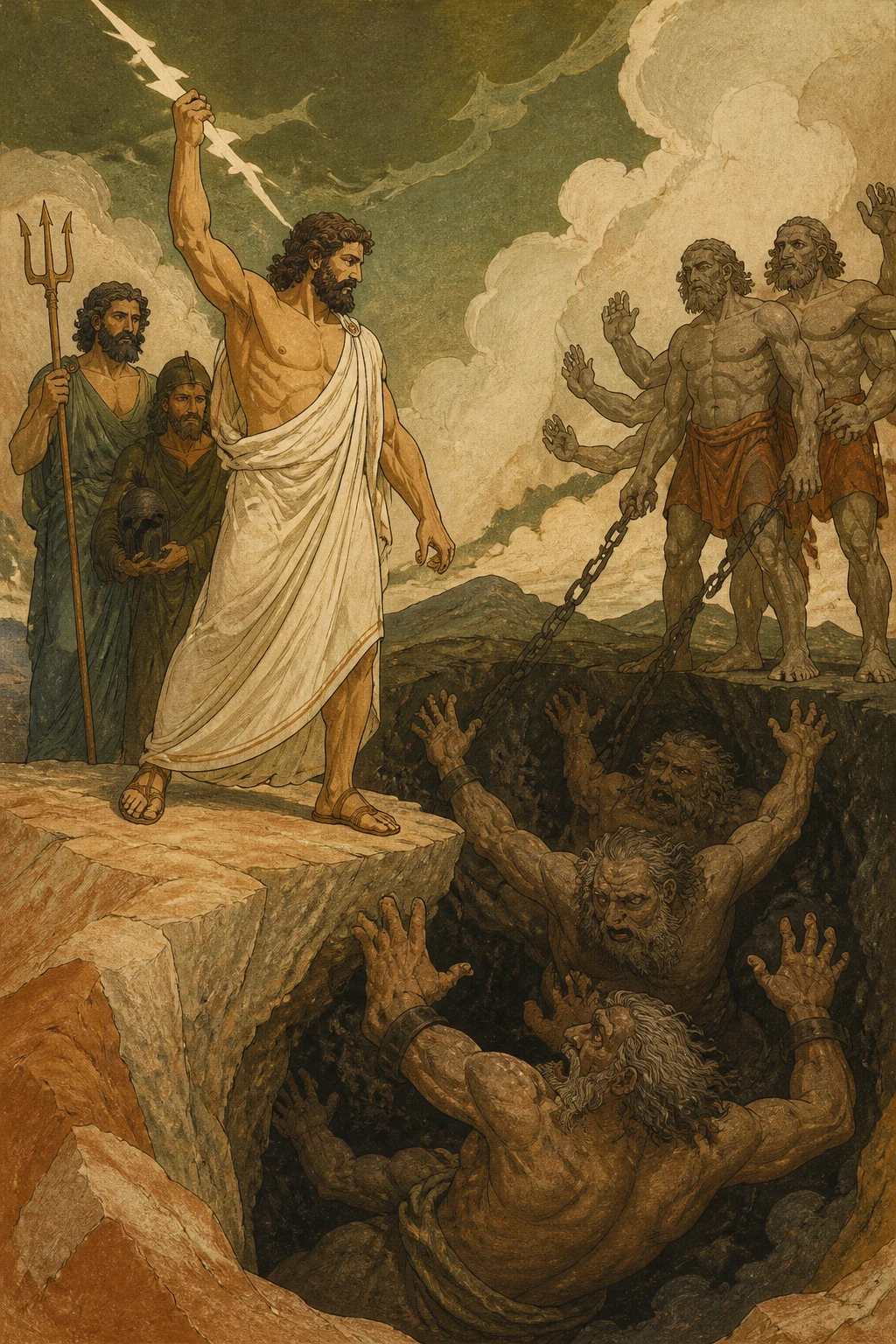
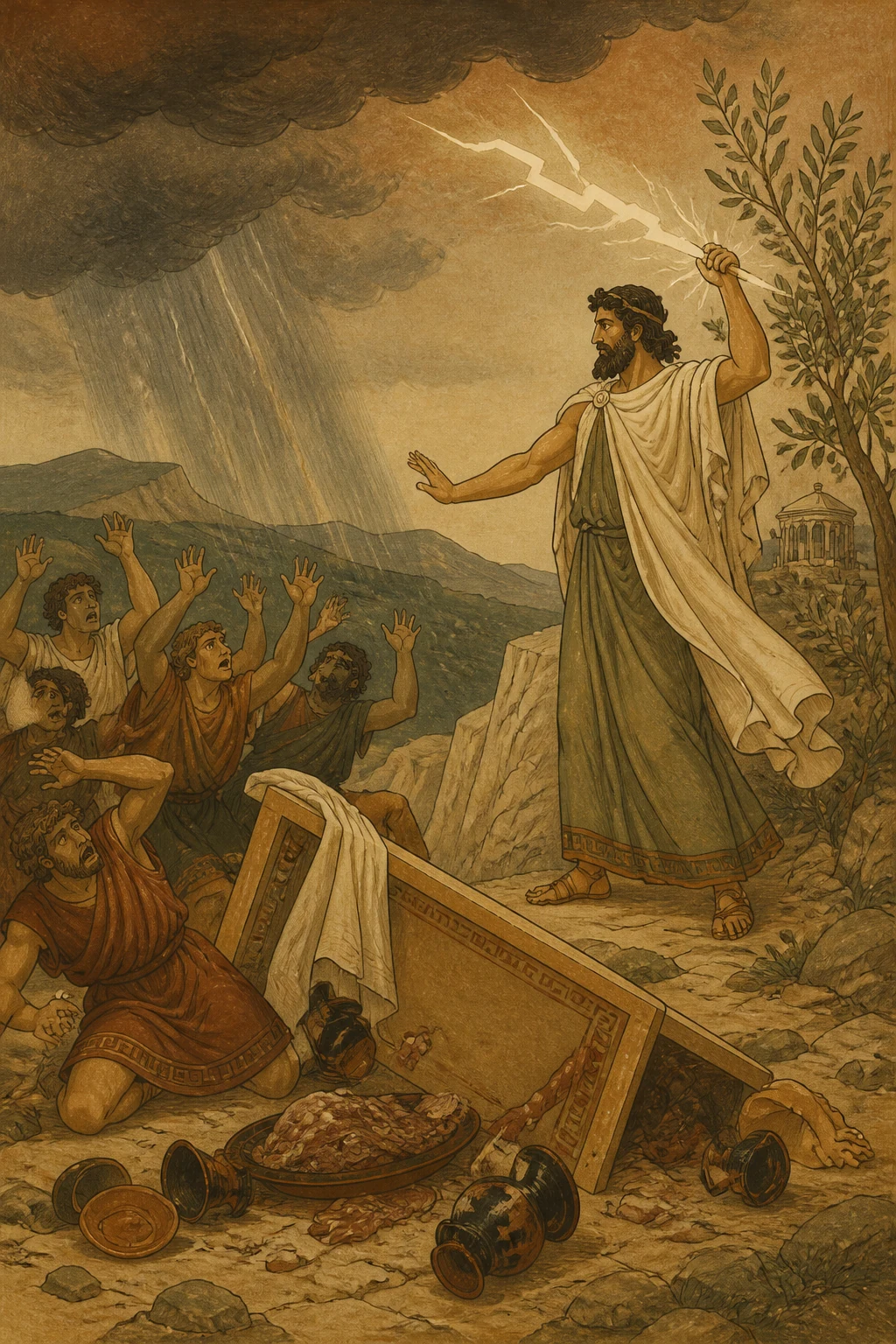
4. Zeus, fearing that people might learn the art of healing from him and come to one another’s aid, struck him down with a thunderbolt. Enraged by this, Apollo killed the Cyclopes who had made Zeus’s thunderbolt. Zeus was about to cast him into Tartarus, but at Leto’s entreaty he ordered him instead to serve a mortal for a year. Apollo went to Admetus, son of Pheres, at Pherae, and served him as a herdsman, making all his cows bear twins. Some, however, say that Aphareus and Leucippus were sons of Perieres, son of Aeolus; that Cynortas had a son Perieres, who in turn had Oebalus; and that Oebalus and the naiad Bateia had Tyndareus, Hippocoon, and Icarius.
5. Hippocoon’s sons were Dorycleus, Scaeus, Enarophorus, Euteiches, Bucolus, Lycaethus, Tebrus, Hippothous, Eurytus, Hippocorystes, Alcinous, and Alcon. With these sons at his side, Hippocoon drove Icarius and Tyndareus out of Lacedaemon. They fled to Thestius and fought as his allies in his war against his neighbors, and Tyndareus married Thestius’s daughter Leda. Later, when Heracles killed Hippocoon and his sons, they returned, and Tyndareus took over the kingdom.
6. Icarius and the naiad Periboea had Thoas, Damasippus, Imeusimus, Aletes, Perileos, and a daughter, Penelope, whom Odysseus married. Tyndareus and Leda had Timandra, whom Echemus married; Clytemnestra, whom Agamemnon married; and Phylonoe, whom Artemis made immortal.
7. Zeus took the form of a swan and lay with Leda, and Tyndareus lay with her on the same night. Polydeuces and Helen were born to Zeus, and Castor and Clytemnestra to Tyndareus. Some, however, say that Helen was the daughter of Nemesis and Zeus. Nemesis, they say, changed herself into a goose to escape Zeus’s embraces, but Zeus likewise took the form of a swan and lay with her. From their union she laid an egg, which a shepherd found in the woods and brought to Leda. She placed it in a chest and kept it safe, and when Helen was born in due time, she brought her up as her own daughter. Helen grew to be exceptionally beautiful, and Theseus carried her off to Aphidnae.
While Theseus was in Hades, Polydeuces and Castor marched against the city, captured it, and recovered Helen. They also took Theseus’s mother Aethra away as a captive.
8. The rulers of Greece came to Sparta to seek Helen’s hand in marriage. Her suitors were these: Odysseus, son of Laertes; Diomedes, son of Tydeus; Antilochus, son of Nestor; Agapenor, son of Ancaeus; Sthenelus, son of Capaneus; Amphimachus, son of Cteatus; Thalpius, son of Eurytus; Meges, son of Phyleus; Amphilochus, son of Amphiaraus; Menestheus, son of Peteos; Schedius and Epistrophus, sons of Iphitus; Polyxenus, son of Agasthenes; Peneleos, son of Hippalcimus; Leitus, son of Alector; Ajax, son of Oileus; Ascalaphus and Ialmenus, sons of Ares; Elephenor, son of Chalcodon; Eumelus, son of Admetus; Polypoetes, son of Pirithous; Leonteus, son of Coronus; Podalirius and Machaon, sons of Asclepius; Philoctetes, son of Poeas; Eurypylus, son of Euaemon; Protesilaus, son of Iphiclus; Menelaus, son of Atreus; Ajax and Teucer, sons of Telamon; and Patroclus, son of Menoetius.
9. Seeing how many there were, Tyndareus feared that if one were preferred, the others would quarrel. Odysseus offered to suggest a way to prevent any discord, provided Tyndareus would help him win Penelope’s hand. When Tyndareus promised his help, Odysseus advised him to make all the suitors swear to come to the chosen bridegroom’s aid if anyone wronged him in his marriage. On hearing this, Tyndareus bound the suitors by oath and chose Menelaus as the bridegroom; he also sought Penelope’s hand from Icarius on Odysseus’s behalf.