Prevod
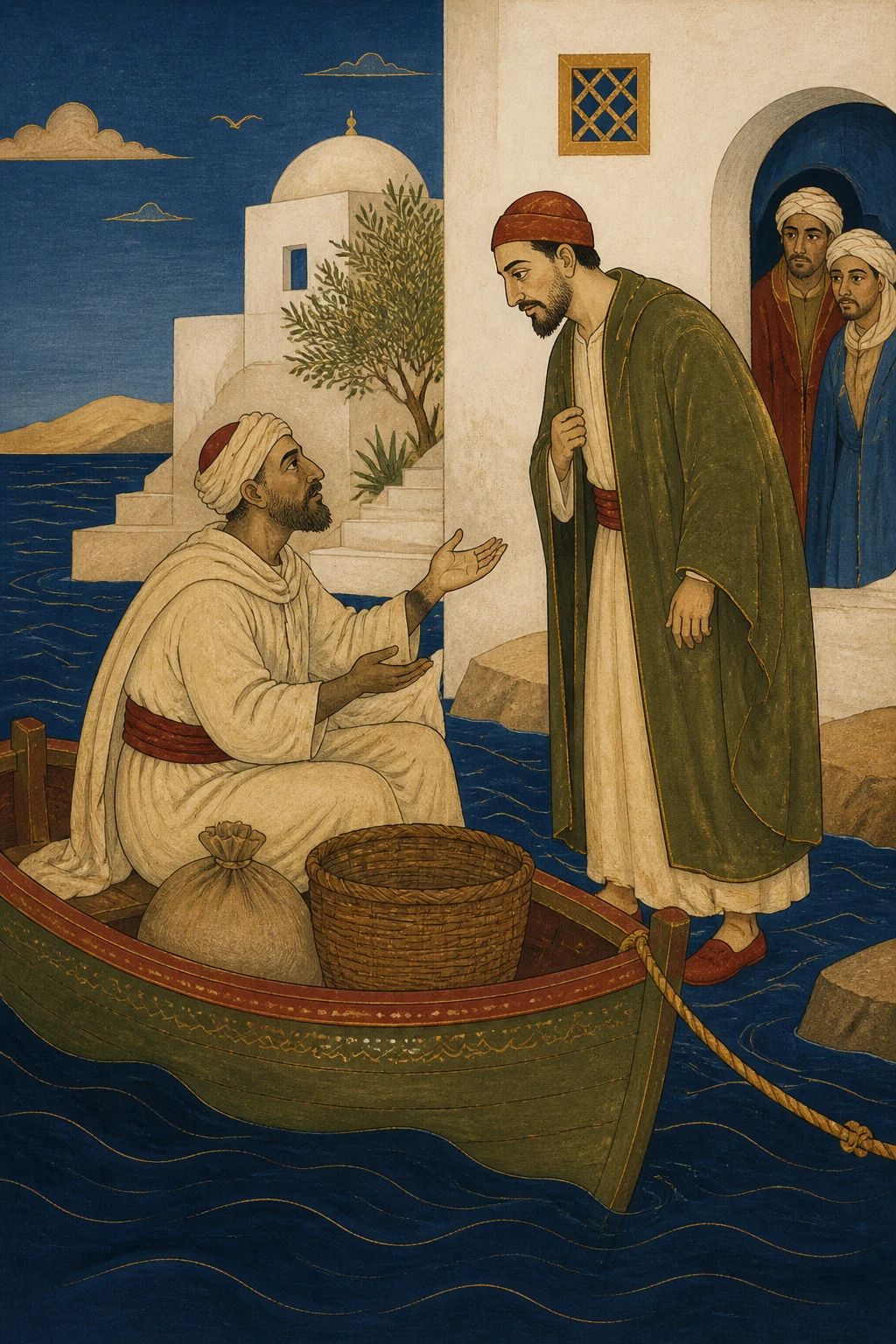
There was once a merchant, a wealthy man, who died and left his son to take his place. But the son did not follow his clever father’s example. He began squandering his fortune until he was penniless. When his money was gone, his mother said to him, “Open a shop and buy and sell in it, so you can earn a living and become a merchant like your father. You must not remain idle and let people laugh at you.” He listened to his mother, opened a shop, and began buying and selling. One day, as he was sitting in his shop, a man came in and said, “Peace be upon you.” “And upon you be peace and the mercy of God,” he replied. The man said, “Hasan, your father was a dear friend of mine. Praise be to God that he left a son behind him! I have been asking after you until at last I found you. I should like to stay with you. Listen to my advice, and I shall make you like your father.” He stayed as his guest for three days. On the third day he said, “Come, I will teach you a craft by which you can earn your living.” He took a little box from his bag and opened it. Inside was a powder for making gold. “Go and buy me some iron rods,” he said.
Hasan bought them and brought them to him. The man heated the fire and laid the iron rods upon it. When they were hot, he sprinkled the powder over them, and they turned to gold. “Take them to the market,” he said. Hasan took them to the market and sold each one for a hundred mahbubs. He brought back the money, and the man asked, “Do you like this craft?” Then he said, “Come, bring me some more rods.” Hasan brought more rods. The man put them on the fire, sprinkled the powder over them, and they became like the others. Hasan went and told his mother. “My son,” she said, “in my heart I do not like this guest.” “You too!” he exclaimed. He silenced his mother, saying, “In two years he will make me a rich man.” His mother said no more and brought supper for him and his guest. After they had eaten, they drank coffee. The guest put a drug into Hasan’s coffee, and Hasan al-Basri fell unconscious. The man put him in a chest, lifted it up, and carried him away in the night. In the morning his mother rose to find that neither her son nor the guest was there. Both were gone. She went out to the shops and searched, but found nothing. She returned home and sat weeping, poor woman. In the room where her son had slept she made a grave, and every day she came to it and wept. She believed her son was dead and buried him in that grave in her thoughts. Meanwhile, the man who had carried him away in the chest traveled with him for three days. Then he opened the chest and gave him an antidote to the drug. Hasan woke, sneezed, and said, “Praise be to God!” Then he asked, “Whose hands am I in now?” “In the hands of Ibrahim the Magian,” the man replied. “How can this be?” said Hasan. “You came to me, I received you as a guest in my house, you ate bread and salt with me, and now you betray me?” “I came a year’s journey to find you,” he said, “so that I might catch you and get you into my power.” He took a copper drum from his bag, and three she-camels appeared. Each man mounted one, and the third carried their provisions. They set off, covering a month’s journey every day. He traveled with Hasan for ten days.
After ten days Hasan said to the Magian, “Let me rest, and give me some water to drink.” They made the camels kneel and took out enough water to satisfy their thirst. When they had drunk, Hasan al-Basri looked around and saw a mountain rising very high into the sky. “What is that mountain?” he asked. “It is called the Mountain of Clouds,” the man replied. Hasan looked to his right and saw a palace gleaming high in the heavens. “Ibrahim,” he asked, “is that palace inhabited or empty?” “Do not ask me about it,” he said. “My enemies live there.” They mounted and went on toward the mountain, which stood straight before them. They reached its foot and dismounted. Then Ibrahim took one of the she-camels and slaughtered it. “Hasan, skin it,” he said. And Hasan skinned it.
When he had skinned it, they emptied its belly. Ibrahim said, “Come, I will show you what to do now. I shall put you inside it and sew it up around you. Vultures will come and carry you to the mountaintop. When you reach the summit and feel that they have set you on the ground, take out your knife and slit the camel’s belly. When you come out, the vultures will fly away. Stand on the summit, and you will see a chamber before you. Enter it, and you will find a cupboard. Above the cupboard is a tablet covered with writing. Bring it to me, and I shall return you to your home.” Hasan brought the tablet. “Come,” Ibrahim said, “give me the tablet you have fetched.” “I will not give it to you until you first take me home.” “Give me the tablet, and I will take you home.” Hasan handed it to him. The moment he had it, Ibrahim said, “Stay there and die of hunger and thirst!” He went away and left Hasan wandering in hunger and thirst. Hasan roamed the mountaintop, eating grass and turning things over in his mind. “What am I doing here?” he said to himself. He thought of pulling up the esparto grass and making ropes from it, so that he could fashion a ladder. He began twisting and twisting the grass into rope, measuring it as he went. But he found that there was still a long way down: the mountain plunged far below him. “Come, I will go down,” he said. He bound himself securely with the esparto rope and thought, “Whether I live or die!” Then he lowered himself down until he reached the end of the rope.
He looked below him. There was still a great distance to the bottom. He proclaimed his faith, closed his eyes, and let go. He fell and landed in water, finding himself unharmed. He swam until he reached the shore. Then he walked along the seashore for ten
days, eating grass and snails. At last, one day, he saw a palace in the distance and made his way toward it. This was the very palace he had asked Ibrahim about, when Ibrahim had told him, “That is my enemies’ palace.” He reached it and waited at the gate for three or four hours, but no one appeared. He entered and found couches and food and drink ready. He ate, drank, and rested. Then he went into a small chamber and hid, saying, “I shall see who owns this palace.”
Now the palace belonged to a sultan of the jinn. Suitors had asked for his daughters, but he would not allow them to marry. He summoned the sages of the jinn and said, “Build me a palace containing everything that mouth and tongue can describe.” They built him a palace three years’ journey away from them all. The king of the jinn rode out to inspect it and found it to his liking. He sent his seven daughters to live there. They lived there until Hasan al-Basri came. Hasan hid in the little chamber, saying, “I shall
see who its owners are.” The girls went out hunting every day. When they returned from the hunt, each went to her room; they washed their faces and ate. The youngest sister found Hasan al-Basri in the chamber and said, “Who is this? A human or a jinni?” “A human, of humankind,” he replied. “Are you Hasan al-Basri?” she asked.
“Yes, I am Hasan al-Basri.” “You are Hasan, whom Ibrahim the Magian brought here! He used you for his purpose and left you on the mountaintop. How many men like you he has brought and left to die of hunger and thirst! But your allotted life in this world is not yet over. That man is a cheat and a deceiver.” Then she said, “You shall stay here with us. Wait here. Do not leave the room.” “Very well,” he said. She went to her sisters and asked, “If a guest comes to us, shall we harm him or welcome him?” “If he is a good man, we shall welcome him. If he is wicked, we shall harm him.” “He is good,” she said. “That is what I was waiting to hear. I shall go and bring him.” She brought him in, and they greeted him. “You are here now,” they said. “Stay here with us.” While they were sitting in the palace, they opened a window and saw an army encamped around it. “What is this?” they asked. The commander came forward and said, “Your father says he wishes you to come to him. There is a wedding, and he would like you to stay for a month, until the festivities are over.” The youngest sister said, “Hasan, we are going away and shall be absent for a month. Come, I will show you something.” She took him through the palace and showed him all the rooms. “You may open every one of these rooms,” she told him, “except this door. Do not open it. You will want for nothing; all your provisions are here in the palace.” He stayed there for the first day and the second. Then he began to grow restless.
“They told me not to open that room,” he said. “I shall never know unless I open it.” He opened the door and found a ladder leaning against the wall. He climbed it and came out onto a terrace. Looking to right and left, he saw a wonderfully beautiful garden, filled with flowers and fruit beyond anything mouth or tongue could describe. There was a pool in it. As he sat looking, he saw ten doves approaching. They alighted at the edge of the pool. One took off her feather garment and became a woman. All ten did the same. They went down into the water, swimming and playing naked, while he sat watching them.
He fell in love with one of them, the most beautiful of all. He crept down, but they saw him and fled. He went back sick with love and lay down. When his sisters returned from their father’s house, they found him ill. “What is wrong, brother?” the youngest asked. “I am ill. I have no strength.” “Surely you have opened that door I warned you not to open!” “I opened it,” he said, “and saw something such as I had never seen in my life.
Doves came, took off their feather garments, and swam. I fell in love with one of them.” “Curse Satan!” she said. “This will be a difficult thing for you.” But he said, “I must have her.” At last, when he began to weep, she said, “I will see what can be done for you. They come once a month. When they come, go up onto the terrace and watch for them. When you see them take off their feather garments and begin to swim, go down and steal the garment of the one who has captivated you. Without her garment she cannot fly.” He waited until the month was over.
He went to the place. The doves came and took off their garments in their usual spot. He crept down very quietly and stole the garment of the one who had captivated him. His sister had told him, “When you steal the garment, do not speak. They will call out, ‘You who have stolen the garment, give it back! We shall give you riches, we shall give you riches!’ If you speak, they will harm you.” He obeyed his sister and kept silent. He remained silent until the time came for them to fly away. Each took her garment and flew off, but the one whose garment he had stolen stayed behind. Hasan caught her. “Now I have you!” He took her to his youngest sister, who said to her, “Welcome! What a blessing your visit brings us!” But the girl wept and wept. The youngest brought her other sisters, and they greeted her. She began to rail at them. “You keep a human in your house to steal the daughters of kings!” The eldest sister said, “When he caught you, did he do anything shameful to you? Did he hurt you?” “He did not hurt me.” “Then why do you weep? Woman is for man, and man is for woman.” For three days she wept and refused to marry him. And what did Hasan do during those days? He came and kissed his youngest sister, begging for her help. She told the girl, “Hasan al-Basri waits upon you and serves you like a servant, though you are no better than he is. Look at his bearing: it is the bearing of kings.” At last her heart softened toward marriage. They drew up the marriage contract, and Hasan married her and stayed with them for a time. Then he began to long for his mother. He went to his sisters and said, “I should like to go and see my mother. I do not know whether she is alive or dead.” “Very well,” they said. “God bless you. Go.” But his youngest sister looked at him and said, “Stay three more days, and then go. In three
days Ibrahim the Magian will bring another Muslim and put him on the mountaintop. He will try to make him do what he made you do.” Ibrahim brought a man and stopped at the foot of the mountain. The girl said, “Go, Hasan, and kill him.” “He is a magician,” Hasan replied. “I cannot kill him.” “I will give you a sword,” she said. “It has talismans engraved upon it. This sword will kill him.” Hasan took the sword, and they all mounted and set out. They found Ibrahim at the foot of the mountain, tormenting the man. He did not see the girls; he saw only Hasan with the sword in his hand. His sister had warned him, “Do not speak to him, or he will throw powders over you and turn you to dust.” Ibrahim said, “Am I not your father?” Hasan kept silent, struck him, and cut off his head. Then he untied the captive Muslim and took him to the palace. The man rested and recovered his breath. They gave him some money and a mount, and he returned to his own country. The copper drum that had belonged to Ibrahim the Magian was a magic drum. Hasan took it and put it in his bag.
“My sisters,” he said, “I have now been away from my dear mother for three years.” “We shall not keep you from your mother,” they said. “We give you leave to go.” “My sisters,” he said, “I give you my word that I shall come back to visit you.” He took out the drum and beat it, and the camels appeared. He mounted one, his wife mounted another, and the third carried their provisions. The sisters gave him some money, and he returned to the city of Basra. He went to his mother’s house and knocked on the door. His poor mother was sitting there weeping. “Who is it?” she asked. “Open!” he said. She heard her son’s voice, and her heart leaped. She opened the door. Her son came in and took her hands, and she began kissing him. “My dear son,” she said, “you have been away so long! You have been gone three years.” “Here I am,” he said. “I shall not leave you again.” He brought in his wealth, and his mother rejoiced in him and in the woman he had married. Then she said to him, “You cannot spend this wealth here in this town. Let us go to Baghdad and live under the sultan’s protection, where no one knows where you came from.” “God bless our venture,” he said.
He took out the drum and beat it, and three camels appeared. His mother mounted one, his wife another, and he the third. When he reached Baghdad, he bought a house and moved into it with his wealth and belongings. He lived there for three years, and his wife bore him two sons, one after the other. He named one Nasr and the other Mansur. Then he said to his mother, “I shall go and visit my sisters. I gave them my promise that I would come and see them. It would be shameful not to go.” “Go, my son,” she said, “but do not stay away too long.” “I shall be away for six months,” he said. “After six months I shall return.” When he was about to leave, he called his mother and said, “Come and look. My wife’s feather garment is locked in this chest. Take care of it, lest she fly away in it.” His wife listened and heard what they were saying. Then he went out.
He took out the drum and beat it, and three camels appeared. He loaded two with goods to offer as gifts, mounted the third, put his trust in God, and set off. He reached his sisters, greeted them, and they rejoiced to see him. He stayed with them. Now he was in the palace, and the tale returns to his wife. After two months she said to his mother, “Mother, I am dirty. I should like to go to the bathhouse.” “Your husband left me strict instructions,” she replied. “He told me not to let you go out of the door. How can I let you go?” The young woman grew distressed and began to weep. Her mother-in-law took pity on her and said, “Come, then, let us go.” She gathered her things, took her children, and went with her mother-in-law to the bathhouse. They entered. As she took off her clothes, the women stared at her with their mouths open. She went in and bathed.
Among them was a slave girl belonging to Zubayda, the wife of al-Rashid. She too gazed at Hasan’s wife. “When I return to my mistress,” she thought, “I shall tell her about this woman I have seen in the bathhouse. There is no beauty like hers in the whole world.” She returned to her mistress, and Zubayda asked, “What is the matter with you? Why have you taken so long?” “My lady,” she said, “I saw a woman whose beauty has no equal in all the world. She was what delayed me. I stayed there looking at her.” “Do not say such things,” Zubayda said. “I swear it is true! There is a woman beside whom you are not worth a single hair.” “Do you know where she lives?” “My lady, when she left the bathhouse, I followed her until I saw which house she entered.” Zubayda called for the steward of the palace, whose name was Baba Surur, and said, “Go with the slave girl. She will show you the house of the beautiful woman she has told me about. Bring her here.” Baba Surur went with the girl, and she showed him the house. He knocked, and the old woman came to the door. “Who is it?” she asked. “The sultan’s steward.” She opened the door, and he entered. “I hope nothing is wrong?” she said. “Nothing at all. My mistress has sent me to fetch the woman who is staying with you, so that she may see her.” “The woman who is staying with me does not go out. Her husband is away.” “I must bring her,” he said. “I cannot let you take her.” But he took her by force, and she brought her children with her. The old woman came too, locking the house behind her. They reached al-Rashid’s palace and went upstairs. Al-Rashid’s wife saw the young woman and gazed at her, turning her this way and that. They took off her outer clothes and seated her on a chair, staring in wonder at her extraordinary beauty. The musicians began to play, and the women sang and made merry.
The women rose to dance, but she had not yet danced. Zubayda looked at her and said, “Now it is your turn.” “Very well,” she replied. She rose and danced, leaving them all astonished, so beautifully did she dance. “Well done!” said Zubayda. “If I had my feather garment,” she replied, “I would show you something wonderful.” “Where is your garment?” they asked. “In my mother-in-law’s keeping.”
Zubayda said, “Bring it, old woman.” “My lady, I have no such thing.” The young woman said, “She has it locked in a chest.” The old woman began to cry out, but Zubayda said, “Be quiet! Come here, Baba Surur. Go to the house, break open the chest, and bring the garment.”
Baba Surur went to the house, broke open the chest, and brought the feather garment. They unfolded it and said, “Come, my lady, here is your garment.” She took it and put it on, became a dove, and hopped onto the window ledge, performing before them. They were delighted. “What a marvelous performance this is with the garment!” they said. She took her children, putting one under her right wing and the other under her left.
She sprang up onto the roof. Then she turned to her mother-in-law and said, “Mother, if your son is a lover who yearns for me, if the wind of longing carries him away, let him come to the Island of Waq-Waq.” She flew away and was gone. The old woman wept, saying, “Ah, my son’s wife has gone!” And the others wept with her.
She returned home, saying, “When my son comes back and cannot find his wife and children, he will kill me.” She went into one of the rooms and dug three graves, two small and one large. “When my son returns,” she said, “and asks me where his children and his wife are, I shall tell him they died.”
Meanwhile, her son said to his sisters, “I am going home to my mother, my wife, and my children.” “God bless you,” they said. “We shall not keep you from your wife, your children, and your mother.” He took out the copper drum, and three camels appeared. One carried the gifts, one the provisions, and he mounted the third and set off for home. When he reached his house, he made the camels kneel and knocked at the door. “Who is it?” his mother asked. “Open!” he said.
She heard her son’s voice and opened the door. He brought the camels inside, and his mother rejoiced to see him. He unloaded the goods, dismissed the camels, and they went away. He sat down and said, “What is the matter? Neither my wife nor my children are here.” She wept. “My son, they died. If you do not believe me, come and see their graves in the room.” She took him to the graves of his wife and children. “Tell me how they died,” he said. Then he said, “Mother, bring me the pickaxe and the spade.” She brought them. “I shall dig them up,” he said, “so that I can see my wife and children.” He dug into the first grave and found nothing. “Tell me the truth,” he said, “or I shall kill you.” “If lying can save a life,” she said, “truth can save it better still. My son, she wept until I took pity on her, and I took her to the bathhouse. One of al-Rashid’s slave girls saw her and went to tell Zubayda. Zubayda sent for her and had her taken by force. She danced before them, and they admired her dancing. Then she told them, ‘If I had my feather garment, I would show you something wonderful.’ They asked her, ‘Where is your garment?’
“She told them, ‘My mother-in-law has it.’ They ordered me to bring it, but I refused. Then the palace steward came by force, broke open the chest, and took the garment. He brought it to her, and she put it on. As soon as she had put it on, she took her children and left. She told me, ‘If your son is a lover who yearns for me, if the wind of longing carries him away, let him come to the Island of Waq-Waq.’”
The poor man fell silent and spent that night with his mother. The next day he took out the drum and beat it. Three she-camels appeared. He mounted and returned to his sisters. When they saw him, they were astonished. “What can have happened? He has come back so soon!” They welcomed him gladly. His youngest sister took him into her room and said, “Tell me what has happened.” He collapsed. When he came to himself, she asked, “What is wrong, dear brother? Surely all is well?” “My wife and children have gone!” “Did she say anything when she left?” “She told my mother, ‘If your son is a lover who yearns for me, if the wind of longing carries him away, let him come to the city of Waq-Waq.’” “Ah, brother,” she said, “this is a hard thing!” He wept and sobbed until he fainted. His youngest sister went to the others and brought them into the room. “What has happened now?” they asked. He told them, and they began to comfort him. But he said, “My children, or I shall die!” His youngest sister turned to him. “Hasan, tell us: what did she say when she left?” He repeated her words. They lowered their eyes and looked at one another. The eldest looked at him and said, “Brother, give up this matter. It is beyond you and beyond her.” He wept and sobbed. The six sisters rose and each went to her own room. His youngest sister, who loved him dearly, stayed beside him. She sprinkled him with water until he recovered. “Hasan,” she said, “give up this matter.”
“Either I shall have my wife and children,” he replied, “or I shall die.” “Be patient,” she said. “Do not torment yourself. God willing, you will be reunited with your children and your wife. Be patient.” Then she said, “Hasan, we have an uncle, an old man without children. He loves us dearly, and once a year he comes to stay with us for a little while. When he comes, we shall tell him, and he will find some way to help you. If he says, ‘I will take you to them,’ you may consider your wife and children as good as restored to you. But if he says, ‘I cannot take you to them,’ then God alone can help you.” Hasan al-Basri waited a little while, and their uncle arrived riding an elephant. They rejoiced to see him. After three days the youngest girl went to him and said, “Uncle, I am your little daughter.” “Tell me what you want,” he said. “There is a human staying here with us. His wife and children have been taken from him.” “Who is his wife?”
“A daughter of the Great King, one of those who put on dove garments and fly.” “That is difficult!” he said. The girl began to weep. When he saw her tears, he said, “Bring him to me.” She brought Hasan, who bent to kiss him and sat down beside him. “Tell me your story, Hasan.” Hasan told him all that had happened.
“Hasan,” he said, “give up this matter. It is too difficult for you and for me. Take another wife. Your sisters will give you money, and I shall give you money too.” “Either I shall have my wife and children,” he replied, “or I shall die.” “Wait until I have finished my visit with my brother’s daughters.” When his visit was over, he mounted the elephant to go home, and Hasan mounted behind him. The elephant flew away with them until they came to a mountaintop. The old man dismounted and found a cave. “Hasan,” he said, “wait here. Be patient.
“A black horse will come to you, without a single marking. Mount it.” He put a letter into Hasan’s hand and said, “The horse will carry you to the mouth of a cave. Stay there for three days. If a man dressed in red comes out, abandon all hope in this world. But if a man dressed in white comes out, be assured that you will reach your wife.” The horse flew with him and set him down at the mouth of the cave. He stayed there for three days. Then a gray-haired man dressed in white came out and said, “Welcome, Hasan.” He took him by the hand and led him into the cave.
“What do you seek, Hasan?” Hasan told him about his wife and children. “My son,” the old man said, “this is a difficult thing. Put it out of your mind. There are many women. Take another wife. You are still young, and she will bear you children.” “No, no,” he said. “I want my wife and children, or I shall perish.” “Let us go to the students,” the old man said. The students whom he taught came to him and said, “His heart is burning for his children, not for women. You would be doing a good deed if you helped him reach them.” The sheikh summoned an ifrit, and when it came he said, “Hasan, climb onto its back and close your eyes. You will find yourself with my brother, who is older than I am. Mount it. It will set you down at the mouth of a cave. Stay there for three days. After three days a little boy will come out and ask what you want. Give him the letter I have written to my brother. Then wait another three days. If a black servant comes out, abandon all hope in this world. But if the same boy comes out again, be assured that you will reach your wife and children.” Hasan al-Basri climbed onto the ifrit’s back and put the letter in his bag. The ifrit set him down at the mouth of the cave. He waited three days. A boy dressed in white came out, and Hasan gave him the letter. He waited another three days. Then a little boy in white clothes came out and said, “Come in with me, Hasan.” He led him to the sheikh. Hasan approached, kissed him, and handed him the letter. The sheikh read it and laughed. “Hasan,” he said, “this is a difficult matter.” “I place myself in your hands,” Hasan replied. “Do you know how many years’ journey lie between you and your country? The master of the elephant who carried you away from the girls took you two years’ journey. The horse carried you another two years’ journey to my brother’s dwelling, and from my brother’s dwelling the ifrit carried you three years’ journey. Do you know my brother’s name? My brother is called Abd al-Zayyad, and I am called Abd al-Quddus. Come, I shall give you a marid of the jinn, who will carry you a year’s journey. You will come to a mountain full of birds, flying and singing. Do not speak. Stop your ears with cotton. After the birds, he will carry you a year’s journey through fire. You will find a mountain filled with fire, with flames pouring out of it. Then he will carry you another year’s journey. Once you have passed the wild beasts, he will take you through wilderness where you will see neither human nor jinni.
“He will set you down on the seashore, with a country before you. I shall give you a letter to the sultan of that country.” He gave him the letter, and the marid carried him away. It carried him past the mountain of fire, with flames pouring out of it, past the wild beasts, and through the wilderness, until they reached the country.
A man met him and asked, “Where are you going?” “To the king.” “Come, I will take you to his house.” He led him to the king’s house, and Hasan handed over the letter. The sultan read it, kissed it, and treated Hasan with honor. “Hasan, my son, welcome!” he said. “You are a human, yet you have reached this dwelling. Your star is in the ascendant. Stay here with me and rest. God willing, He will grant your desire. You shall stay with me for a month.” “Yes, very well,” Hasan said. “Every month,” the sultan continued, “the ships come and take goods from here to the land of the Great King, where your wife is. I shall entrust you to a captain, who will put you ashore. My son, when he sets you ashore, you will find an army encamped in huts made of wood.
“Do not let anyone see you. Go to the first hut that stands before you, enter it, and hide. When its mistress comes, fall at her feet and weep. Say, ‘My lady, I have fallen from the sky.’ If she takes pity on you, your wish will be fulfilled. But if she does not welcome you, then God alone can help you.” “God bless our venture,” Hasan said. He stayed there for a month, until the ships came, loaded their goods, and prepared to sail. The king sent for the captain and said, “Put this young man ashore in the country to which you are sailing. I wish no one but you to see him.” He entrusted Hasan to the captain, who took him aboard, and they sailed away.
When they reached the country, Hasan looked out from the ship and saw huts made of wood. There were eighty thousand in the army, all women, without a single man. When darkness fell, the captain said, “Come, young man, go ashore.” Hasan went ashore. The women came and bought the goods, buying everything. Hasan went to the camp, entered a hut, and hid inside. Its mistress had not yet returned. He waited there until she came. As she took off her clothes, he fell at her knees and began to weep. “How have you come here, my son Hasan?” she asked. “My lady, I place myself under your protection. I have fallen from the sky.” She was the stewardess of the camp, and the ruler of the army was Hasan’s wife’s sister, whose name was Manar al-Nisa. The old woman said, “If your wife is in this army, I shall bring you to her.” He spent the night with her. When they rose, she said, “At daybreak they all go down to bathe. I shall take you there and put you where you can watch. Look carefully and see whether you recognize your wife among them.” “God bless you,” he said. She dressed him as a slave girl and took him to his place, where he watched. But after looking at all the women, he did not find his wife. “I have not found her,” he told the old woman. “Come with me,” she said. He went with her to her hut. “Stay here until I return.” The stewardess went to the queen who ruled the whole army and said, “My lady, a poor human has come to us, looking for his wife and children.” “Bring him to me,” the queen said. “I shall not bring him unless you promise me safe conduct for him and swear that you will not hurt him.” “I grant him safe conduct. I shall not harm him.” “Since you have granted him safety, I shall bring him.” The stewardess went to Hasan and said, “Come, Hasan. Get up. Let us go to the queen.” “Very well,” he said. “Do you know how to speak in her presence?” she asked. “Take care not to say more than you should.”
She took him by the hand and led him up to the queen. He stood before her, and she said, “Speak, my son.” “My wife and children have come into this land.” “Would you recognize your wife if you saw her?” “What do you mean? Would I not recognize my own wife and children? She bore my children.” The queen ordered all the women to come before him with their faces uncovered. They came in, and he looked at them. After they had all passed, she asked, “Hasan, did you recognize your wife among them?” “No,” he said. “I did not.” She turned to the old woman and said, “I am the only one left whom he has not seen!” “He must see you too, my lady.” The queen looked at the stewardess and said, “By all that is true, if it were not for the care of the nurse who raised me, I would kill you this instant.”
“Now I am in a predicament,” she said. “I gave him my word, and you gave him yours too. We must not let him go away brokenhearted.” Then she said, “Come and stand here, in front of me.” When he stood before her, she said, “God has indeed favored you, allowing you to come face to face with the daughters of kings.” She uncovered her face and said, “Come, look at me. Look closely. Am I the one?” The moment he saw her, he fell to the ground. “What is the matter?” she asked. “Am I the one?” “No,” he said, “not you. But she looks just like you. You and she are like a bean split in two.” The queen turned to the governess. “What is the meaning of this?” “He has seen all the women,” she answered, “and not one of them stirred him. But when he saw me, he fell down.” “Perhaps she is one of your sisters. Who can tell?” The governess looked at Nur en-Nisa. “It can only be your sister,” she said. “She was away from us for so many years, and when she returned she brought two children with her. Whenever we asked her about them, she told us, ‘I found them abandoned, so I took them in and brought them up.’” The queen said to her, “Take Si Hasan home with you as your guest, and put him somewhere safe.” She took Si Hasan to her palace and said, “Stay here. I shall be away from you for a little while. Everything you need will be brought to you; you need neither toil nor trouble yourself.” Then she returned to the queen. The queen gave her a letter and said, “Tell my father we have a celebration here, and I want my sister to come and stay with me for a while.” She added, “Once my father gives her permission, go to my sister and ask her to give you the children. Bring them on ahead, and come quickly.” The governess went to the king and gave him the letter. He read it and understood what it said. “This is the dream I had,” he told those around him. “Tell us about it,” they said. “I dreamed that I held seven flowers in my hand. One of them was lovelier than all the others, and I loved it dearly. I wished to keep it beside me on my throne. But a bird swooped down from the sky and snatched it away.” He had awakened in alarm. “Ever since that dream,” he told them, “I have feared that something might happen to my daughter.” “You must not keep her from her sister,” they said. So he told her, “Go to your sister, then. I bid you farewell.
“I do not know whether you will return to me or not.” She went back to her house, where the queen’s governess came to her. “My lady,” she said, “give me the children to take with me. You can follow in three
days, at your leisure.” The princess began to wonder. “Why has my sister sent for the children to go ahead of me? Could there be some reason?” The governess understood what she was thinking. “My lady, do not trouble your mind,” she said. “Their aunt has had two outfits made for them and wants to try them on.” “God bless her,” said the princess, and handed the children over to her.
“God willing, I shall be with you on the third day,” she said. The woman set off with the children. When she reached the queen, the queen took them from her and said, “Bring Hasan.” She went and fetched him. Si Hasan stood before the queen, who said, “You have traveled from land to land in search of your wife and children. If you have spoken the truth, you shall be saved; if you have not, all your efforts have been in vain.” She brought him closer and uncovered the children’s faces. As soon as they saw Hasan, they cried, “Father! Father!” They began jumping for joy, embracing and kissing him. The queen looked at him. “Are these your children, Hasan?” “Yes,” he answered. She turned to the governess. “Were it not for the debt I owe you for bringing me up, I would have both you and Hasan killed. Go home. As for Hasan, have him taken out of the country and cast away.” The governess returned home, and Si Hasan was carried out of the country and abandoned. The queen seized the two children, fastened a chain around each one’s neck, and secured them to the wall until their mother arrived. “Seize her!” she ordered. They seized her and brought her before the queen. “Ah, you shameless creature!” she said. “You go whoring in the land of mortals, bear children in secret, and then bring a man’s children here! If that was what God had ordained for you, why did you not leave his children with him? Must you bring a mortal here to disgrace us?” She ordered her punished. They gave her five hundred strokes of the rod, then the queen put her in prison with her children before her. Now the tale returns to Si Hasan. He opened his eyes and found himself in a desolate wilderness. He looked around in despair, thinking he must have died. He wandered through the waste, eating grass and whatever small creatures he could find along the seashore. At last he saw a town ahead of him. “Let me make for that town,” he said. “There I shall either die or live.” Si Hasan walked on, but the town was still far away when he came upon two boys fighting. They were brothers.
“Why are you fighting?” he asked. “Over our father’s inheritance,” they answered. “And what did your father leave you?” “A cap and a wand. Our father was a sage, a sorcerer among the sorcerers of the jinn.” “What is special about this cap and wand?” he asked. “If you take the wand and trace a circle on the ground with it, seven kings of the jinn will appear before you, and each king rules fourteen tribes. As for the cap, when you put it on your head, neither mortal nor jinn can see you.” Hasan thought to himself, “Unless you take them, you will never return to your mother, your children, or your wife. Your country is fourteen years’ journey away.” “Boys,” he said, “I shall settle this for you.”
“You cannot settle it,” they said. “We have been to the bey, the judge, and the mufti, and none of them could decide between us.” “I shall settle it for you now.” “How will you settle it? He wants the cap, and I want the cap. He wants the wand, and I want the wand.” “Put the cap and wand down beside me. I shall throw a stone far away, and whichever of you brings it back first shall have both the cap and the wand.” He threw the stone, and off they raced to see who could fetch it first. He put the cap on his head and took the wand in his hand. When they came racing back, they could find neither Si Hasan nor anyone else. They searched here and there, but found nothing. They turned to one another. “Did I not tell you, brother? Our father warned us. He said, ‘A mortal will come and take them out of your hands,’ and he told us how we would know him. But we forgot. Our hearts were blind.” Meanwhile Si Hasan returned to the governess in the queen’s palace. He touched her on one side and then the other, but she could see no one. She turned around. “Is that you, Si Hasan of Basra?” “Yes,” he said. “Have you got the cap and the wand?” “Yes.” “Go quickly, then. Save yourself, and take your wife and children away. They are suffering the most dreadful torment.” He went to them and freed his wife and children from their chains.
She picked up one child, he picked up the other, and they went out. But as he was about to leave, the great gate through which he had entered closed against him. He turned to his wife. “I had not reckoned with this gate,” he said. “Soon day will break, and they will catch us and kill us all.”
While he was wondering what to do, the governess opened the gate. “Well, Si Hasan,” she said, “have you tasted the anguish of death? I shall only let you through if you take me with you. If you leave me here, the queen will kill me.” “Yes, come,” he answered. “I swear before God that I shall take you with me.” They went out. Once they were outside, the governess spoke an incantation. A jar appeared, and she mounted it and flew on ahead of them. “Now watch,” she said. “When we reach the open country, we shall have no more need to concern ourselves with any of them. I could turn the sea loose upon this whole country and change them all into fish, but I fear God’s punishment.” “Come,” they said, “let us get out of the country.” They left the country, and Si Hasan took out the wand and traced a circle on the ground. The seven kings of the jinn appeared. “Show me what you can do for me,” he said. “This is my hour of need. Bring me all the armies under your command, so that I may see them.” “You could not bear the sight,” they said. “Some are as tall as palm trees, some are headless bodies, and some have only half a human form.” “Then let one carry me, and another carry my wife.” “We are kings,” they answered. “It does not befit us to serve as mounts. My lord, the king whose daughter you have taken is greater than we are and rules over us. Yet for your sake we are going to fight him and oppose him.” “Then find a way,” he said.
“My lord,” they said, “we shall bring you a horse of the jinn, and another for your wife, and another for the old woman.” They brought the horses, each with a saddlebag full of provisions, so that whenever a rider grew hungry, he had only to reach in and eat. They mounted and set off, flying the distance of a three years’ journey. Now the tale returns to her sister, the queen. In the morning she rose and said, “Bring that woman here. I shall have her beaten and tortured.” They went to fetch her, but found neither the woman nor the children. They returned to the queen. “They are not there,” they said. She realized what had happened. “Hasan has taken her!” She ordered the armies to prepare for war, pursue her, and bring her back. She also wrote to her father, telling him, “My sister has been carried off.” At once he sent her two kings, each with an army. “You must bring her back,” he said, “even if you have to cross half the world.” She took the armies and went in pursuit. The old woman looked back and saw the troops coming behind them.
“Come, Si Hasan,” she said. “Prepare yourself for battle.” Si Hasan dismounted and made a camp in a sheltered place among the mountains, where he could leave his wife and children. He summoned the kings. “This is the great day,” he said. “Sit and watch,” they told him. “You have no lack of men.” Si Hasan sat watching as the armies hurled themselves upon one another. They began fighting in the sky: on one side rain, on another thunder, on another stones, on another hail, and on another snow. Night fell, and they withdrew to rest. Si Hasan turned to his army. “What have you accomplished?” “We have taken thirty thousand prisoners,” they said, “and killed two hundred thousand of them. God willing, tomorrow, when day breaks, we shall finish the matter.” Day broke, and the battle began again. They defeated the enemy and captured the queen and the kings sent by her father. Si Hasan had them all as prisoners, along with thirty thousand soldiers.
When they were brought before Si Hasan, and the queen who had fought against him stood there, the governess sprang up. “Ah, daughter of a whore!” she cried. “What does she deserve? Give me a sword, and I shall strike off the shameless creature’s head.” Her sister, Hasan’s wife, rose in tears. She caught hold of the old woman and threw herself upon her. “Mother,” she pleaded, “for the sake of the care with which you brought us up, grant me her life.” “Did you not see what she did to you?” said the old woman. “She tortured you, had you beaten, and put you and your children in chains.” “The wrong was hers,” she replied. “Let forgiveness be mine.” The old woman turned to the queen. “Do you see? Your sister is younger than you, yet she takes pity on you, while you tortured her. Her heart is tender, and yours is hard.” “I repent, my lady,” the queen said. The old woman released her and the kings who were with her, and they made their peace. Hasan’s wife turned to the old woman. “Send her back to her country, and do her no harm.” She gave her word before God that she would not harm her.
The old woman and the queen returned to their country. The queen wrote to her father, saying, “I did not find my sister.” Si Hasan and his wife mounted, and the kings of the jinn carried them on their way. Then Si Hasan began to think. “I must go to the king who sent me across the sea and pay him a visit. If I do not, I shall be an ungrateful wretch, a man of no breeding.”
He went to the king. The king was seated in his court dispensing justice when Si Hasan entered. He turned to him. “Have you accomplished your purpose, my son?” “Yes, I have.” “You are a fortunate man. No one who has gone to that country has ever returned unharmed.” Hasan stayed with him for three days, and the king was delighted to have him. After three days he gave him a letter. “This letter is for Sheikh Abd al-Quddus. Ask him to recite the Fatiha for us.” Then he said, “Would you like me to provide you with something to carry you on your way?” “May God increase your bounty,” Hasan answered. “I already have what I need.” He mounted and traveled on until he reached Sheikh Abd al-Quddus. The sheikh was sitting there when Hasan entered. “Welcome, welcome, Si Hasan! Thank God for your safe return.” Hasan went in and began kissing the sheikh’s hands. The sheikh asked him, “Have you accomplished your purpose?” “Yes,” he answered, and handed him the king’s letter. The sheikh read it. “Tell me, my friend,” he said, “what happened to you.”
Hasan told him everything that had befallen him. When he came to the cap and the wand, the sheikh said, “You are going back to the land of mortals now. You will have no further use for them. I shall take the cap and wand.” “What if her father or her brothers should come after me?” Hasan asked. “Have no fear,” he said. “Any jinn her father sends must pass this way, and I shall let no one reach you. I shall also write you a letter. Whenever you are in distress, erase a line of it. You are still my son, and I shall watch over you.” “My lord,” said Hasan, “my country is still far away. How am I to get home?” “By something swifter than what you have.” He summoned two birds of the jinn. “Do you wish to go to your mother in Baghdad?” “First I should like to visit my sisters in the palace, who were so kind to me.” “Mount these birds. They will carry you a three years’ journey in two hours.” He mounted and reached his sisters, who rejoiced to see him and celebrated his wedding anew. He stayed a month. Then he turned to his youngest sister. “I long for my mother. God’s favor lies in a parent’s blessing!” “We shall not keep you from your mother,” she said. “Stay with us just another three days, and then go home.” She turned to her sisters. “Let each of you who loves me give Hasan a present.” They gave him jewels, money, and diamonds. Si Hasan grew rich enough to become a great merchant. He beat the drum, and the ships came. He embarked with his wealth, his wife, and his children, and, putting his trust in God, returned to the city of Baghdad and his mother. She was sitting at home when there came a knock at the door. She went out. “Who is there?” “Open the door. It is Hasan, your son.” She rejoiced and threw her arms around his neck. “How I have missed you, my son!” He was happy, and stayed with her. In time he grew restless, opened a shop in the great market, and began buying and selling there. One day al-Rashid found himself short of money. “I shall levy a million or two million on the merchants,” he said. The merchants protested. “We are only people working to earn our bread. We do not have such money.”
Si Hasan of Basra heard them talking and went to sit beside them, so that he could listen closely. “Do not trouble yourselves,” he said. “I shall go to al-Rashid and give him the money.” The merchants rejoiced. “Go home,” he told them, “and sleep in peace.” In the morning al-Rashid was sitting in judgment when the chief doorkeeper announced, “My lord, the merchants of the city have come.” They entered, approached the sultan, bowed low before him, and withdrew. Si Hasan stepped forward. “My lord,” he said to al-Rashid, “whatever is required of the people of this city, I undertake to pay it.” “May God reward you with goodness!” said al-Rashid. Si Hasan brought the money. Then al-Rashid declared, “Si Hasan shall be my trusted vizier, governor of the city, and my deputy!”