Prevod
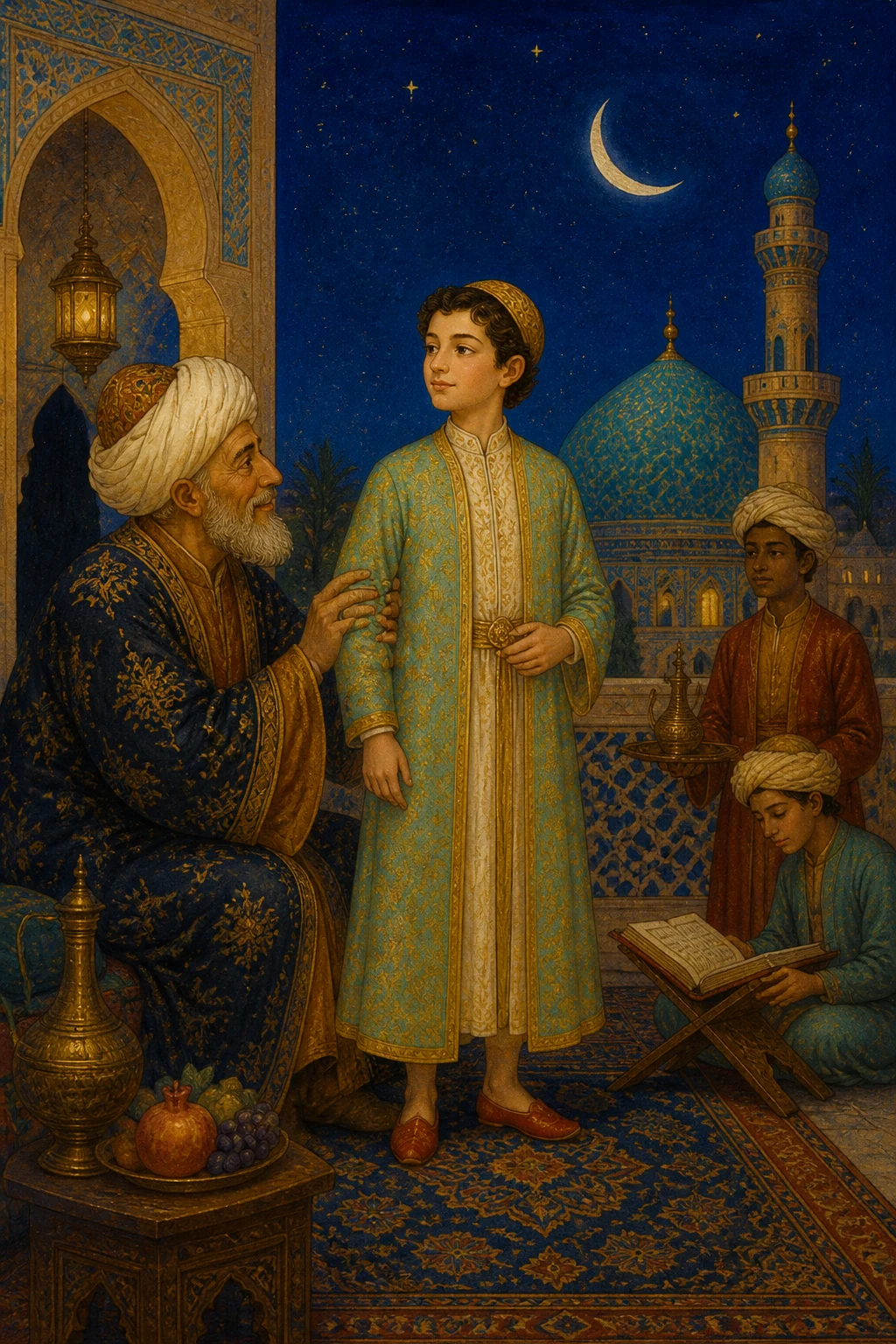
It is told that the Commander of the Faithful, Harun al-Rashid, had a son who had reached the age of sixteen. He had turned away from the world and followed the path of ascetics and devout worshippers. He would go out to the burial grounds and say, “Once you possessed the world, yet that could not save you, and now you have come to your graves. Would that I knew what you said, and what was said to you!” Then he would weep with fear and trembling, and recite these words of a poet:
“Funeral processions fill me with dread at every turn, and the weeping of the mourning women grieves me.” One day his father happened to pass him in his procession, surrounded by his ministers, the great officers of his state, and the dignitaries of his realm. They saw the son of the Commander of the Faithful wearing a woollen robe, with a woollen cloth wrapped about his head, and said to one another, “This boy has disgraced the Commander of the Faithful before the other kings. If only his father would rebuke him, he might abandon these ways.” The Commander of the Faithful overheard them, and spoke to his son about it, saying, “My son, you have disgraced me by the way you live.” The boy looked at him but made no answer. Then he looked at a bird perched on one of the palace battlements and said, “Bird, by Him who created you, come down upon my hand.” The bird swooped down onto the boy’s hand. “Return to your place,” he said, and it returned. Then he said, “Come down upon the hand of the Commander of the Faithful.” But the bird refused to alight on his hand. The boy said to his father, “It is you who have disgraced me among the friends of God by your love of this world. I have resolved to leave you, never to return to you until the hereafter.” He then journeyed down to Basra, where he worked with the labourers in clay. He would work for no more than a dirham and a daniq a day, living on the daniq and giving the dirham away in charity.
Abu Amir al-Basri said: A wall in my house had fallen down, so I went to the place where the labourers gathered to find a man to rebuild it. My eye fell upon a handsome youth with a radiant face. I approached him, greeted him, and said, “My dear boy, would you like some work?” “Yes,” he replied. “Then come with me and build a wall.” “I have certain conditions,” he said. “What are they, my dear boy?” I asked. He replied, “My wage is a dirham and a daniq, and when the muezzin gives the call to prayer, you must let me go and pray with the congregation.” “Agreed,” I said. I took him home, and he worked as I had never seen anyone work before. I offered him the midday meal, but he declined, and I knew that he was fasting. When he heard the call to prayer, he said, “You know our agreement.” “Yes,” I answered. He loosened his belt and made ready for his ablutions, which he performed more beautifully than any I had ever seen. Then he went out and prayed with the congregation, after which he returned to his work. When the afternoon call sounded, he performed his ablutions and went to pray, then came back to work again. I said to him, “My dear boy, the working day is over. Labourers work only until the afternoon prayer.” “Glory be to God!” he replied. “My work lasts until nightfall.” He went on working until night, when I gave him two dirhams. Seeing them, he asked, “What is this?” “By God,” I said, “this is only part of what your diligence in my service deserves.” But he tossed them back to me, saying, “I want nothing beyond what we agreed.” I tried to persuade him, but could not prevail, so I gave him a dirham and a daniq, and he went away.
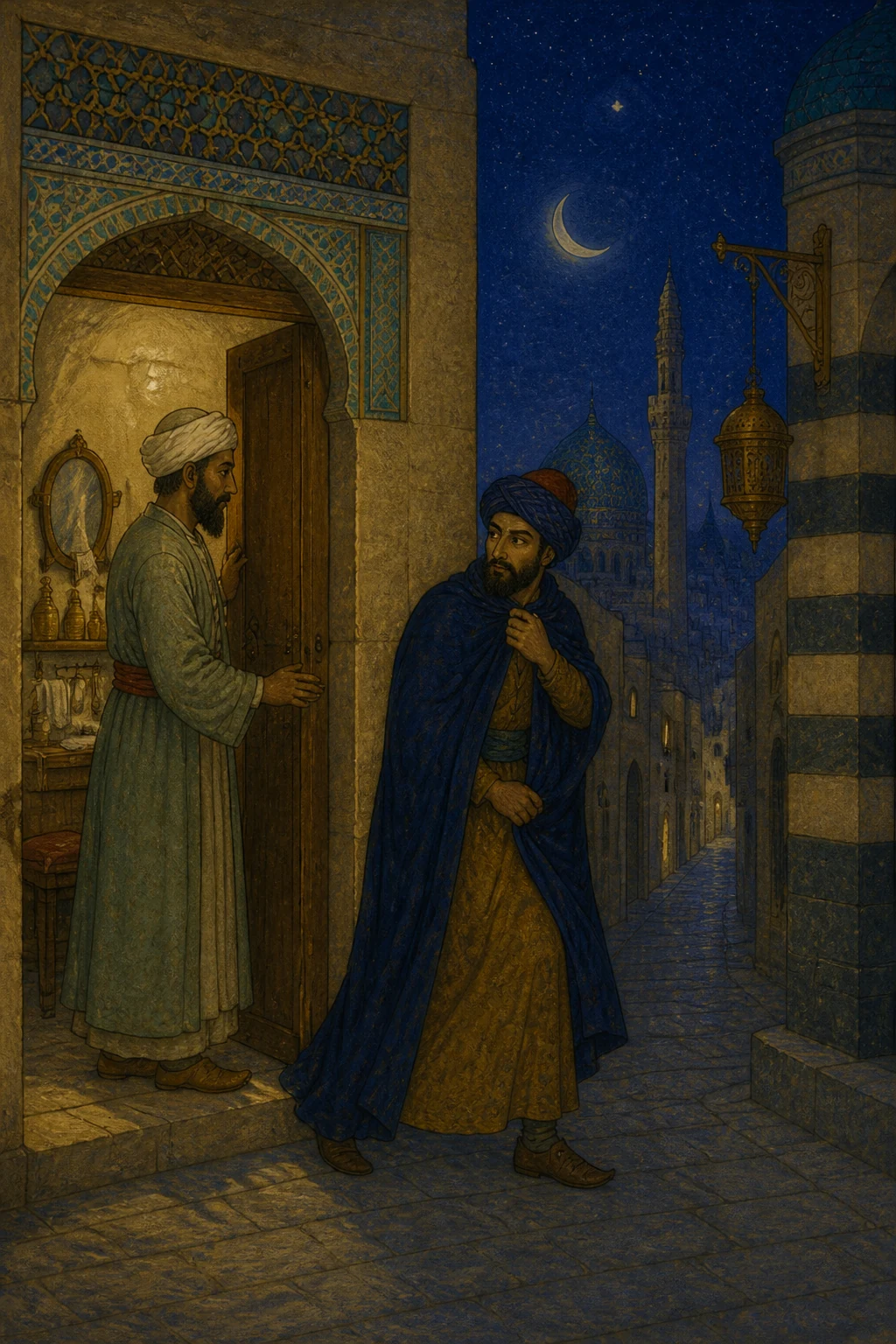
The next morning I went early to the labourers’ gathering place, but did not find him. I asked after him and was told, “He comes here only on Saturdays.” When the following Saturday came, I went there and found him. “In God’s name,” I said, “come and work for me.” “On the conditions you know,” he replied. “Yes,” I said. I took him to my house and stood watching him without his seeing me. He took a handful of clay and placed it on the wall, and behold, the stones began to set themselves one upon another. “Such are the friends of God,” I said to myself. He worked that day and accomplished even more than before. At nightfall I paid him his wage, and he took it and left. On the third Saturday I went to the gathering place but did not find him. When I asked after him, I was told, “He is ill, lying in the shelter of such-and-such a woman.” She was an old woman renowned for her piety, who had a reed shelter in the burial ground. I went there and entered, and found him lying on the bare earth with nothing beneath him, his head resting on an unbaked brick and his face shining with light. I greeted him, and he returned my greeting. Then I sat at his head, weeping to see one so young, so far from home, whom God had guided to such obedience. “Is there anything you need?” I asked. “Yes,” he said. “What is it?” “Come here tomorrow in the forenoon, and you will find me dead. Wash me and dig my grave, but tell no one. Unpick this robe I am wearing and shroud me in it. Search its pocket, take out what you find there, and keep it with you. When you have prayed over me and laid me in the earth, go to Baghdad and watch for the Caliph Harun al-Rashid to come out. Give him what you find in my pocket, and convey my greetings to him.” Then he pronounced the testimony of faith, praised his Lord in the most eloquent words, and recited these verses:
“Deliver to al-Rashid the trust of one whose death has come; in this you shall find your reward. Say: A stranger longs to see you, and through enduring love and distance answers your call. No hatred kept him from you, nor any weariness, for his welcome lay in kissing your right hand. It was only a soul too chaste to take your worldly wealth that kept him far from you, my father.” After this the boy occupied himself in asking God’s forgiveness. But morning overtook Shahrazad, and she fell silent, leaving her permitted tale untold.
Then, when it was the four hundred and second night,
She said: It has reached me, O fortunate king, that the boy then occupied himself in asking forgiveness, invoking blessings and peace upon the lord of the righteous, and reciting verses from the Quran. Then he recited these lines: “My father, do not be deceived by ease and luxury: life runs out, and pleasure passes away. If you learn of a people’s wretched plight, know that you will be called to account for them. And when you bear a body to the grave, know that you too shall one day be borne.” Abu Amir al-Basri said: When the boy had finished his instructions and his verses, I left him and went home. The next morning I returned in the forenoon and found that he had died—may God have mercy upon him. I washed him and unpicked his robe, and in its pocket I found a ruby worth thousands of dinars. “By God,” I said to myself, “this youth renounced the world utterly!” After burying him, I set out for Baghdad and went to the caliph’s palace, where I waited for al-Rashid to come out. When he did, I approached him along his route and handed him the ruby. He recognized it at once and fell unconscious. The servants seized me, but when he recovered, he told them, “Release him, and escort him gently to the palace.” They did as he commanded. When he had entered his palace, he sent for me and had me brought into his private chamber. “What has become of the owner of this ruby?” he asked. “He is dead,” I replied, and told him of the boy’s life. He began to weep, saying, “The son has prospered, and the father has failed.” Then he called out for a certain woman. She came forth, but on seeing me she was about to withdraw. “Come,” he said. “You need not be concerned about him.” She entered and greeted us, and he tossed her the ruby. When she saw it, she gave a terrible cry and fell unconscious. On recovering, she said, “Commander of the Faithful, what has God done with my son?” “Tell her his story,” he said to me, overcome by tears. I told her, and she began to weep, saying in a faint voice, “How I long to see you, O joy of my eyes! Would that I had been there to give you water when you had no one to bring you a drink! Would that I had kept you company when you had no companion!” Then her tears flowed, and she recited these verses:
“I weep for a stranger whom death found alone, with no dear friend to hear his sorrow. After honour and a household gathered about him, he came to be solitary, seeing no one. His fate reveals what the days hold hidden: death has never spared a single one of us. O absent one, whom my Lord decreed should live a stranger, once so near to me and now so far away! Though death has robbed me of the hope of seeing you, my son, tomorrow we shall meet upon the Day of Reckoning.” I said, “Commander of the Faithful, was he your son?” “Yes,” he replied. “Before I assumed this office, he used to visit scholars and sit with the righteous. But when I became caliph, he shrank from me and kept his distance. I said to his mother, ‘This boy has devoted himself entirely to God Most High. Hardship may befall him, and he may be sorely tried. Give him this ruby, so that he may have it in his hour of need.’ She gave it to him and insisted that he keep it. He obeyed her and took it, then left us to our worldly life and went away. He remained absent until he met God, mighty and glorious, pure and devout.” Then he said, “Come, show me his grave.” I went out with him and led the way until I had shown it to him. He wept and sobbed until he fell unconscious. When he recovered, he asked God’s forgiveness and said, “To God we belong, and to Him we return.” He prayed for his son, then asked me to become his companion. I replied, “Commander of the Faithful, in your son I have found the greatest of admonitions.” Then I recited these verses:
“I am a stranger, seeking shelter with no one; a stranger, though I dwell in my own land. I am a stranger, with neither family nor child, and no one of my own with whom to seek refuge. In the mosques I find shelter, and keep them filled with worship; never shall my heart depart from them. Praise be to God, Lord of all the worlds, for His bounties, so long as the spirit remains within the body.”