Prevod
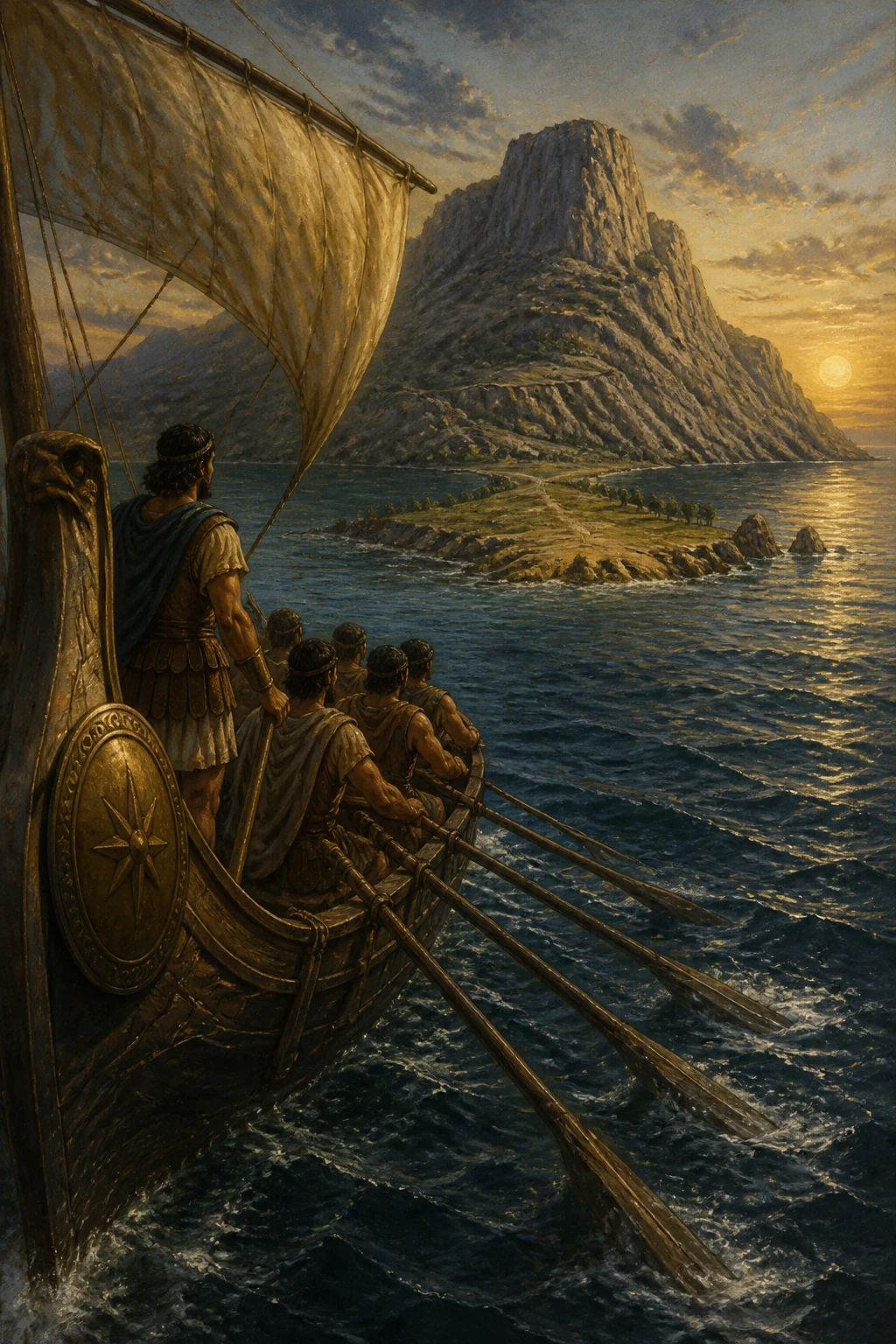
When the sun rose from the earth’s farthest bounds and shone upon the dew-wet hills, waking the shepherds, they untied their mooring ropes from the laurel’s lowest branches, put aboard as much of the spoil as they needed to take, and steered before the wind up the swirling Bosporus.
There a wave like a towering mountain rises before the ship, seeming about to rush upon her, lifted high above the clouds. You would not think it possible to escape a dreadful death, for it hangs fiercely over the very middle of the ship like a cloud. Yet even that wave subsides, if you have the good fortune to find a skilled helmsman.
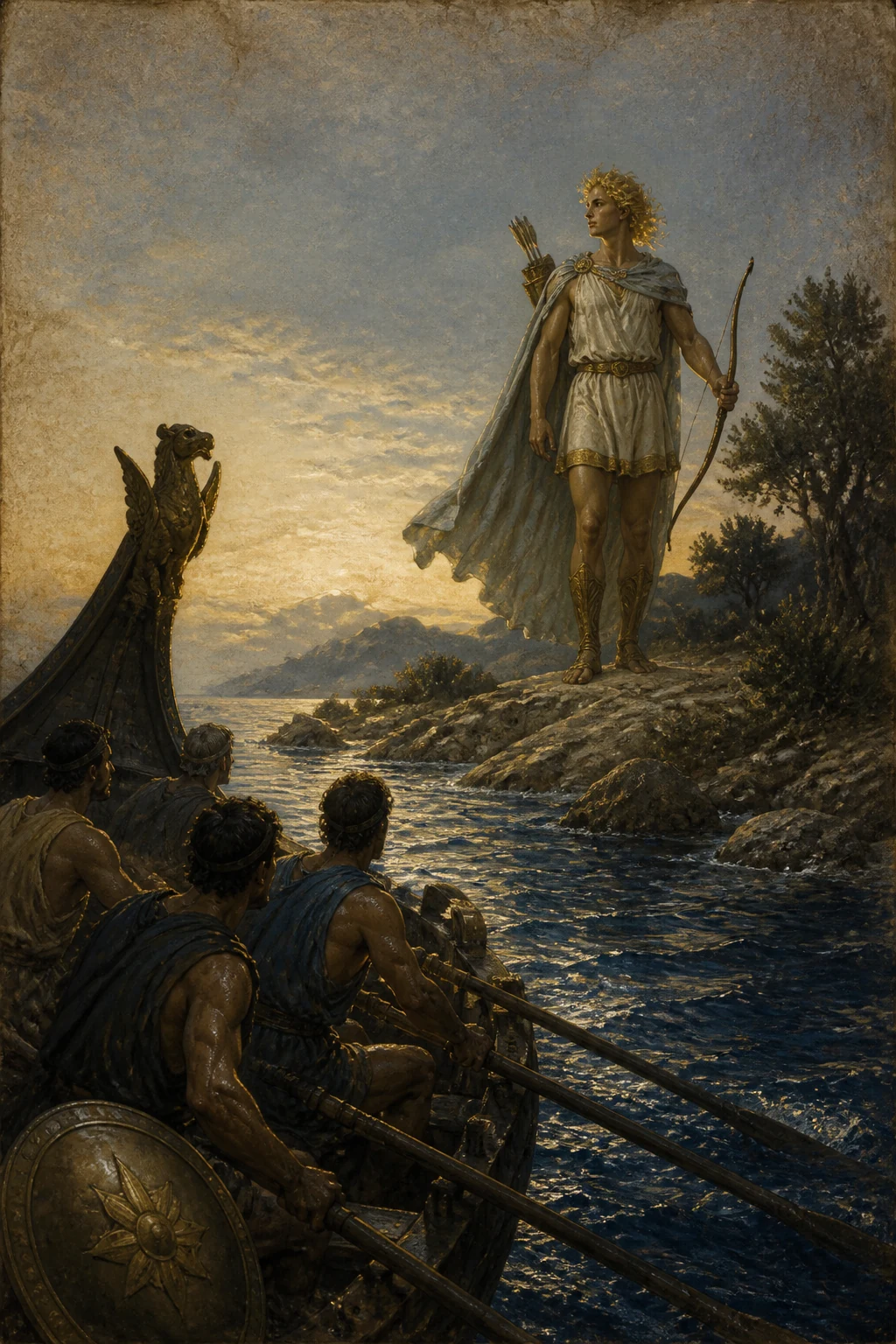
So, through the skill of Tiphys, they sailed on, unharmed but terrified. The next day they fastened their moorings to the Bithynian shore opposite. There Phineus, son of Agenor, had his dwelling by the sea. Beyond all other men he had endured grievous suffering because of the gift of prophecy that Leto’s son had once bestowed upon him. For he showed no reverence even for Zeus himself, but faithfully revealed his sacred purposes to mortals.
Therefore Zeus laid upon him a lingering old age and took the sweet light from his eyes. Nor would he allow him to enjoy the abundant food that his neighbors continually brought to his house when they came to learn his prophecies.
Instead, the Harpies would suddenly swoop down through the clouds and snatch it with their jaws from his mouth and hands. Sometimes not a morsel remained; sometimes they left a little, so that he might live on in misery.
And over it they poured a foul stench. No one could have borne it, not merely when bringing the food to his lips, but even standing far away: so vile was the reek of the remnants of his meal. As soon as Phineus heard the voices and the tread of the company, he knew that these were the men now approaching whose coming, by Zeus’s decree, would enable him to enjoy his food.
Rising from his bed like a lifeless dream, he went toward the door on shriveled feet, leaning on a staff and feeling along the walls. His limbs trembled as he moved, with weakness and old age. His wasted flesh had hardened with grime, and nothing but skin held his bones together.
When he had come out of the hall, his knees gave way beneath him, and he sat down on the courtyard threshold. A dark stupor enveloped him; the earth seemed to whirl about him from its depths, and he lay speechless in a helpless swoon.
When they saw him, they gathered round in astonishment. At last, scarcely drawing breath from the depths of his breast, he addressed them with prophetic knowledge: “Listen, you foremost men of all the Greeks, if you are indeed those whom Jason is leading aboard the Argo in quest of the fleece, under a king’s cruel command—δή corrected diacritic error (δή) in the source text.
“You are those very men. My mind still knows all things through its prophetic power. For that, lord, son of Leto, I thank you even amid my grievous suffering. By Zeus, protector of suppliants, most terrible to sinful men, by Phoebus, and by Hera herself, who above all the gods watches over your voyage, I beseech you: help me, rescue an unfortunate man from his torment. Do not sail away and leave me here, heedless of my plight. For it is not only upon my eyes that the Fury has set her heel, nor only this endless old age that I drag to its close: beyond these afflictions, another and bitterer evil hangs over me.
“The Harpies snatch the food from my mouth, swooping upon me like destroyers from some unseen place. I have no device to help me. Indeed, when hunger possesses me, I could more easily escape my own thoughts than those creatures, so swiftly do they fly through the air.
“And if they ever leave me a little food, it breathes out such a foul and unbearable stench that no mortal could endure to approach it even for a moment, though his heart were forged of adamant.
“Yet bitter, insatiable necessity compels me to remain, and, remaining, to put it into my wretched belly. It is foretold that the sons of Boreas shall drive them off. Nor will they be defending a stranger—if I am indeed that Phineus once renowned among men for wealth and prophecy, whose father was Agenor. For when I ruled among the Thracians, I brought their sister Cleopatra to my house as my bride, after giving wedding gifts.
So spoke Agenor’s son, and deep sorrow seized every hero, but above all the two sons of Boreas. Wiping away their tears, they came close, and Zetes took the suffering old man’s hand in his own and said: “Unhappy man, I declare that no mortal is more wretched than you. Why have such sorrows been laid upon you?
“Did you, despite your knowledge of prophecy, offend the gods through some ruinous folly? Is that why they are so terribly angry with you? Our hearts are troubled, eager though we are to help, if a god has indeed reserved this privilege for us two. For the rebukes of the immortals are plain enough to mortals. Eager as we are, we would not drive away the Harpies when they come until you swear that, by doing so, we shall not incur the gods’ displeasure.”
So he spoke. The old man at once raised his sightless eyes toward him, opened them wide, and answered: “Hush, my child. Do not harbor such thoughts about me. Let Leto’s son, who graciously taught me prophecy, bear witness; let the accursed fate that has fallen to my lot, and this dark cloud upon my eyes, bear witness; and let the powers beneath the earth, who would show me no mercy even in death, bear witness that no divine anger will fall upon you for helping me.”
Then, reassured by his oath, the two were eager to defend him. The younger men quickly prepared a meal for the old man, the last prey that the Harpies would seize, and the brothers stood close beside him, ready to strike the creatures with their swords when they swooped down.
The old man had scarcely touched his food when suddenly, like savage squalls or flashes of lightning, they sprang from the clouds and rushed upon him, shrieking in their hunger. At the sight the heroes cried out together; but even as the cry arose, the Harpies had devoured everything and were flying far away over the sea. Behind them lingered an intolerable stench.
After them sped the two sons of Boreas, holding their swords ready. Zeus had put tireless strength into them, for without Zeus they could not have kept pace: whenever the Harpies flew to Phineus or away from him, they always outstripped the gusts of the west wind.
As hounds skilled in hunting race along the mountain slopes on the track of horned goats or deer, and, straining just behind them, snap their teeth in vain at the ends of their jaws, so Zetes and Calais, darting close behind, reached vainly toward the Harpies with their fingertips.
And despite the gods’ will they would have torn them to pieces, overtaking them far away at the Floating Islands, had swift Iris not seen them and leapt from heaven through the air to restrain them with these words: “Sons of Boreas, it is not lawful for you to strike with your swords the Harpies, the hounds of mighty Zeus. But I myself will swear that they shall never again draw near him.”
With these words she swore by the waters of Styx, the most dread and binding oath among all the gods, that the Harpies would never again approach the house of Phineus, Agenor’s son; for so, indeed, fate had ordained.
Yielding to her oath, the brothers turned back to return to the ship. For this reason men changed the islands’ name from the Floating Islands to the Islands of Turning. Then the Harpies and Iris parted: the Harpies sank into a hiding place in Minoan Crete, while Iris soared toward Olympus, borne aloft on her swift wings.
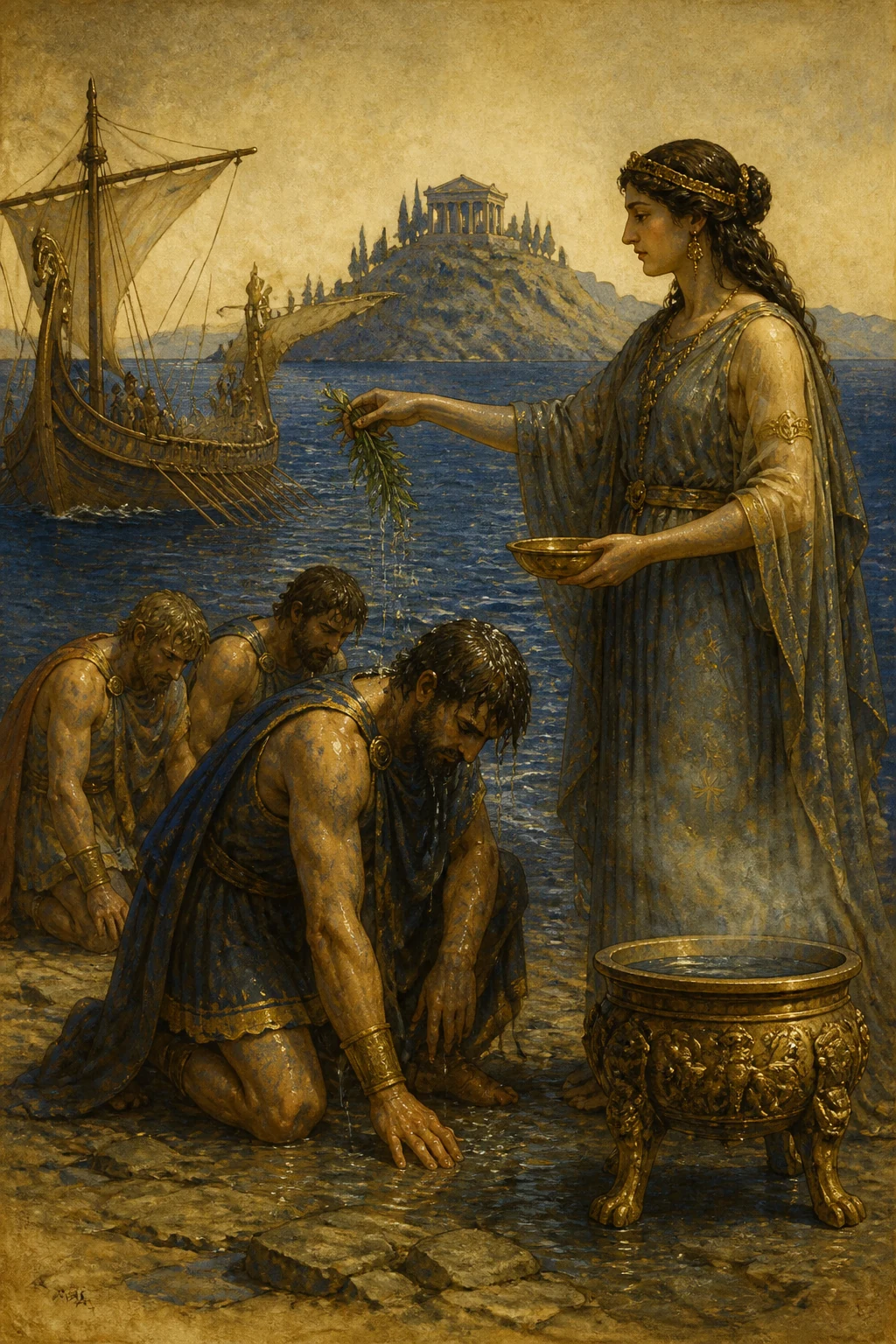
Meanwhile the heroes had washed all the grime from the old man’s skin and chosen sheep for sacrifice from those they had taken in the raid on Amycus. When they had set out a great supper in the hall, they sat down to feast. Phineus feasted eagerly with them, delighting his heart as though in a dream.
When they had eaten and drunk their fill, they stayed awake all night awaiting the sons of Boreas. The old man himself sat among them beside the hearth, telling them the course of their voyage and how they would reach its end. “Listen now,” he said. “It is not lawful for you to learn everything precisely, but whatever the gods are pleased to reveal I shall not conceal.
“Once before I sinned against the will of Zeus through folly, declaring his purposes in full, from first to last. For he himself wishes the prophecies revealed to mortals to fall short of complete knowledge, so that they may still have need of the gods’ counsel.
“First, when you leave me, you will see the two Cyanean Rocks where the sea narrows. No one, I tell you, can pass between them and escape. For they are not fixed upon deep foundations, but continually rush together against one another into a single mass, and high above them the seawater surges boiling up, while a harsh roar resounds about the rugged shore.
“So now obey my advice, if you truly mean to cross with prudent minds and reverence for the blessed gods. Do not recklessly perish by a death of your own choosing, nor rush onward at the prompting of youth.
“First make trial with a dove—δή corrected diacritic error (δή) in the source text.—releasing it from the ship to fly ahead. If it passes safely on its wings between the rocks and out to sea, do not yourselves delay upon your course, but grip your oars firmly in your hands and cleave the narrow strait. For your deliverance will depend less upon prayer than upon the strength of your arms.
“Therefore put everything else aside and labor boldly for your safety. Yet I do not forbid you to pray to the gods beforehand. But if the bird flies straight ahead and perishes between the rocks, turn back: it is far better to yield to the immortals. You could not escape destruction at those rocks, even if the Argo were made of iron.
“Poor men, do not dare to disregard my prophecy, even if you think me three times more hateful to the gods of heaven than I am, or more still. Do not dare to sail onward without the bird’s guidance.
“These things will happen as they are destined. But if you escape unharmed through the clashing rocks into the Pontus, sail on at once with the land of the Bithynians on your right, keeping clear of the breakers, until you round the swift-flowing river Rhebas and the Black Cape and reach the harbor of the Thynian island.
“From there you will cross no great stretch of sea before putting in on the opposite coast, in the land of the Mariandynians. There is a path that leads down to Hades, and the jutting Acherusian headland rises high. Below it the swirling Acheron cuts through the headland itself and pours its waters from a great ravine.
“Close beyond it you will pass many hills of the Paphlagonians, over whom Pelops of Enete first ruled, and from whose blood they boast descent. There is a headland facing Helice, the Bear, sheer on every side, which men call Carambis. The blasts of the north wind divide about it: so far does it stretch into the sea, rising to the sky.
“When you have rounded it, a long beach lies before you. At the end of that great beach, beside a jutting shore, the waters of the river Halys roar terribly as they pour forth. Beyond it, close by, the smaller Iris rolls its white eddies into the sea.
“Farther on, a great, towering elbow of land thrusts outward. Beyond it the mouth of the Thermodon, flowing down from the broad mainland, empties into a sheltered gulf beneath the Themiscyrian headland.
“There lies the plain of Doeas, and nearby are the three cities of the Amazons. Beyond them the Chalybes, the most wretched of men, inhabit a harsh and stubborn land: they are laborers, and their work is with iron.
“Nearby dwell the Tibarenians, rich in sheep, beyond the Genetaean headland sacred to Zeus, protector of strangers. Next to them the Mossynoeci inhabit the wooded mainland and its mountain slopes, where they have built their homes in wooden towers, 382a: huts and stoutly fashioned towers, which they call 383a: mossynes; from these they themselves take their name.
“After passing their country, you will put in at a low-lying island, once you have used every device to drive away the shameless birds that haunt that lonely island in countless numbers. There the Amazon queens Otrere and Antiope built a stone temple to Ares when they went to war.
“For there, out of the cruel sea, help will come to you that I must not reveal. That is why, with your welfare at heart, I tell you to stop there. But why must I offend again by declaring every detail of my prophecy without reserve?
“Beyond the island, on the mainland opposite, live the Philyres. Above the Philyres are the Macrones, and beyond them the vast tribes of the Becheires. Next to these dwell the Sapeires, and adjoining them the Byzeres, beyond whom, at last, live the warlike Colchians themselves. But sail onward until you reach the innermost recess of the sea.
“There, in the land of Cytaea, the swirling Phasis pours its broad stream into the sea, flowing from the distant Amarantian mountains and across the Circaean plain. When you have brought your ship into that river’s mouth, you will see the towers of Cytaean Aeetes and the shady grove of Ares. There, stretched high upon an oak, hangs the fleece, and about it keeps watch a serpent, a monster terrible to behold. Neither by day nor by night does sweet sleep subdue its unrelenting eyes.”
So he spoke, and at once fear seized them as they listened. Long they sat struck dumb. At last the heroic son of Aeson, bewildered by the hardships ahead, said: “Old man, you have now told us the end of our voyage’s trials, and the sign by which we may pass between the dreadful rocks into the Pontus, if we obey you. But whether, after escaping them, we shall return again to Greece—that too I would gladly learn from you.
“What am I to do? How am I to travel so great a sea road, knowing nothing of it, with companions who know no more? For Colchian Aea lies at the farthest bounds of sea and land.” So he spoke, and the old man answered him: “My child, once you have escaped through the deadly rocks, take courage. A god will guide you by another route from Aea, and after Aea you will have guides enough.
“But, friends, consider the cunning aid of the Cyprian goddess. For upon her depends the glorious fulfillment of your labors. Ask me no more beyond this.” So spoke Agenor’s son. Just then the two sons of Thracian Boreas swooped down through the air and set their swift feet upon the threshold. At the sight of their return, the heroes sprang from their seats.
Still panting heavily from his exertions, Zetes told his eager listeners how far they had driven the Harpies, how Iris had restrained them from killing the creatures, and what oaths the kindly goddess had sworn. The Harpies, he said, had fled in terror into a vast cavern in the Dictaean cliff.
Then all the companions in the house, and Phineus himself, rejoiced at the news. At once the son of Aeson addressed him with heartfelt goodwill: “Phineus, surely some god took pity on your grievous affliction and brought us here from far away so that the sons of Boreas might defend you. If he would also give your eyes their light, I think I should rejoice as much as if I had returned to my own home.”
So he spoke, but Phineus bowed his head and answered: “Son of Aeson, that cannot be recovered; there is no remedy to restore it, for my empty eyes have wasted away. Instead, may the god soon grant me death, and when I am dead I shall share in every blessing.”
Thus they spoke to one another in turn. Before long, while they were still conversing, early-born Dawn appeared. The men who lived nearby gathered around Phineus, as they had often come there before by day, each bringing, as always, a share of his own food.
The old man prophesied kindly for them all, however humble the man who came, and through his prophetic gift had freed many from their troubles. Therefore they visited him and cared for him. With them came Paraebius, whom he loved most dearly, and he was delighted to see the heroes in the house.
For Phineus himself had foretold long before that a company of noble men, sailing from Greece toward the city of Aeetes, would moor their ship in the Thynian land, and that they would restrain the Harpies that came upon him at Zeus’s command.
The old man then sent his visitors away, comforting them with wise words, but asked Paraebius alone to stay there with the heroes. Soon afterward he urged him to go and bring back the finest of their sheep. When Paraebius had left the hall, he spoke gently to the assembled oarsmen: “Friends, not all men, it seems, are arrogant or forgetful of kindness. This man too, good as he is, once came here to learn his fate.
“For the more he labored and the harder he toiled, the more his poverty wore him down. Each day dawned more cruelly than the last, and there was no respite from his suffering.
“Yet he was paying the bitter penalty for his father’s sin. Once, while cutting trees alone in the mountains, his father had scorned the pleas of a Hamadryad nymph. Weeping, she implored him with earnest words not to cut the trunk of the oak that had grown with her, in which she had lived through all her long life. But in the reckless pride of youth he cut it down.
“So the nymph laid a bitter fate upon him and upon his children after him. When this man came to me, I understood the sin, and told him to build an altar to the Thynian nymph and offer sacrifices of atonement upon it, praying to escape his father’s doom.
“After he escaped that heaven-sent affliction, he never forgot or neglected me. I can scarcely send him out of doors against his will, so eager is he to remain beside me in my suffering.” So spoke Agenor’s son. Soon Paraebius returned, bringing two sheep from the flock. At the old man’s bidding Jason rose, and with him the sons of Boreas.
At once they called upon Apollo, god of prophecy, and offered sacrifice upon the hearth as the day was just declining. The younger companions prepared a satisfying feast. When they had eaten well, some lay down beside the ship’s moorings, while others slept together in the house.
At dawn the Etesian winds began to blow, those breezes that, through Zeus’s aid, breathe alike over all the earth. It is told that in ancient times a maiden named Cyrene tended sheep beside the marsh of the Peneus, for she delighted in maidenhood and an untouched bed. But Apollo carried her away while she was tending her flock beside the river and set her far from Haemonia among the nymphs of the land who dwelt in Libya near the Myrtoan height.
There she bore Phoebus a son, Aristaeus, whom the Haemonians, rich in cornfields, call Agreus and Nomius. In his love the god made her a long-lived nymph of that place, a huntress, but carried his infant son to Chiron’s cave to be reared.
When the boy had grown, the divine Muses arranged his marriage and taught him the arts of healing and prophecy. They made him shepherd of their flocks, which grazed across the Athamantian plain of Phthia, around towering Othrys, and beside the sacred stream of the Apidanus.
When Sirius scorched the Minoan islands from the sky, and for a long time their inhabitants could find no remedy, they summoned him, at the command of the Far-Shooter, to defend them against the pestilence. At his father’s bidding he left Phthia and settled in Ceos, gathering a company of Parrhasians, descendants of Lycaon. He built a great altar to Zeus, bringer of moisture, and on the mountains duly offered sacrifices to the star Sirius and to Zeus himself, son of Cronus. For this reason the Etesian breezes sent by Zeus cool the earth for forty days; and even now the priests in Ceos offer sacrifices before the rising of the Dog Star.
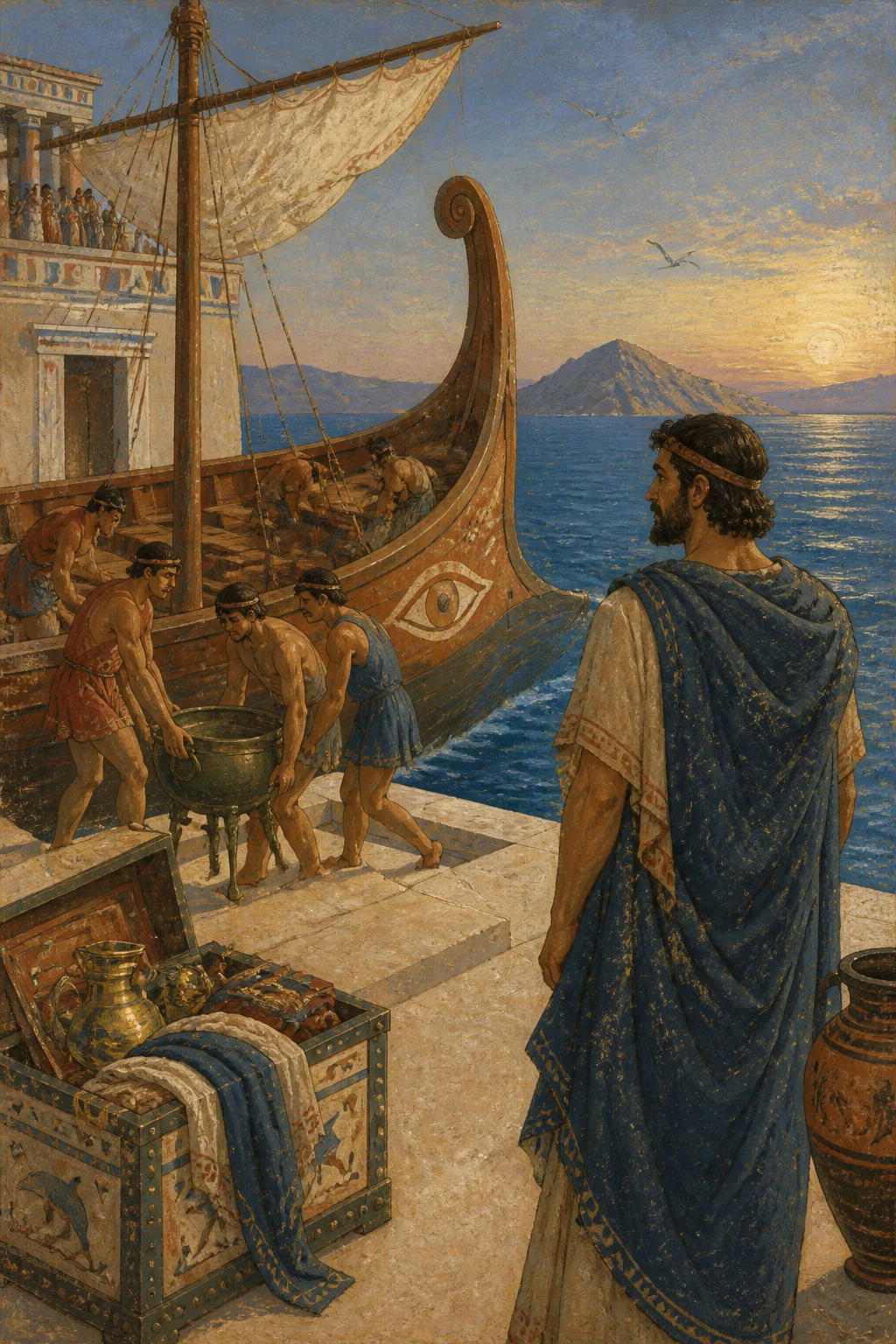
Such is the tale they tell. Meanwhile the heroes remained there, held back by the winds, and all day long the Thynians sent them abundant gifts of hospitality to show their goodwill toward Phineus.