Waltey
Favst in Dafroza
Cuentos antiguos
Cuentos de Navidad, de la patria y antiguos · Emilia Pardo BazánO besedilu
Favst in Dafroza
- Vir
- Cuentos de Navidad, de la patria y antiguos
- Avtor
- Emilia Pardo Bazán
- Jezik branja
- English
- Jezik izvirnika
- Español
- Čas branja
- 7 min branja
- Obseg
- 5 strani
- Naslov izvirnika
- 037 Fausto y Dafrosa
O izvirniku
Cuentos de Navidad, de la patria y antiguos
Sedemintrideset avtorskih zgodb v treh zgodovinskih knjižnih skupinah. Bralni jezik je English, izvirnik pa prihaja iz vira Cuentos de Navidad, de la patria y antiguos v jeziku Español.
Besedilo
Favst in Dafroza
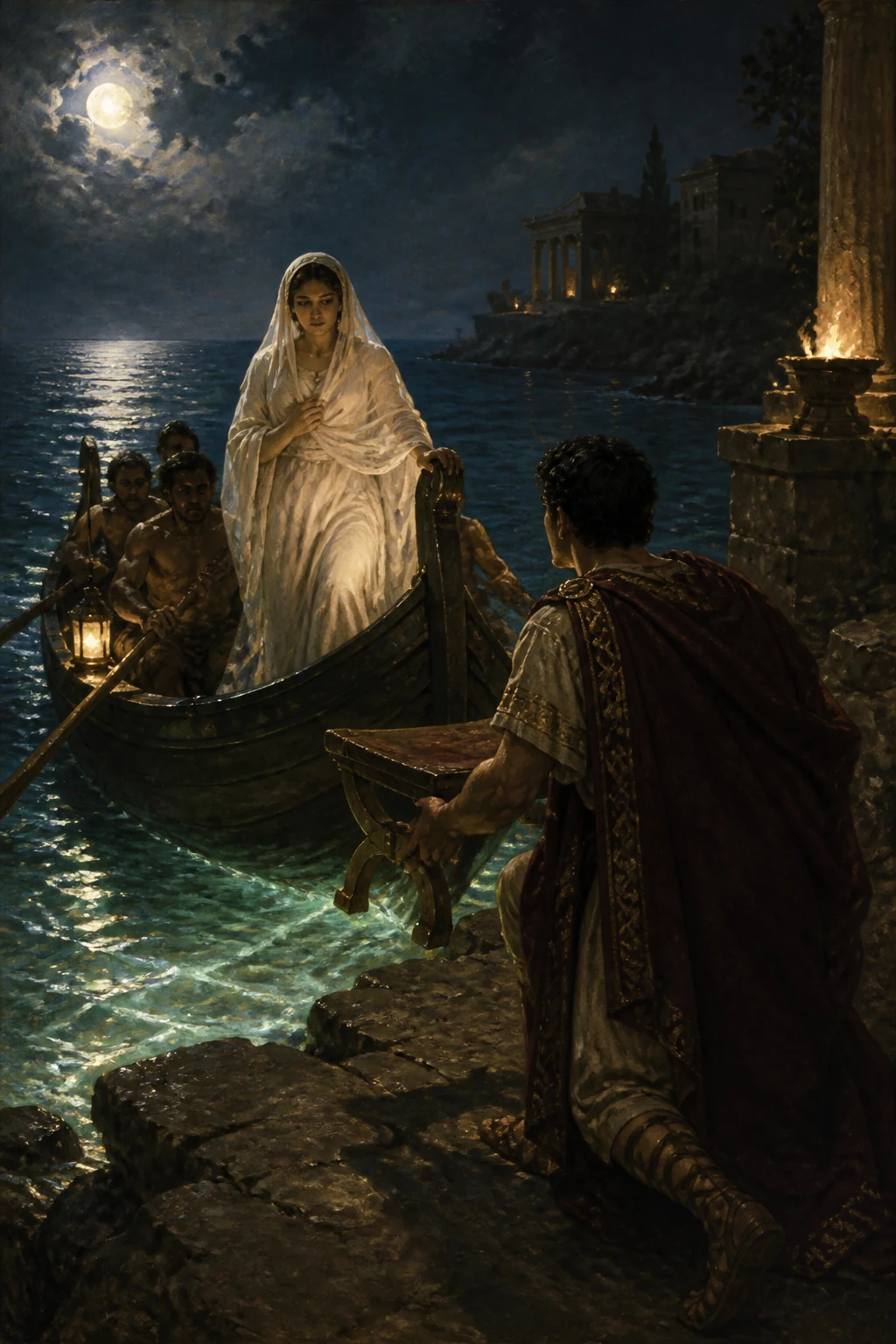
He was waiting for her at the landing as night fell, and when he caught sight in the distance of the boat, driven forward by the rowers’ strong arms, cutting a greenish wake of light through the phosphorescent sea, the blood surged into Fausto’s heart and his eyes grew dim.
She was coming—or rather, they were bringing her, handing her over to him; she would be in his power, the woman for whom he had so often lain awake all night, feverish, tasting bitterness, despairing and biting his fists with rage, or hoping against all reason.
Against all reason? Criminally would be nearer the truth. For the woman reclining in the bow, wrapped in white veils, lost in thought, Fausto had stooped to informing and spying like a freedman, casting a black stain upon the honour of his consular lineage. For her he had whispered into the Apostate Emperor’s ear the counsel that had proved fatal to the former prefect Flaviano; and on more than one evening, in the wavering light of the three-wicked bedchamber lamp, the shadows of the curtains had traced before Fausto’s terrified eyes the pale figure of an illustrious man, his forehead marked by the iron used to brand malefactors... But at that moment the musical splash of the oars banished remorse and anguish, and from the depths of the waters the voices of the sirens of happiness rose like a hymn...
Fausto hurried down to the quay and, taking the cedarwood stool from the slaves, set it beneath Dafrosa’s foot; but she leapt nimbly onto the pointed stones without resting her weight upon it. To the greeting, the “Ave!” that Fausto uttered in a trembling voice, she replied with a sad smile. They set off towards the villa, Fausto not daring to offer his arm for Dafrosa to lean upon. Yet the matron’s slight breathlessness suggested that such help would not have been amiss.
On the villa’s terrace, lit by torches fixed to the wall, a welcoming repast had been laid out: milk, fruit, fine white bread, boiled fish—the simple fare a Christian woman favoured. Fausto pointed this out to Dafrosa, who broke one of the loaves and raised a piece to her lips, first making the sign of the cross. Fausto and the woman he had so long desired were left alone. The stars twinkled in the deep-blue firmament, and the air wafted gusts of fragrance from crimson roses—roses the Emperor Juliano himself had brought from Alexandria to festoon the altar of Aphrodite, for their scent was believed to possess the power of a love potion to enthral the heart.
It was Dafrosa who broke the dangerous silence. “Fausto,” she said with quiet melancholy, “who would have told us that we should meet again like this? When I tearfully confessed that I could not forget you, could I have imagined that the Sacred Emperor would banish me to live with you?”
Fausto hesitated, uncertain whether to fall at the matron’s feet and clasp her knees or to make some reply—he knew not what. Then Dafrosa threw back the white veil surrounding the oval of her face, and by the torchlight Fausto saw, in astonishment, a face wasted by grief, dulled eyes, hollow cheeks; her hair, modestly bound with violet woollen ribbons, was no longer that golden mass, that halo of gold. Dafrosa’s hair had turned entirely grey: the grey of clouds, the grey of dry ashes heaped upon the hearth!
“You may look at me without fear, Fausto,” she added. “I am another woman. The Dafrosa you knew is no longer in this world. Once you have looked at me, you will return to your palace in Rome and leave me alone on this island, where I shall do penance. I have been justly punished for loving you, an involuntary love I could not tear out of myself, however hard I tried. They took my husband away to kill him by slow degrees, and me they scorned. I deserved it. Now those wicked men are handing me over to you, perhaps because they believe you are a danger. For Dafrosa there are no dangers left. Look at me as I am; take your time, look closely; examine me. Divine mercy has stripped me of all my beauty.”
Fausto stood motionless, filled with a strange feeling, unlike any that had ever stirred his complex soul, the soul of a Roman of the decadence, a friend of that refined philosopher, the Caesar Juliano. Not long before, in the imperial palace, before the restored altars of Hellenic Kaleos, the two friends had solemnized a pact, a kind of mysterious initiation into a secret cult, unlike the vulgar paganism that sated itself with sacrifices of oxen and calves, with impure ceremonies. This other religion, which Juliano preferred, replaced theogony and superstition with the worship of supreme beauty, of Form in its divine harmony, its sacred proportion, whose concord the intellect perceives beyond the senses. A statue of a woman, supremely perfect, flawless in its lines, the work of Phidias, rose above the altar in the middle of the little chapel, or cella, where the emperor performed the rite, pouring clear libations and burning Sabaean incense in a golden censer of exquisite Eastern workmanship. And the Apostate, taking his friend by the hand, made him prostrate himself there, murmuring: “This is the Goddess, this—and not the sorrowful Galilean, who has brought ugliness into the world.” And now, in Dafrosa’s presence—the woman he had so coveted when she belonged to Flaviano and lived secluded beside her household gods lest her eyes betray her thoughts—Fausto felt within himself an upheaval, an incomprehensible change. The longings, the delirium, the hunger to possess, the fever of passion so long endured, nourished by Beauty, which binds souls and does not release them until the grave, had vanished. The adored Form no longer existed, nor did anything that sprang from it. In the tranquil sea the singing sirens had fallen silent; in the deep-blue sky the stars no longer twinkled with love. The roses gave off not an atom of fragrance: the night dew was perhaps freezing their cups, pouring a chill serenity into them. The stubborn bonds of the flesh were breaking within Fausto; his blood, once fire, flowed through his veins transformed into light. And approaching Dafrosa, he took her hands and raised them to his forehead, murmuring with a sigh:
“Because you have lost your beauty, I love you more. You will think it cannot be true, and yesterday I would have thought so too; but believe me, I am not deceiving you.”
Dafrosa did not withdraw her hands. This simple contact inspired less horror in the Christians of those centuries than in those of our own, perhaps because in those days they were more chaste at heart. Dafrosa’s palms caressed Fausto’s bowed head, and, bringing her lips close to his ear, she whispered:
“I believe you. What you tell me is natural. You too, Fausto, my brother, are a Christian.” The chronicle relates that Saint Fausto suffered martyrdom and that Saint Dafrosa recovered his body by night so that the dogs would not devour it, paying for this act of charity with her life.
Izvirnik
037 Fausto y Dafrosa
Naslednje strani prikazujejo izvirno besedilo za primerjavo.
La aguardaba en el embarcadero á boca de noche, y cuando divisó á lo lejos la barca, que avanzaba al empuje de los brazos fuertes de los remeros, abriendo estela de luz verdosa en el mar fosforescente, al corazón de Fausto se agolpó la sangre, y sus ojos se nublaron.
Venía, ó mejor dicho, la traían, se la entregaban; en su poder iba á estar aquélla por quien tantas veces había pasado la noche en vela, febril, paladeando acíbar, desesperando y mordiéndose los puños de rabia, ó esperando insensatamente.
¿Insensatamente? Criminalmente se diría mejor. Por aquella que se reclinaba en la proa, envuelta en blancos velos, en actitud pensativa, Fausto había descendido á la delación y al espionaje como un liberto, echando negra mancha sobre el decoro de su estirpe consular. Por ella había deslizado en los oídos del Emperador Apóstata el consejo fatal al ex-prefecto Flaviano, y más de una velada, á la claridad indecisa de la triple lámpara cubicularia, las sombras del cortinaje dibujaron ante los ojos espantados de Fausto la pálida figura de un varón ilustre marcado en la frente con el hierro que estigmatiza á los facinerosos... Pero en aquel instante el musical chapaleteo de los remos ahuyentaba remordimientos y angustias, y de lo profundo de las aguas la voz de las sirenas de la felicidad subía como un himno...
Descendió Fausto al muelle con precipitación, y cogiendo de manos de los esclavos el taburete de cedro, lo presentó al pie de Dafrosa, que prontamente, sin hacer hincapié, saltó á las puntiagudas piedras. A la salutación, al ¡Ave! que en temblorosa voz articuló Fausto, respondió ella con una sonrisa triste. Y echaron á andar hacia la villa, sin que Fausto se atreviese á ofrecer el antebrazo para que Dafrosa se apoyase. Un poco de sobrealiento de la matrona indicaba, sin embargo, que no hubiese sido supérfluo el auxilio.
En la terraza de la villa, alumbrada por antorchas fijas en la pared, estaba dispuesto un refresco de bienvenida; leche, frutas, pan de flor, peces cocidos--los sencillos manjares de que gusta una cristiana.--Se lo hizo observar Fausto á Dafrosa, la cual, rompiendo uno de los panes, lo llevó á los labios, no sin hacer antes la señal de la cruz. Quedáronse solos Fausto y la tan deseada. Parpadeaban las estrellas en el firmamento turquí, y el aire columpiaba bocanadas de esencia de rosas purpúreas--unas rosas que el mismo emperador Juliano había traído de Alejandría para adornar con festones de ellas el ara de la Afrodita, porque se atribuían á su aroma virtudes como de filtro para enajenar el corazón.
Fue Dafrosa quien rompió el peligroso silencio.
--Fausto--dijo con tranquila melancolía,--¿quién nos dijera que nos encontraríamos así otra vez? Cuando yo me confesaba llorando de que no podía olvidarte, ¿iba á suponer que el Sacro Emperador me desterrase á vivir contigo?
Indeciso Fausto, dudó entre caer á los pies de la matrona y abrazar sus rodillas ó contestar algo--no sabía qué.--Entonces Dafrosa echó atrás el velo blanco que envolvía el óvalo de su rostro, y á la luz de las antorchas Fausto pudo ver con asombro una cara consumida por el dolor, unos ojos marchitos, unas mejillas demacradas; el pelo, recogido modestamente con cintas de lana violeta, no era ya aquella rubia vedija, aureola de oro; ¡á Dafrosa se le había vuelto el cabello todo gris, del gris de las nubes, del gris de la ceniza seca y hacinada en el hogar!
--Puedes mirarme impunemente, Fausto--añadió ella.--Soy otra. La Dafrosa que conociste no está ya en el mundo. Después de que me contemples, te volverás á tu palacio de Roma, dejándome sola en esta isla, donde haré penitencia. He sido justamente castigada por haberte querido, cariño involuntario que yo no podía arrancar de mí por más que hacía. Se llevaron á mi marido para matarle poco á poco, y á mí me despreciaron. Lo merecía. Ahora los malvados me entregan á ti, quizás por creer que tú eres un peligro. Para Dafrosa ya no hay peligros. Mírame así; despacio, con atención; examíname. La misericordia divina me ha quitado enteramente mi hermosura.
Inmóvil permanecía Fausto, penetrado de un sentimiento singular, diferente de cuantos hasta entonces habían agitado su alma complicada de romano de la decadencia, de amigo del refinado filósofo, el césar Juliano. No hacía mucho que en el palacio imperial, ante las aras restauradas de la Kaleos helénica, habían celebrado los dos amigos un pacto, especie de misteriosa iniciación de un culto secreto, diverso del vulgar paganismo que se saciaba con los sacrificios de bueyes y terneros, con las ceremonias impuras. Esta otra religión, preferida por Juliano, reemplazaba la teogonía y las supersticiones con la adoración de la belleza suprema, de la Forma en su armonía divina, en su euritnia sacrosanta, cuya relación percibe la inteligencia por encima de los sentidos. Una estatua de mujer, perfectísima, de líneas impecables, obra de Fidias, se erguía sobre el ara, en mitad de la capillita ó cella donde el emperador cumplía el rito, derramando las claras libaciones, quemando el incienso sabeo en el pebetero de oro de exquisita labor oriental. Y el Apóstata, tomando de la mano á su amigo, le obligaba á postrarse allí, murmurando: «Esta es la Diosa, ésta, y no el triste Galileo, que ha traído la fealdad al mundo.» Y ahora, Fausto, en presencia de Dafrosa, la mujer tan codiciada cuando la poseía Flaviano y ella vivía recluída al pie de sus lares, por no descubrir en los ojos los pensamientos, ahora Fausto advertía en sí mismo un trastorno, una variación incomprensible. Los afanes, los delirios, las ansias de posesión, la fiebre pasional tanto tiempo sufrida, alimentada por la Beldad, que ata las almas y no las suelta hasta el sepulcro, habían desaparecido. La Forma adorada no existía, y tampoco lo que se deriva de ella. En el mar tranquilo habían enmudecido las sirenas cantoras; en el cielo turquí las estrellas ya no parpadeaban de amor. Las rosas no desprendían ni un átomo de esencia: el rocío de la noche probablemente congelaba sus cálices, derramando en ellos una serenidad frígida. Las tenaces ligaduras de la carne se rompían en Fausto; su sangre, antes fuego, discurría convertida en luz por las venas. Y acercándose á Dafrosa, la tomó las manos y las llevó á su frente, murmurando en un suspiro:
--Porque has perdido tu hermosura, te quiero más. Te parecerá que es mentira, y á mí ayer me lo parecería también, pero mira que no te engaño.
No retiró las palmas Dafrosa. Este sencillo contacto no infundía tanto horror á los cristianos de aquellos siglos como á los actuales, acaso porque entonces eran más castos en su corazón. Las palmas de Dafrosa halagaron la inclinada cabeza de Fausto, y acercando los labios á su oído, susurró:
--Te creo. Es natural eso que me dices. Tú, Fausto, hermano mío, eres cristiano también.
La crónica refiere que San Fausto sufrió el martirio y que Santa Dafrosa recogió de noche su cuerpo para que no lo devorasen los perros, pagando esta obra de caridad con la vida.
Nadaljuj z branjem