Waltey
Duh v steklenici
Grimmove pravljice · Jacob in Wilhelm GrimmO besedilu
Duh v steklenici
- Vir
- Grimmove pravljice
- Avtor
- Jacob in Wilhelm Grimm
- Jezik branja
- English
- Jezik izvirnika
- Deutsch
- Čas branja
- 9 min branja
- Obseg
- 7 strani
- Naslov izvirnika
- Der Geist im Glas
O izvirniku
Grimmove pravljice
Gozdovi, čarobni predmeti in ljudska logika evropske pripovedne tradicije. Bralni jezik je English, izvirnik pa prihaja iz vira Grimmove pravljice v jeziku Deutsch.
Besedilo
Duh v steklenici
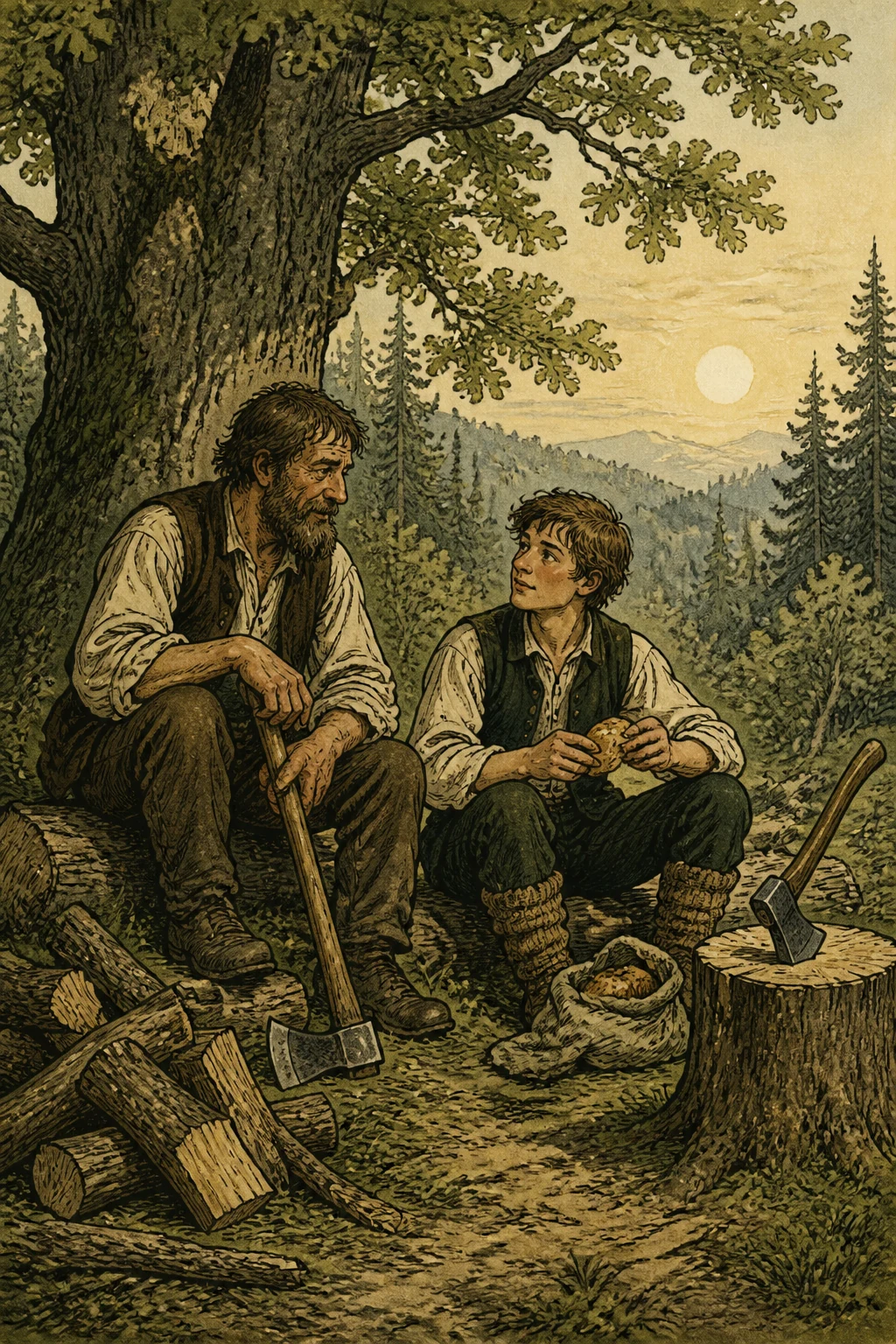
Once upon a time there was a poor woodcutter who worked from morning until late at night. When at last he had saved a little money, he said to his boy, "You are my only child, and I mean to spend the money I have earned by the sweat of my brow on your education. If you learn something worthwhile, you will be able to support me in my old age, when my limbs have grown stiff and I must sit at home." So the boy went to a university and studied diligently, earning the praise of his teachers, and remained there for some time. But after he had completed several courses of study, though he had not yet mastered everything, the little his father had scraped together was all spent, and he had to return home. "Alas," said his father sadly, "I can give you nothing more, and in these dear times I cannot earn a penny beyond what we need for our daily bread." "Dear Father," answered the son, "do not trouble yourself about it. If this is God's will, it will turn out for the best. I shall make the best of it." When the father was about to go into the forest to earn a little by cutting and stacking firewood, the son said, "I will go with you and help." "Ah, my son," said the father, "you would find it hard. You are not used to heavy work and would never stand it. Besides, I have only one axe and no money to buy another." "Just go to the neighbour," answered the son. "He will lend you his axe until I have earned enough to buy one of my own."
So the father borrowed an axe from the neighbour, and at daybreak the next morning they went out into the forest together. The son helped his father, working briskly and cheerfully. When the sun stood high above them, the father said, "Let us rest and eat our midday meal. We shall work all the better afterwards." The son took his bread in his hand and said, "You rest, Father. I am not tired. I shall walk about in the forest a little and look for birds' nests." "You silly fellow," said his father, "why do you want to go wandering about? Afterwards you will be tired and unable to lift your arm. Stay here and sit beside me!"
But the son went into the forest, eating his bread in high spirits and peering into the green branches to see whether he could spot a nest. He wandered to and fro until at last he came to a great, forbidding oak, surely many hundreds of years old, so broad that five men could not have encircled it with their arms. He stopped and looked at it, thinking, "Many a bird must have built its nest in there." Suddenly he thought he heard a voice. He listened and heard a deep, muffled cry: "Let me out! Let me out!" He looked all around but could see nothing, though the voice seemed to come from beneath the ground. So he called, "Where are you?" The voice answered, "I am down here among the oak roots. Let me out! Let me out!" The student began clearing away the debris beneath the tree and searching among the roots, until at last he discovered a glass bottle in a little hollow. He lifted it up and held it to the light, and inside he saw something shaped like a frog, hopping up and down. "Let me out! Let me out!" it cried again, and the student, suspecting no harm, pulled the stopper from the bottle. At once a spirit rose out of it and began to grow, swelling so swiftly that within a few moments a dreadful creature, half as tall as the tree, stood before the student. "Do you know," it cried in a terrible voice, "what your reward shall be for letting me out?" "No," answered the student fearlessly. "How should I know?" "Then I shall tell you," cried the spirit. "I must break your neck for it." "You should have told me that before," answered the student. "Then I would have left you where you were. But my head is not yours to take. Others must have a say in that." "Others or no others," cried the spirit, "you shall have the reward you deserve. Do you think I was shut up there all that time as a kindness? No, it was my punishment. I am the mighty Mercurius. Whoever releases me, I must break his neck." "Easy now," answered the student. "Not so fast. First I must be sure that you really were inside that little bottle, and that you are indeed the same spirit. If you can get back into it, I will believe you, and then you may do whatever you please with me." Full of pride, the spirit said, "That is a simple trick," and drew himself together, becoming as thin and small as he had been at first, until he could creep back through the same opening and down the neck of the bottle. But scarcely was he inside when the student thrust the stopper back in and tossed the bottle among the oak roots where it had lain before. The spirit had been outwitted.
The student was about to return to his father, but the spirit cried most pitifully, "Oh, do let me out! Do let me out!" "No," answered the student, "not a second time. Once someone has tried to take my life, I will not let him loose again after I have caught him." "If you set me free," cried the spirit, "I will give you enough to last you all your days." "No," answered the student, "you would deceive me as you did the first time." "You are throwing away your good fortune," said the spirit. "I will do you no harm, but reward you richly!" The student thought, "I will risk it. Perhaps he will keep his word, and I shall see to it that he does me no harm." So he took out the stopper, and the spirit rose out as before, stretching and swelling until he was as tall as a giant. "Now you shall have your reward," he said, and handed the student a little scrap of cloth, just like a plaster. "If you rub a wound with one end," he said, "it will heal; and if you rub steel or iron with the other, it will turn to silver." "I must try that first," said the student. He went to a tree, cut a gash in its bark with his axe, and rubbed it with one end of the plaster. At once the bark closed up again and was healed. "Well, it is just as you said," he told the spirit. "Now we may go our separate ways." The spirit thanked him for setting him free, and the student thanked the spirit for his gift and went back to his father.
"Where have you been wandering?" said his father. "Why have you forgotten your work? I said from the start that you would get nothing done." "Do not fret, Father. I will make up for it." "Make up for it indeed!" said his father angrily. "This is no way to work." "Watch, Father. I shall fell that tree in a moment, and down it will come with a crash." He took his plaster, rubbed the axe with it, and struck a mighty blow. But because the iron had turned to silver, the cutting edge bent over. "Why, Father, just look! What a poor axe you have given me. It has bent right out of shape." His father was horrified and said, "Oh, what have you done? Now I must pay for the axe, and I do not know what with. This is all the good your work has done me." "Do not be angry," answered the son. "I shall pay for the axe." "You blockhead!" cried his father. "What will you pay for it with? You have nothing but what I give you. Your head is full of students' tricks, but you know nothing about woodcutting."
After a little while the student said, "Father, I cannot do any more work now, so we might as well call it a day." "What nonsense!" his father answered. "Do you think I mean to sit with my hands in my lap as you do? I still have work to do, but you can be off home." "Father, this is my first time in this forest. I do not know the way on my own. Please come with me!" By now his father's anger had cooled, and at last he allowed himself to be persuaded and went home with him. There he said to his son, "Go and sell the ruined axe, and see what you can get for it. I shall have to earn the rest to pay the neighbour back." The son took the axe and carried it into town to a goldsmith, who tested it, laid it on the scales, and said, "It is worth four hundred thalers. I do not have that much in ready money." The student said, "Give me what you have, and you may owe me the rest." The goldsmith gave him three hundred thalers and remained a hundred in his debt. Then the student went home and said, "Father, I have some money. Go and ask what the neighbour wants for the axe." "I know already," answered the old man. "One thaler and six groschen." "Then give him two thalers and twelve groschen. That is twice as much, and quite enough. You see, I have money to spare." He gave his father a hundred thalers and said, "You shall never want for anything. Live as comfortably as you please." "My God," said the old man, "how did you come by such riches?" Then the son told him all that had happened, and how, trusting to his good fortune, he had made so rich a catch. With the rest of the money he returned to the university and continued his studies, and because he could heal every wound with his plaster, he became the most celebrated doctor in the whole world.
Izvirnik
Der Geist im Glas
Naslednje strani prikazujejo izvirno besedilo za primerjavo.
Ein Märchen der Brüder Grimm
Es war einmal ein armer Holzhacker, der arbeitete vom Morgen bis in die späte Nacht. Als er sich endlich etwas Geld zusammengespart hatte, sprach er zu seinem Jungen: "Du bist mein einziges Kind, ich will das Geld, das ich mit saurem Schweiß erworben habe, zu deinem Unterricht anwenden; lernst du etwas Rechtschaffenes, so kannst du mich im Alter ernähren, wenn meine Glieder steif geworden sind und ich daheim sitzen muß." Da ging der Junge auf eine hohe Schule und lernte fleißig, so daß ihn seine Lehrer rühmten, und blieb eine Zeitlang dort. Als er ein paar Schulen durchgelernt hatte, doch aber noch nicht in allem vollkommen war, so war das bißchen Armut, das der Vater erworben hatte, draufgegangen, und er mußte wieder zu ihm heimkehren. "Ach," sprach der Vater betrübt, "ich kann dir nichts mehr geben und kann in der teuren Zeit auch keinen Heller mehr verdienen als das tägliche Brot." - "Lieber Vater," antwortete der Sohn, "macht Euch darüber keine Gedanken, wenn's Gottes Wille also ist, so wird's zu meinem Besten ausschlagen; ich will mich schon dreinschicken." Als der Vater hinaus in den Wald wollte, um etwas am Malterholz (am Zuhauen und Aufrichten) zu verdienen, so sprach der Sohn: "Ich will mit Euch gehen und Euch helfen." - "Ja, mein Sohn," sagte der Vater, "das sollte dir beschwerlich ankommen, du bist an harte Arbeit nicht gewöhnt, und hältst das nicht aus; ich habe auch nur eine Axt und kein Geld übrig, um noch eine zu kaufen." - "Geht nur zum Nachbar," antwortete der Sohn, "der leiht Euch seine Axt so lange, bis ich mir selbst eine verdient habe."
Da borgte der Vater beim Nachbar eine Axt, und am andern Morgen, bei Anbruch des Tages, gingen sie zusammen hinaus in den Wald. Der Sohn half dem Vater und war ganz munter und frisch dabei. Als nun die Sonne über ihnen stand, sprach der Vater: "Wir wollen rasten und Mittag halten, hernach geht's noch einmal so gut." Der Sohn nahm sein Brot in die Hand und sprach: "Ruht Euch nur aus, Vater, ich bin nicht müde, ich will in dem Wald ein wenig auf und ab gehen und Vogelnester suchen." - "O du Geck," sprach der Vater, "was willst du da herumlaufen, hernach bist du müde und kannst den Arm nicht mehr aufheben; bleib hier und setze dich zu mir!"
Der Sohn aber ging in den Wald, aß sein Brot, war ganz fröhlich und sah in die grünen Zweige hinein, ob er etwa ein Nest entdeckte. So ging er hin und her, bis er endlich zu einer großen, gefährlichen Eiche kam, die gewiß schon viele hundert Jahre alt war und die keine fünf Menschen umspannt hätten. Er blieb stehen und sah sie an und dachte: Es muß doch mancher Vogel sein Nest hineingebaut haben. Da war ihm auf einmal, als hörte er eine Stimme. Er horchte und vernahm, wie es mit so einem recht dumpfen Ton rief: "Laß mich heraus, laß mich heraus!" Er sah sich ringsum, konnte aber nichts entdecken, doch es war ihm, als ob die Stimme unten aus der Erde hervorkäme. Da rief er: "Wo bist du?" Die Stimme antwortete: "Ich stecke da unten bei den Eichwurzeln. Laß mich heraus, laß mich heraus!" Der Schüler fing an, unter dem Baum aufzuräumen und bei den Wurzeln zu suchen, bis er endlich in einer kleinen Höhlung eine Glasflasche entdeckte. Er hob sie in die Höhe und hielt sie gegen das Licht, da sah er ein Ding, gleich einem Frosch gestaltet, das sprang darin auf und nieder. "Laß mich heraus, laß mich heraus!" rief's von neuem, und der Schüler, der an nichts Böses dachte, nahm den Pfropfen von der Flasche ab. Alsbald stieg ein Geist heraus und fing an zu wachsen und wuchs so schnell, daß er in wenigen Augenblicken als entsetzlicher Kerl, so groß wie der halbe Baum, vor dem Schüler stand. "Weiß du," rief er mit einer fürchterlichen Stimme, "was dein Lohn dafür ist, daß du mich herausgelassen hast?" - "Nein," antwortete der Schüler ohne Furcht, "wie soll ich das wissen?" - "So will ich dir's sagen," rief der Geist, "den Hals muß ich dir dafür brechen." - "Das hättest du mir früher sagen sollen," antwortete der Schüler, "so hätte ich dich stekken lassen; mein Kopf aber soll vor dir wohl feststehen, da müssen mehr Leute gefragt werden." - "Mehr Leute hin, mehr Leute her," rief der Geist, "deinen verdienten Lohn, den sollst du haben. Denkst du, ich wäre aus Gnade da so lange Zeit eingeschlossen worden, nein, es war zu meiner Strafe; ich bin der großmächtige Merkurius. Wer mich losläßt, dem muß ich den Hals brechen." - "Sachte," antwortete der Schüler, "so geschwind geht das nicht, erst muß ich auch wissen, daß du wirklich in der kleinen Flasche gesessen hast und daß du der rechte Geist bist; kannst du auch wieder hinein, so will ich's glauben, und dann magst du mit mir anfangen, was du willst." Der Geist sprach voll Hochmut: "Das ist eine geringe Kunst," zog sich zusammen und machte sich so dünn und klein, wie er anfangs gewesen war, also daß er durch dieselbe Öffnung und durch den Hals der Flasche wieder hineinkroch. Kaum aber war er darin, so drückte der Schüler den abgezogenen Pfropfen wieder auf und warf die Flasche unter die Eichwurzeln an ihren alten Platz, und der Geist war betrogen.
Nun wollte der Schüler zu seinem Vater zurückgehen, aber der Geist rief ganz kläglich: "Ach, laß mich doch heraus, laß mich doch heraus!" -"Nein," antwortete der Schüler, "zum zweiten Male nicht: Wer mir einmal nach dem Leben gestrebt hat, den laß ich nicht los, wenn ich ihn wieder eingefangen habe." - "Wenn du mich freimachst," rief der Geist, "so will ich dir soviel geben, daß du dein Lebtag genug hast." - "Nein," antwortete der Schüler, "du würdest mich betrügen, wie das erste Mal." - "Du verscherzest dein Glück," sprach der Geist, "ich will dir nichts tun, sondern dich reichlich belohnen!" Der Schüler dachte: Ich will's wagen, vielleicht hält er Wort, und anhaben soll er mir doch nichts. Da nahm er den Pfropfen ab und der Geist stieg wie das vorige Mal heraus, dehnte sich auseinander und ward groß wie ein Riese. "Nun sollst du deinen Lohn haben," sprach er und reichte dem Schüler einen kleinen Lappen, ganz wie ein Pflaster, und sagte: "Wenn du mit dem einen Ende eine Wunde bestreichst, so heilt sie; und wenn du mit dem andern Ende Stahl und Eisen bestreichst, so wird es in Silber verwandelt." - "Das muß ich erst versuchen," sprach der Schüler, ging an einen Baum, ritzte die Rinde mit seiner Axt und bestrich sie mit dem einen Ende des Pflasters; alsbald schloß sie sich wieder zusammen und war geheilt. "Nun, es hat seine Richtigkeit," sprach er zum Geist, "jetzt können wir uns trennen." Der Geist dankte ihm für seine Erlösung, und der Schüler dankte dem Geist für sein Geschenk und ging zurück zu seinem Vater.
"Wo bist du herumgelaufen?" sprach der Vater; "warum hast du die Arbeit vergessen? Ich habe es ja gleich gesagt, daß du nichts zustande bringen würdest." - "Gebt Euch zufrieden, Vater, ich will's nachholen." - "Ja, nachholen," sprach der Vater zornig, "das hat keine Art." - "Habt acht, Vater, den Baum da will ich gleich umhauen, daß er krachen soll." Da nahm er sein Pflaster, bestrich die Axt damit und tat einen gewaltigen Hieb; aber weil das Eisen in Silber verwandelt war, so legte sich die Schneide um. "Ei, Vater, seht einmal, was habt Ihr mir für eine schlechte Axt gegeben, die ist ganz schief geworden." Da erschrak der Vater und sprach: "Ach, was hast du gemacht! Nun muß ich die Axt bezahlen und weiß nicht womit; das ist der Nutzen, den ich von deiner Arbeit habe." - "Werdet nicht bös," antwortete der Sohn, "die Axt will ich schon bezahlen." - "O du Dummbart," rief der Vater, "wovon willst du sie bezahlen? Du hast nichts, als was ich dir gebe; das sind Studentenkniffe, die dir im Kopf stecken, aber vom Holzhacken hast du keinen Verstand."
Über ein Weilchen sprach der Schüler: "Vater, ich kann doch nichts mehr arbeiten, wir wollen lieber Feierabend machen." - "Ei was," antwortete er, "meinst du, ich wollte die Hände in den Schoß legen wie du? Ich muß noch schaffen, du kannst dich aber heimpacken." - "Vater, ich bin zum erstenmal hier in dem Wald, ich weiß den Weg nicht allein, geht doch mit mir!" Weil sich der Zorn gelegt hatte, so ließ der Vater sich endlich bereden und ging mit ihm heim. Da sprach er zum Sohn: "Geh und verkauf die verschändete Axt und sieh zu, was du dafür kriegst; das übrige muß ich verdienen, um sie dem Nachbar zu bezahlen." Der Sohn nahm die Axt und trug sie in die Stadt zu einem Goldschmied, der probierte sie, legte sie auf die Waage und sprach: "Sie ist vierhundert Taler wert, soviel habe ich nicht bar." Der Schüler sprach: "Gebt mir, was Ihr habt, das übrige will ich Euch borgen." Der Goldschmied gab ihm dreihundert Taler und blieb einhundert schuldig. Darauf ging der Schüler heim und sprach: "Vater, ich habe Geld, geht und fragt, was der Nachbar für die Axt haben will." - "Das weiß ich schon," antwortete der Alte, "einen Taler sechs Groschen." - "So gebt ihm zwei Taler zwölf Groschen, das ist das Doppelte und ist genug; seht Ihr, ich habe Geld im Überfluß," und gab dem Vater einhundert Taler und sprach: "Es soll Euch niemals fehlen, lebt nach Eurer Bequemlichkeit." - "Mein Gott," sprach der Alte, "wie bist du zu dem Reichtum gekommen?" Da erzählte er ihm, wie alles zugegangen wäre und wie er im Vertrauen auf sein Glück einen so reichen Fang getan hätte. Mit dem übrigen Geld aber zog er wieder hin auf die hohe Schule und lernte weiter, und weil er mit seinem Pflaster alle Wunden heilen konnte, ward er der berühmteste Doktor auf der ganzen Welt.
Nadaljuj z branjem