Prevod
Back in the first half of the previous century, Lima talked of nothing but the soul of a Mercedarian friar who had come from the next world—I cannot say whether by coach, ship, or on foot—with the express purpose of giving a merchant of this city the fright of his life. The tale was as popular as the procession of souls at San Agustín, the hooded figure of San Francisco, the headless nun, Zavala’s coach, Gasparito’s ghost, the hairy hand of I forget which street, the black dog of the little square of San Pedro, the little widow of the Concepción cemetery, the goblins of Santa Catalina, and all the other nonsense our grandmothers used to tell us, making us tremble with fear and burrow under the bedclothes.
I would gladly offer my readers something today in which no spirits from the other side came capering about, even if I had to fall back on the story of Noah’s sons, who were five in number and named Bran, Bren, Brin, Bron, and Brun, as the old women tell it. But the fact is that a young lady, as pretty as she is devout, has asked me to put this old tale into print, and you can see for yourselves that there is no wriggling out of the obligation.
“Oh, how it burns! Oh, how it blazes, the soul in torment!” was the refrain with which the sexton of the parish of San Marcelo begged alms for the blessed souls in purgatory, to which some wag would invariably reply, completing the quatrain:
“Then let it burn, and welcome too, for I am going home.” I Father Venancio and Father Antolín loved each other as dearly as two brothers—meaning, of course, two brothers who know how to love each other and do not come to blows over a penny more or less of their inheritance.
They had entered the monastery on the very same day, passed through their novitiate together, and received holy orders from the same bishop. They were, so to speak, Damon and Pythias with tonsures, Orestes and Pylades with shaven crowns.
They certainly never passed for friars of great learning, nor did they shine with grandiloquent sermons, nor did they attain the office of syndic or procurator, or a lucrative chaplaincy; they did not even give the gossips something to talk about with a scandal in the street or a quarrel in the chapter house.
They never attended a bullfight, nor were they ever found after eight at night sweeping the city’s pavements with their habits. Come now! When I tell you their reverences were a pair of saints!
They were two friars of little wit and no great substance, modest and austere in their habits; in other words, two friars of Mass and meals, and there you have the whole of it.
But not even in the sanctity of the cloister is the spirit at peace, and though his concern was not worldly but thoroughly pious, Friar Venancio had something constantly on his mind.
The Dominicans, Augustinians, Franciscans, and even the Brothers of Saint John of God and the bearded Bethlehemites proudly displayed in their first cloister the principal scenes from the lives of their patron saints, painted on canvases which, truth be told, do not captivate anyone by the skill of their brushwork.
What a disgrace! The Mercedarians had no scenes from the life of Saint Peter Nolasco adorning their cloister. In thinking this, our good friar’s soul harbored just a little prick of envy.
And this was what kept gnawing at Friar Venancio, and what he vowed to accomplish for the honor of his community. Father Antolín, from whom Father Venancio had no secrets, thought the plan impossible, for canvases are painted not by angels but by men who, like the abbot, must earn their bread by their singing. By the two friars’ reckoning, at least ten thousand duros would be needed for the work.
Father Venancio did not lose heart, and replied to his companion that faith and perseverance overcome impossibilities and work miracles. And the two of them never spoke of the matter again.
But the little father patiently set about gathering his small coins, and whenever the savings from his monthly monastery allowance, gratuities, Mass offerings, and other emoluments amounted to a pile of sixty gleaming gold onzas, he would make his way with great caution to the Botoneros arcade and enter the shop of Don Marcos Guruceta, a merchant who enjoyed a great reputation for integrity and was therefore the banker or custodian of many people’s funds.
And the deposit was made without so much as a scrap of paper changing hands; for the honor of the merchant—a man who fulfilled his religious duties daily, took Communion on the great feast days, and was steward of an archconfraternity—would have been offended had anyone demanded a receipt or other acknowledgment. What patriarchal times those were! Try doing the same today, and see how deep in water you find yourself.
The sums Friar Venancio had handed over already amounted to six thousand pesos when, one night, he was seized by a violent attack of the intestinal obstruction known as miserere, a very common ailment in those centuries. When Friar Antolín came to him, he found his alter ego with his jaws locked and at death’s door. Thus not the slightest confidence could pass between them, and Friar Venancio went into the ground.
The honest merchant, seeing month after month go by without anyone claiming the deposit, grew fond of it and came to regard it as his own. But Saint Peter Nolasco apparently did not take kindly to being deprived of the chance to display his handsome figure in oils.
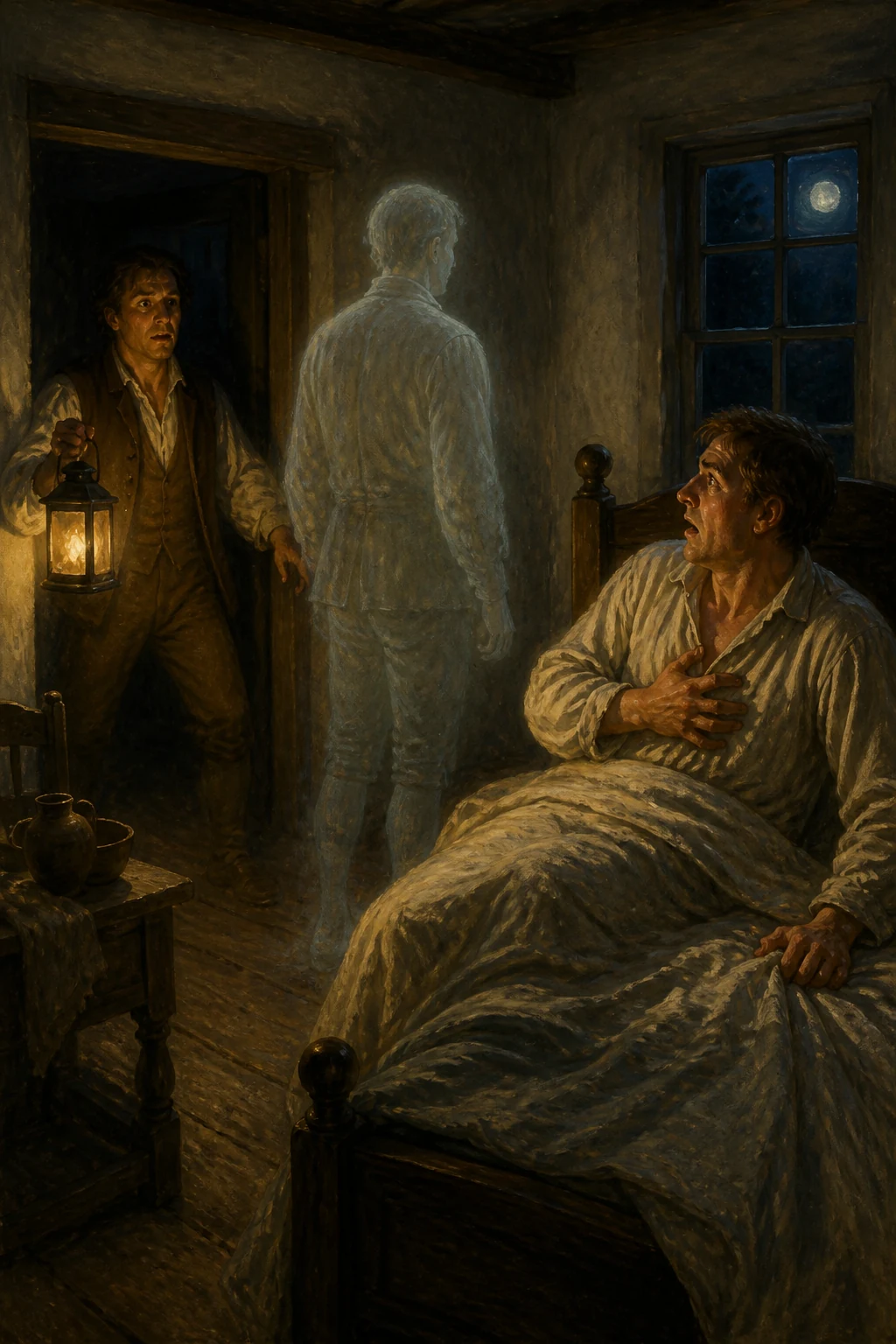
II And years passed after Friar Venancio’s death. One night Father Antolín was sleeping peacefully when he awoke with a start at the touch of a cold hand upon his forehead.
A taper burning beneath an image of the Virgin Protectress of Captives cast faint, mysterious gleams about the cell. At the head of the bed, in a leather-seated chair, sat Friar Venancio.
“Do not be alarmed,” said the apparition. “God has given me leave to come and entrust you with a matter. Go tomorrow at noon to the Botoneros arcade and ask Don Marcos Guruceta for six thousand pesos which I gave him for safekeeping, and which are intended to furnish the first cloister with scenes from the life of our patron saint.”
And with these words the vision vanished. Father Antolín was left in a state you may well imagine. Hearing a dead man speak is a very serious business. In the morning our frightened friar went to the commander of the order and related what had happened to him, whether dream or reality.
“There is nothing to lose, brother,” replied the superior, “by going to see Guruceta.” And indeed, it was on the very stroke of noon that Friar Antolín arrived at the merchant’s counter and made the claim we know of. Don Marcos flew into a rage and told him he was either a mad friar or a swindler.
The emissary withdrew crestfallen; but when he reached the gatehouse of his monastery, a friar came out to meet him, and in him he recognized Friar Venancio.
“Well, brother, how did you fare?” “Very badly indeed, brother,” replied the other. “Guruceta called me a dreamer and an impostor.” “Did he now? Then go back and tell him that if he will not agree to pay you, I shall come for my money myself within five minutes.”
Friar Antolín returned to the arcade, and when Don Marcos saw him come through the shop door, he said, “Have you come back to plague me?” “Nothing of the sort, Señor Guruceta. I have come to tell you that in a few moments Friar Venancio will be here in person to settle matters with you. I have come ahead to wait for him.”
At these words, and at the composure with which they were spoken, Guruceta felt a strange shock, and became decidedly afraid that he might have to deal with a soul from the next world.
“There is no need for Friar Venancio to trouble himself to come,” he stammered. “It is possible that, with so many matters on my mind, I have forgotten he gave me money. Be that as it may, since the purpose is a Christian one and I am very devoted to Saint Peter Nolasco, let Your Reverence send a servant for the six bags of money.”
The piety of the people of Lima supplied in alms and donations the sum still needed to pay the painters, and a year later, on the patron saint’s feast day, the canvases we know today were unveiled.
Such is the tradition which, in his childhood, the writer of these lines heard told by Friar León Fajardo, a most venerable priest and commander of La Merced.