Prevod
"My poor flowers are quite dead!" said little Ida. "They were so beautiful last night, and now all their leaves are drooping and withered! Why do they do that?" she asked the student who was sitting on the sofa. She was very fond of him, for he knew the most delightful stories and cut out such amusing paper pictures: hearts with little ladies dancing inside them, flowers, and great castles with doors that could be opened. He was a merry student! "Why do the flowers look so poorly today?" she asked again, showing him a whole bouquet that was quite withered.
"Well, do you know what is wrong with them?" said the student. "The flowers were at a ball last night, and that is why their heads are drooping!" "But flowers can't dance!" said little Ida.
"Oh yes," said the student, "when it grows dark and the rest of us are asleep, they leap merrily about. They have a ball almost every night of their lives!" "Aren't any children allowed to go to the ball?"
"Oh yes," said the student, "tiny little daisies and lilies of the valley!" "Where do the prettiest flowers dance?" asked little Ida. "Haven't you often been out beyond the city gate to the great palace where the king lives in summer, where there is that lovely garden with all the flowers? You've seen the swans that swim towards you when you offer them breadcrumbs. They have splendid balls out there, you may be sure!"
"I was out in the garden yesterday with my mother!" said Ida. "But all the leaves had fallen from the trees, and there weren't any flowers left at all! Where are they? I saw so many in the summer!"
"They are inside the palace!" said the student. "You see, as soon as the king and all his courtiers move into town, the flowers run straight from the garden up to the palace and make merry. You ought to see them! The two most beautiful roses sit on the throne, and then they are king and queen. All the red cockscombs line up beside them and bow; they are the gentlemen of the court. Then all the loveliest flowers arrive, and there is a grand ball. The blue violets play the part of young naval cadets, and dance with hyacinths and crocuses, whom they call young ladies! The tulips and the great yellow lilies are old matrons; they make sure the dancing is elegant and everything is conducted properly!"
"But," asked little Ida, "doesn't anyone punish the flowers for dancing in the king's palace?" "No one really knows about it!" said the student. "Sometimes, it is true, the old palace steward comes round at night to keep watch. He carries a great bunch of keys, but as soon as the flowers hear the keys rattling, they grow perfectly quiet, hide behind the long curtains, and peep out. 'I can smell flowers in here,' says the old palace steward, but he cannot see them."
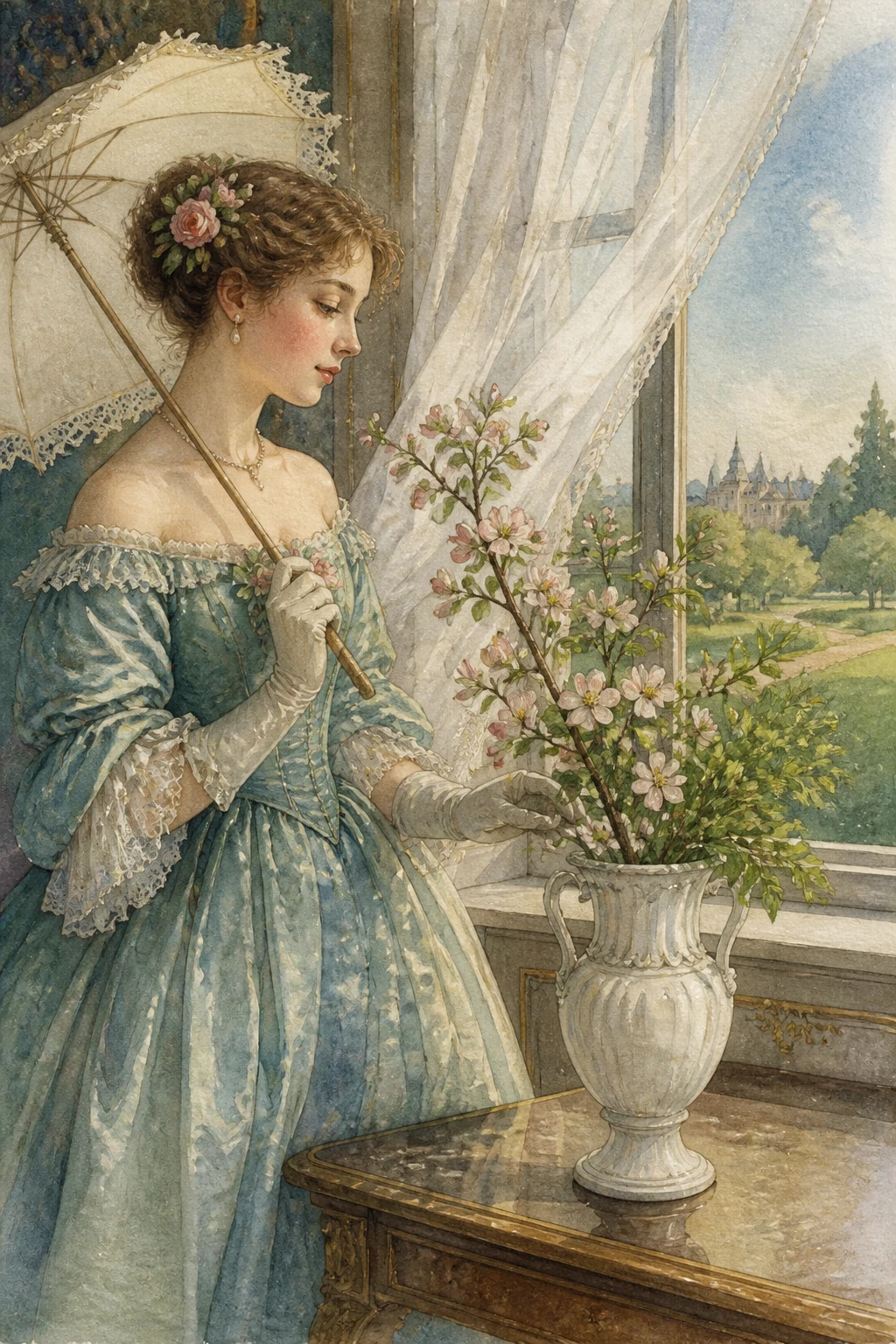
"How funny!" said little Ida, clapping her hands. "But wouldn't I be able to see the flowers either?" "Oh yes," said the student. "Just remember to look in through the window the next time you go there, and you are sure to see them. I did that today, and there was a tall yellow daffodil lying on the sofa, stretching herself. She was a lady-in-waiting!"
"Can the flowers in the botanical garden go there too? Can they travel all that way?" "Indeed they can!" said the student. "For when they choose, they can fly. Surely you've seen the beautiful butterflies, the red, yellow, and white ones? They look almost like flowers, and flowers are what they once were. They have sprung from their stalks high into the air and flapped their leaves as though they were little wings, and then off they flew. And because they behaved themselves well, they were allowed to fly about in the daytime too, instead of having to go home and sit still on their stalks; and at last their leaves became real wings. You've seen that yourself! Still, it may well be that the flowers in the botanical garden have never been to the king's palace and don't know how merry it is there at night. So now I'll tell you something! Won't it astonish the professor of botany who lives next door—you know him, don't you? When you go into his garden, you must tell one of the flowers that there is a grand ball at the palace. Then it will tell all the others, and off they will fly. And when the professor comes out into the garden, there won't be a single flower left, and he won't be able to understand where they have all gone."
"But how can the flower tell the others? Flowers can't talk!" "No, indeed they can't!" answered the student. "But they use gestures! Haven't you noticed how, when there is a little breeze, the flowers nod and move all their green leaves? It is just as plain as if they were speaking!"
"Can the professor understand their gestures, then?" asked Ida. "Indeed he can! One morning he came down into his garden and saw a great stinging nettle making gestures with its leaves to a lovely red carnation. It was saying, 'You are so pretty, and I am so fond of you!' But the professor doesn't approve of that sort of thing at all, and he promptly slapped the nettle's leaves, for those are its fingers. But then it stung him, and ever since that day he has never dared touch a stinging nettle."
"How funny!" said little Ida, laughing. "Fancy putting such notions into the child's head!" said the tiresome chancery councillor, who had come to pay a visit and was sitting on the sofa. He could not bear the student, and always grumbled when he saw him cutting out his strange, amusing paper pictures: now a man hanging from a gallows with a heart in his hand, because he was a stealer of hearts; now an old witch riding on a broomstick with her husband perched on her nose. The councillor did not approve, and then he would say, just as he did now, "What notions to put into a child's head! Such foolish fancy!"
But little Ida thought the student's tales about her flowers were such fun, and she thought a great deal about them. The flowers' heads were drooping because they were tired from dancing all night; they must certainly be ill. So she carried them over to all her other toys, which stood on a pretty little table, with a whole drawer full of lovely things. Her doll, Sophie, lay asleep in the doll's bed, but little Ida said to her, "You really must get up, Sophie, and make do with sleeping in the drawer tonight. The poor flowers are ill, and they must have your bed. Perhaps then they will get well!" And she lifted the doll out, but it looked very sulky and did not say a single word, for it was angry at not being allowed to keep its bed.
Then Ida laid the flowers in the doll's bed, tucked the little blanket right up around them, and said that now they must lie nice and still, and she would boil some water for tea so they could get well and be up again tomorrow. And she drew the curtains close around the little bed, so the sun would not shine in their eyes.
All evening she could not help thinking about what the student had told her, and when it was time for her own bed, she first had to go behind the curtains hanging over the windows, where her mother's lovely flowers stood, both hyacinths and tulips. Then she whispered very softly, "I know quite well that you're going to a ball tonight!" But the flowers pretended not to understand anything and did not stir a leaf. Still, little Ida knew what she knew.
Once she was in bed, she lay for a long time thinking how lovely it would be to see the beautiful flowers dancing out at the king's palace. "I wonder whether my flowers really went too?" But then she fell asleep. During the night she woke again. She had been dreaming of the flowers and the student, whom the councillor was scolding for putting notions into her head. It was quite still in the bedroom where Ida lay. The night-light was burning on the table, and her father and mother were asleep.
"I wonder whether my flowers are lying in Sophie's bed now?" she said to herself. "How I wish I knew!" She raised herself a little and looked towards the door, which stood half open. In the next room were the flowers and all her toys. She listened, and it seemed to her that someone was playing the piano in there, very softly, and more beautifully than she had ever heard before.
"All the flowers must be dancing in there now!" she said. "Oh, how I wish I could see them!" But she dared not get up, for then she would wake her father and mother. "If only they would come in here!" she said. But the flowers did not come, and the music went on playing so beautifully that at last she could resist no longer; it was far too lovely. She crept out of her little bed, went very softly to the door, and peeped into the room. Oh, what a wonderful sight she saw!
There was no night-light in there, yet it was quite bright: the moon shone through the window onto the middle of the floor! It was almost like daylight. All the hyacinths and tulips stood in two long rows on the floor; there were none left in the window, only empty pots. Down on the floor all the flowers were dancing so prettily around one another, forming a proper chain and holding one another by their long green leaves as they whirled about. But at the piano sat a great yellow lily, which little Ida was certain she had seen in the summer, for she remembered quite well that the student had said, "Why, how like Miss Line it is!" Everyone had laughed at him then, but now Ida really thought the tall yellow flower did look like the young lady, and it played in just the same way, tilting its long yellow face first to one side, then to the other, and nodding in time to the lovely music! No one noticed little Ida at all. Now she saw a great blue crocus leap right up onto the table where the toys stood, go straight to the doll's bed, and draw the curtains aside. There lay the sick flowers, but they got up at once and nodded to those below to say that they wanted to join the dancing too. The old incense man, whose lower lip had broken off, stood up and bowed to the pretty flowers. They did not look ill at all; they jumped down among the others and were very merry.
There was a sound as though something had fallen off the table. Ida looked that way: it was the Shrovetide switch jumping down, for it too felt that it belonged among the flowers. It was very pretty, and at the top sat a little wax doll wearing just such a broad hat as the councillor wore. The Shrovetide switch hopped on its three red wooden legs right into the midst of the flowers and stamped very hard, for it was dancing the mazurka, and that was a dance the other flowers could not manage, because they were so light and could not stamp.
All at once the wax doll on the Shrovetide switch grew tall and large, spun round above the paper flowers, and shouted at the top of its voice, "Fancy putting such notions into the child's head! Such foolish fancy!" And now the wax doll looked exactly like the councillor in his broad hat, every bit as yellow and cross. But the paper flowers beat him about his thin legs, and then he shrank back into a tiny little wax doll again. It was such fun to watch! Little Ida could not help laughing. The Shrovetide switch went on dancing, and the councillor had to dance along, whether he made himself tall and large or remained the little yellow wax doll with the big black hat. Then the other flowers pleaded for him, especially those that had been lying in the doll's bed, and the Shrovetide switch left him alone. Just then there was a loud knocking inside the drawer where Ida's doll Sophie lay among so many other toys. The incense man ran to the edge of the table, lay flat on his stomach, and managed to pull the drawer out a little. Sophie stood up and looked all around in great surprise. "There seems to be a ball here!" she said. "Why hasn't anyone told me?"
"Will you dance with me?" said the incense man. "Oh, you're a fine one to dance with!" she said, turning her back on him. Then she sat on the drawer, thinking that surely one of the flowers would come and ask her to dance, but none came. So she coughed, "Ahem, ahem, ahem!" But still not one came. The incense man danced all by himself, and not at all badly!
Since none of the flowers seemed to notice Sophie, she let herself tumble from the drawer straight onto the floor, making a great commotion. All the flowers came running and gathered round her, asking whether she had hurt herself, and they were all so kind to her, especially the flowers that had been lying in her bed. But she had not hurt herself at all, and all Ida's flowers thanked her for the lovely bed and were very fond of her. They took her into the middle of the floor, where the moon was shining, and danced with her, while all the other flowers formed a ring around them. Now Sophie was happy! And she said they were welcome to keep her bed; she did not mind sleeping in the drawer at all.
But the flowers said, "Thank you so very much, but we cannot live much longer! Tomorrow we shall be quite dead. But tell little Ida to bury us out in the garden, where the canary lies, and then we shall grow up again in the summer and be much more beautiful!"
"No, you mustn't die!" said Sophie, and she kissed the flowers. Just then the drawing-room door opened, and a whole crowd of lovely flowers came dancing in. Ida could not imagine where they had come from; surely they were all the flowers from the king's palace. At the very front came two lovely roses wearing little gold crowns: they were a king and queen. Then came the prettiest stocks and carnations, bowing in every direction. They had brought music with them: great poppies and peonies blew on pea pods until their faces were quite red. The bluebells and the little white snowdrops jingled as though they wore tiny bells. What merry music it was! Then came so many other flowers, and they all danced together, the blue violets and the red daisies, the little field daisies and the lilies of the valley. And all the flowers kissed one another; it was lovely to see!
At last the flowers wished one another good night, and little Ida too crept back to bed, where she dreamed of everything she had seen. When she got up the next morning, she hurried to the little table to see whether the flowers were still there. She drew back the curtain from the little bed, and yes, there they all lay, but they were quite withered, much more so than yesterday. Sophie lay in the drawer where Ida had put her, looking very sleepy.
"Can you remember what you were supposed to tell me?" said little Ida. But Sophie looked quite blank and did not say a single word. "You're not good at all," said Ida, "and yet they all danced with you." Then she took a little cardboard box with pretty birds drawn on it, opened it, and laid the dead flowers inside. "This shall be your pretty coffin," she said, "and later, when my Norwegian cousins come, they shall help bury you out in the garden, so that you can grow up again in the summer and be even more beautiful!"
The Norwegian cousins were two lively boys named Jonas and Adolph. Their father had given them two new bows, and they had brought them along to show Ida. She told them about the poor flowers that had died, and then they were allowed to help bury them. The two boys walked in front with their bows over their shoulders, and little Ida followed with the dead flowers in the pretty box. Out in the garden a little grave was dug. First Ida kissed the flowers, then she lowered them into the earth in their box, and Adolph and Jonas shot their bows over the grave, for they had neither guns nor cannons.