Prevod
In the city of Florence, not far from the Piazza del Granduca, runs a little cross street called, I believe, Porta Rossa. Here, in front of a sort of bazaar where vegetables are sold, stands a finely wrought metal boar. Fresh, clear water trickles from the mouth of the animal, which has turned quite blackish-green with age; only its snout shines as though polished bright, and so it has been, by the many hundreds of children and poor people who grasp it with their hands and put their mouths to the animal’s to drink. It is quite a picture to see the shapely creature embraced by a handsome, half-naked boy, pressing his fresh young lips to its snout.
Anyone who comes to Florence is sure to find the place; he need only ask the first beggar he sees about the metal boar, and he will find it.
It was late on a winter’s evening. Snow lay on the mountains, but there was moonlight, and moonlight in Italy gives as much light as a dark winter’s day in the North—indeed, more, for the air glows, the air uplifts, while in the North the cold, grey roof of lead presses us down to the earth, the cold, wet earth that will one day press upon our coffin.
Over in the duke’s palace garden, beneath the canopy of the pines, where a thousand roses bloom in winter, a little ragged boy had sat all day—a boy who might have been the very image of Italy, so beautiful, so smiling, and yet so full of suffering. He was hungry and thirsty; no one gave him a penny, and when darkness fell and the garden was to be closed, the porter drove him away. For a long time he stood dreaming on the bridge over the River Arno, looking at the stars that twinkled in the water between him and the splendid marble bridge.
He made his way to the metal boar, half knelt down, threw his arms about its neck, put his little mouth to its shining snout, and drank the fresh water in great draughts. Nearby lay a few lettuce leaves and a couple of chestnuts; these became his supper. There was not a soul in the street; he was quite alone. He sat down on the metal boar’s back and leaned forward until his little curly head rested on the animal’s, and before he knew it, he had fallen asleep.
It was midnight. The metal boar stirred, and he heard it say quite distinctly, “Hold tight, little boy, for now I am going to run!” And away it ran with him; it was a strange ride. First they came to the Piazza del Granduca, where the metal horse that bore the duke’s statue neighed aloud. The coloured coats of arms on the old town hall shone like pictures lit from behind, and Michelangelo’s David swung his sling. What a strange life was stirring! The bronze groups of Perseus and the Rape of the Sabine Women stood all too vividly alive; a death cry from them swept across the splendid, deserted square.
At the Palazzo degli Uffizi, in the arcade where the nobility gather for the pleasures of carnival, the metal boar stopped. “Hold tight!” said the animal. “Hold tight, for now we are going up the stairs!” The little boy still said not a word; he was half trembling, half blissfully happy.
They entered a long gallery. He knew it well; he had been here before. Paintings adorned the walls, and statues and busts stood about, all in the most beautiful light, as though it were day. But the greatest splendour came when the door to one of the side rooms opened. Yes, the little boy remembered the glories here; yet tonight everything shone with its loveliest radiance.
Here stood a lovely naked woman, as beautiful as only nature and the greatest master of marble could fashion her. She moved her lovely limbs, dolphins leapt at her feet, and immortality shone from her eyes. The world calls her the Medici Venus. On either side of her stood magnificent marble statues of handsome men. One was sharpening a sword; he is called the Grinder. The Wrestling Gladiators formed the other group. The sword was being sharpened, the wrestlers struggled before the goddess of beauty.
The boy was almost dazzled by all this splendour; the walls blazed with colour, and everything there was life and movement. The image of Venus appeared twice over, the earthly Venus, as full and passionate as Titian had seen her. Portraits of two lovely women: their beautiful, unveiled limbs stretched upon soft cushions, their breasts rose, and their heads moved so that rich locks fell about their rounded shoulders, while their dark eyes spoke ardent thoughts. Yet none of the pictures dared step wholly out of its frame. The goddess of beauty herself, the gladiators, and the grinder remained in their places, for the glory shining from the Madonna, Jesus, and John held them fast. The holy pictures were pictures no longer; they were the holy ones themselves.
What radiance and what beauty, from room to room! And the little boy saw them all, for the metal boar walked step by step through all that splendour and magnificence. One sight drove out another; only one painting truly fixed itself in his mind, chiefly because of the glad, happy children in it. Once, in daylight, the little boy had nodded to them.
Many people surely pass this painting by without a thought, yet it holds a treasure of poetry. It shows Christ descending into the underworld, but it is not the tormented who surround him; no, these are the heathens. The Florentine Angiolo Bronzino painted it. Most wonderful of all is the expression of the children’s certainty that they are going to Heaven. Two little ones are already embracing; another reaches down his hand to a child below and points to himself, as though saying, “I am going to Heaven!” All the older people stand uncertain and hopeful, or bow in humble prayer before the Lord Jesus.
The boy looked at this painting longer than at any other. The metal boar rested quietly before it. A soft sigh was heard; did it come from the painting or from the animal’s breast? The boy stretched out his hand towards the smiling children—then the animal rushed away with him, away through the open entrance hall.
“Thanks and blessings, you lovely creature!” said the little boy, patting the metal boar, which went bump, bump! down the stairs with him. “Thanks and blessings to you too!” said the metal boar. “I have helped you, and you have helped me, for only with an innocent child upon my back do I gain the strength to run! Yes, you see, I even dare pass beneath the beam of the lamp before the picture of the Madonna. I can carry you anywhere, except into the church! But outside it, when you are with me, I can look in through the open door. Do not climb down from my back; if you do, I shall lie dead, as you see me by day in the street of Porta Rossa!”
“I shall stay with you, my blessed creature!” said the little boy, and away they sped through the streets of Florence to the square before the church of Santa Croce.
The great double doors sprang open, and the lights shone from the altar, through the church, and out into the deserted square. A strange radiance streamed from a tomb in the left aisle; a thousand moving stars seemed to form a halo about it. A coat of arms adorned the tomb, a red ladder on a blue field, and it seemed to glow like fire. It was Galileo’s tomb. It is a simple monument, but the red ladder on the blue field is a meaningful emblem, as though it belonged to art itself, for art’s path always leads upwards on a burning ladder, yet towards Heaven. All the prophets of the spirit go to Heaven like the prophet Elijah.
In the right aisle of the church, every statue on the rich sarcophagi seemed to have come to life. Here stood Michelangelo, there Dante with a laurel wreath about his brow; Alfieri, Machiavelli—side by side these great men, the pride of Italy, rest here. It is a magnificent church, far more beautiful, though not so large, as Florence’s marble cathedral.
It was as though the marble draperies stirred, as though the great figures lifted their heads still higher and gazed through the night, amid singing and music, towards the glowing, many-coloured altar, where boys dressed in white swung golden censers. The strong fragrance streamed out of the church into the open square.
The boy stretched his hand towards the radiance, and at that very instant the metal boar darted away. He had to cling tightly to it; the wind whistled about his ears, and he heard the church door creak on its hinges as it closed. But at the same moment he seemed to lose consciousness; he felt an icy chill—and opened his eyes.
It was morning. He sat half slipped from the metal boar, which stood where it always stood, in the street of Porta Rossa. Fear and dread filled the boy at the thought of the woman he called his mother, who had sent him out yesterday and told him to get money. He had none; he was hungry and thirsty. Once more he put his arms about the metal boar’s neck, kissed its snout, nodded to it, and then wandered away to one of the narrowest streets, only wide enough for a well-laden donkey. A great iron-bound door stood half ajar. He went in and climbed a stone staircase with filthy walls and a smooth rope for a handrail, and came to an open gallery hung with rags. A staircase led from here down to the courtyard, where stout iron wires stretched from the well to every storey of the house, and one water bucket hung beside another, while the pulley squeaked and the bucket danced in the air, splashing water down into the courtyard. Up another crumbling stone staircase he went. Two sailors, Russians, came bounding merrily down and almost knocked the poor boy over. They were returning from their night’s revelry. A woman, no longer young but strongly built, with thick black hair, followed them. “What have you brought home?” she asked the boy.
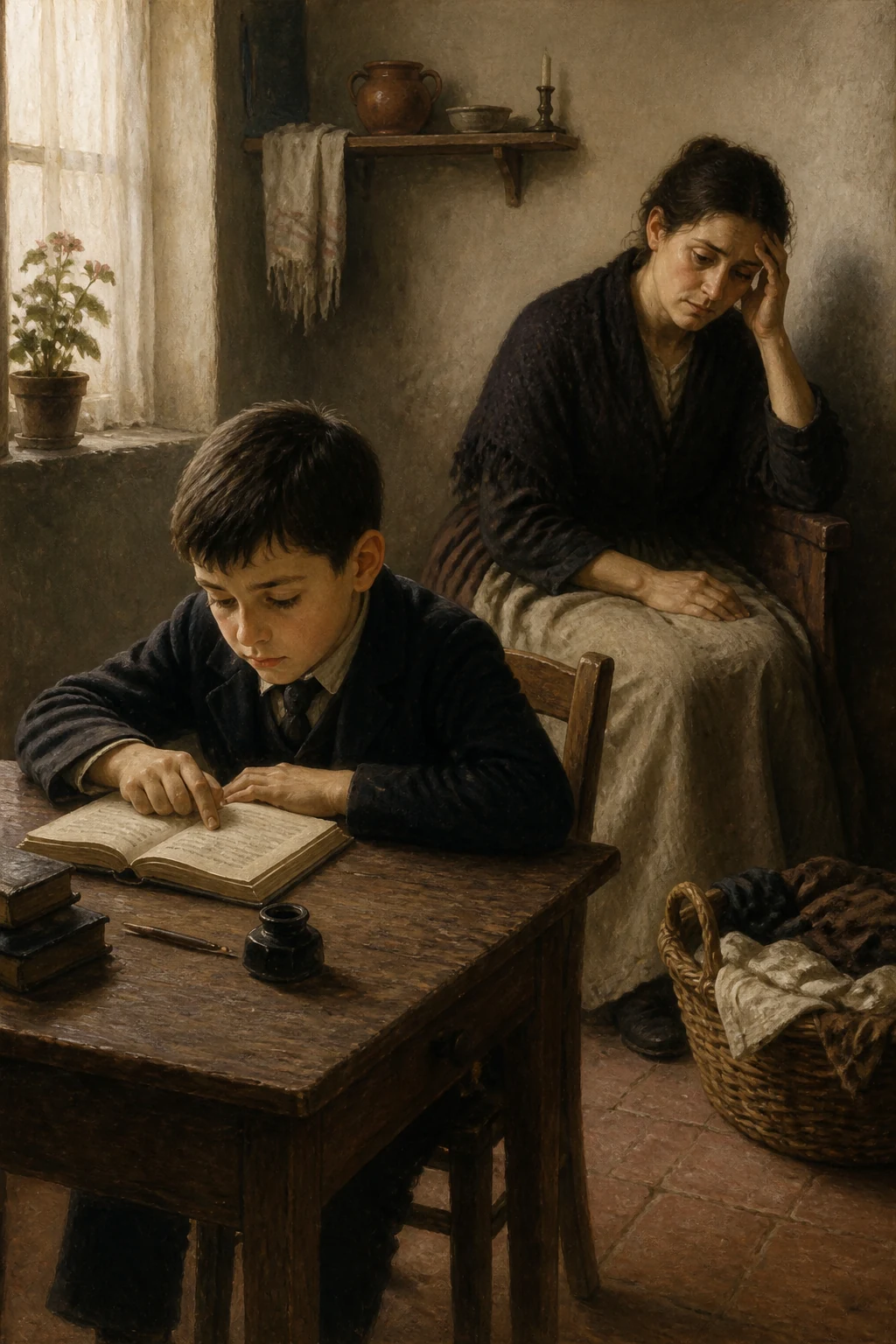
“Don’t be angry!” he pleaded. “I got nothing, nothing at all!” And he caught at his mother’s dress as though to kiss it. They entered the room. We shall not describe it; enough to say that there stood an earthenware pot with a handle, filled with burning charcoal—a marito, as it is called. She took it on her arm, warmed her fingers, and prodded the boy with her elbow. “Of course you have money!” she said. The child wept; she kicked him, and he wailed aloud. “Will you be quiet, or shall I smash your screaming head?” she said, swinging the fire pot she held in her hand. The boy ducked to the floor with a shriek. Just then the woman next door came in, also carrying her marito on her arm. “Felicita! What are you doing to the child?”
“The child is mine!” Felicita replied. “I can murder him if I please, and you too, Gianina!” She swung her fire pot; the other woman raised hers to ward off the blow, and the two pots crashed together, sending shards, fire, and ashes flying about the room. But at that very instant the boy was out of the door, across the courtyard, and out of the house. The poor child ran until at last he could scarcely breathe. He stopped at the church of Santa Croce, the church whose great door had opened for him the night before, and went inside. Everything shone. He knelt by the first tomb on the right—it was Michelangelo’s—and soon he was sobbing aloud. People came and went, Mass was being said, and no one paid any heed to the boy. Only one elderly citizen stopped, looked at him, and then went away like the others.
Hunger and thirst tormented the little boy; he was quite faint and ill. He crept into the corner between the wall and the marble monument and fell asleep. It was towards evening when he woke again to find someone shaking him. He started up, and the same elderly citizen stood before him.
“Are you ill? Where do you live? Have you been here all day?” These were a few of the many questions the old man asked him. They were answered, and the old man took him to a little house nearby in one of the side streets. They entered a glovemaker’s workshop. His wife was sitting busily sewing when they came in; a little white Bolognese dog, clipped so close that its rosy skin showed through, bounced about on the table and leapt towards the little boy.
“Innocent souls know one another,” said the wife, stroking both the dog and the boy. The good people gave him food and drink and told him he might stay there for the night; the next day Father Giuseppe would speak to his mother. He was given a poor little bed, but to him, who so often had to sleep on a hard stone floor, it was royally splendid. He slept soundly and dreamed of the glorious pictures and the metal boar.
Father Giuseppe went out the next morning, and the poor child was not at all happy about it, for he knew this outing was meant to bring him back to his mother. He wept and kissed the little lively dog, while the wife nodded to them both. And what news did Father Giuseppe bring? He talked a great deal with his wife, and she nodded and stroked the boy. “He is a lovely child!” she said. “What a fine glovemaker he could become, just as you were! And his fingers are so slender and supple. The Madonna has destined him to be a glovemaker!”
And the boy stayed in the house, and the wife herself taught him to sew. He ate well, slept well, grew merry, and began to tease Bellissima—that was the little dog’s name. The wife shook her finger at him, scolded him, and grew angry, and the boy took it to heart. He sat thoughtfully in his little room, which looked out on the street and was used for drying skins. Thick iron bars covered the window. He could not sleep; the metal boar was in his thoughts, and suddenly he heard outside, “Clop, clop!” Yes, it must be the boar! He sprang to the window, but there was nothing to be seen; it was all over.
“Help the signore carry his paint box!” the mistress said to the boy next morning, as their young neighbour, the painter, came struggling along with it and a large rolled canvas. The child took the box and followed the painter. They made their way to the gallery and climbed the same staircase he knew so well from the night he had ridden on the metal boar. He knew the statues and pictures, the lovely marble Venus and the women who lived in colour; he saw again the Mother of God, Jesus, and John.
Now they stopped before Bronzino’s painting, where Christ descends into the underworld and the children round him smile in sweet certainty of Heaven. The poor child smiled too, for here he was in his own heaven.
“Now, off home with you!” the painter said, when the boy had stood there long enough for him to set up his easel. “May I watch you paint?” asked the boy. “May I see how you get the picture over here onto the white canvas?” “I am not painting yet!” the man replied, taking out his black chalk. His hand moved quickly, his eye measured the great painting, and though only a slender line appeared, Christ hovered there just as he did in the coloured picture.
“Now do go!” said the painter, and the boy wandered quietly home, sat up on the table, and—learned to sew gloves. But all day his thoughts were in the picture gallery, and so he pricked his fingers and worked clumsily, though he did not tease Bellissima. When evening came and the street door happened to be open, he slipped outside. It was cold, but the stars were shining, so beautiful and clear. He wandered through the streets, which were already quiet, and soon stood before the metal boar. He bent over it, kissed its gleaming snout, and sat upon its back. “You blessed creature,” he said, “how I have longed for you! We must go for a ride tonight.”
The metal boar lay motionless, and the fresh stream gushed from its mouth. The little boy sat astride it; then something tugged at his clothes. He looked round. It was Bellissima, little close-clipped Bellissima. The dog had slipped out of the house with him and followed without his noticing. Bellissima yapped as though to say, “You see, I am here too; why are you sitting there?” No fiery dragon could have frightened the boy more than the little dog in this place. Bellissima in the street, and without being dressed, as the old mistress called it! What would come of this? The dog never went out in winter without being put into a little sheepskin, cut and sewn to fit. It could be fastened about the neck with a red ribbon, with a bow and a bell attached, and was tied beneath the belly as well. The dog looked almost like a little kid when, dressed in this fashion in winter, it was allowed to trot out with the signora. Bellissima had come along without being dressed; what would come of it? All his fancies had vanished; still, the boy kissed the metal boar, took Bellissima in his arms, and, as the animal was shivering with cold, ran as fast as he could.
“What are you running off with there?” shouted two gendarmes he met, and Bellissima barked. “Where did you steal that pretty dog?” they asked, taking it from him.
“Oh, give it back to me!” wailed the boy. “If you haven’t stolen it, you can tell them at home that the dog may be fetched from the guardhouse.” They told him where it was and went away with Bellissima.
What misery and distress! He did not know whether to throw himself into the Arno or go home and confess everything. They would surely beat him to death, he thought. “But I am willing to be beaten to death; I want to die, and then I shall go to Jesus and the Madonna!” And he went home, chiefly to be beaten to death.
The door was shut, and he could not reach the knocker. There was no one in the street, but a loose stone lay there, and with it he hammered on the door. “Who is there?” they called from within. “It is me!” he said. “Bellissima is gone! Let me in, and then beat me to death!”
There was great alarm, especially on the mistress’s part, for poor Bellissima. She looked at once towards the wall where the dog’s little garment ought to hang; the little sheepskin was hanging there.
“Bellissima at the guardhouse!” she cried aloud. “You wicked child! How did you get him out? He will freeze to death! That delicate creature among those rough soldiers!”
And the old man had to set off at once! His wife lamented, and the boy wept. Everyone in the house gathered, the painter among them. He took the boy between his knees and questioned him, and bit by bit he learned the whole story of the metal boar and the gallery. It was not easy to understand. The painter comforted the little boy and pleaded with the old woman, but she was not satisfied until her husband returned with Bellissima, who had been among the soldiers. What rejoicing there was! The painter patted the poor boy and gave him a handful of pictures.
Oh, they were splendid things, comical heads! But best of all, there was the metal boar itself, as large as life. Oh, nothing could be more wonderful! A few strokes had brought it onto the paper, and even the house behind it was suggested.
“If only one could draw and paint! Then one could have the whole world for oneself!” The next day, at his first moment alone, the little boy seized a pencil and tried, on the blank back of one of the pictures, to copy the drawing of the metal boar. And he succeeded! A little crooked, a little lopsided, one leg thick and another thin, but still you could tell what it was, and he himself rejoiced over it! The pencil would not quite go as straight as it ought, he could see that; but the next day another metal boar stood beside the first, and it was a hundred times better. The third was so good that anyone could recognise it.
But the glove-sewing went badly, and errands about town took a long time, for the metal boar had now taught him that every picture must be capable of being put onto paper, and the city of Florence is a whole picture book, if one chooses to turn its pages. In the Piazza della Trinità stands a slender column, and at its summit stands the goddess of Justice, blindfolded and holding her scales. Soon she stood on the paper, and it was the glovemaker’s little boy who had put her there. The collection of pictures grew, but everything in it was still lifeless. Then one day Bellissima bounded in front of him. “Stand still!” he said, “and you shall be beautiful and have a place among my pictures!” But Bellissima would not stand still, so he had to be tied. He was tied by the head and tail; he yapped and leapt about, and the string had to be pulled tighter. Then the signora came in.
“You wicked boy! The poor creature!” was all she could say. She thrust the boy aside, kicked him, and drove him out of her house—he, the most ungrateful wretch, the most wicked child! And weeping, she kissed her little half-strangled Bellissima.
The painter was coming up the stairs at that very moment—and here is the turning point of the story. In 1834 there was an exhibition at the Academia delle Arte in Florence. Two paintings hung side by side drew a crowd of spectators. The smaller painting showed a merry little boy sitting at his drawing. His model was a little white pug, closely clipped, but the animal would not stand still and had therefore been tied with string, both by the head and by the tail. There was a life and truth in it that could not fail to appeal to everyone. The painter, people said, was a young Florentine who was supposed to have been found in the street as a small child and brought up by an old glovemaker. He had taught himself to draw; a painter, now famous, had discovered his talent when the boy was about to be turned out for tying up the mistress’s favourite, the little pug, and making it his model.
The glovemaker’s boy had become a great painter; this picture showed it, and still more the larger one beside it. Here there was only a single figure, a lovely ragged boy sitting asleep in the street, leaning against the metal boar in Porta Rossa. All the spectators knew the place. The child’s arms rested on the boar’s head; the little boy slept so peacefully, and the lamp before the picture of the Madonna cast a strong light upon his pale, beautiful face. It was a magnificent painting. A great gilded frame surrounded it, and on one corner of the frame hung a laurel wreath; but among the green leaves wound a black ribbon, and a long mourning veil hung down from it. The young artist had, in those very days—died!