Prevod
It has also reached me that in ancient times, in ages long gone by, there lived in Damascus of Syria a king among the caliphs named Abd al-Malik ibn Marwan. One day he was seated with the great men of his realm, kings and sultans, when they fell to discussing the peoples of old. They recalled the accounts of our lord Solomon son of David, peace be upon them both, and the dominion and authority God Most High had granted him over men and jinn, birds and beasts, and all besides. They said, “We have heard from those who came before us that God, glorified and exalted be He, bestowed on no one what He bestowed on our lord Solomon. He attained what no other man attained: he would even imprison jinn, rebellious spirits, and devils in vessels of brass, pour molten lead over them, and seal them with his signet.” But dawn overtook Shahrazad, and she fell silent, leaving her tale untold.
When it was the five hundred and sixty-seventh night,
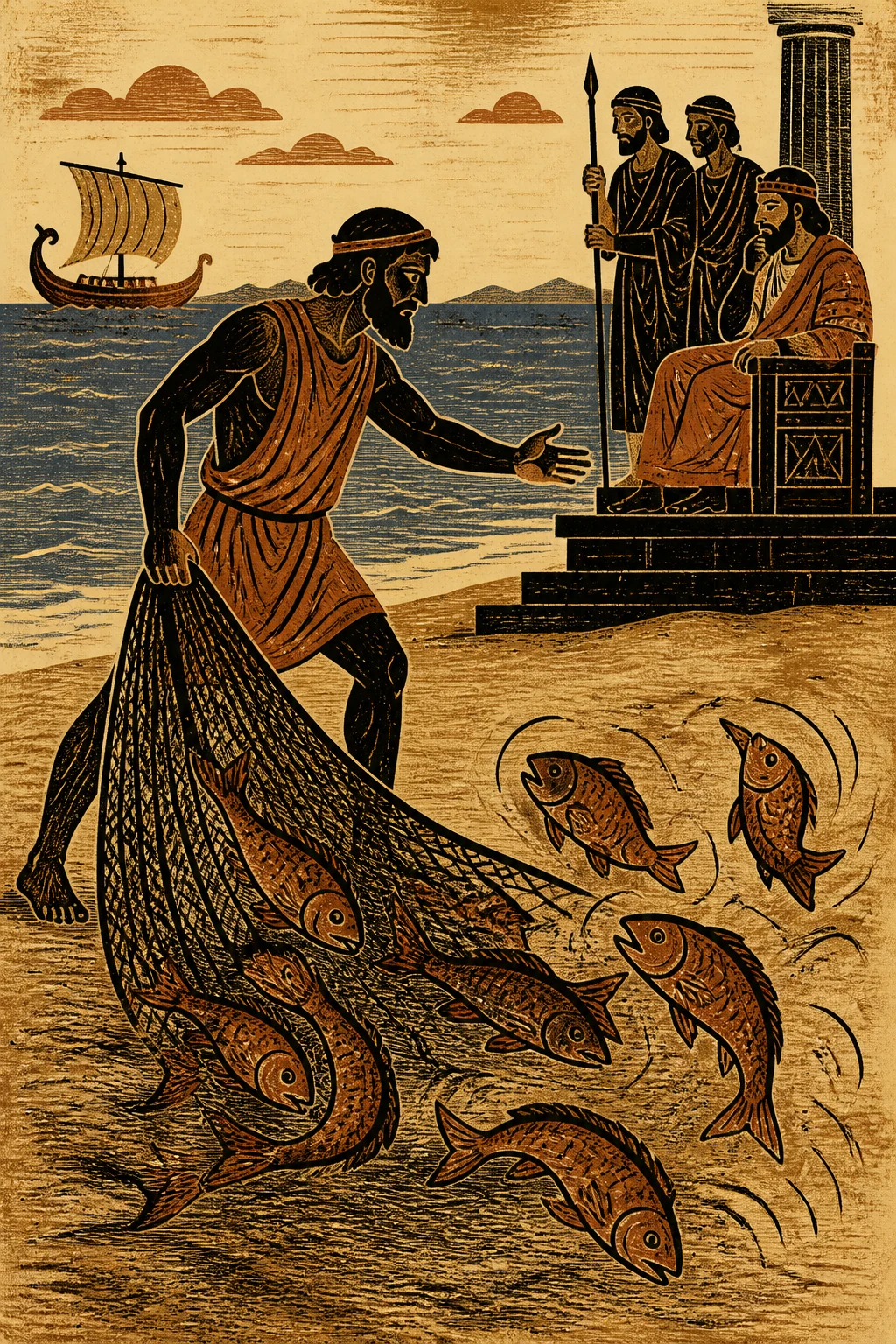
She said: It has reached me, O fortunate king, that when the Caliph Abd al-Malik ibn Marwan was speaking with his attendants and the great men of his realm, and they recalled our lord Solomon and the dominion God had granted him, he said, “He attained what no other man attained: he would even imprison rebellious spirits and devils in vessels of brass, pour molten lead over them, and seal them with his signet.” Now Talib related that a man had boarded a ship with a company of others and sailed toward the lands of India. They journeyed on until a wind arose and drove them to a land among the lands of God Most High. This happened in the darkness of night. When day broke, there came out to them from the caves of that land a people black of skin and naked of body, like wild beasts, who understood no speech. They had a king of their own race, and none but he knew Arabic. When they saw the ship and those aboard it, the king went out with a company of his companions, greeted the voyagers, welcomed them, and asked them about their religion. They told him their circumstances, and he said, “You have nothing to fear.” When he asked about their faith, each of them followed one of the religions that existed before the coming of Islam and before Muhammad, God bless him and grant him peace, was sent as a prophet. The people of the ship said, “We do not understand what you are saying, and we know nothing of this religion.” The king told them, “No son of Adam has ever reached us before you.” He then entertained them with the flesh of birds and wild beasts and with fish, for they had no other food. Afterward the voyagers went ashore to look about the city. They saw a fisherman lower his net into the sea to catch fish, and when he drew it up, there was a brass vessel in it, sealed with lead and stamped with the signet of Solomon son of David, peace be upon them both. The fisherman brought it ashore and broke it open. Blue smoke issued from it and rose to the vault of heaven. “Then we heard a dreadful voice crying, ‘I repent! I repent, O Prophet of God!’ The smoke took the shape of a being terrible to behold and monstrous in form, whose head reached as high as the mountain; then he vanished from their sight.” As for the voyagers, their hearts nearly leaped from their breasts, but the black inhabitants thought nothing of it. One of the men returned to the king and asked him about this. He replied, “Know that this was one of the jinn whom Solomon son of David, when angry with them, imprisoned in these vessels, sealing them with lead and casting them into the sea. When a fisherman casts his net, it often brings up one of these vessels. When it is broken, a jinni comes out, and, imagining that Solomon is still alive, repents and cries, ‘I repent, O Prophet of God!’” The Commander of the Faithful, Abd al-Malik ibn Marwan, marveled at this account and said, “Glory be to God! Truly Solomon was granted a mighty kingdom.” Among those present at that gathering was al-Nabigha al-Dhubyani, who said, “Talib has spoken truly in what he has related. The proof of his truth is in the words of the sage of old:
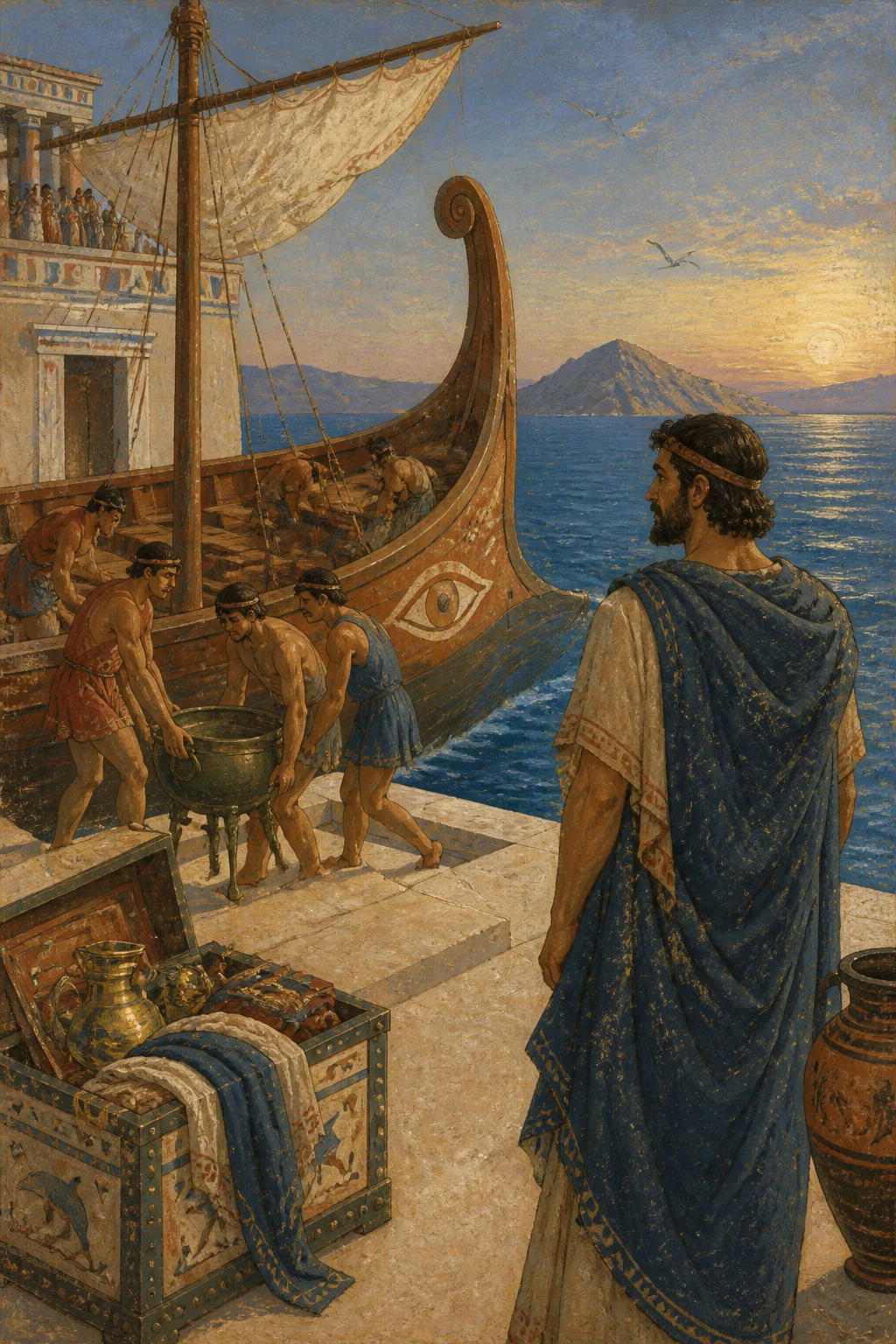
‘And of Solomon, when God said to him: Arise as ruler, and judge with diligent judgment. Honor whoever obeys you for his obedience, and whoever defies you, imprison him forever.’ He would put them into vessels of brass and cast them into the sea.” The Commander of the Faithful was pleased by these words and said, “By God, I long to see some of these vessels.” Talib ibn Sahl said to him, “O Commander of the Faithful, you can do so without leaving your own country. Send to your brother Abd al-Aziz ibn Marwan and bid him bring you some from the lands of the West. Let him write to Musa, ordering him to ride from the western lands to the mountain we have mentioned and bring you as many of these vessels as you desire, for the land extends unbroken from the furthest boundary of his province to that mountain.” The Commander of the Faithful approved his counsel and said, “Talib, what you say is true. I wish you to be my envoy to Musa ibn Nasr in this matter. You shall have the white banner and whatever you desire of wealth, rank, or anything else, and I shall take your place in caring for your family.” He replied, “Gladly and with honor, O Commander of the Faithful.” The caliph said, “Go with the blessing and aid of God Most High.” Then he ordered a letter to be written to his brother Abd al-Aziz, his deputy in Egypt, and another to Musa, his deputy in the western lands. In it he commanded Musa to go in person in search of Solomon’s vessels, leaving his son to govern the country in his stead, taking guides with him, spending whatever money was needed, and bringing a great number of men. He was to show no slackness and offer no excuse. The caliph sealed both letters, handed them to Talib ibn Sahl, and bade him make haste, with banners raised above his head. He provided him with money, mounts, and men to assist him on the road, and ordered that his household be supplied with everything it needed. Then Talib set out for Egypt. But dawn overtook Shahrazad, and she fell silent, leaving her tale untold.
When it was the five hundred and sixty-eighth night,
She said: It has reached me, O fortunate king, that Talib ibn Sahl and his companions journeyed through the lands from Syria until they entered Egypt. The governor of Egypt received him, lodged him in his own house, and treated him with the utmost honor throughout his stay. Then he sent a guide with him to Upper Egypt, until they reached the Emir Musa ibn Nusayr. When Musa learned of his arrival, he went out to meet him and welcomed him with joy. Talib handed him the letter, and he took it, read it, understood its contents, and laid it upon his head, saying, “I hear and obey the Commander of the Faithful.” He then resolved to summon the officers of his government. When they had assembled, he asked their advice about the matter set forth in the letter. They said, “O emir, if you seek someone to show you the way to that place, send for Sheikh Abd al-Samad ibn Abd al-Quddus al-Samudi. He is a learned man who has traveled widely, and knows the wildernesses, deserts, and seas, their inhabitants and their wonders, and the lands and their regions. Send for him, and he will guide you to what you seek.” Musa ordered him to be brought, and there appeared before him an aged sheikh, bowed beneath the passing years. The Emir Musa greeted him and said, “Sheikh Abd al-Samad, our master the Commander of the Faithful, Abd al-Malik ibn Marwan, has commanded us to do such and such. I have little knowledge of that land, but I am told you know those countries and their roads. Are you willing to fulfill the Commander of the Faithful’s desire?” The sheikh replied, “Know, O king, that this road is rugged, the journey long, and its paths few.” The emir asked, “How long is the journey?” He answered, “Two years and some months going, and as much again returning. Along it are hardships and terrors, marvels and wonders. You are a warrior in the faith, and our country lies near the enemy. The Christians may advance during your absence, so you must appoint someone to govern your realm in your stead.” “Yes,” said Musa. He appointed his son Harun to rule in his place, bound him by a solemn charge, and commanded the troops not to oppose him but to obey all his orders. They heard his words and obeyed.
His son Harun was a man of great valor, a noble and high-hearted champion, and a warrior skilled in battle. Sheikh Abd al-Samad explained to Musa that the place where the object of the Commander of the Faithful’s desire was to be found lay four months’ journey away, on the seacoast, and that the route consisted of a succession of halting places with grass and springs. He said, “God may make it easy for us through your blessing, O deputy of the Commander of the Faithful.” The Emir Musa asked, “Do you know whether any king has trodden this land before us?” He replied, “Yes, O Commander of the Faithful. This land belongs to Daran the Roman, king of Alexandria.” Then they set out and journeyed on until they came to the palace. The emir said, “Lead us to this palace, which is a lesson to those who will take heed.” Musa approached it with Sheikh Abd al-Samad and his closest companions until they reached its gate, which they found open. It had lofty towers and flights of steps, among them two broad steps of colored marble such as had never been seen. The ceilings and walls were adorned with gold, silver, and other metals. Over the gate was a tablet inscribed in Greek. Sheikh Abd al-Samad said, “Shall I read it, O emir?” He replied, “Go forward and read, and may God bless you. Whatever good has come to us on this journey is through your blessing.” He read it, and found these verses:
“A people—you see their works left behind, weeping for the kingdom stripped away. This palace tells the final tale of lords whom the dust has gathered in. Death destroyed and scattered them; all they amassed was lost in the earth. It was as though they had laid down their burdens to rest, then suddenly departed.” The Emir Musa wept until he fainted, and said, “There is no god but God, the Living, the Everlasting, who never passes away.” Then he entered the palace and was bewildered by the beauty of its construction. He gazed at its pictures and statues, and there, over the second doorway, were more verses. The Emir Musa said, “Go forward, sheikh, and read.” He went forward and read:
“How many peoples dwelt beneath these domes in ancient times, and then departed! Look at what the blows of fate have done to others when they fell upon them. They shared out all that they had gathered, then left it behind and went away. How many blessings they enjoyed, how many feasts they ate—now in the dust they themselves are eaten.” The Emir Musa wept bitterly, and the world grew pale before his eyes. Then he said, “Truly we were created for a mighty purpose.” They looked about the palace and found it empty of inhabitants, bereft of family and household, its courts desolate and its precincts deserted. In its midst rose a lofty dome, soaring into the air, and around it were four hundred graves. The Emir Musa drew near them and saw among them a tomb built of marble, engraved with these verses:
“How often I stood my ground, how often I slew, how many events I witnessed! How much I ate, how much I drank, how often I listened to singing girls! How often I commanded, how often I forbade! How many fortresses seemed impregnable, yet I besieged them, searched them, and brought forth the jewels of their fair women. But in my ignorance I went too far in pursuit of desires that were doomed to perish. Reckon with your soul, young man, before you drink the cup of death. Soon the earth will be heaped upon you, and you will lie lifeless.” The Emir Musa and his companions wept. Then he approached the dome and found that it had eight doors of sandalwood, with golden nails studded with silver stars and inlaid with every kind of precious stone. On the first door were written these verses:
“What I have left behind, I did not leave from generosity, but by fate and the decree that governs all mankind. Long was I joyful and content, guarding my domain like a ravening lion. I knew no rest and would not part with a mustard seed, so tightly did I cling to it, though I were cast into the fire. At last the decrees ordained by God, the Mighty, the Creator, the Maker, struck me down. When my death was swiftly decreed, all my abundance could not turn it aside. The troops I had assembled did not help me; neither friend nor neighbor came to my aid. All my long life was a weary journey beneath the sway of death, in ease and hardship alike. Before dawn all your wealth has passed intact to another, while they bring a bearer and a grave-digger for you. On the day you are brought to judgment, you will meet God alone, bearing your sins, your crimes, your burdens. Let not the world deceive you with its finery; look at what it has done to your kin and neighbors.” When the Emir Musa heard these verses, he wept bitterly until he fainted. On recovering, he entered the domed chamber and saw a long tomb, awesome to behold, upon which lay a tablet of Chinese iron. Sheikh Abd al-Samad drew near and read it. It bore these words: “In the name of God, the Everlasting, the Eternal without end. In the name of God, who neither begot nor was begotten, and whose equal is none. In the name of God, Lord of might and dominion. In the name of the Living One who never dies…” But dawn overtook Shahrazad, and she fell silent, leaving her tale untold.
When it was the five hundred and sixty-ninth night,
She said: It has reached me, O fortunate king, that after Sheikh Abd al-Samad had read what we have related, he saw these further words inscribed upon the tablet: “Now then, you who have reached this place, take warning from what you see of the turns of time and the blows of fate. Do not be deceived by the world and its finery, its falsehood and lies, its allurements and adornments. It is a flatterer, cunning and treacherous; all it gives is lent, and it takes back the loan from the borrower. It is like the confused visions of a sleeper, the dreams of a dreamer, like a mirage upon a plain that a thirsty man mistakes for water. Satan makes it fair in the eyes of man until death comes. Such is the nature of the world: put no trust in it, nor incline toward it, for it betrays whoever leans upon it and relies upon it in his affairs. Do not fall into its snares or cling to its skirts. I kept four thousand chestnut horses in my stables, and married a thousand daughters of kings, budding virgins fair as moons. I was blessed with a thousand sons like fierce lions, and lived a thousand years in happiness and peace of mind. I amassed riches beyond the power of the kings of all lands, and thought my bliss would endure forever. Then, before I knew it, there descended upon us the Destroyer of Delights, the Sunderer of Companies, who makes homes desolate and lays thriving houses waste, who sweeps away great and small, infants, children, and mothers. We had been left secure in this palace until the decree of the Lord of the Worlds, Lord of the heavens and the earth, descended upon us. The cry of manifest truth seized us, and each day two of us died, until a great number of our people had perished. When I saw that destruction had entered our dwellings and settled among us, drowning us in the sea of death, I summoned a scribe and ordered him to write these verses, admonitions, and lessons. I had them traced with the compass upon these doors, tablets, and tombs.
“I had an army of a thousand thousand horsemen, men of battle, armed with spears, coats of mail, and sharp swords, and possessed of mighty arms. I commanded them to don their ample coats of mail, gird on their cleaving swords, couch their terrible lances, and mount their noble steeds. When the decree of the Lord of the Worlds, Lord of earth and heaven, descended upon us, I said, ‘O troops and armies, can you ward off what has befallen me from the All-Conquering King?’ But the troops and armies were powerless, and said, ‘How can we fight One whom no chamberlain bars, the Master of the gate that has no gatekeeper?’ Then I said, ‘Bring me my wealth.’ It filled a thousand vaults, each containing a thousand quintals of red gold, with pearls and jewels of every kind, and as much again in white silver, and treasures beyond the reach of the kings of the earth. They did so, and when the wealth was set before me, I said, ‘Can you save me with all these riches and buy me a single day of life?’ They could not do so, and surrendered to fate and destiny. I bore God’s decree and affliction patiently until He took my soul and lodged me in my tomb. If you ask my name, I am Kush ibn Shaddad ibn Ad the Elder.” On that tablet these verses were also written:
“If you remember me after my long years, after the changing days and turns of fate, I am the son of Shaddad, who ruled mankind and all the earth in every quarter. All the unruly hosts submitted to me, and Syria, from Egypt to Adnan. I possessed a might that humbled kings, and all the peoples of the earth feared my dominion. I saw the tribes and armies in my grasp; I saw the countries and their peoples tremble before me. When I rode forth, I saw my troops mounted upon a thousand thousand neighing steeds. I owned wealth beyond all counting, laid by against the blows of fate. I resolved to ransom my soul with all my riches, if only for a little while, but God would have nothing save the fulfillment of His will, and I was left alone among my brethren. Death came to me, the Sunderer of Mankind, and I was carried from glory to a dwelling of abasement. I have encountered all the deeds I sent before me; I am held hostage by them, and I was their author. Guard your soul from standing on the brink, and beware—may you be rightly guided—the visitations of fate.” The Emir Musa wept until he fainted at the sight of the people’s downfall. As they wandered through the palace, contemplating its halls and pleasure grounds, they came upon a table standing on four legs of alabaster. Upon it was written: “At this table have eaten a thousand one-eyed kings and a thousand kings with both eyes sound. All have departed this world and taken up their abode in graves and tombs.” The Emir Musa copied all of this, then left, taking nothing from the palace but the table. The army marched on, with Sheikh Abd al-Samad before them to show the way. They traveled all that day, and the second and the third, until they came upon a high hill. Looking up, they saw upon it a horseman of brass, with a broad, gleaming spearhead upon his lance that almost dazzled the eyes. On it was written: “You who have reached me, if you do not know the road to the City of Brass, rub the horseman’s palm. He will turn, then come to rest. Go in the direction he faces, without fear or misgiving, for it will lead you to the City of Brass.” But dawn overtook Shahrazad, and she fell silent, leaving her tale untold.
When it was the five hundred and seventieth night,
She said: It has reached me, O fortunate king, that when the Emir Musa rubbed the horseman’s palm, he spun like a flash of lightning and faced a direction other than the one in which they had been traveling. The company turned that way and set out. They found it was indeed a road and followed it, journeying day and night until they had crossed far-distant lands. One day, as they traveled, they came upon a pillar of black stone in which a being was sunk into the earth up to his armpits. He had two enormous wings and four arms: two with hands like a man’s, and two with paws like a beast’s, armed with claws. The hair upon his head was like horses’ tails, and his two eyes were like glowing coals. He had a third eye in his forehead, like a leopard’s, from which fiery sparks flashed. He was black and tall, and cried, “Glory be to my Lord, who has condemned me to this grievous affliction and painful torment until the Day of Resurrection!” When the company saw him, their wits deserted them. They were so appalled by his appearance that they turned and fled. The Emir Musa said to Sheikh Abd al-Samad, “What is this?” He replied, “I do not know what it is.” Musa said, “Go near him and inquire into his condition. Perhaps he will reveal his story, and you may learn what has befallen him.” Sheikh Abd al-Samad said, “May God prosper the emir! We are afraid of him.” Musa replied, “Do not be afraid. His plight prevents him from harming you or anyone else.” So Sheikh Abd al-Samad approached him and said, “O being, what is your name? What is your story? What has placed you here in this form?” He answered, “I am an ifrit of the jinn, and my name is Dahish ibn al-Amash. Here I am restrained, imprisoned by divine majesty, tormented by divine power for as long as God, mighty and glorious, wills.” The Emir Musa said, “Sheikh Abd al-Samad, ask him why he was imprisoned in this pillar.” He asked, and the ifrit replied, “My story is a strange one. One of the sons of Iblis had an idol of red carnelian, and I was appointed its keeper. It was worshiped by a king among the kings of the sea, a man of great dignity and power, who commanded a thousand thousand warriors of the jinn. They fought with swords before him and answered his call in times of hardship. The jinn who obeyed him were under my command and subject to me, following my word whenever I gave an order. All of them were in rebellion against Solomon son of David, peace be upon them both. I used to enter the hollow of the idol and issue commands and prohibitions to them. This king had a daughter who often prostrated herself before the idol and was devoted to its worship. She was the fairest woman of her age, endowed with beauty, grace, splendor, and perfection. She was described to Solomon, peace be upon him, and he sent to her father, saying, ‘Give me your daughter in marriage, break your carnelian idol, and bear witness that there is no god but God and that Solomon is the Prophet of God. If you do this, you shall have the same rights and duties as we have. But if you refuse, I shall come against you with armies you have no power to withstand. Prepare an answer to the question and put on the robe of death, for I shall march against you with hosts that fill the heavens and make you as yesterday that has passed away.’ When Solomon’s messenger came to him, the king grew insolent and tyrannical, swollen with pride and arrogance. He said to his viziers, ‘What do you say of this matter of Solomon son of David? He has sent to demand my daughter, bid me break my carnelian idol, and enter his religion.’ They replied, ‘O mighty king, can Solomon do this to you when you are in the midst of this great sea? If he marches against you, he cannot overcome you, for the rebellious jinn will fight at your side. You may seek aid against him from the idol you worship, and it will help you and grant you victory. The proper course is to consult your lord in this matter’—meaning the idol of red carnelian—‘and hear its answer. If it advises you to fight him, fight; otherwise, do not.’ At once the king went to his idol. After making offerings and slaughtering sacrifices, he fell prostrate before it, weeping and reciting these verses:
‘O my lord, I know your worth, and here is Solomon seeking to break you. O my lord, I seek your aid: command me, for I obey your command.’ Then the ifrit, half imprisoned in the pillar, said to Sheikh Abd al-Samad, while those around him listened, ‘In my ignorance and folly, and thinking little of Solomon’s power, I entered the hollow of the idol and recited these verses:
“As for me, I do not fear him, for I have knowledge of all things. If he seeks war with me, I shall advance; I shall advance to wrest his soul from him.” When the king heard my reply, his heart grew bold, and he resolved to make war upon Solomon, the Prophet of God, peace be upon him, and give him battle. When Solomon’s messenger appeared, he had him beaten cruelly, gave him a shameful answer, and sent him back with threats, saying, “Your soul has beguiled you with idle hopes! Do you threaten me with empty words? Either march against me, or I shall march against you.” The messenger returned to Solomon and told him all that had happened and what he had suffered. When Solomon, the Prophet of God, heard this, his wrath rose and his resolve was kindled. He mustered his armies of jinn and men, wild beasts, birds, and creeping things. He commanded his vizier al-Dimriyat, king of the jinn, to gather the rebellious spirits from every place, and he assembled six hundred thousand thousand devils. He ordered Asaf ibn Barkhiya to muster his human armies, and they numbered a thousand thousand or more. They prepared their equipment and weapons, and Solomon and his hosts of jinn and men mounted the carpet, with the birds flying above his head and the beasts traveling beneath the carpet, until he descended upon the king’s domain and surrounded his island, filling the land with troops.’” But dawn overtook Shahrazad, and she fell silent, leaving her tale untold.
When it was the five hundred and seventy-first night,
She said: It has reached me, O fortunate king, that the ifrit said, “When Solomon, the Prophet of God, peace be upon him, encamped with his armies around the island, he sent to our king, saying, ‘Here I have come. Ward off what has descended upon you, or else submit to my authority, acknowledge my mission, break your idol, worship the One who alone is worthy of worship, and give me your daughter in lawful marriage. Say, you and all who are with you: I bear witness that there is no god but God, and I bear witness that Solomon is the Prophet of God. If you say this, you shall have safety and peace. But if you refuse, your fortifications on this island will not protect you from me. God, blessed and exalted be He, has commanded the wind to obey me. I shall order it to bear me to you upon the carpet, and make you a warning and an example to others.’ The messenger came and delivered the message of Solomon, the Prophet of God, peace be upon him. The king replied, ‘There is no possibility of my granting what he asks. Tell him I am coming out to meet him.’ The messenger returned to Solomon with this answer. Then the king sent throughout his lands and gathered a thousand thousand of the jinn under his command, adding to them other rebellious spirits and devils from the islands of the seas and the mountaintops. He equipped his armies, opened his arsenals, and distributed weapons among them.
“As for Solomon, the Prophet of God, peace be upon him, he drew up his troops and ordered the beasts to divide into two companies, one on the army’s right and one on its left. He commanded the birds to take their places on the islands and, when the charge began, to pluck out the enemy’s eyes with their beaks and beat their faces with their wings. He ordered the beasts to fall upon their horses. They said, ‘We hear and obey God and you, O Prophet of God.’ Then Solomon, the Prophet of God, had a throne of alabaster set up for him, inlaid with jewels and plated with red gold. He placed his vizier Asaf ibn Barkhiya on his right and his vizier al-Dimriyat on his left, with the kings of men to his right and the kings of the jinn to his left, and the beasts, vipers, and serpents before him. Then they advanced upon us in a single charge. We fought him on a wide plain for two days. On the third day calamity overtook us, and the decree of God Most High was fulfilled upon us. I and my troops were the first to charge against Solomon. I told my companions, ‘Hold your positions while I go forth and challenge al-Dimriyat to single combat.’ There he came, like a mighty mountain, his fires blazing and his smoke rising high. He advanced and hurled a fiery meteor at me, and his bolt overpowered my fire. He gave such a terrible shout that I imagined the sky had fallen upon me, and the mountains shook at his voice. Then he ordered his companions forward, and they charged us as one man. We charged in turn, shouting at one another. Flames rose and smoke mounted; hearts almost burst, and the battle raged in earnest. Birds fought in the air and beasts fought upon the ground, while I battled al-Dimriyat until he had exhausted me and I had exhausted him. Then my strength failed me. I failed my companions and my troops, and my clans were routed. Solomon, the Prophet of God, cried, ‘Seize this mighty tyrant, this accursed, abominable creature!’ Men charged against men and jinn against jinn. Our king was defeated, and we became Solomon’s spoils. His armies swept upon our hosts, with the beasts surrounding them on right and left. Above our heads the birds snatched out men’s eyes, now with their claws, now with their beaks, and beat their faces with their wings. The beasts tore at the horses and devoured the men, until most of our company lay upon the ground like fallen palm trunks. As for me, I flew from al-Dimriyat’s grasp, and he pursued me for a journey of three months until he overtook me. I had fallen where you now see me.” But dawn overtook Shahrazad, and she fell silent, leaving her tale untold.
When it was the five hundred and seventy-second night,
She said: It has reached me, O fortunate king, that when the jinni in the pillar had told them his story from its beginning until his imprisonment there, they asked him, “Where is the road to the City of Brass?” He pointed out the road to the city. Between them and it were twenty-five gates, yet not one gate was visible, nor could any trace of one be found. Its wall was like a piece of mountain, or iron cast in a mold. The company dismounted, as did the Emir Musa and Sheikh Abd al-Samad, and they strove to discover a gate or find a way in, but could not. The Emir Musa said, “Talib, how can we contrive to enter this city? We must find a gate through which to go in.” Talib replied, “May God prosper the emir! Let him rest for two or three days, and, God Most High willing, we shall devise a way to reach it and enter.” Then the Emir Musa ordered one of his servants to mount a camel and ride around the city, in the hope of discovering some trace of a gate, or a place where the wall was lower than at their encampment. One of his servants mounted and rode around it for two days and nights, pressing on without rest. On the third day he came in sight of his companions, bewildered by the extent and height of what he had seen, and said, “O emir, the most accessible place in it is this place where you are camped.”
Then the Emir Musa took Talib ibn Sahl and Sheikh Abd al-Samad, and they climbed a mountain opposite the city that overlooked it. When they reached its summit, they saw a city greater than any eye had ever beheld. Its palaces were lofty, its domes resplendent, its houses well built, its rivers flowing, its trees laden with fruit, and its gardens flourishing. Yet this city of impregnable gates was empty and still, without a sound or a living soul. Owls hooted in its quarters, birds circled over its open spaces, and ravens croaked through its districts and streets, mourning those who had dwelt there. The Emir Musa stood lamenting its emptiness, bereft of inhabitants, abandoned by its people and households. He said, “Glory be to Him whom the passing ages cannot change, who created all creatures by His power!” As he was glorifying God, mighty and glorious, his gaze turned in one direction, and he saw seven tablets of white marble gleaming in the distance. He approached them and found them engraved with inscriptions, which he ordered to be read. Sheikh Abd al-Samad stepped forward, examined them, and read. They contained admonitions and lessons, and warnings for those with eyes to see. On the first tablet, in Greek characters, was written: “O son of Adam, how heedless you are of what lies before you! Your passing years have distracted you from it. Do you not know that the cup of death is being filled for you, and that soon you will drink it? Look to your soul before you enter your grave. Where are those who ruled countries, humbled mankind, and led armies? By God, the Destroyer of Delights descended upon them, the Sunderer of Companies, the Ravager of Thriving Homes, and carried them from the spaciousness of palaces to the narrowness of graves!” At the foot of the tablet were written these verses:
“Where are the kings and those who peopled the earth? They have left what they built and all they raised upon it. They lie captive in the grave to the deeds they wrought, crumbled to dust after their burial. Where are their armies? They neither warded off death nor availed them. Where is all they gathered and stored away? The decree of the Lord of the Throne came swiftly upon them; neither riches nor refuge could save them from it.” The Emir Musa was overcome, and tears ran down his cheeks. He said, “By God, renouncing the world is the highest grace and the fullest wisdom.” Then he called for an inkwell and paper and copied what was on the first tablet. He approached the second and found written upon it: “O son of Adam, what has beguiled you into thinking time will last, and distracted you from the coming of your appointed end? Do you not know that the world is an abode of ruin, in which no one may remain? Yet you gaze upon it and devote yourself to it. Where are the kings who built up Iraq and ruled the horizons? Where are those who built Isfahan and the lands of Khurasan? The herald of death summoned them, and they answered him; the herald of destruction called them, and they obeyed. What they built and raised did not avail them, nor did what they gathered and counted ward death away.” At the foot of the tablet were written these verses:
Where are those who built for that life, raising chambers whose like no building ever matched? They gathered armies and hosts for fear of the abasement decreed by God, yet were themselves brought low. Where are the Persian kings whose strongholds none could breach? They left their lands as though they had never been. Emir Musa wept and said, “By God, we were created for a mighty purpose.” Then he copied the inscription and approached the third tablet … But dawn overtook Shahrazad, and she fell silent, leaving her tale untold.
When it was the five hundred and seventy-third night,
She said: It has reached me, O fortunate King, that Emir Musa approached the third tablet and found these words inscribed upon it: “O son of Adam, you are distracted by love of this world and heedless of your Lord’s command. Each day of your life slips away, yet you remain content and satisfied. Lay up provisions for the appointed day, and prepare to answer before the Lord of all His servants.” At the foot of the tablet were these verses:
Where is he who ruled all lands, Sind and Hind, and dealt in tyranny and oppression? The Zanj and the Abyssinians obeyed his command, and the Nubians too, when he waxed arrogant and cruel. Expect no good tidings of what lies with him in his grave: far, far from you is anyone who could bring such news. The sudden blows of death befell him, and nothing he had built could save him from their reach. Emir Musa wept bitterly, then approached the fourth tablet and saw written upon it: “O son of Adam, how long will your Master grant you respite while you are sunk in the sea of your diversions? Each day His bounty reaches you, keeping you alive. O son of Adam, let not your days and nights deceive you, nor the hours you squander in distraction and heedlessness. Know that death lies in wait for you and is climbing upon your shoulder. Not a day passes but it greets you in the morning and visits you in the evening. Beware its onslaught and prepare for it. I seem already to see you stripped of your long life, the pleasures of your days lost to you. Hear my words and trust in the Master of all masters. This world has no permanence: it is but a spider’s web.” At the foot of the tablet he saw these verses inscribed:
Where are those who laid the foundations of lofty palaces, built them, and raised their towers still higher? Where are the people of the fortresses, those who dwelt within them? Every one has turned away from those strongholds. They lie in their graves, held against a day when every secret shall be laid bare. None endures save God Most High, who has ever been worthy of all honor. Emir Musa wept, copied all this down, and descended from the mountain, with the true nature of the world now pictured before his eyes. When he reached the army, they spent the day devising a way to enter the city. Emir Musa said to his vizier, Talib ibn Sahl, and the trusted men around him, “How can we contrive to enter the city and see its wonders? Perhaps we may find something there with which to win the favor of the Commander of the Faithful.” Talib ibn Sahl replied, “May God preserve the emir’s blessings! Let us make a ladder and climb it. Perhaps we can reach the gate from within.” Emir Musa said, “That very thought occurred to me. It is an excellent plan.” He summoned the carpenters and smiths and ordered them to prepare the timber and make a ladder reinforced with iron plates. They built it soundly and securely, spending a full month upon the work. Then the men gathered around it, raised it, and set it against the wall. It reached exactly to the top, as though it had been made to measure long before that day. Emir Musa marveled and said, “God bless you! So fine is your workmanship that one would think you had measured it against the wall!” Then he said to the men, “Which of you will climb this ladder, mount the wall, walk along it, and contrive to descend into the city, discover how matters stand, and tell us how to open the gate?” One of them said, “I will climb it, O emir, and go down and open the gate.” Emir Musa told him, “Climb, and God bless you.” The man climbed to the top of the ladder, stood upright, and gazed into the city. Then he clapped his hands, shouted at the top of his voice, “How lovely you are!” and threw himself down inside the city, crushing his flesh upon his bones. Emir Musa said, “If this is what a sane man does, what would a madman do? If we do this with all our companions, not one will remain, and we shall fail to accomplish our purpose and that of the Commander of the Faithful. Let us depart. We have no need of this city.”
But some of them said, “Perhaps another will be steadier than he.” A second climbed up, then a third, a fourth, and a fifth. They continued to climb the ladder to the wall, one after another, until twelve men had perished, each doing as the first had done. Then Sheikh Abd al-Samad said, “None but I can undertake this. A man of experience is not like one who has none.” Emir Musa replied, “Do not do it. I will not allow you to climb this wall, for if you die, you will be the cause of all our deaths. Not one of us will survive, since you are our guide.” Sheikh Abd al-Samad said, “Perhaps, by the will of God Most High, this may be accomplished through me.” All the company agreed that he should ascend. Sheikh Abd al-Samad rose, gathered his strength, and said, “In the name of God, the Compassionate, the Merciful.” Then he climbed the ladder, invoking God Most High and reciting verses of deliverance, until he reached the top of the wall. There he clapped his hands and stared before him. All the men cried out, “Sheikh Abd al-Samad, do not do it! Do not throw yourself down!” They said, “To God we belong, and to Him we return! If Sheikh Abd al-Samad falls, we shall all perish.” Then Sheikh Abd al-Samad laughed long and loudly, and sat for a considerable time invoking God Most High and reciting verses of deliverance. At last he rose to his feet and called at the top of his voice, “O emir, you have nothing to fear! God Almighty has turned the Devil’s guile and cunning away from me through the blessing of ‘In the name of God, the Compassionate, the Merciful.’” The emir asked, “What did you see, O sheikh?” He replied, “When I reached the top of the wall, I saw ten maidens like moons, calling out …” But dawn overtook Shahrazad, and she fell silent, leaving her tale untold.
When it was the five hundred and seventy-fourth night,
She said: It has reached me, O fortunate King, that Sheikh Abd al-Samad said, “When I reached the top of the wall, I saw ten maidens like moons, beckoning to me with their hands to come to them. I imagined that beneath me lay a sea of water, and I wished to throw myself down as our companions had done. But I saw them lying dead, and held myself back. I recited a passage from the Book of God Most High, and God turned the maidens’ guile away from me. They withdrew, and I did not cast myself down. God protected me from their cunning and their magic. This is undoubtedly a spell and a snare devised by the people of this city to repel anyone who seeks to look down upon it or gain entrance. Here lie our companions, cast down dead.” Then he walked along the wall until he reached the two brass towers. He saw that they had two golden doors without locks or any visible means of opening them. The sheikh stood examining them for as long as God willed, and saw in the middle of the door the figure of a horseman in brass, one hand stretched out as though pointing. Upon it was an inscription, which Sheikh Abd al-Samad read: “Turn the pin in the horseman’s navel twelve times, and the door will open.” He examined the horseman and found a firmly fitted, cunningly fashioned pin in its navel. He turned it twelve times, and at once the door opened with a sound like thunder. Sheikh Abd al-Samad entered. He was a learned and virtuous man, versed in every language and script. He walked on until he entered a long passage, from which he descended a flight of steps into a place furnished with handsome benches. Upon them lay dead men, with costly shields, keen-edged swords, strung bows, and arrows ready nocked above their heads. Behind the gate were an iron bar, wooden crossbars, intricate locks, and ingenious mechanisms. Sheikh Abd al-Samad said to himself, “Perhaps these men have the keys.” Looking around, he saw an old man who appeared to be the eldest of them, seated on a high bench among the dead. He said to himself, “Who knows? Perhaps this old man has the keys to the city. He may have been its gatekeeper, and these men his subordinates.” He approached him and lifted his clothes, and there were the keys hanging at his waist. At the sight, Sheikh Abd al-Samad rejoiced so greatly that he nearly lost his senses for joy.
Sheikh Abd al-Samad took the keys, approached the gate, opened the locks, and pulled back the gate, the crossbars, and the mechanisms. They yielded, and the gate swung open with a sound like thunder, so vast and formidable was it and so massive its workings. Then the sheikh cried, “God is great!” and the company echoed him, rejoicing and exchanging glad tidings. Emir Musa was delighted that Sheikh Abd al-Samad was safe and that the city gate had been opened, and all the men thanked the sheikh for what he had done. The whole army hurried toward the entrance, but Emir Musa called out, “My men, we cannot be sure what may happen when we enter. Let half go in and half remain behind.” Emir Musa entered the gate with half the men, bearing their weapons. They saw their companions lying dead and buried them. They found the gatekeepers, servants, chamberlains, and officers reclining upon silken bedding, all dead. They went into the city’s marketplace and saw a great bazaar of lofty buildings, all standing in an even line. The shops were open, the scales hanging, the brassware neatly arranged, and the caravanserais filled with merchandise of every kind. The merchants lay dead in their shops, their skins dried and their bones crumbling: a warning to anyone who would take heed. They saw four separate bazaars whose shops were filled with wealth, but left them and went on to the silk market. There they found silk and brocade in many colors, woven with red gold and white silver. Their owners lay dead upon leather mats, looking almost as though they might speak. They left them and passed into the market of gems, pearls, and rubies, then continued to the money changers’ bazaar. They found them dead, with silk and floss silk beneath them and their shops full of gold and silver. Leaving them, they went on to the perfumers’ market, where the shops were filled with perfumes of every kind and fragrant musk, ambergris, aloeswood, compounded incense, camphor, and other scents. All the people there were dead, and none had any food. When they emerged from the perfumers’ market, they found nearby an ornamented palace, finely and solidly built. They entered and found banners unfurled, swords drawn, bows strung, shields hanging from chains of gold and silver, and helmets plated with red gold. In the palace corridors were ivory benches faced with gleaming gold and silk. Upon them lay men whose skin had dried upon their bones. An ignorant observer would have thought them asleep, but they had died for lack of food and tasted death. Emir Musa stood glorifying and praising God Most High, contemplating the palace’s beauty, its sound construction, its marvelous workmanship, its perfect proportions and skillful design. Much of its decoration was in green lapis lazuli, and around it were inscribed these verses:
Look upon what lies before you, O man, and take heed before you depart. Send good deeds ahead as your provisions, that you may prosper forever, for every dweller in a house must one day leave it. Look upon a people who adorned their homes, then lay in the dust, held answerable for their deeds. They built, but their buildings availed them nothing; they hoarded, but their wealth could not save them when their appointed hour was spent. How often they hoped for what was never decreed for them! They went to their graves, and hope availed them nothing. From the heights of their proud estate they were brought down to the humiliation of narrow tombs—an evil lodging indeed. After their burial, a voice cried out to them: “Where are the couches, the crowns, the robes? Where are the faces once kept veiled, before which curtains and canopies were hung?” The grave answered plainly on their behalf, enough to satisfy the questioner: “The roses have faded from those cheeks.” Long did they eat and drink, but after all their fine feasting, they themselves were eaten. Emir Musa wept until he fainted, then ordered the verses to be copied and entered the palace. But dawn overtook Shahrazad, and she fell silent, leaving her tale untold.
When it was the five hundred and seventy-fifth night,
She said: It has reached me, O fortunate King, that Emir Musa entered the palace and saw a great chamber and four lofty, spacious halls facing one another, decorated with gold and silver in many colors. In their midst stood a large marble fountain beneath a canopy of brocade. The halls had wings containing ornamented fountains and marble-clad walls, with watercourses flowing beneath the halls. These four streams flowed into a great pool lined with marble of many colors. Emir Musa said to Sheikh Abd al-Samad, “Let us enter these halls.” They went into the first and found it filled with gold, white silver, pearls, gems, rubies, and precious metals. There too they found chests full of red, yellow, and white brocade. They passed into the second hall and opened a storeroom, which they found filled with weapons and armor: gilded helmets, coats of mail such as David made, Indian swords, lances from al-Khatt, Khwarazmian maces, and other instruments of war and combat. They went on to the third hall and found storerooms secured with locks, with curtains hanging over them embroidered in many designs. They opened one and found it filled with weapons ornamented with gold, silver, and jewels of every kind. Then they went into the fourth hall, where there were more storerooms. They opened one and found it full of vessels for eating and drinking, made of gold and silver, crystal bowls, goblets set with lustrous pearls, agate cups, and much else. They began taking whatever suited them, each soldier carrying as much as he could bear.
As they were preparing to leave the halls, they saw a door in the middle of the palace made of teak inlaid with ivory and ebony and plated with gleaming gold. A silken curtain embroidered with many designs hung over it, and it was secured by locks of white silver, which could be opened by a trick without a key. Sheikh Abd al-Samad approached the locks and opened them through his knowledge, courage, and skill. The company entered a marble-lined corridor. Along its sides were hangings bearing figures of wild beasts and birds, all worked in red gold and white silver, with eyes of pearls and rubies, bewildering everyone who saw them. They came to a finely wrought hall, and Emir Musa and Sheikh Abd al-Samad were astonished by its workmanship. Passing onward, they found a hall of polished marble inlaid with jewels. Anyone looking at it would imagine running water lay across his path and that whoever stepped upon it would slip. Emir Musa ordered Sheikh Abd al-Samad to spread something over it so that they could walk across. He did so, contriving a way for them to pass. Within, they found a great domed chamber built of stone plated with red gold, more beautiful than anything they had yet seen. In its center stood another great dome of marble, encircled by ornamented windows set with emerald bars such as no king could afford. Beneath it was a canopy of brocade supported on pillars of red gold. There were birds with feet of green emerald, and beneath each bird a net of lustrous pearls draped over a fountain. Above the fountain stood a couch set with pearls, gems, and rubies. Upon the couch lay a maiden like the radiant sun, more beautiful than any the onlookers had ever seen. She wore a robe of lustrous pearls, and upon her head were a crown of red gold and a jeweled diadem. Around her neck hung a necklace of gems, with brilliant stones at its center, and upon her forehead were two jewels whose light was like the sun. She seemed to be looking at them, studying them to right and left. But dawn overtook Shahrazad, and she fell silent, leaving her tale untold.
When it was the five hundred and seventy-sixth night,
She said: It has reached me, O fortunate King, that when Emir Musa saw the maiden, he marveled beyond measure at her beauty. He was bewildered by her loveliness, her rosy cheeks, and her black hair. Anyone looking at her would have thought her alive rather than dead. They said to her, “Peace be upon you, maiden.” But Talib ibn Sahl said to him, “May God prosper you! Know that this maiden is dead and has no spirit within her. How can she return your greeting?” Then Talib ibn Sahl said, “O emir, this figure has been ingeniously prepared. After her death, her eyes were removed, mercury was placed beneath them, and they were returned to their sockets. Thus they gleam as though her lashes were moving them, and the onlooker imagines she is blinking, though she is dead.” Emir Musa said, “Glory be to God, who subdues His servants through death.”
Now the couch upon which the maiden lay had steps leading up to it. On the steps stood two slaves, one white and the other black. One held an instrument of steel, the other a jeweled sword that dazzled the eyes. Before the two slaves was a tablet of gold bearing this inscription: “In the name of God, the Compassionate, the Merciful. Praise be to God, the Creator of man, the Lord of lords and the Cause of all causes. In the name of God, the Everlasting, the Eternal. In the name of God, who ordains fate and destiny. O son of Adam, how foolishly you cherish distant hopes, and how heedless you are of your approaching end! Do you not know that death has summoned you and is hastening to take your soul? Be ready to depart, and take provisions from this world, for soon you shall leave it. Where is Adam, the father of mankind? Where is Noah, and where are his descendants? Where are the Persian kings and the Caesars? Where are the kings of India and Iraq? Where are the kings of all the earth? Where are the mighty men of old? Where are the tyrants? Their dwellings stand empty; they have left their families and their homelands. Where are the kings of the Persians and the Arabs? All have died and become peoples of the past. Where are the lords of high rank? They have died, every one. Where are Qarun and Haman? Where is Shaddad son of Ad? Where are Canaan and the Lord of the Stakes? By God, the destroyer of lives has cut them off and emptied their dwellings. Did they send provisions ahead for the Day of Return, and prepare to answer the Lord of all His servants? O you who do not know me, I shall tell you my name and lineage. I am Turmuz, son of a daughter of the mighty kings who ruled their lands with justice. I possessed what no other king possessed. I judged justly, dealt fairly with my subjects, bestowed gifts and grants, and lived long in joy and ease. I freed slave women and slave men, until death came knocking at my door and calamities descended upon me. For seven years in succession, no rain fell upon us from the sky and no grass grew for us upon the earth. We ate all the provisions we had, then turned to our livestock and beasts and ate them, until nothing remained. Then I brought out my wealth, measured it by the measure, and sent it with trustworthy men. They traveled through every country, leaving no city unvisited in their search for food, but found none. After a long absence, they returned to us with the wealth. Then we brought out our riches and treasures, shut the gates of our city’s fortifications, submitted to our Lord’s decree, and entrusted our fate to our Master. Thus we all died, as you see us, leaving behind all we had built and stored. This is our story; when the living are gone, only their traces remain.” At the foot of the tablet they saw these verses inscribed:
Children of Adam, let not hope make fools of you: from all your hands have hoarded you must depart. I see you covet this world and its adornments, yet those who went before you strove for them too. They amassed wealth by lawful means and forbidden, but it could not turn aside the decree when their appointed hour was spent. They led armies, host upon host, and gathered riches, then left their wealth and buildings and departed to graves, where they lay cramped in the dust, held answerable for their deeds. They were like travelers who set down their baggage in the depth of night at a house with no lodging, whose owner said, “My people, there is no place for you here.” They loaded up again, though they had only just alighted. Each was fearful and trembling, finding no comfort in staying or departing. Send good deeds ahead as provisions, that tomorrow you may rejoice: no deed avails without the fear of your Lord. Emir Musa wept when he heard these words: “By God, piety is the beginning of all things, their sure foundation and their firm support. Death is the manifest truth and the certain promise; through it, O man, lies your return and your homecoming. Take warning from those who preceded you into the dust, and hasten toward the path of the hereafter. Do you not see that gray hairs summon you to the grave, and the whiteness of your hair announces your own death? Be watchful, ready for departure and reckoning. O son of Adam, how hard your heart is! What has deluded you concerning your Lord? Where are the peoples of old? Here is a lesson for those who will take heed. Where are the kings of China, men of might and power? Where is Ad? Where is Shaddad, and all he built and raised? Where is Nimrod, who was tyrannical and proud? Where is Pharaoh, who denied and disbelieved? Death overcame them all, one after another, sparing neither young nor old, neither female nor male. The destroyer of lives, He who folds night over day, cut them down. Know, you who have reached this place and seen us, that you must not be deceived by this world or its fleeting goods. It is treacherous and cunning, an abode of ruin and delusion. Blessed is the servant who remembers his sins, fears his Lord, deals well with others, and sends provisions ahead for the Day of Return. Whoever reaches our city and enters it, God having made entry easy for him, may take as much wealth as he can carry. But let him touch nothing upon my body, for it covers my nakedness and is my last provision from this world. Let him fear God and strip nothing from it, lest he bring destruction upon himself. I leave him this counsel and place this trust in his keeping. Peace be upon you. I ask God to preserve you from the evil of calamity and sickness.” But dawn overtook Shahrazad, and she fell silent, leaving her tale untold.
When it was the five hundred and seventy-seventh night,
She said: It has reached me, O fortunate King, that when Emir Musa heard these words, he wept bitterly until he fainted. When he recovered, he wrote down everything he had seen and took warning from all he had witnessed. Then he said to his companions, “Bring the sacks and fill them with this wealth, these vessels, treasures, and jewels.” Talib ibn Sahl said to Emir Musa, “O emir, shall we leave this maiden with all she wears? These things are beyond compare; nothing like them can be found in our time. They are worth more than all the wealth you have taken and would be the finest gift with which to win the favor of the Commander of the Faithful.” Emir Musa replied, “Man, did you not hear the maiden’s instructions on this tablet? Above all, she has left this as a trust, and we are not men who betray a trust.” The vizier Talib said, “Are we to leave all this wealth and these jewels merely because of those words, when she is dead? What use has she for them? These are the adornments of this world and ornaments for the living. A cotton robe would cover the maiden, and we have more right to these things than she.” He approached the stairway and climbed the steps until he stood between the two pillars and between the two figures. At once one of the figures struck him in the back, while the other struck him with the sword in its hand, severing his head, and he fell dead. Emir Musa said, “May God grant no mercy to your resting place! There was surely enough in all this wealth. Greed brings disgrace upon its master.” Then he ordered the soldiers to enter. They came in and loaded the camels with the wealth and precious metals, after which Emir Musa ordered them to close the gate as it had been.
They traveled along the coast until they came in sight of a high mountain overlooking the sea, with many caves in it. There they saw a people of the blacks, dressed in hides and wearing hooded caps of hide upon their heads. Their speech was unintelligible. When they saw the army, they took fright and fled into the caves, while their women and children stood at the entrances. Emir Musa asked, “Sheikh Abd al-Samad, who are these people?” He replied, “These are the people the Commander of the Faithful seeks.” They halted, pitched their tents, and unloaded the treasure. They had scarcely settled when the king of the blacks came down from the mountain and approached the army. He knew Arabic, and when he reached Emir Musa he greeted him. The emir returned his greeting and received him with honor. The king of the blacks asked Emir Musa, “Are you men or jinn?” Emir Musa answered, “We are men. But surely you are jinn, since you live apart from all mankind on this lonely mountain and are so great of stature.” The king of the blacks replied, “No, we are human beings, descendants of Ham son of Noah, peace be upon him. As for this sea, it is known as al-Karkar.” Emir Musa asked him, “How did knowledge reach you, when no prophet bearing revelation has come to you in such a land?” He answered, “Know, O emir, that from this sea there appears to us a figure whose radiance lights the horizons. He calls in a voice heard far and near, ‘Children of Ham, stand in awe of Him who sees but is not seen, and say: There is no god but God, and Muhammad is the Messenger of God. I am Abu al-Abbas al-Khidr.’ Before that, we used to worship one another, but he called us to worship the Lord of all His servants.” Then he said to Emir Musa, “He taught us words to recite.” Emir Musa asked, “What are those words?” He replied, “‘There is no god but God alone, who has no partner. His is the dominion and His the praise. He gives life and causes death, and He has power over all things.’ We seek nearness to God Almighty through these words alone and know no others. Every Friday eve we see a light upon the face of the earth and hear a voice saying, ‘All-glorious, all-holy, Lord of the angels and the Spirit! What God wills comes to pass, and what He does not will does not come to pass. Every blessing is a grace from God. There is no power and no strength save in God, the Most High, the Almighty.’” Emir Musa said to him, “We are the men of the king of Islam, Abd al-Malik ibn Marwan. We have come for the brass vessels that lie in your sea, in which devils have been imprisoned since the days of Solomon son of David, peace be upon them both. He has ordered us to bring him some so that he may see them and marvel at them.” The king of the blacks replied, “Most gladly, and with all honor.”
Then he entertained him with fish and ordered the divers to bring some of Solomon’s vessels out of the sea. They brought up twelve vessels for them. Emir Musa, Sheikh Abd al-Samad, and the soldiers rejoiced at having fulfilled the Commander of the Faithful’s wish. Emir Musa bestowed many gifts and generous presents upon the king of the blacks. In return, the king of the blacks gave Emir Musa a gift of marvelous sea creatures shaped like human beings, saying, “The food served to you during these three days has been the flesh of these fish.” Emir Musa said, “We must take some with us for the Commander of the Faithful to see. They will give him even greater satisfaction than Solomon’s vessels.” Then they took their leave and traveled until they reached Syria. They appeared before the Commander of the Faithful, Abd al-Malik ibn Marwan, and Emir Musa told him everything he had seen, reciting the verses, stories, and admonitions he had encountered, and relating what had happened to Talib ibn Sahl. The Commander of the Faithful said, “Would that I had been with you to witness what you witnessed!” Then he took the vessels and began opening them one after another. The devils came out, saying, “We repent, O Prophet of God! Never again shall we do such a thing!” Abd al-Malik ibn Marwan marveled at this. As for the sea maidens, of whose kind the king of the blacks had served them, wooden tanks were made for them and filled with water. They were placed in them, but died from the intense heat. Then the Commander of the Faithful had the treasure brought before him and divided it among the Muslims. But dawn overtook Shahrazad, and she fell silent, leaving her tale untold.
When it was the five hundred and seventy-eighth night,
She said: It has reached me, O fortunate King, that when the Commander of the Faithful, Abd al-Malik ibn Marwan, saw the vessels and what was within them, he marveled beyond measure. He ordered the treasure to be brought and divided it among the Muslims, saying, “God has granted no one the like of what He granted Solomon son of David.” Then Emir Musa asked the Commander of the Faithful to appoint his son in his place as governor of his lands, so that he himself might go to Holy Jerusalem and worship God there. The Commander of the Faithful appointed his son, and Musa went to Holy Jerusalem, where he died. This is the full account that has reached us of the story of the City of Brass, and God knows best.