Prevod
But when they reached the ford of the fair-flowing river, eddying Xanthus, whom immortal Zeus begot, Achilles split their ranks in two. Some he drove across the plain toward the city, along the very way the Achaeans had fled in terror the day before, when glorious Hector raged. There they poured in panic, and Hera spread a deep mist before them to hold them back. The other half were penned into the deep-flowing river with its silver eddies. They plunged in with a mighty splash; the steep channels roared, and the banks on either side rang out. Shouting, they swam this way and that, whirling about the eddies.
As locusts rise before the rush of fire and flee toward a river, when an unwearied blaze flares suddenly behind them and they cower in the water, so before Achilles the sounding stream of deep-eddying Xanthus filled with a mingled mass of horses and men.
Then the Zeus-born warrior left his spear on the bank, leaning against the tamarisks, and leapt in like a god, armed only with his sword and bent on slaughter. He struck on every side. Hideous groans rose from the men his blade was killing, and the water reddened with blood.
As fish flee a monstrous dolphin and crowd in terror into the recesses of a sheltered harbor—for it devours whatever it catches—so the Trojans crouched beneath the overhanging banks along the dreadful river’s streams. When his hands grew weary with killing, Achilles chose twelve young men alive from the river as payment for the dead Patroclus, son of Menoetius. He led them out, dazed as fawns, and bound their hands behind their backs with the well-cut straps they themselves had worn about their woven tunics. Then he gave them to his comrades to take down to the hollow ships.
He himself rushed back, hungry for slaughter. There he met Lycaon, son of Priam the Dardanian, escaping from the river. Once before Achilles had seized him and carried him off unwilling from his father’s orchard, coming upon him at night. Lycaon had been cutting young shoots from a wild fig tree with sharp bronze, to make the rails of a chariot, when noble Achilles came upon him as an unforeseen calamity.
Then Achilles had taken him by ship to well-built Lemnos and sold him, and Jason’s son had paid the price. From there a guest-friend, Eetion of Imbros, ransomed him at great cost and sent him to sacred Arisbe. Escaping secretly from there, he reached his father’s house.
For eleven days after his return from Lemnos he rejoiced among his loved ones. On the twelfth a god cast him once more into Achilles’ hands, and Achilles was to send him to the house of Hades, though he had no wish to go.
When swift-footed, noble Achilles saw him naked, without helmet or shield or spear—for he had thrown them all to the ground, worn out with sweat as he fled from the river, his knees overcome by weariness—he spoke in dismay to his own proud heart: “Well now, what a marvel meets my eyes! Surely the proud Trojans I have killed will rise again from the murky darkness, since this man too has come back, escaping his pitiless fate, though he was sold into holy Lemnos. Not even the expanse of the gray sea could hold him, though it keeps so many far from home against their will.
“Come, he shall taste the point of my spear as well, so that I may see and know in my heart whether he will return even from there, or whether the life-giving earth will hold him fast, as it holds even the strongest.”
So he pondered as he stood waiting. Lycaon drew near, bewildered, eager to clasp his knees, longing above all to escape evil death and his black doom. Noble Achilles raised his long spear, intent on striking him, but Lycaon darted beneath it and stooped to seize his knees. The spear passed over his back and stood in the earth, hungry to glut itself on human flesh.
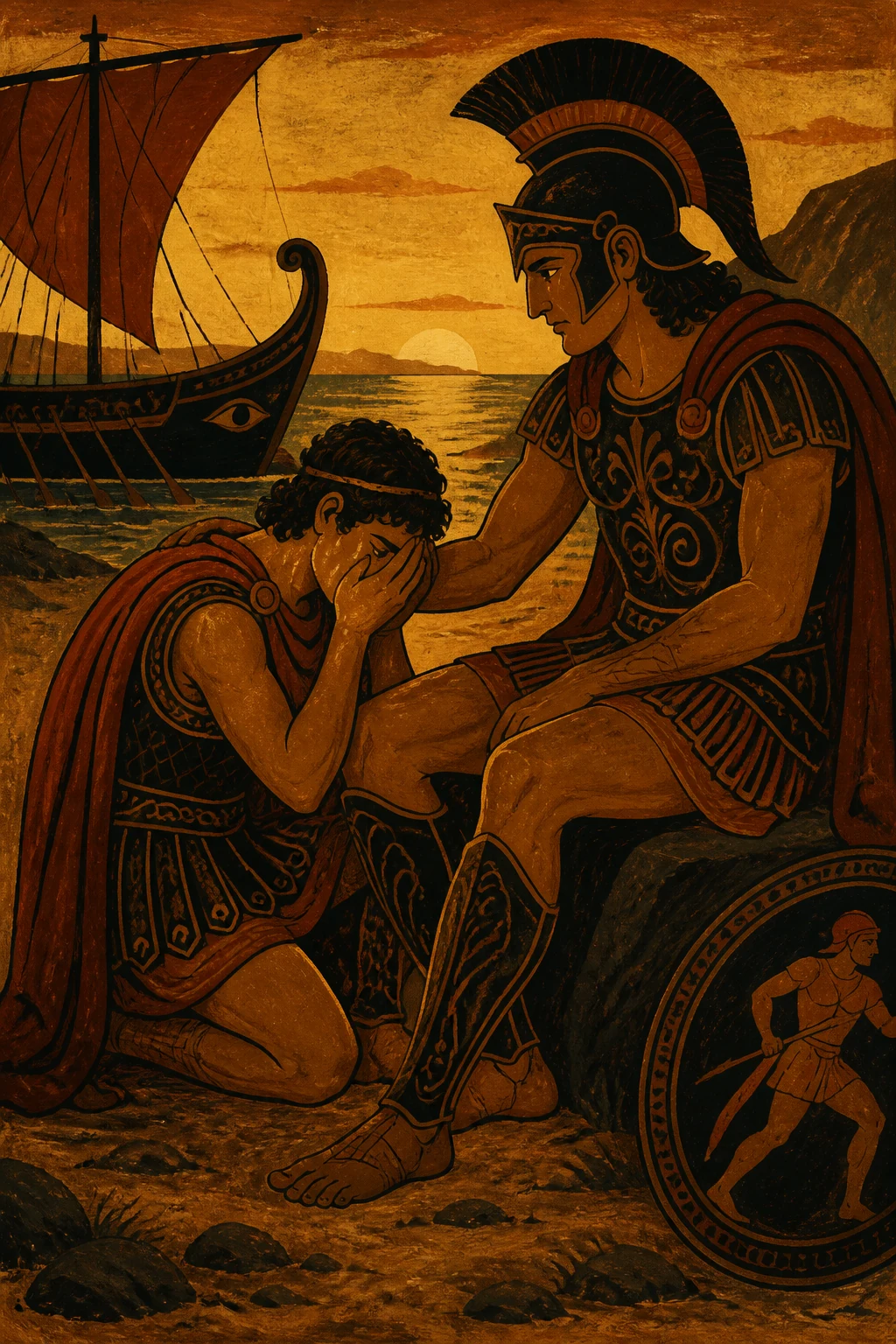
With one hand Lycaon clasped his knees in supplication; with the other he held the sharp spear and would not let it go. Then he spoke these winged words: “By your knees I beg you, Achilles: respect my plea and pity me. To you, cherished of Zeus, I stand as a suppliant entitled to reverence, for at your table I first tasted Demeter’s grain on the day you took me captive in the well-tended orchard. You carried me far from my father and my friends and sold me in holy Lemnos, and I fetched you the price of a hundred oxen.
“Now I have been ransomed for three times as much. This is only the twelfth dawn since I came to Ilios after many sufferings, and now deadly fate has put me in your hands again. Surely Father Zeus must hate me, to have given me to you once more. My mother bore me to a short life—Laothoe, daughter of old Altes, Altes who rules the warlike Leleges and holds steep Pedasus beside the Satnioeis.
“Priam married his daughter, as he married many others, and she bore the two of us. You will cut both our throats. One you have already brought down among the foremost fighters, godlike Polydorus, whom you struck with your sharp spear. Now evil will befall me here as well, for I do not think I shall escape your hands, since a god has brought me within reach.
“One thing more I will tell you; take it to heart. Do not kill me, for I am not born of the same mother as Hector, who killed your comrade, so gentle and so strong.” Thus Priam’s glorious son pleaded with him, but heard a merciless reply: “Fool, do not speak to me of ransom or offer any plea. Before Patroclus met his destined day, it was dearer to my heart to spare the Trojans, and many I took alive and sold. But now not one shall escape death whom a god puts into my hands before Ilios—not one of all the Trojans, and least of all the sons of Priam.
“Come, friend, you too must die. Why lament so bitterly? Patroclus died, and he was a far better man than you. Do you not see how handsome I am, how tall? My father is a noble man, and a goddess bore me. Yet over me too hang death and mighty fate. A dawn will come, or an evening, or a noonday, when someone will take my life in battle, striking me with a spear or an arrow from the bowstring.”
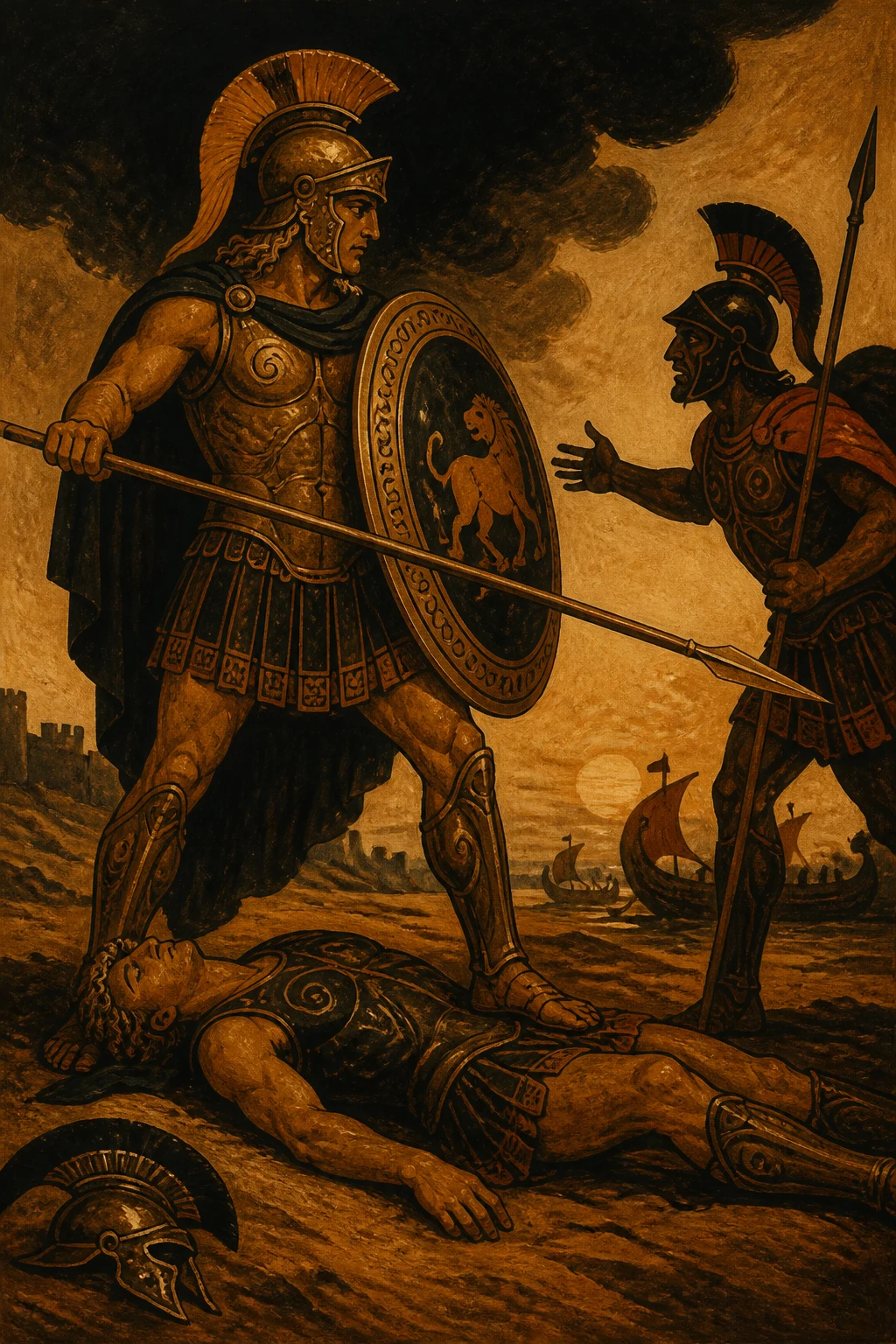
So he spoke, and Lycaon’s knees and heart gave way. He released the spear and sank down, spreading both hands. Achilles drew his sharp sword and struck him at the collarbone beside the neck. The whole two-edged blade sank in, and Lycaon lay stretched face downward on the earth. Black blood flowed out and soaked the ground.
Achilles seized him by the foot and flung him into the river to be carried away, and exulted over him with winged words: “Lie there now among the fish, who will lick the blood from your wound without a care. Your mother will not lay you on a bier and mourn you; eddying Scamander will carry you into the broad bosom of the sea. Some fish will leap through the waves and dart beneath the dark ripple to feed on Lycaon’s white fat.
“Perish, all of you, until we reach the city of sacred Ilios—you fleeing, I slaughtering behind you. Not even your fair-flowing river with its silver eddies shall save you, though for so long you have sacrificed many bulls to him and lowered living, single-hoofed horses into his whirls.
“Even so, you shall die an evil death, until you have all paid for the killing of Patroclus and the slaughter of the Achaeans whom you slew beside the swift ships while I was away.” So he spoke, and the river grew still angrier in his heart. He pondered how to stop noble Achilles’ work and ward destruction from the Trojans.
Meanwhile the son of Peleus, holding his long-shadowed spear, sprang at Asteropaeus, son of Pelegon, intent on killing him. Pelegon was born to the broad-flowing Axius and Periboea, eldest of the daughters of Acessamenus, for the deep-eddying river had lain with her.
Achilles rushed at him, and Asteropaeus came out of the river and stood to face him, holding two spears. Xanthus put courage in his heart, enraged at the young men whom Achilles was slaughtering without pity in his stream.
When they drew near each other, swift-footed, noble Achilles was the first to speak: “Who are you, and from where, that you dare to come against me?
“Only the sons of unhappy parents face my fury.” Then Pelegon’s glorious son answered him: “Great-hearted son of Peleus, why ask my lineage? I come from distant, fertile Paeonia, leading the long-speared Paeonians. This is the eleventh dawn since I came to Ilios.
“My lineage springs from broad-flowing Axius, Axius who sends the fairest water over the earth. He begot Pelegon, famed for his spear, and Pelegon, men say, begot me. Now let us fight, glorious Achilles.”
So he spoke in challenge. Noble Achilles raised his Pelian ash spear, while the hero Asteropaeus hurled both spears at once, for he could wield either hand. With one he struck the shield, but did not pierce it: the gold, the god’s gift, stopped the point. The other grazed Achilles’ right forearm, and dark blood gushed out. The spear flew past him and lodged in the earth, longing to glut itself on flesh.
Then Achilles in turn hurled his straight-flying ash spear at Asteropaeus, intent on killing him. He missed the man and struck the high bank, driving the ash shaft halfway into it.
The son of Peleus drew his sharp sword from beside his thigh and leapt at him fiercely. Asteropaeus could not wrench Achilles’ ash spear from the bank with his strong hand. Three times he shook it, straining to pull it free; three times his strength failed him. On the fourth he meant to bend and break the ash spear of Aeacus’ grandson, but before he could, Achilles came close and took his life with the sword.
He struck him in the belly beside the navel, and all his bowels spilled upon the ground. Darkness covered his eyes as he gasped. Achilles sprang upon his chest, stripped off his armor, and spoke in triumph: “Lie there! It is hard to strive with the children of mighty Cronus’ son, even though you are born of a river.
“You claimed descent from a broad-flowing river, but I boast that my lineage comes from great Zeus. My father is Peleus, son of Aeacus, who rules over many Myrmidons; and Aeacus was born of Zeus.
“As Zeus is stronger than the rivers flowing to the sea, so the offspring of Zeus are stronger than a river’s offspring. Here beside you is a mighty river, if he can help you at all. But there is no fighting Zeus, the son of Cronus. Not even lord Achelous is his equal, nor the great strength of deep-flowing Ocean, from whom all rivers and every sea, all springs and deep wells draw their waters. Even Ocean fears great Zeus’s thunderbolt and the dreadful thunder when it crashes from the heavens.”
So he spoke, and wrenched his bronze spear from the bank. The man whose life he had taken he left lying there on the sand, with the dark water washing over him.
Eels and fish busied themselves about him, nibbling and tearing away the fat around his kidneys. But Achilles went after the Paeonian chariot-warriors, who were still fleeing in panic beside the eddying river, since they had seen their best man brought down in fierce combat by the hands and sword of Peleus’ son.
There he killed Thersilochus, Mydon, Astypylus, Mnesus, Thrasius, Aenius, and Ophelestes. And swift Achilles would have killed still more Paeonians, had not the deep-eddying river, angered, taken a man’s likeness and spoken from his deep whirlpool: “Achilles, beyond all men you are mighty, and beyond all men you commit outrages, for the gods themselves are always at your side.
“If the son of Cronus has granted you to destroy all the Trojans, at least drive them out of me and do your dreadful deeds upon the plain. My lovely streams are choked with corpses. I cannot pour my current into the shining sea, so clogged am I with dead men, while you go on killing without mercy.
“Come now, leave off. Horror possesses me, leader of armies.” Swift-footed Achilles answered him: “It shall be as you command, Scamander, cherished of Zeus.
“But I will not stop killing the arrogant Trojans until I have penned them in their city and tried my strength face to face with Hector, whether he will master me or I him.” With that he rushed upon the Trojans like a god. Then the deep-eddying river spoke to Apollo: “Ah, silver-bowed son of Zeus, you have not kept the command of Cronus’ son, though he charged you again and again to stand beside the Trojans and defend them until the late-setting sun comes down and shadows the fertile fields.”
He spoke, and Achilles, famed for his spear, leapt from the bank into the midst of the river. The river surged against him in a swelling flood, stirring all his waters into tumult. The many dead whom Achilles had killed and who lay thick within him he thrust out upon the dry land, bellowing like a bull. But the living he saved in his lovely streams, hiding them in his great, deep eddies.
A dreadful, seething wave rose around Achilles. The current struck his shield and drove him back, and he could find no footing. He caught hold of a great, well-grown elm, but it tore out by the roots, carrying the whole bank with it. Its thick branches dammed the lovely streams, and as the whole tree fell across the water it made a bridge. Achilles sprang out of the whirlpool and sped on swift feet across the plain in terror. But the great god did not cease. Dark-crested, he rose against him, to stop noble Achilles’ work and ward destruction from the Trojans.
The son of Peleus leapt back a spear’s cast, with the swoop of the black hunting eagle, strongest and swiftest of winged creatures. Like that bird he darted, and the bronze upon his breast clanged fearfully. He swerved away beneath the wave and fled, while the river followed behind with a mighty roar.
As a man channels water from a dark spring among his plants and gardens, hoe in hand, clearing obstructions from the ditch, and all the pebbles roll beneath the advancing stream, which runs swiftly murmuring down the slope and overtakes the man who guides it, so the river’s wave kept catching Achilles, swift though he was. The gods are stronger than men.
Whenever swift-footed, noble Achilles tried to stand his ground and learn whether all the immortals who hold the broad heavens were driving him to flight, a great wave of the heaven-fed river struck him high above the shoulders. He leapt upward in anguish, but the violent current rushing beneath him weakened his knees and swept the earth from under his feet.
The son of Peleus looked up into the broad heavens and cried aloud: “Father Zeus, will none of the gods take pity on me and save me from the river? Afterward let whatever comes befall me. Yet none of the heavenly gods is so much to blame as my own mother, who beguiled me with lies. She said that beneath the wall of the armored Trojans I would perish by Apollo’s swift arrows.
“If only Hector had killed me, the best man bred in this land! Then a brave man would have slain me, and a brave man would have been stripped of his armor. But now it seems I was fated to die a wretched death, trapped in a great river like a swineherd boy whom a torrent sweeps away as he crosses in a storm.”
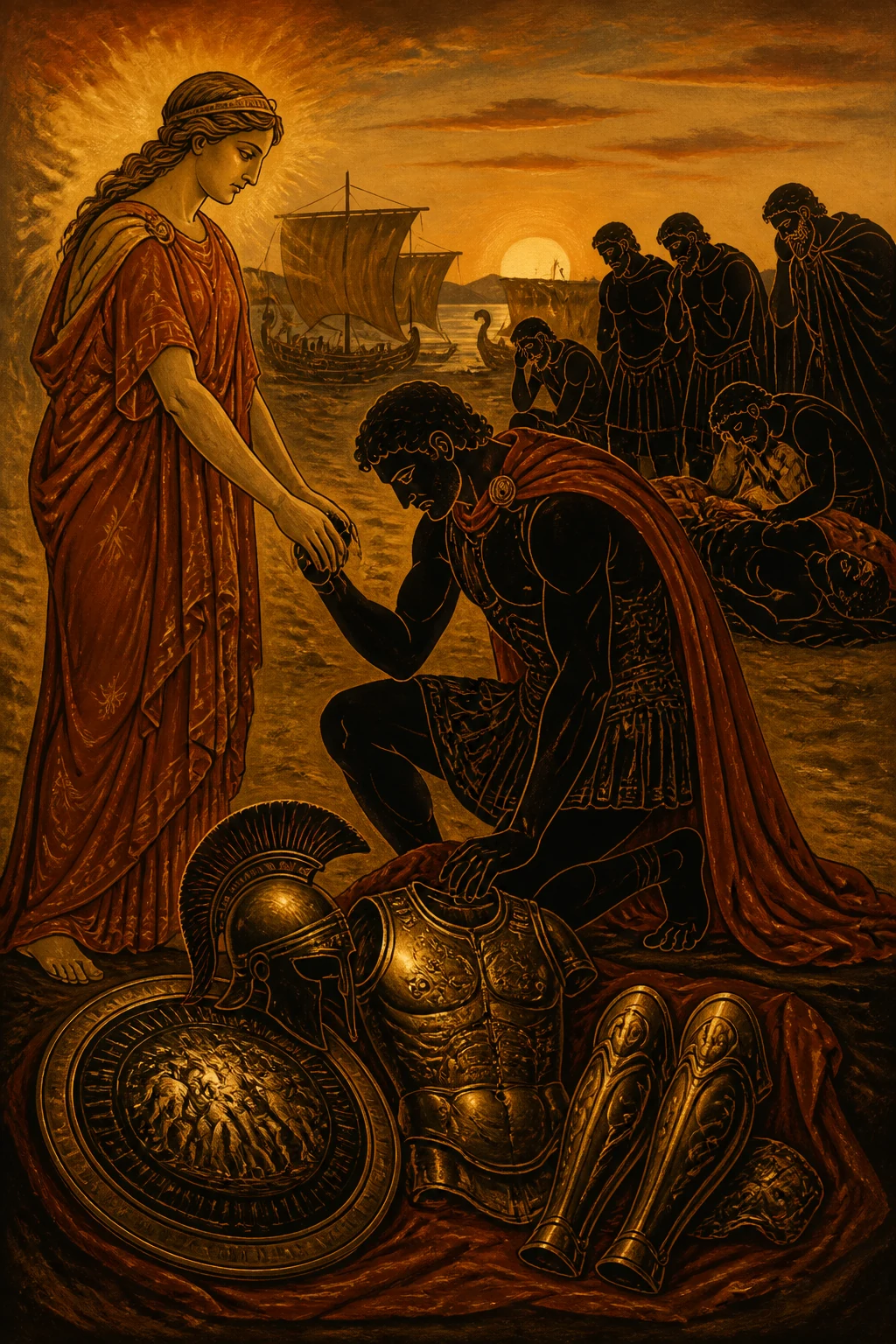
So he spoke, and Poseidon and Athena swiftly came and stood beside him in the likeness of men. Taking his hand in theirs, they reassured him with their words. Poseidon the earth-shaker spoke first: “Son of Peleus, do not tremble so or be afraid. With Zeus’s approval, two such gods as we stand at your side—I and Pallas Athena. It is not your fate to be overcome by a river. Soon this one will subside, as you yourself will see. But we will give you sound counsel, if you will listen: do not stay your hands from relentless war until you have driven all the Trojan host that escapes beneath the famous walls of Ilios. Then, when you have taken Hector’s life, return to the ships. We grant you glory.”
With these words the two went back among the immortals. Achilles pressed on toward the plain, greatly heartened by the gods’ command. It was all awash with floodwater, and many fine pieces of armor from young men slain in battle floated there, along with corpses. He lifted his knees high as he charged straight against the current, and the broad-flowing river could not stop him, for Athena had put great strength into him.
Nor did Scamander abate his fury. Still more enraged at Peleus’ son, he reared on high and crested his stream with a wave. He shouted to Simois: “Dear brother, let us join our strength and hold this man back. Soon he will sack the great city of lord Priam; the Trojans will not stand against him in battle.
“Come quickly to my aid. Fill your streams with water from the springs, rouse all your torrents, raise a mighty wave, and stir up a great roaring mass of logs and stones, so we may stop this savage man who now prevails and thinks himself a match for the gods.
“Neither his strength, I say, nor his beauty shall avail him, nor his splendid armor, which shall lie deep beneath the pool, covered in mud. I will wrap him in sand and pour over him a boundless mass of shingle. The Achaeans will not even know where to gather his bones, so deep beneath the silt will I bury him.
“Here his tomb shall be made, and there will be no need to heap a mound when the Achaeans perform his burial.” He spoke and rushed at Achilles, surging high in turmoil, roaring with foam and blood and corpses.
The dark wave of the heaven-fed river towered up, ready to overwhelm the son of Peleus. Hera cried aloud, greatly afraid that the mighty, deep-eddying river would sweep Achilles away. At once she spoke to Hephaestus, her dear son: “Rise, my lame-footed child! We thought it was against you that eddying Xanthus would stand in battle. Come quickly to our aid; show forth a mighty flame.
“I myself will rouse from the sea a fierce storm of the West Wind and the clearing South Wind, which shall burn the Trojans’ heads and armor as it bears the deadly blaze. Burn the trees along Xanthus’ banks, and turn your fire upon the river himself. Do not let him turn you back with soothing words or threats. Do not check your fury until I shout the word; then restrain your tireless fire.”
So she spoke, and Hephaestus prepared a wondrous blaze. First the fire kindled on the plain and burned the many dead whom Achilles had killed and who lay thick upon it. The whole plain dried out, and the shining water was checked.
As in harvest time the North Wind swiftly dries a newly watered orchard, to the delight of the man who tends it, so the whole plain dried, and the dead were burned. Then Hephaestus turned his dazzling flame upon the river.
Elms and willows and tamarisks burned; clover, rushes, and sedge burned, all that grew thick around the river’s lovely streams. The eels and fish within the eddies were tormented, tumbling this way and that through the lovely waters, overcome by the scorching breath of cunning Hephaestus.
The river’s strength was burning away, and he cried out: “Hephaestus, none of the gods can stand against you! I cannot fight you when you blaze with fire like this.
“Cease your strife! Let noble Achilles drive the Trojans from their city this very moment. What have I to do with fighting or defending them?” So he spoke, burning in the fire, and his lovely streams seethed. As a cauldron boils under the press of a great fire, melting the fat of a tender-fed hog, bubbling all over with dry wood blazing beneath it, so his lovely streams burned in the fire, and the water boiled. It would not flow onward but was checked, tormented by the fierce blast of wise Hephaestus. Then the river pleaded earnestly with Hera in winged words: “Hera, why has your son singled out my stream for torment? I am not so much to blame as all the others who defend the Trojans.
“I will leave off, if you command it; but let him leave off as well. And I will swear this oath: never again will I ward the evil day from the Trojans, not even when all Troy burns in ravening fire, kindled by the warlike sons of the Achaeans.”
When the white-armed goddess Hera heard this, she spoke at once to her dear son Hephaestus: “Hephaestus, stop, my glorious child. It is not fitting to batter an immortal god like this for the sake of mortals.”
So she spoke, and Hephaestus quenched his wondrous fire. The river’s wave rushed back along his lovely channels. Once Xanthus’ strength was subdued, the two ceased fighting, for Hera held them back, angry though she was. But among the other gods there fell a grievous, weighty strife, and their hearts were divided. They clashed with a mighty crash; the broad earth roared, and the great heavens rang like a trumpet. Zeus heard it as he sat on Olympus, and his heart laughed with delight to see the gods joining battle.
They did not stand apart for long. Ares, piercer of shields, began it, rushing first at Athena with his bronze spear and speaking words of insult: “Why, you dog-fly, do you set the gods against one another again, filled with boundless impudence, driven on by your proud heart?
“Do you not remember how you urged Diomedes, son of Tydeus, to wound me? You yourself took his spear in plain sight, drove it straight at me, and tore my beautiful flesh. Now, I think, you shall pay for all you did.”
With that he struck her tasseled aegis, the dreadful aegis that not even Zeus’s thunderbolt can overcome. There bloodstained Ares thrust his long spear. But Athena drew back and took in her strong hand a stone that lay upon the plain, black and rough and huge, which men of former times had set as a boundary marker for a field. With it she struck raging Ares on the neck and brought his limbs to the ground.
He lay across seven hundred feet as he fell; his hair was fouled with dust, and his armor clattered about him. Pallas Athena laughed, and spoke these winged words in triumph: “Fool, have you still not learned how much stronger I claim to be, that you match your strength with mine?
“So may you pay the full price of your mother’s curses! She is angry and devises evil for you, because you abandoned the Achaeans and defend the arrogant Trojans.” With these words she turned her shining eyes away. Aphrodite, daughter of Zeus, took Ares by the hand and led him off, groaning heavily. He could scarcely gather his senses.
When the white-armed goddess Hera saw her, she spoke winged words at once to Athena: “Look, tireless daughter of aegis-bearing Zeus! There is that dog-fly again, leading Ares, the scourge of mortals, out of the turmoil of deadly war. After her!”
So she spoke, and Athena sped after Aphrodite, rejoicing in her heart. She overtook her and drove her strong hand against her breast. Aphrodite’s knees and heart gave way at once, and the two lay together on the earth that feeds so many. Athena exulted over them with winged words: “May all who defend the Trojans be like these when they fight the armored Argives—just as bold and steadfast as Aphrodite, who came to help Ares and faced my strength! Then we should long ago have ended the war and sacked the well-built city of Ilios.”
So she spoke, and white-armed Hera smiled. Then lord Poseidon the earth-shaker addressed Apollo: “Phoebus, why do we two stand apart? It is not fitting, now the others have begun. It would be shameful to return without a fight to Olympus and Zeus’s bronze-floored house.
“Begin, for you are younger. It would not become me to strike first, since I am older and know more. Fool, how thoughtless your heart is! Do you not even remember all the suffering we two, alone of all the gods, endured around Ilios, when we came at Zeus’s bidding and served proud Laomedon for a year at an agreed wage? He was our master and gave us his orders.
“I built the Trojans a wall about their city, broad and very beautiful, to make the city unassailable. You, Phoebus, tended their shambling, curved-horned cattle in the glens of wooded Ida with its many folds.
“But when the joyful seasons brought the term of our hire to its end, terrible Laomedon robbed us of all our wages and sent us away with threats. He threatened to bind your hands and feet and sell you on distant islands, and boasted that he would slice off both our ears with bronze.
“We went back with angry hearts, enraged at the wages he had promised but withheld. And now you favor his people, instead of trying with us to bring the arrogant Trojans to utter, miserable ruin, with their children and their honored wives!” Lord Apollo, who strikes from afar, replied: “Earth-shaker, you would not call me wise if I fought you for the sake of wretched mortals, who are like leaves: now they flourish in their splendor, feeding on the fruits of the earth, and now they wither, lifeless. Let us cease fighting at once, and leave them to their own quarrels.”
With these words he turned away, for he shrank from coming to blows with his father’s brother. But his sister, wild Artemis, mistress of beasts, rebuked him bitterly: “So you flee, far-shooter, and hand the whole victory to Poseidon, giving him glory for nothing! Fool, why carry that bow, useless as the wind?
“Let me never hear you boast again in our father’s halls, as once you did among the immortal gods, that you would meet Poseidon face to face in battle.” So she spoke, but far-shooting Apollo gave no answer. Instead Zeus’s honored wife grew angry and reviled the archer goddess: “How dare you, shameless bitch, stand up against me? You will find my strength hard to face, bow-bearer though you are. Zeus has made you a lion among women and granted you to kill whichever of them you please.
“Better to kill wild beasts and deer in the mountains than to fight those stronger than yourself. But if you wish to learn of war, come, and you shall know how much stronger I am, since you would match your might with mine.”
She spoke, and with her left hand caught both Artemis’ wrists. With her right she took the bow and quiver from her shoulders and, smiling, beat her about the ears with them as she twisted away. The swift arrows spilled out.
Weeping, the goddess fled from her, like a dove that flies from a hawk into a cleft in a hollow rock, for it is not fated to be caught. So Artemis fled in tears, leaving her bow behind.
Then Hermes, the guide and slayer of Argus, spoke to Leto: “Leto, I will not fight you. It is a dangerous thing to come to blows with the wives of Zeus the cloud-gatherer. You may freely boast among the immortal gods that you overcame me by sheer strength.”
So he spoke, and Leto gathered up the curved bow and the arrows that lay scattered here and there in the swirling dust. Taking her daughter’s weapons, she went back. Artemis meanwhile reached Olympus and Zeus’s bronze-floored house. Weeping, the maiden sat upon her father’s knees, her immortal robe trembling about her. Her father, the son of Cronus, drew her close and asked with a gentle laugh: “Which of the heavenly gods has treated you like this, dear child, so wantonly, as though you had been caught doing wrong?”
The clear-voiced goddess of the lovely crown replied: “Your wife has battered me, Father—white-armed Hera, who has brought strife and quarrelling among the immortals.” So they spoke together. But Phoebus Apollo entered sacred Ilios, for he was troubled for the wall of the well-built city, lest the Danaans should sack it that day before its fated time.
The other ever-living gods went back to Olympus, some angry, some greatly exulting, and sat beside their Father of the dark clouds. But Achilles went on killing the Trojans and their single-hoofed horses alike.
As smoke rises and reaches the broad heavens from a burning city, kindled by the wrath of the gods, bringing toil to all and sorrow to many, so Achilles brought toil and sorrow upon the Trojans.
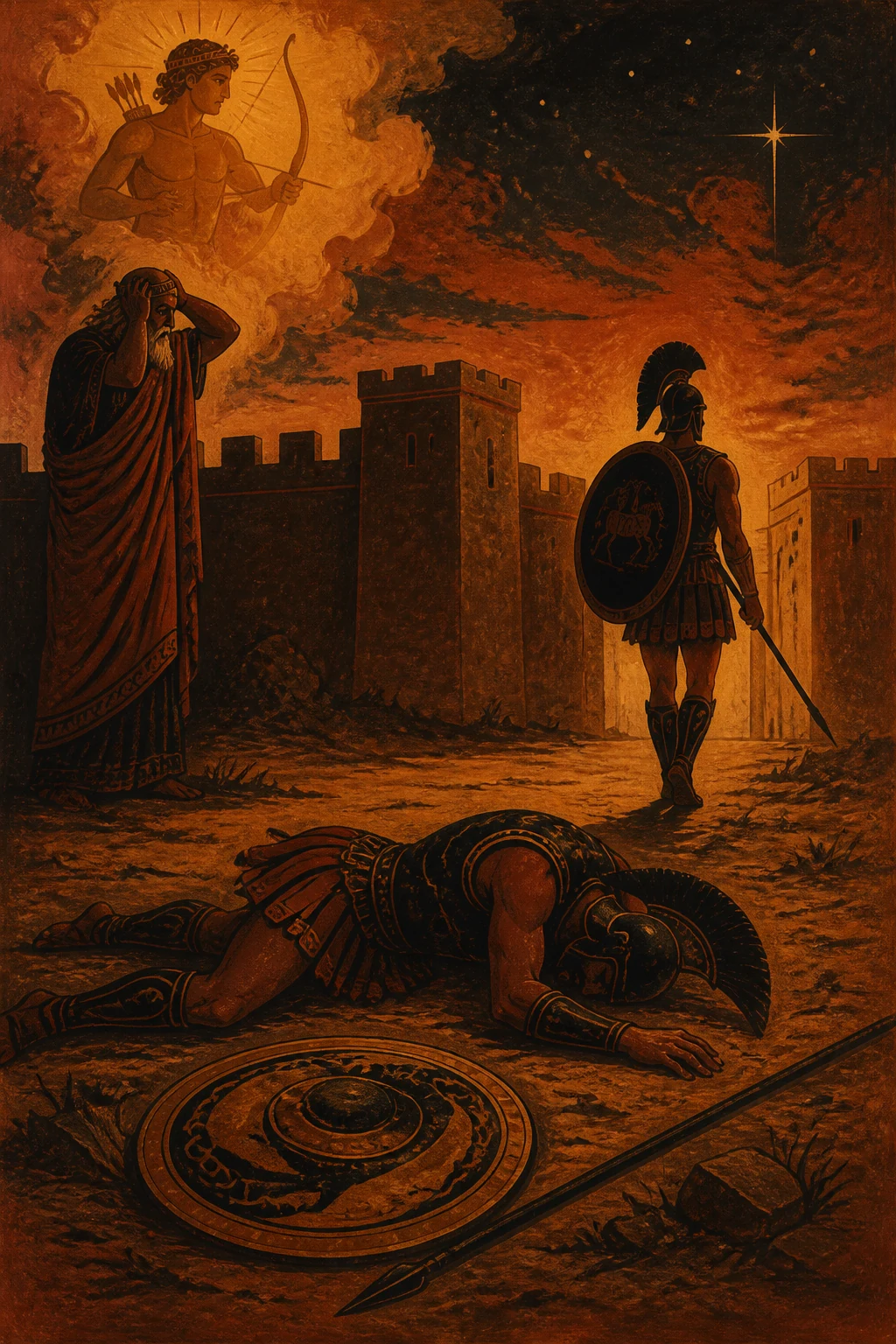
Old Priam stood upon the sacred tower and caught sight of mighty Achilles. Before him the Trojans were driven headlong in terror, and none could stand against him. With a groan the old man came down from the tower to the ground, calling to the renowned gatekeepers along the wall: “Hold the gates wide open until our men have come into the city from their flight. Achilles is close upon them, driving them before him. Now, I fear, disaster is at hand.
“But once they have gathered within the walls and caught their breath, close the tightly fitted doors again. I fear that deadly man may burst inside.” So he spoke, and they opened the gates and thrust back the bars. As the doors swung wide, they offered a gleam of deliverance; and Apollo sprang out to meet the Trojans and ward off destruction.
Straight toward the city and its lofty wall they fled across the plain, parched with thirst and thick with dust. Achilles pressed fiercely after them with his spear; a terrible frenzy gripped his heart, and he thirsted to win glory.
Then the sons of the Achaeans would have taken high-gated Troy, had not Phoebus Apollo roused noble Agenor, Antenor’s son, a warrior strong and blameless. He put courage into his heart and stood beside him, leaning against an oak, to ward off the heavy hands of death, himself concealed in a deep mist.
When Agenor saw Achilles, sacker of cities, he stood his ground, though his heart surged with anxious thoughts as he waited. Troubled, he spoke to his own proud spirit: “Alas for me! If I flee before mighty Achilles along the way the others are being driven in panic, he will catch me even so and cut my throat like a coward’s.
“But what if I leave these men to be driven before Achilles, Peleus’ son, and run another way, away from the wall toward the plain of Ilios, until I reach the foothills of Ida and hide among the thickets? Then at evening I could bathe in the river, wash off the sweat, and return refreshed to Ilios. But why does my heart dwell on such thoughts?
“He may see me leaving the city for the plain, dart after me, and catch me on his swift feet. Then there will be no escaping death and doom, for his strength is far beyond that of all other men.
“What if I go out to face him before the city? His flesh too can be pierced by sharp bronze; there is but one life within him, and men say that he is mortal. Yet Zeus, the son of Cronus, grants him glory.”
With these words he gathered himself and waited for Achilles, his valiant heart eager for battle and combat. As a leopard comes out of a deep thicket to face a hunter, neither trembling nor fleeing when it hears the hounds bay—even if the hunter strikes first and wounds it with a thrust or a cast, still, though pierced by the spear, it does not abandon the fight until it closes with him or is slain—so noble Agenor, son of illustrious Antenor, would not flee before he had tried his strength against Achilles.
He held his rounded shield before him, aimed his spear at Achilles, and shouted aloud: “Surely, glorious Achilles, you hope in your heart to sack the city of the proud Trojans this very day! Fool! There is much suffering still in store for you before it falls.
“Within it we are many, and brave, and we will defend Ilios before our dear parents, our wives, and our sons. Here you shall meet your doom, for all your fearsome might and your boldness in battle.”
He spoke and hurled his sharp spear from his powerful hand. It struck Achilles on the shin below the knee, true to its mark. The greave of newly wrought tin rang out terribly around his leg, but the bronze point sprang back from the blow and did not pierce it: the god’s gifts held it off.
Then Peleus’ son rushed in his turn at godlike Agenor. But Apollo would not let him win that glory: he snatched Agenor away, wrapped him in a deep mist, and sent him safely out of the battle.
Then by a trick he drew Peleus’ son away from the army. The far-shooting god took on Agenor’s likeness in every detail and stood in Achilles’ path, and Achilles rushed after him in pursuit. Across the wheat-bearing plain he chased him, turning him along the deep-eddying river Scamander, while the god ran only a little way ahead. Apollo beguiled him, keeping him always hopeful that his own feet would overtake him. Meanwhile the other Trojans, fleeing in terror, streamed gladly toward the city in a throng, and it filled with the men who crowded into it.
They dared no longer wait for one another outside the city and its wall, or find out who had escaped and who had died in battle. Instead they poured headlong into the city, all whose feet and knees had carried them to safety.