Prevod
Meanwhile Theseus, having done his share of their common labour, was making his way to the Erechthean citadel of Pallas. Achelous, swollen with rain, barred his passage and delayed his journey. “Come beneath my roof,” he said, “illustrious son of Cecrops, and do not trust yourself to these ravening waters: they often carry off solid beams and roll great boulders headlong with a mighty roar. I have seen lofty cattle sheds along the banks swept away, herds and all: there strength was no help to the cattle, nor speed to the horses.
Here too this torrent, swollen by melting mountain snows, has drowned many young bodies in its swirling flood. It is safer to rest until the river runs within its accustomed bounds, until its own bed can hold the dwindling waters.” The son of Aegeus nodded. “Achelous,” he replied, “I shall accept both your house and your advice.” And he availed himself of both. He entered halls built of porous pumice and rough tufa: the ground was damp with soft moss, and shells, alternating with purple murex, panelled the ceiling.
Now Hyperion had measured out two-thirds of the daylight, and Theseus and his companions in labour reclined upon couches: on one side sat Ixion’s son, on the other the hero of Troezen, Lelex, whose temples were already sprinkled with a few grey hairs, with others whom the river god of Acarnania had deemed worthy of equal honour, overjoyed to entertain so great a guest.
At once barefoot nymphs furnished the tables with a feast, and when the food was cleared away, served unmixed wine in jewelled cups. Then the greatest of heroes, gazing out over the sea below, said, “What is that place?” He pointed with his finger. “Tell me the name of that island—though it seems there is more than one.” The river god replied, “What you see is not a single island: there are five; distance conceals the channels between them.
And so you may marvel less at what Diana did when slighted, these islands were once naiads. After slaughtering ten young bulls and inviting the country gods to their sacred rites, they led their festive dances, forgetting me. I swelled, and rose as high as I have ever risen at my fullest flood; monstrous alike in anger and in waters, I tore woodland from woodland and field from field, and swept the nymphs, who at last remembered me, with their land into the sea. My waters and the sea’s split the once-unbroken ground, dividing it into as many parts as the Echinades you see amid the waves.
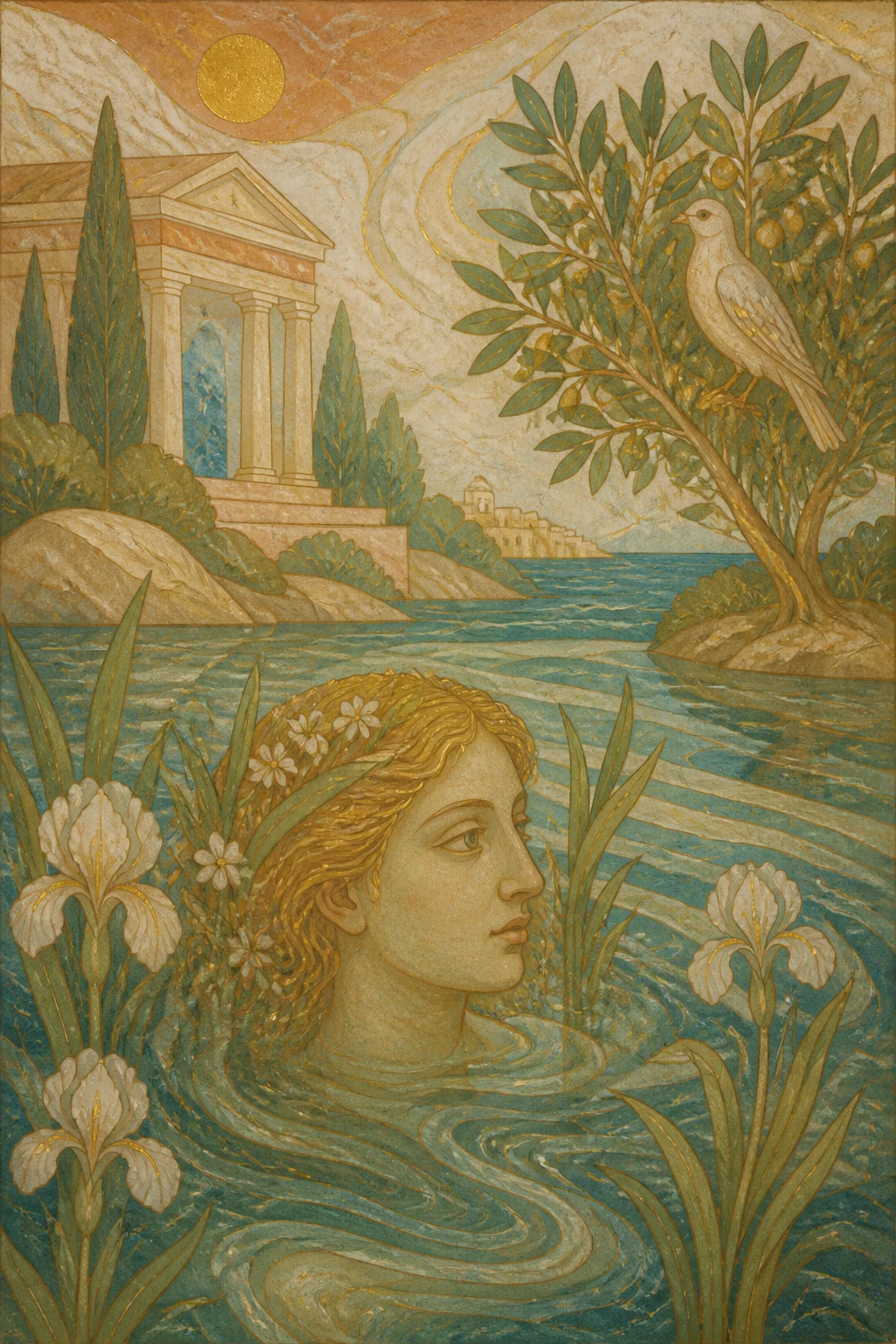
Yet, as you yourself can see, one island lies far, far apart, dear to me; sailors call it Perimele. I loved her and robbed her of her maidenhood. Her father Hippodamas took this bitterly, and from a cliff hurled his daughter’s body into the deep to die. I caught her, and as I bore her afloat, I said, ‘O trident-bearer, to whom the restless waters, the realm next to earth, fell by lot, in whom we sacred rivers end, toward whom we run, come here, Neptune, and graciously hear my prayer.
I have wronged this girl whom I bear. Had Hippodamas been gentle and just, had he been a father, or merely less cruel, he ought to have pitied her and forgiven us. This too I shall embrace.’ The king of the sea nodded and shook all his waters with his assent. The nymph was frightened, yet still she floated. As she floated, I touched her breast, her heart beating in terror.
And while I touched her, I felt her whole body harden, and her breast become buried beneath gathering earth. Bring her help, I pray, and, drowned through her father’s cruelty, grant her a place, Neptune; or let her herself become a place.’ As I spoke, new earth enfolded her floating limbs, and from her transformed body a solid island grew.