Prevod
You know the nisse, but do you know the mistress, the gardener’s wife? She was well read, could recite verses by heart, and could even write them herself with ease; only the rhymes, the “clinking,” as she called it, gave her a little trouble. She had a gift for writing and a gift for speaking; she might well have been a parson, or at least a parson’s wife.
“The earth is lovely in its Sunday best!” she said, and she had put that thought into words and “clinking,” made it into a song, so beautiful and long. The student teacher, Mr. Kisserup—the name is neither here nor there—was her cousin and was staying with the gardener and his wife; he heard the mistress’s poem and said it had done him good, a world of good. “You have spirit, madam!” he said.
“Fiddle-faddle!” said the gardener. “Don’t go putting such notions into her head! A wife should be flesh and blood, decent flesh and blood, and mind her pot so the porridge doesn’t burn.”
“I take the burnt taste out with a glowing ember!” said the mistress. “And I take the burnt taste out of you with a little kiss. Anyone would think you thought of nothing but cabbages and potatoes, and yet you love flowers!” And then she kissed him. “Flowers are the spirit!” she said.
“Mind your pot!” he said, and went into the garden; that was his pot, and he minded it. But the student teacher sat with the mistress and talked to her; he preached something like a whole sermon on her beautiful words, “The earth is lovely,” in his own fashion.
“The earth is lovely; subdue it, we were told, and we became its masters. One rules by the spirit, another by the body; one was put into the world as an exclamation mark of astonishment, another as a dash, so that one may well ask, what was he put here for? One becomes a bishop, another only a poor student teacher, but all is wisely ordered. The earth is lovely, and always in its Sunday best! That was a thought-provoking poem of yours, madam, full of feeling and geography.”
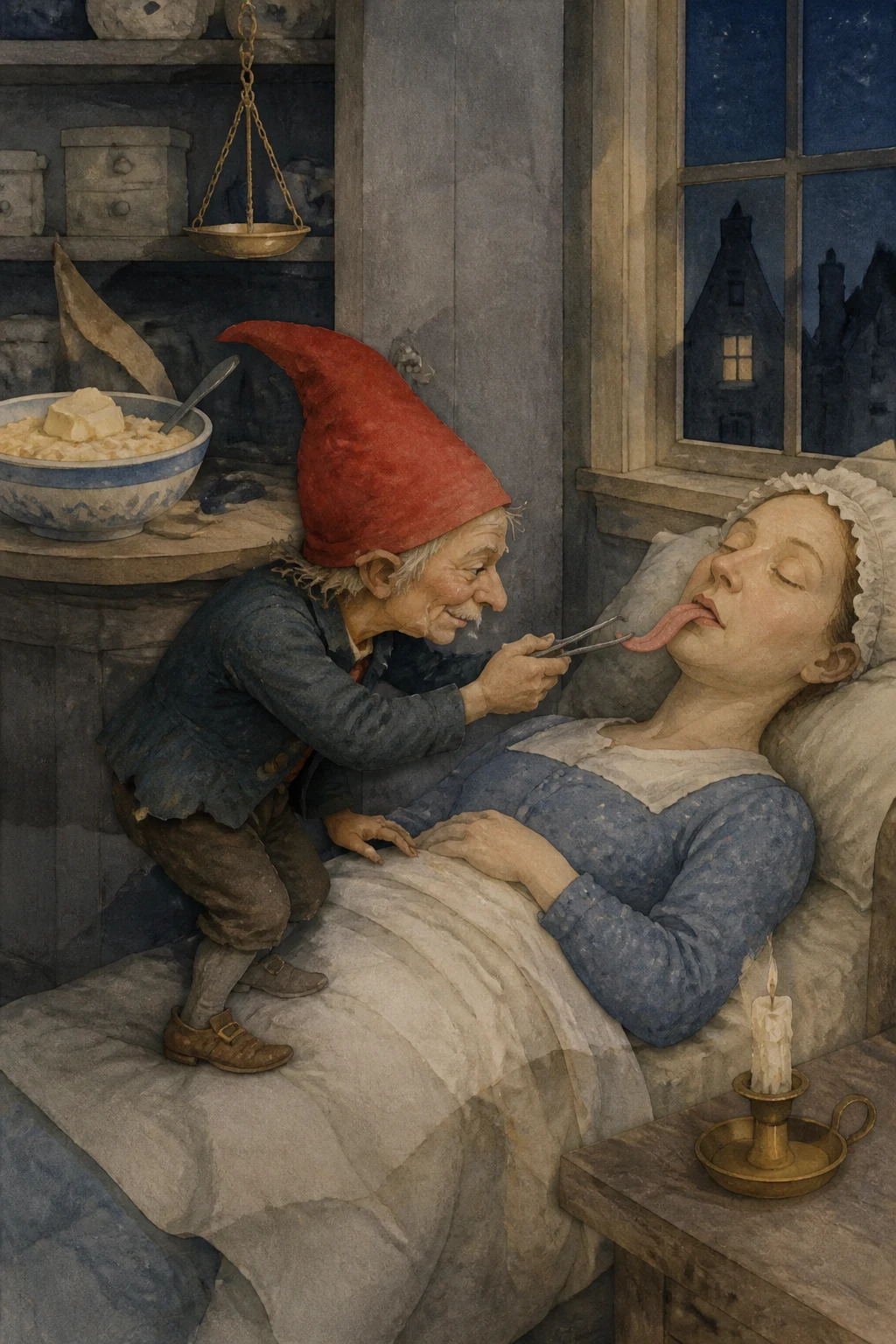
“You have spirit, Mr. Kisserup!” said the mistress. “A great deal of spirit, I assure you! Talking to you helps one understand oneself.” And so they went on talking, just as beautifully and just as well; but out in the kitchen someone else was talking too. It was the nisse, the little grey-clad nisse with the red cap; you know him! The nisse sat in the kitchen, peeping into the pots; he talked, but no one heard him except the big black tomcat, “Cream-Thief,” as the mistress called him.
The nisse was very angry with her, for he knew she did not believe he existed. True, she had never seen him, but with all her reading she ought surely to know he was there, and show him a little consideration. It never occurred to her on Christmas Eve to put out so much as a spoonful of porridge for him; all his forefathers had been given it, and by mistresses who had no book-learning at all. The porridge had swum in butter and cream. The cat’s whiskers grew quite wet at the very thought of it.
“She calls me a notion!” said the nisse. “That’s beyond all my notions. Why, she denies my existence! I found that out by eavesdropping, and now I’ve been eavesdropping again; she sits there hissing away for that boy-beater, the student teacher. I say with the master, ‘Mind your pot!’ She doesn’t, though; now I’ll make it boil over!”
And the nisse blew on the fire, which flared and blazed. “Whirr-a-whirr-a-whoop!” Over boiled the pot. “Now I’ll go in and pick holes in the master’s socks!” said the nisse. “I’ll unravel a great hole in the toe and heel, so there’ll be something to darn, instead of her going off to write poetry. Madam Poet, darn the master’s stockings!”
The cat sneezed at this; he had a cold, although he always wore a fur coat. “I’ve opened the pantry door,” said the nisse. “There’s scalded cream in there, as thick as flour paste. If you won’t lap it up, I will!”
“If I’m to get the blame and the beating,” said the cat, “then let me have the cream as well!” “First the cream, then the scream!” said the nisse. “But now I’m going into the student teacher’s room to hang his braces on the looking-glass and put his socks in the washbasin; then he’ll think the punch was too strong and went to his head. Last night I sat on the woodpile by the kennel; I get a great deal of pleasure from teasing the chained-up dog. I let my legs hang down and dangle. The dog couldn’t reach them, however high he jumped; that annoyed him. He barked and barked, and I dangled and swung; what a racket it was! It woke the student teacher, who got up three times and looked out, but he didn’t see me, although he had his spectacles on; he always sleeps in his spectacles.”
“Say meow when the mistress comes!” said the cat. “I can’t hear very well; I’m ill today.” “You’re only sick with greed!” said the nisse. “Lick away! Lick your sickness away! But wipe your whiskers so the cream doesn’t cling to them! Now I’m off to listen at the door.”
And the nisse stood by the door, which was ajar. There was no one in the room but the mistress and the student teacher; they were talking about what the student teacher so beautifully called the things that ought to be placed above pots and pans in every household: the gifts of the spirit.
“Mr. Kisserup!” said the mistress. “Since we are on the subject, I shall show you something I have never yet shown to a living soul, least of all a man: my little verses. Some of them are rather long, to be sure. I have called them ‘Clinkings of a True Danish Woman!’ I am so fond of old Danish words.”
“And we must hold on to them!” said the student teacher. “We must weed the German out of our language.” “So I do!” said the mistress. “You will never hear me say ‘klejner’ or ‘butterdej’; I say ‘fat-cakes’ and ‘leaf-pastry.’”
And from the drawer she took a notebook with a pale-green cover and two inkblots. “There is much seriousness in this book!” she said. “My deepest feelings incline towards sorrow. Here we have ‘The Sigh in the Night,’ ‘My Sunset Glow,’ and ‘When I Won Klemmensen’—my husband. You may skip that one, though there is feeling and thought in it. ‘The Housewife’s Duties’ is the best piece; they are all very sorrowful, that is where my talent lies. Only one piece is playful; it contains a few merry thoughts, such as one may have, thoughts about—you mustn’t laugh at me!—thoughts about being a poetess. It is known only to myself, my drawer, and now to you as well, Mr. Kisserup! I love poetry; it comes over me, it teases, rules, and reigns. I have expressed it under the title ‘Little Nisse.’ You surely know the old country belief in the household nisse, who is always playing tricks about the house; I imagined that I myself was the house, and that poetry, the feelings within me, was the nisse, the spirit that rules there. I have sung of his power and greatness in ‘Little Nisse’! But you must give me your hand and your word that you will never reveal it to my husband or anyone else. Read it aloud, so I can hear whether you can make out my handwriting.”
And the student teacher read, and the mistress listened, and the little nisse listened too; he was eavesdropping, you know, and had arrived just as the title was being read: Little Nisse.
“Why, that’s about me!” he said. “What can she have written about me? Ah, I’ll pinch her, pinch her eggs, pinch her chickens, chase the fat off her fatted calf. Just listen to the mistress!”
And he listened with pursed lips and ears stretched long; but as he heard about the nisse’s glory and power, his dominion over the mistress—it was the art of poetry she meant, you know, but the nisse took it literally, just as the title said—the little fellow smiled more and more. His eyes shone with delight, something almost grand came into the corners of his mouth, and he raised his heels and stood on tiptoe, growing a whole inch taller than before; he was enchanted by what was being said about Little Nisse.
“The mistress has spirit and great cultivation! How unfairly I have treated that woman! She has put me into her ‘clinking’; it will be printed and read! Now the cat shan’t be allowed to drink her cream; I shall do it myself! One drinks less than two; that is always a saving, and I shall introduce it, and esteem and honour the mistress!”
“How human that nisse is!” said the old cat. “Just one sweet meow from the mistress, a meow about himself, and he changes his tune at once. She’s a sly one, the mistress!”
But she was not sly; it was the nisse who was human. If you cannot understand this story, then ask someone, but you mustn’t ask the nisse, nor the mistress either.