Prevod
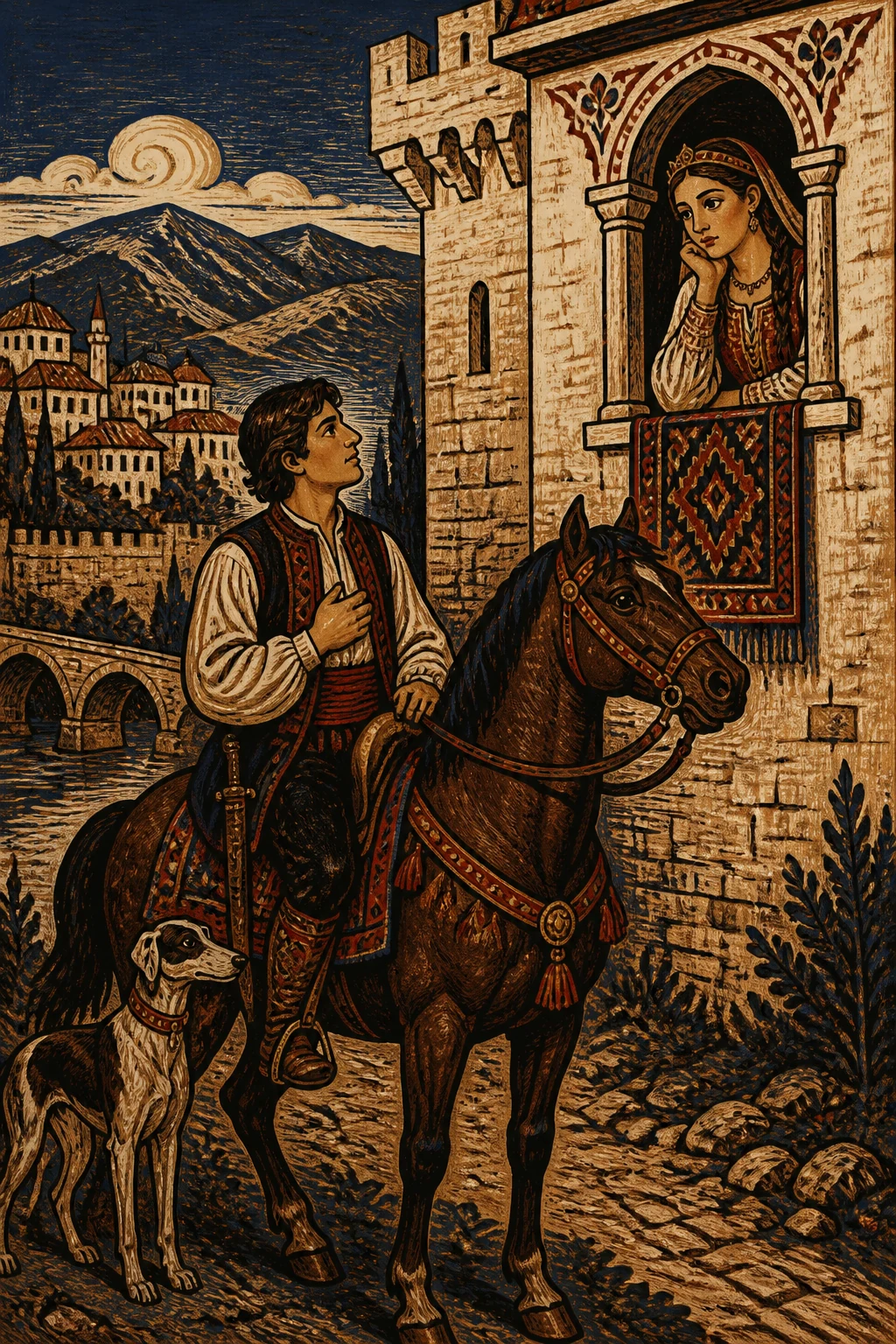
In the time of Gaoxin, an old woman living in the royal palace suffered for many years from an ailment of the ear. A physician probed it and drew out a worm as large as a silkworm’s cocoon. The woman took it away and placed it in a gourd vessel, covering it with a platter. Before long, the worm changed into a dog. Its markings were of five colors, and so it was named Panhu—“Platter and Gourd”—and kept in the palace. At that time, Rongwu was powerful and repeatedly invaded the frontier. Generals sent to subdue him could not prevail. The king therefore proclaimed throughout the realm that whoever could bring him the head of General Rongwu would receive a thousand jin of gold, a fief of ten thousand households, and his youngest daughter in marriage. In time, Panhu came to the palace gate carrying a head in his jaws. The king examined it and found that it was indeed Rongwu’s. What was to be done? His ministers all said, “Panhu is a beast. He cannot be given office or rank, nor can he take a wife. Though he has rendered a great service, there is no reward we can bestow upon him.” When the youngest daughter heard this, she addressed the king: “Your Majesty has already promised me to whoever fulfilled your decree. Panhu has brought the head and rid the kingdom of its scourge. This was surely ordained by Heaven; how could it have been accomplished through a dog’s intelligence and strength alone? A true king honors his word, and a hegemon keeps faith. You must not, for the sake of one insignificant woman, break a solemn pledge made before the whole realm. That would bring calamity upon the kingdom.” Alarmed, the king agreed. He ordered his youngest daughter to go with Panhu, who led her into the southern mountains, where the vegetation grew thick and no human footprints could be seen. There she took off her courtly robes, tied her hair in the manner of a servant boy, and put on simple working clothes. She followed Panhu up the mountain and into a valley, where they made their home in a stone chamber. The king grieved and longed for her, and sent men to seek her out. But whenever they went, wind and rain arose, the mountains shook, and clouds darkened the way, so that none could reach her. After some three years, she had borne six sons and six daughters. Panhu died, and afterward the children paired among themselves and became husbands and wives. They spun and wove tree bark, dyeing it with the fruits of plants. They favored clothing in five colors, all cut with a tail-like extension. Later, their mother returned and told the king about them. The king sent envoys to bring the sons and daughters to court, and this time Heaven sent no rain. Their garments were short and scant, their speech like the twittering of birds. They squatted as they ate and drank, loved the mountains, and disliked the capital. The king respected their wishes and granted them famous mountains and broad marshlands, calling them the “Manyi.” The Manyi appear simple on the outside but are shrewd within; they are attached to their land and cherish their old ways. Because Heaven’s decree had endowed them with a different nature, they were governed by special laws. They farmed and traded without being required to carry frontier permits or travel passes, or to pay rents and taxes. They had settlements, and their chiefs were all granted official seals and ribbons. They made their caps of otter skins, honoring the animal’s ability to swim and find food in the water. Their descendants are the Yi peoples now living in Lianghan, Bashu, Wuling, Changsha, and Lujiang Commandery. To sacrifice to Panhu, they prepare grain mixed with fish and meat, beat upon a wooden trough, and cry aloud. This custom survives to the present day. Hence the saying: “Bare thighs and skirts wrapped crosswise—the descendants of Panhu.”