Prevod
How can a man who shares his home with a snake ever live at ease?
And again:
To live in a house with a snake is death itself—there can be no doubt.
Even a snake at the edge of the village puts a man’s life in jeopardy.
For us, too, living there means that our lives are in danger every day.”
He replied, “There is no cause for even the slightest despair over this. Greedy as he is, he can surely be killed by some stratagem.
Weapons cannot win such victories over an enemy as cunning can.
Even one small in body, if he understands strategy, cannot be overcome by mighty warriors.
For it is also said:
After devouring many fish, large, small, and middling,
A certain heron, through excessive greed, died in a crab’s grip.”
The two asked, “How did that happen?” He replied: Story 7. The Heron and the Crab. In a certain stretch of forest lay a great lake, inhabited by all manner of water creatures. A heron who had made his home there had grown old and could no longer catch fish. Famished, his throat parched with hunger, he sat on the shore and wept, bathing the ground with streams of tears like showers of pearls. A crab approached him with several other water creatures. Moved by his distress, the crab asked respectfully, “Uncle! Why have you made no effort to find food today? Why do you simply sit here sighing, your eyes filled with tears?”
He replied, “My child, you have observed correctly. I have become utterly disgusted with eating fish and have now resolved to fast to death. That is why I do not eat even the fish that come close to me.”
Hearing this, the crab said, “Uncle, what has brought about this aversion?”
He replied, “My child, I was born in this lake and grew up here. Now I have heard that a drought lasting twelve years is about to begin.”
The crab asked, “From whom did you hear this?” The heron replied, “From an astrologer. Saturn is about to break through the Cart of Rohiṇī and proceed toward Mars and Venus. As Varāhamihira has said:
If the Sun’s son breaks through the Cart of Rohiṇī in the heavens,
Then for twelve years Indra sends no rain upon the earth.
And again:
When the Cart of Prajāpati’s star is broken, the earth, as though guilty of a dreadful sin,
Strewn with ashes and fragments of bone, undertakes, it seems, a skull-bearer’s penance.
And again: If the Sun’s son breaks through the Cart of Rohiṇī,
Or Mars, or the Moon,
What can I say? In that ocean of calamity,
The whole world goes to ruin.
When the Moon stands in the midst of Rohiṇī’s Cart,
People, driven to seek refuge,
Wander far away, eating the cooked flesh of children
And drinking scant water scorched by the sun.
“Now this lake has little water and will soon dry up. Once it is dry, all those with whom I grew up and have always played will perish for lack of water. I cannot bear to witness their loss. That is why I have undertaken this fast to death. Already the creatures in all the smaller pools are being taken by their relatives to larger bodies of water. Some—crocodiles, monitor lizards, river dolphins, water elephants, and the like—are going by themselves. But the creatures in this lake remain quite unconcerned. That is why I weep so bitterly: not even a remnant will survive here to carry on their kind.” Hearing this, the crab reported the heron’s words to the other water creatures. Then all of them, fish, turtles, and the rest, approached him in terror and asked, “Uncle! Is there any way we can be saved?”
The heron replied, “Not far from here is a deep lake, adorned with beds of lotus flowers. It holds so much water that it would not dry up even after twenty-four years without rain. If any of you climbs onto my back, I will carry him there.” They trusted him and crowded around, calling, “Father! Uncle! Brother!” and crying, “Me first! Me first!” But the wicked creature took them onto his back one after another, carried them to a rock not far from the lake, dashed them against it, and ate them at his leisure. Then he returned to the lake and delighted the water creatures with invented news and messages. In this way he secured his food day after day.
One day the crab said to him, “Uncle! I was the first with whom you spoke in friendship. Why, then, do you leave me behind and take the others? Save my life today.”
Hearing this, the wicked heron thought, “I am tired of eating fish. Today I shall have this crab as a change of fare.” With this in mind, he took the crab onto his back and set off toward the killing rock. From a distance the crab saw the heap of bones on the rock and recognized them as fish bones. He asked, “Uncle, how far away is that lake? You must be exhausted by my weight. Tell me.” The foolish heron, thinking that this was a water creature and could do nothing on dry land, answered with a smile, “Crab, what other lake? This is how I make my living. So call upon your chosen deity. I shall dash you against another rock and eat you too.” As he spoke, the crab seized his soft neck, white as a lotus stalk, with his two pincers and killed him. Then, taking the heron’s neck with him, he slowly made his way back to the lake. All the water creatures asked him, “Crab! Why have you come back? And Uncle has not returned either. What is keeping him? We are all waiting eagerly for our turn.” At these words the crab laughed and said, “Fools! That liar deceived all those water creatures, carried them to a rock not far away, and ate them. But my allotted span of life was not yet spent: I discovered the traitor’s purpose and have brought back his neck. So set your fears aside. From now on all the water creatures will be safe.”
“That is why I say, ‘After devouring many fish…’”
The crow said, “My friend, tell me, then, how that wicked snake can be killed.”
The jackal replied, “Go to a city where a king has his residence. There, when some rich man—a king, a minister, or the like—is off his guard, take a gold chain or necklace of his and drop it into the snake’s hollow. The men who come to recover it will kill the snake.” As soon as they heard this, the crow and his wife flew off as they pleased. The female crow came to a lake and saw the women of a king’s household sporting in the water. They had left their gold chains on the bank and taken off their pearl necklaces, clothes, and ornaments. She picked up a gold chain and flew toward her home. The chamberlains and eunuchs saw it being carried away, seized their clubs, and hurried after her. She dropped the chain into the snake’s hollow and settled some distance away. When the king’s servants climbed the tree and peered into the hollow, they found a black snake with its hood spread. They killed it with blows from their clubs, retrieved the gold chain, and went where they wished. From that day on, the crow and his wife lived happily. That is why I say, ‘What one can accomplish by a stratagem…’ *********************************************************************** There is nothing in this world that the intelligent cannot accomplish. As it is said:
He who has intelligence has strength; where is the strength of a fool?
A lion in the forest, drunk with pride, was brought down by a hare.”
Karaṭaka asked, “How did that happen?” He replied: Story 8. The Lion Named Bhāsuraka. In a certain forest lived a lion named Bhāsuraka. So great was his strength that he never ceased killing deer, hares, and other animals in great numbers every day. One day all the creatures of that forest—deer, boars, buffaloes, hares, and the rest—gathered together, approached him, and said, “Master! Why slaughter so many animals every day, when a single one is enough to satisfy you? Make an agreement with us. From today onward, you may remain here, and each day one animal will come for you to eat, each species taking its turn. In this way you will have your livelihood without exertion, and we shall not all be exterminated. Follow, then, this duty of kingship. For it is said:
The wise king who draws upon his kingdom little by little, according to its strength,
Will flourish greatly, as one does by taking a restorative elixir.
Even barren earth, when worked according to the proper rites and sacred formulas,
Yields its fruits, as a fire-stick yields flame when rubbed.
Protecting one’s subjects is praiseworthy and increases the treasure laid up in heaven;
Oppressing them destroys righteousness and brings sin and dishonor.
Like a herdsman, the king should gently draw the milk of wealth from the cow of his subjects,
Protecting and nourishing her, and earning his living justly.
The king who foolishly slaughters his subjects as he would a goat
May satisfy himself once, but never a second time.
A king who desires a harvest should tend his people with care,
Watering them with gifts and honors, as a gardener tends young shoots.
The king is a lamp: though he draws the oil of wealth from his subjects,
No one notices it, so bright are the virtues that form his wick within.
As a cow is milked at the proper time and also cared for, so should subjects be treated;
A vine that gives flowers and fruit is both watered and gathered from.
As a tiny seedling, carefully protected,
Bears fruit in time, so do a well-protected people.
Gold, grain, jewels, and vehicles of every kind,
And whatever else a king possesses, come from his subjects.
Kings who act for the good of their people prosper;
When their people are destroyed, they too perish—of this there is no doubt.”
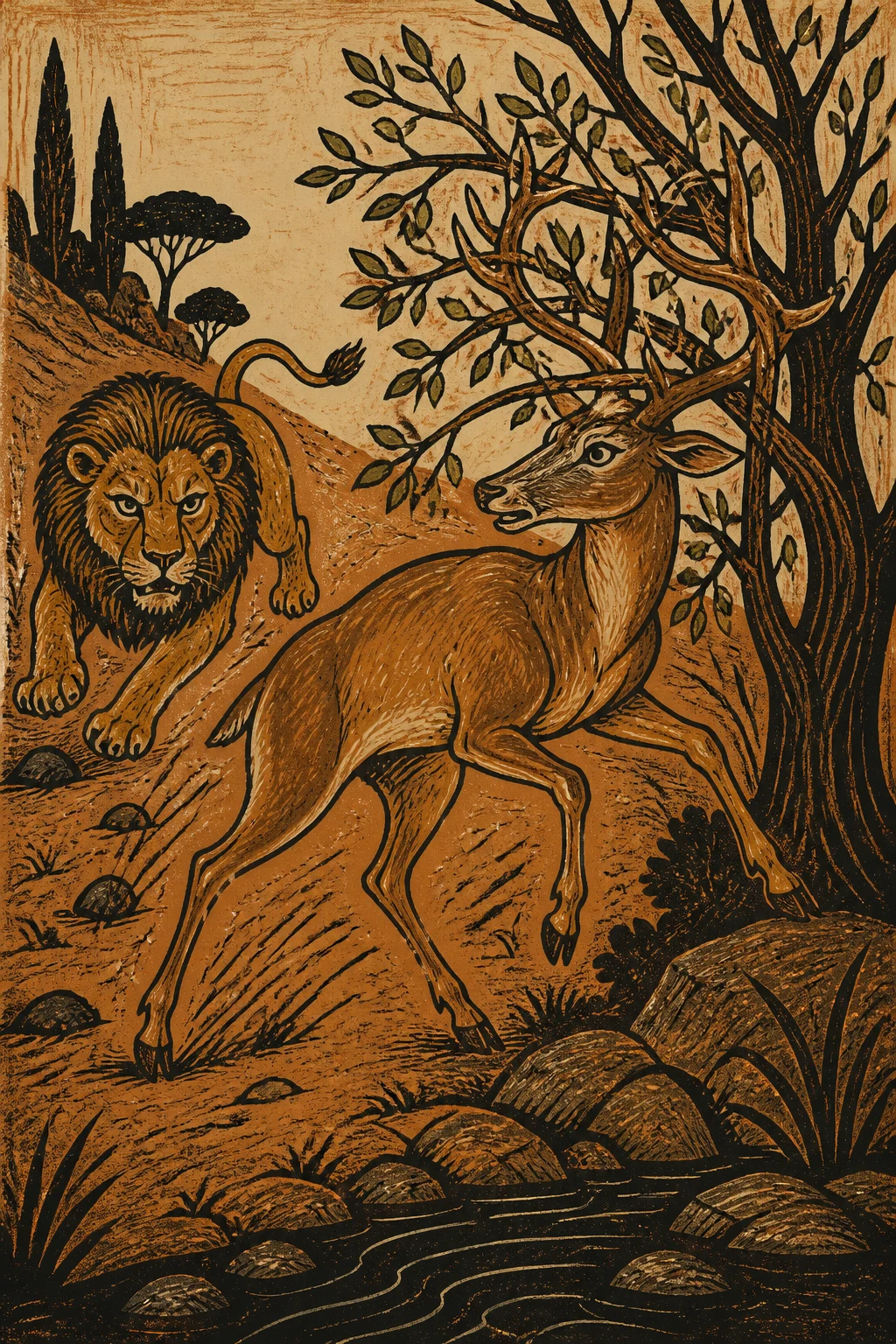
After hearing their words, Bhāsuraka said, “Indeed, you have spoken truly. But if I stay here and a single animal fails to come to me on any day, I shall certainly devour you all.” They agreed to this, and thereafter wandered fearlessly through that forest, enjoying peace. Each day one of them went to him in turn. Whether old, weary of life, stricken with grief, or fearful of losing wife and children, one from among them presented himself at noon to become the lion’s meal. At last, in the rotation of species, a hare’s turn came. Urged on by all the animals, he set off reluctantly and very slowly, pondering how to kill the lion. He deliberately let the appointed hour pass and went on, his mind untroubled. Along the way he came upon a well. Looking over its edge, he saw his own reflection in the water. At the sight he thought, “Here is a way that may work. I shall provoke Bhāsuraka and, by my wits, make him plunge into this well.” It was late in the day when he reached Bhāsuraka. The lion, parched with hunger because his meal was so late, was furious. Licking the corners of his mouth, he thought, “Tomorrow morning I must empty this forest of animals for my breakfast.” While he was thinking this, the hare slowly approached, bowed, and stood before him. Burning with rage, Bhāsuraka snarled, “You miserable hare! In the first place, you are tiny and have come alone; in the second, you are late. For this offense I shall kill you now, and tomorrow morning I shall wipe out every kind of animal in this forest.”
The hare replied humbly, “Master! The fault is neither mine nor the other animals’. Please hear the reason.”
The lion said, “Tell me quickly, before you find yourself between my fangs.”
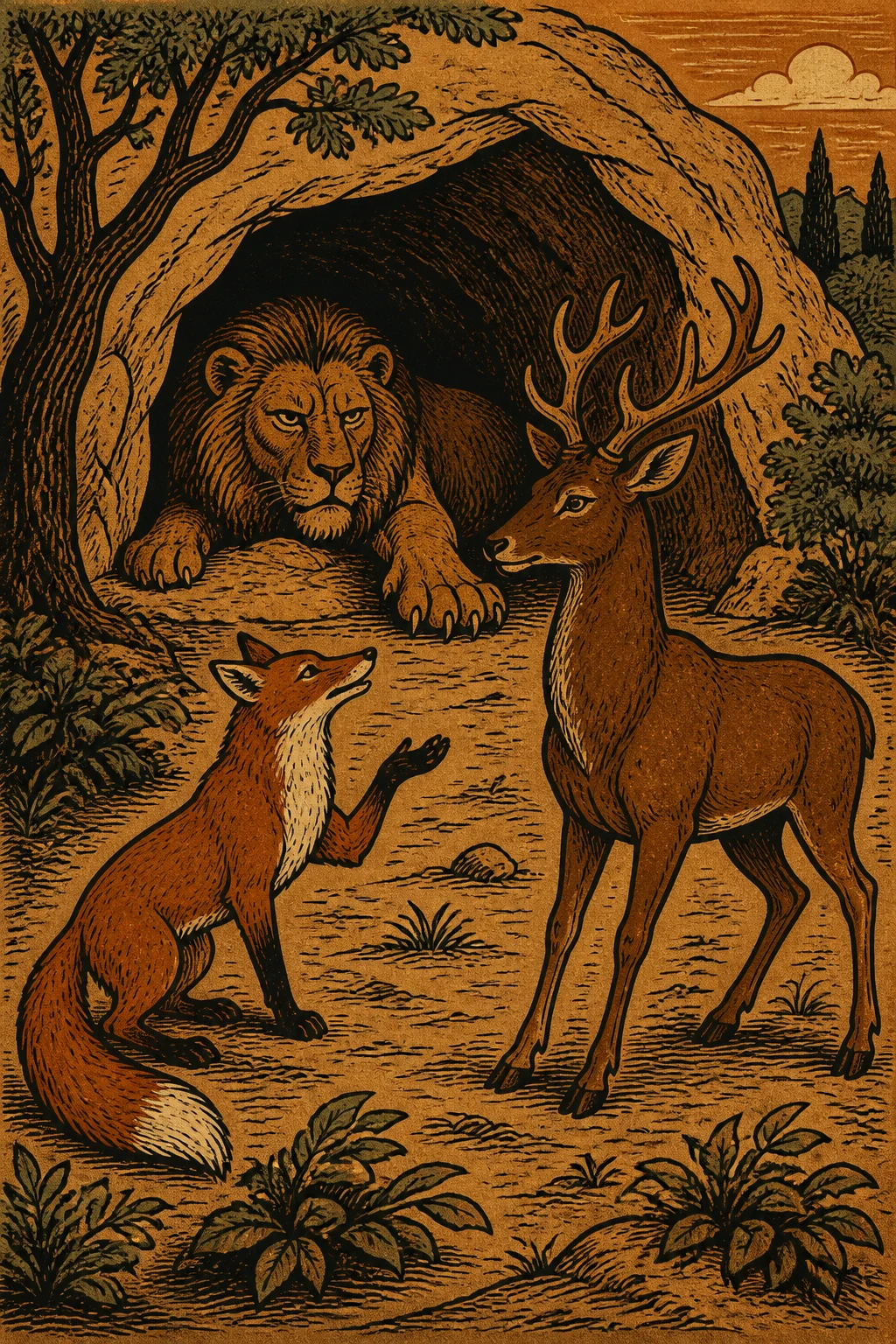
The hare said, “Master, when all the animals learned that today, in the rotation of species, the turn had fallen to me, so small a creature, they sent me with five other hares. But on the way another great lion came out of a cave and said to us, ‘Call upon your chosen deity!’
“I told him, ‘We are going to our master, the lion Bhāsuraka, to serve as his food, in accordance with our agreement.’
“Then he said, ‘If that is so, this forest belongs to me. All the animals must make their agreement with me. That Bhāsuraka is nothing but a thief. If he claims to be king here, leave four hares as hostages, summon him, and return at once. Whichever of us proves himself king by his prowess shall eat all these animals.’
“He ordered me to go, and so I have come to you, master. That is why I am late. Now it is for you to decide.”
Hearing this, Bhāsuraka said, “My good fellow, if that is so, show me this thief of a lion at once. I shall vent on him the anger I feel toward the animals and be at peace. For it is said:
Land, allies, and gold are the three fruits of war.
If not even one of these is to be gained, one should never wage it.
Where there is no substantial reward, and where defeat is likely,
A wise man should not provoke a war or undertake it.”
The hare replied, “Master! That is true. Warriors fight to defend their land and avenge an insult. But he has a fortress to shelter in. It was from his fortress that he came out to stop us, and an enemy entrenched in a fortress is hard to overcome. As it is said:
What kings can accomplish in war with a single fortress cannot be achieved with a thousand elephants or a hundred thousand horses. A single archer stationed on a rampart can hold off a hundred men. That is why those versed in statecraft praise fortresses. Long ago, at his teacher’s bidding, Indra, fearing Hiraṇyakaśipu, had a fortress built through Viśvakarman’s skill. Viśvakarman also granted this boon: ‘The king who possesses a fortress shall be victorious.’ Hence there are thousands of fortresses on earth. Like a snake without fangs or an elephant without its rutting vigor, a king without a fortress falls into everyone’s power.”
Hearing this, Bhāsuraka said, “My good fellow, show me that thief of a lion, even if he is in a fortress, so that I may kill him. For it is said:
He who fails to subdue an enemy or a disease as soon as it appears will be killed by it once it has grown, however strong he may be.
And again:
One who desires his own welfare must not neglect a rising enemy. The learned declare that an enemy and a disease are alike in their growth.
Moreover: Even a weak enemy, neglected through carelessness by men blinded by pride, though easy to deal with at first,
Later becomes incurable, like a disease.
And again:
He who weighs his own strength and then advances with a resolute heart can, though alone, slay many, as Bhārgava slew the warriors.”
The hare replied, “That is true. Still, I have seen that he is powerful. It would not be wise for you to go without knowing his strength. For it is said:
He who rushes eagerly against an enemy without knowing his own strength or his opponent’s perishes like a moth flying into a flame. He who, though strong himself, goes to kill an enemy swollen with might returns stripped of pride, like an elephant with broken tusks.”
Bhāsuraka said, “What business is all this of yours? Show him to me, even if he is in a fortress.”
The hare replied, “If that is your wish, master, come with me.” With these words he went ahead.
He led Bhāsuraka to the very well he had seen on his way and said, “Master, who could withstand your might? The thief of a lion caught sight of you even from a distance and fled into his fortress. Come, and I shall show him to you.” Bhāsuraka said, “Show me the fortress.” The hare pointed out the well. The foolish lion looked down into it, saw his own reflection in the water, and let out a roar. An echo twice as loud rose from the depths of the well. Taking the reflection for his enemy, he hurled himself upon it and lost his life. The hare, overjoyed, brought glad tidings to all the animals. Praised by them, he lived happily among them in that forest. That is why I say, ‘He who has intelligence has strength…’ ***********************************************************************
“So, if you give the word, I shall go there and, by the power of my wits alone, break the friendship between those two.”
Karaṭaka said, “My friend, if that is so, then go. May your path be auspicious. Accomplish what you intend.”
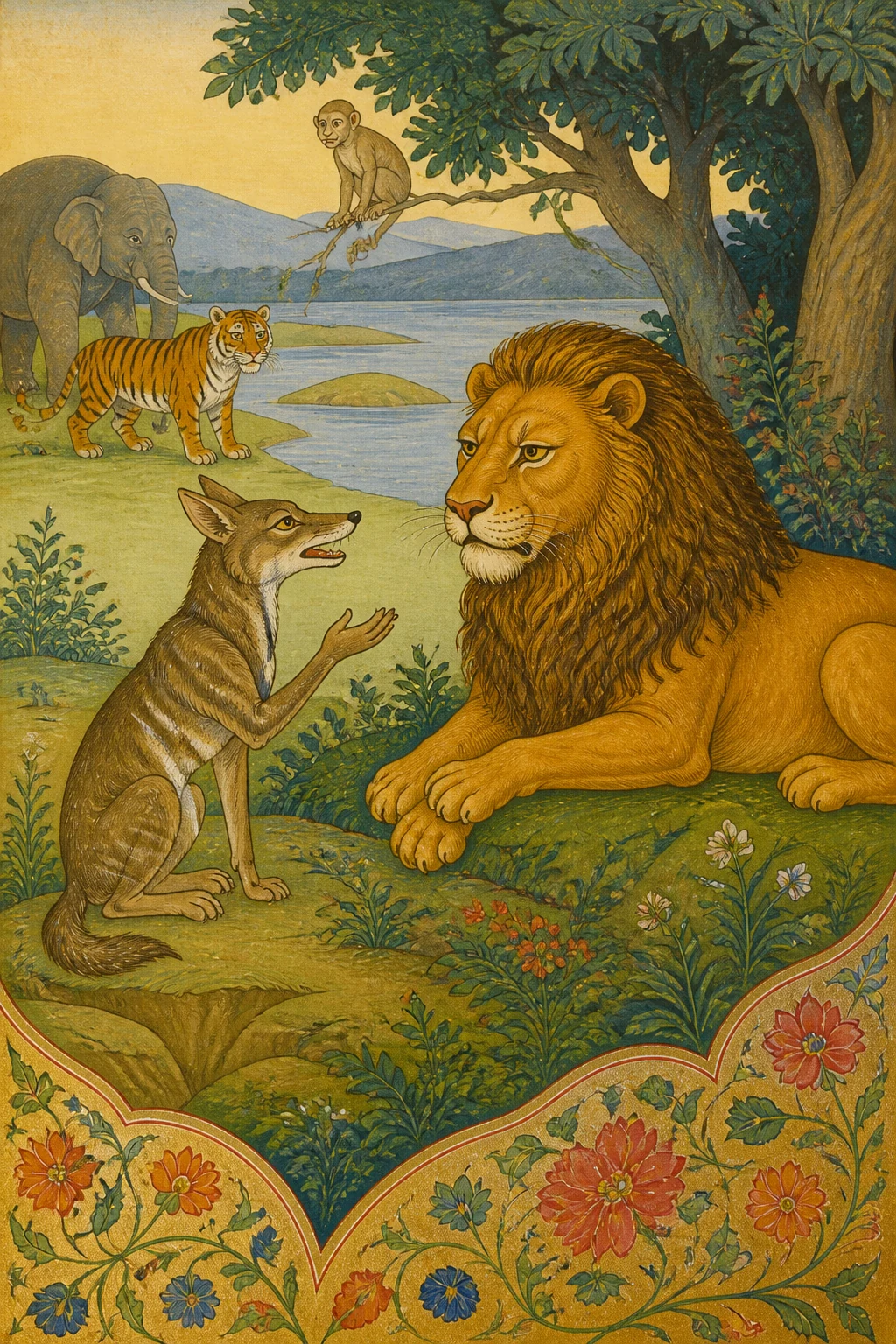
Then Damanaka, finding Piṅgalaka apart from Sañjīvaka, seized the opportunity to approach, bow, and sit before him. Piṅgalaka said, “My good fellow, why have I not seen you for so long?” Damanaka replied, “Your Majesty has had no need of us, and so I have stayed away. Yet, seeing your interests threatened with ruin, my heart burned with distress, and in my anxiety I have come of my own accord to speak. For it is said:
Whether pleasing or unwelcome, whether fortunate or ill,