Prevod
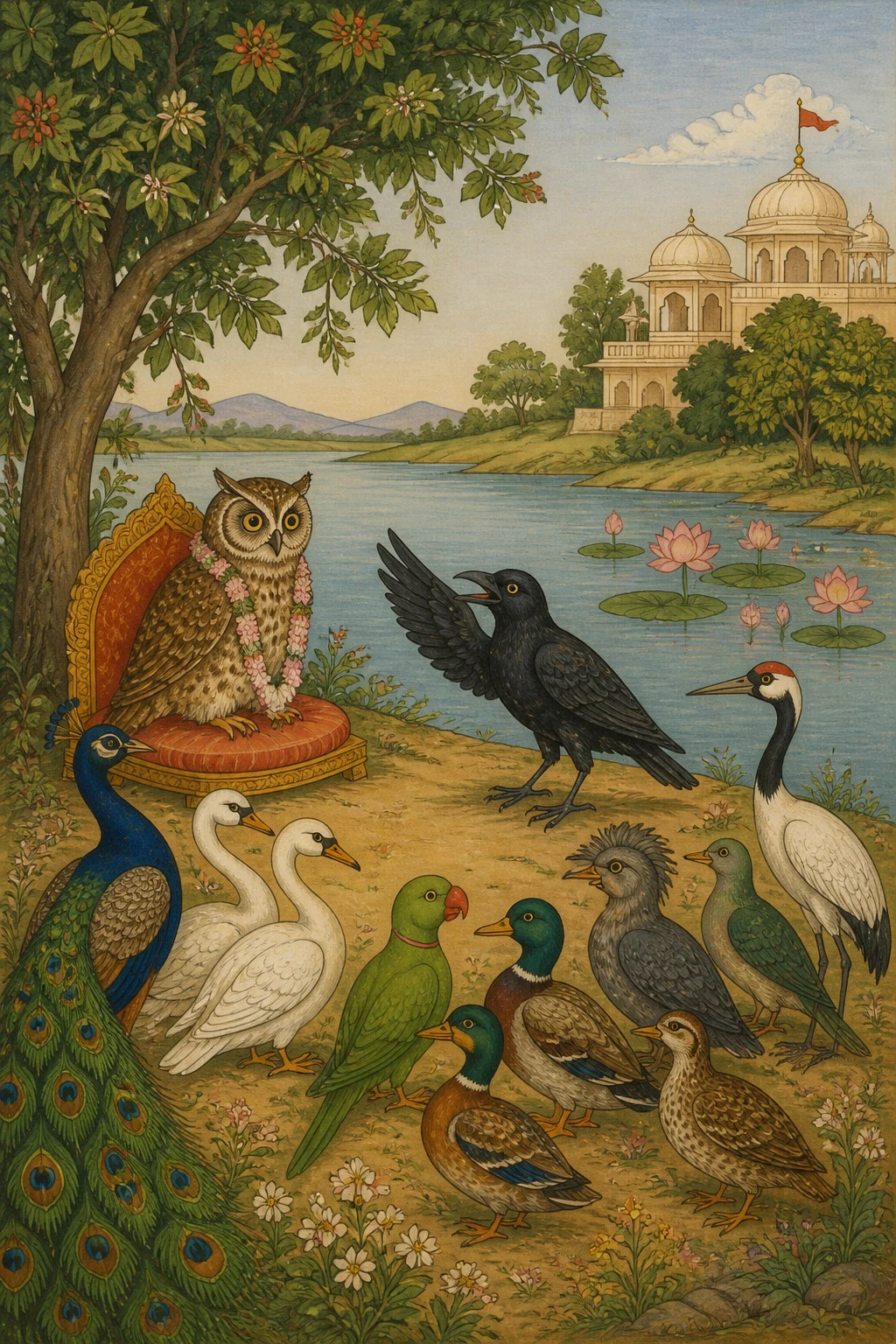
The vizier answered him, saying, “Know, O fortunate king, that in a certain wilderness there was a broad valley, with rivers, trees, and fruit, and birds that sang the praises of God, the One, the All-Subduing, Creator of night and day. Among these birds were crows, who lived most happily. Their chief and ruler was a crow who treated them with kindness and compassion, and under him they dwelt in safety and peace. So well did they manage their affairs among themselves that no other birds could prevail against them. But it happened that their chief died, overtaken by the decree that awaits all creatures. They mourned him deeply, and their sorrow was all the greater because none among them was his equal or could take his place. So they all gathered and took counsel as to who might be fit to rule them. One party chose a certain crow, saying, ‘This one is worthy to be our king,’ while others opposed the choice and would not have him. Discord and dispute broke out, and the strife among them grew fierce. At last, however, they came to an agreement and pledged that they would sleep that night and that none would go out early the next day in search of food. Instead, they would all wait until morning and gather in one place at dawn, then watch to see which bird first took flight. ‘He shall be our chosen king,’ they said. ‘We shall make him our ruler and entrust our affairs to him.’ They all accepted this, pledged themselves to one another, and agreed to abide by their covenant. While they were thus assembled, a falcon appeared, and they said to him, ‘O father of good fortune, we have chosen you to rule us and oversee our affairs.’ The falcon accepted their offer and said, ‘God Most High willing, you shall receive great good from me.’ But after they had made him their ruler, every day when he went abroad with the crows, he would single out one of them, strike him down, eat his brains and eyes, and leave the rest. He continued to do this until they discovered what he was about and saw that most of their number had perished. Certain now that destruction awaited them, they said to one another, ‘What are we to do? Most of us have perished, and we did not wake to the danger until our elders had been destroyed. We must look to our own safety.’ So when morning came, they fled from him and scattered far and wide. Now we fear that the same may befall us and that another king may come to rule over us in your place. But God has bestowed this blessing upon us and turned your heart toward us, and now we are confident of good government, unity, security, trust, and safety in our homeland. Blessed be God the Almighty; to Him be praise, thanks, and fair commendation. May God bless the king and us, his subjects, grant him and us the greatest happiness, and keep his days joyful and his fortunes ever flourishing.”
Then the sixth vizier rose and said, “May God, O king, grant you the fullest joy in this world and the next. The ancients have said that whoever prays and fasts, fulfils his duties toward his parents, and rules justly shall meet his Lord and find Him well pleased with him. You have been set over us and have ruled with justice, and thus all your actions have been blessed. We ask God Most High to grant you an ample reward and recompense you for your goodness. You have heard what this learned man has said of our fear that, without our king, we may be deprived of our good fortune, and that another king may come who is not his equal. Then great discord will arise among us after him, and discord brings calamity. Since matters stand as we have said, it is our duty to beseech God Most High in prayer, that He may grant the king a fortunate son and make him heir to the throne after him. Yet a man may not know the ultimate outcome of what he loves and desires in this world. He should therefore not ask his Lord for something whose consequences he cannot foresee, for its harm may come to him more readily than its benefit, and he may find his ruin in the very thing he seeks. Thus he may suffer what befell the snake-charmer, his wife, his children, and his household.” And dawn overtook Shahrazad, and she fell silent, ceasing her permitted tale.
Then, when it was the nine hundred and seventh night,
She said, “It has reached me, O fortunate king, that when the sixth vizier said to the king, ‘A man should not ask his Lord for something whose consequences he cannot foresee, for its harm may come to him more readily than its benefit, and he may find his ruin in the very thing he seeks, suffering what befell the snake-charmer, his children, his wife, and his household,’ the king asked, ‘And what is the tale of the snake-charmer, his children, his wife, and his household?’”