O besedilu
Stvarjenje sveta in človeštva
- Vir
- Ovidove preobrazbe
- Avtor
- Ovid
- Jezik branja
- English
- Jezik izvirnika
- Latin
- Čas branja
- 5 min branja
- Obseg
- 4 strani
- Naslov izvirnika
- Creation of the World and Humankind
O izvirniku
Ovidove preobrazbe
Pesniški tok antičnih preobrazb, kjer bogovi, ljudje in narava stalno menjavajo obliko. Bralni jezik je English, izvirnik pa prihaja iz vira Ovidove preobrazbe v jeziku Latin.
Besedilo
Stvarjenje sveta in človeštva
My spirit moves me to tell of forms changed into new bodies. Gods, breathe life into my undertaking—for you have wrought these changes too—and from the world's first dawn draw out my unbroken song down to my own time. Before the sea and land and the sky that covers all, nature wore a single face throughout the universe, which men called Chaos: a crude, unordered mass, nothing but inert weight, with the conflicting seeds of ill-matched things all heaped together.
No Titan yet bestowed his light upon the world, nor did Phoebe, waxing, renew her crescent horns; the earth did not hang in the surrounding air, balanced by its own weight, nor had Amphitrite stretched her arms along the far-reaching shores of land. And though air, earth, sea, and ether were all there, the earth was unstable, the water unfit for swimming, the air without light. Nothing kept its own shape; each thing obstructed others, for within a single body cold fought with heat, moisture with dryness, soft things with hard, the weightless with things having weight.
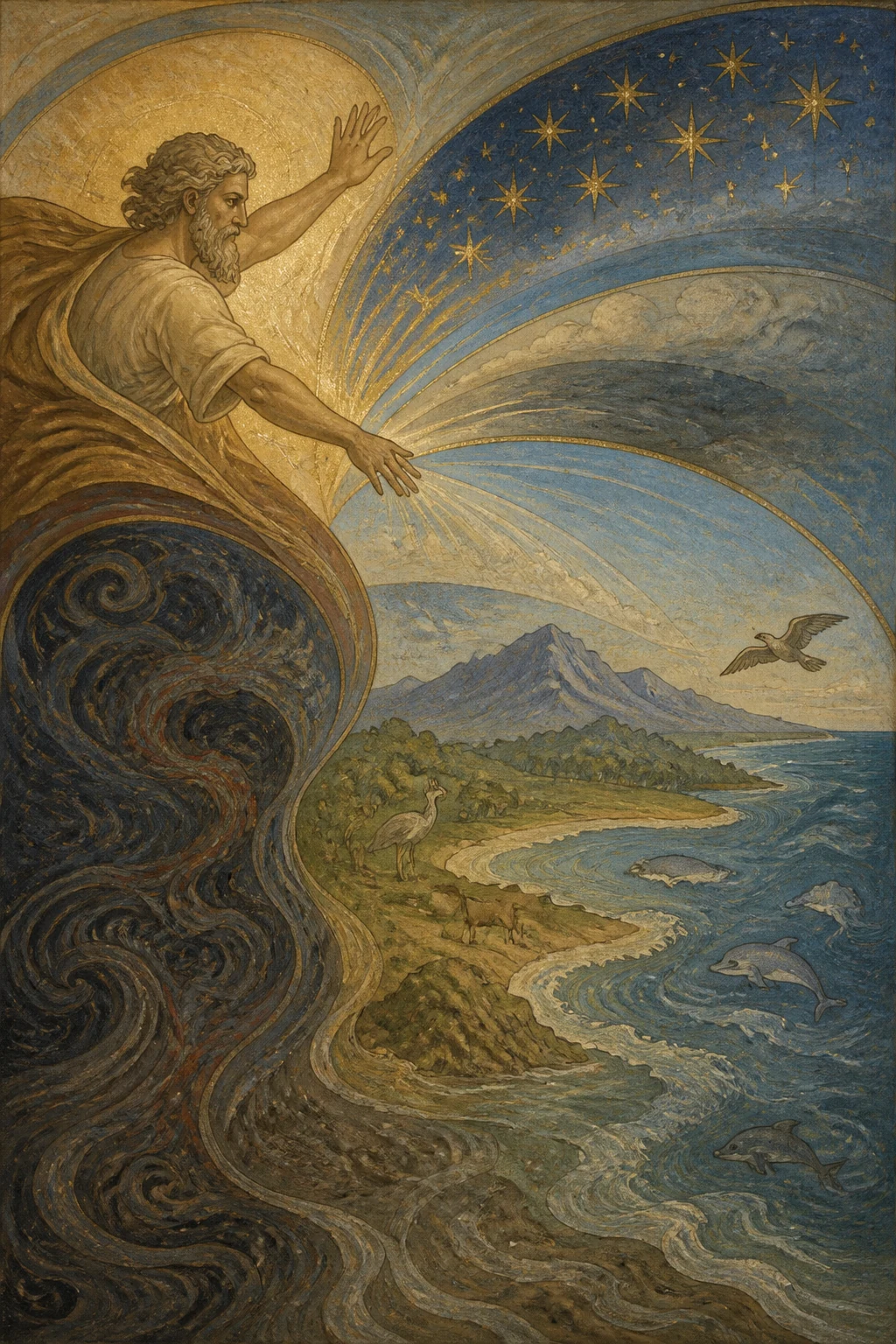
A god, and nature grown more harmonious, resolved this strife. He parted earth from heaven and water from earth, and separated the clear heavens from the dense air. Once he had disentangled them and freed them from that blind heap, he set them in separate places, binding them in harmonious peace. The weightless, fiery force of the arching heavens leapt up and made its home upon the highest height; next came the air, nearest in lightness and in place.
The earth, denser than these, drew the heavy elements to itself and sank beneath its own weight; the encircling water took the outermost regions and enclosed the solid globe. When the god, whichever god he was, had thus divided the mass, ordered it, and shaped its separate parts, he first rounded the earth into a mighty sphere, so that it might be equal on every side.
Then he poured out the seas and commanded them to swell beneath the rushing winds and surround the shores of the encircled earth. He added springs, vast pools, and lakes, and enclosed descending rivers within winding banks. Some, in their various places, are swallowed by the earth itself; others reach the sea, and, welcomed into that expanse of freer water, beat against shores instead of banks.
He commanded plains to spread, valleys to sink, woods to be clothed in leaves, and rocky mountains to rise. And as two zones divide the heavens on the right and two on the left, with a fifth more fiercely burning between them, so the god's care divided the earth enclosed within into the same number, marking out as many regions on its surface. The middle region is uninhabitable from heat; deep snow covers two; and between these extremes he placed two more, giving them a temperate climate, blending heat with cold.
Above them hangs the air, as much heavier than fire as it is lighter than the weight of earth and water. There he commanded mists and clouds to gather, and thunder that would shake the hearts of men, and winds that bring lightning flashes and thunderbolts. Yet the world's maker did not allow these winds free possession of the air. Even now, though each directs its blasts through a separate region, they can scarcely be restrained from tearing the world apart, so great is the brothers' discord.
Eurus withdrew toward Aurora, to the Nabataean kingdoms, Persia, and the mountain ridges beneath the morning rays; the evening star and the shores warmed by the setting sun lie nearest Zephyrus; shuddering Boreas seized Scythia and the seven stars of the northern Bear; the land opposite is drenched by Auster with ceaseless clouds and rain. Above these he set the clear and weightless ether, free of every trace of earthly dross.
Scarcely had he thus confined all things within fixed bounds when the stars, long hidden, crushed beneath that mass, began to blaze throughout the heavens. And so that no region should lack its own living creatures, the stars and the forms of gods inhabit the heavenly realm; the waters became the home of gleaming fish; the earth received wild beasts, the restless air received birds.
Still lacking was a creature more sacred than these, more capable of lofty thought, and able to rule over all the rest. Man was born: either the maker of all things, the source of a better world, made him from divine seed, or the young earth, only lately parted from the lofty ether, still retained the seeds of its kindred heaven. The son of Iapetus mixed this earth with rainwater and shaped it in the image of the gods who govern all.
While other creatures bend their gaze toward the ground, he gave man an uplifted face and bade him look at heaven and raise his eyes upright toward the stars. Thus the earth, so recently crude and shapeless, was transformed and clothed in the unfamiliar forms of men.
Izvirnik
Creation of the World and Humankind
Naslednje strani prikazujejo izvirno besedilo za primerjavo.
Source ID: ovid_metamorphoses_story_001 Citation: Ovid, Metamorphoses 1.1-1.88 Original language: Latin Source: PerseusDL canonical-latinLit Source URL: https://github.com/PerseusDL/canonical-latinLit/blob/master/data/phi0959/phi006/phi0959.phi006.perseus-lat2.xml Segmentation certainty: medium 1: In nova fert animus mutatas dicere formas 2: corpora; di, coeptis (nam vos mutastis et illas) 3: adspirate meis primaque ab origine mundi 4: ad mea perpetuum deducite tempora carmen.
5: Ante mare et terras et quod tegit omnia caelum 6: unus erat toto naturae vultus in orbe, 7: quem dixere chaos: rudis indigestaque moles 8: nec quicquam nisi pondus iners congestaque eodem 9: non bene iunctarum discordia semina rerum. 10: nullus adhuc mundo praebebat lumina Titan, 11: nec nova crescendo reparabat cornua Phoebe, 12: nec circumfuso pendebat in aere tellus 13: ponderibus librata suis, nec bracchia longo 14: margine terrarum porrexerat Amphitrite; 15: utque aer, tellus illic et pontus et aether.
16: Sic erat instabilis tellus, innabilis unda, 17: lucis egens aer: nulli sua forma manebat, 18: obstabatque aliis aliud, quia corpore in uno 19: frigida pugnabant calidis, umentia siccis, 20: mollia cum duris, sine pondere habentia pondus. 21: Hanc deus et melior litem natura diremit. 22: Nam caelo terras et terris abscidit undas, 23: et liquidum spisso secrevit ab aere caelum.
24: Quae postquam evolvit caecoque exemit acervo, 25: dissociata locis concordi pace ligavit. 26: Ignea convexi vis et sine pondere caeli 27: emicuit summaque locum sibi fecit in arce: 28: proximus est aer illi levitate locoque: 29: densior his tellus, elementaque grandia traxit 30: et pressa est gravitate sua: circumfluus umor 31: ultima possedit solidumque coercuit orbem.
32: Sic ubi dispositam quisquis fuit ille deorum 33: congeriem secuit sectamque in membra redegit, 34: principio terram, ne non aequalis ab omni 35: parte foret, magni speciem glomeravit in orbis. 36: Tum freta diffudit rapidisque tumescere ventis 37: iussit et ambitae circumdare litora terrae. 38: Addidit et fontes et stagna inmensa lacusque 39: fluminaque obliquis cinxit declivia ripis, 40: quae, diversa locis, partim sorbentur ab ipsa, 41: in mare perveniunt partim campoque recepta 42: liberioris aquae pro ripis litora pulsant.
43: Iussit et extendi campos, subsidere valles, 44: fronde tegi silvas, lapidosos surgere montes. 45: Utque duae dextra caelum totidemque sinistra 46: parte secant zonae, quinta est ardentior illis, 47: sic onus inclusum numero distinxit eodem 48: cura dei, totidemque plagae tellure premuntur. 49: Quarum quae media est, non est habitabilis aestu: 50: nix tegit alta duas: totidem inter utrumque locavit 51: temperiemque dedit mixta cum frigore flamma.
52: Inminet his aer. Qui quanto est pondere terrae, 53: pondere aquae levior tanto est onerosior igni. 54: Illic et nebulas, illic consistere nubes 55: iussit et humanas motura tonitrua mentes 56: et cum fulminibus facientes fulgura ventos. 57: His quoque non passim mundi fabricator habendum 58: aera permisit: vix nunc obsistitur illis, 59: cum sua quisque regant diverso flamina tractu, 60: quin lanient mundum: tanta est discordia fratrum.
61: Eurus ad Auroram Nabataeaque regna recessit 62: Persidaque et radiis iuga subdita matutinis; 63: vesper et occiduo quae litora sole tepescunt, 64: proxima sunt Zephyro: Scythiam septemque triones 65: horrifer invasit Boreas: contraria tellus 66: nubibus adsiduis pluviaque madescit ab Austro. 67: Haec super inposuit liquidum et gravitate carentem 68: aethera nec quicquam terrenae faecis habentem.
69: Vix ita limitibus dissaepserat omnia certis, 70: cum, quae pressa diu massa latuere sub illa, 71: sidera coeperunt toto effervescere caelo. 72: Neu regio foret ulla suis animalibus orba, 73: astra tenent caeleste solum formaeque deorum, 74: cesserunt nitidis habitandae piscibus undae, 75: terra feras cepit, volucres agitabilis aer. 76: Sanctius his animal mentisque capacius altae 77: deerat adhuc et quod dominari in cetera posset.
78: Natus homo est, sive hunc divino semine fecit 79: ille opifex rerum, mundi melioris origo, 80: sive recens tellus seductaque nuper ab alto 81: aethere cognati retinebat semina caeli; 82: quam satus Iapeto mixtam pluvialibus undis 83: finxit in effigiem moderantum cuncta deorum. 84: Pronaque cum spectent animalia cetera terram, 85: os homini sublime dedit, caelumque videre 86: iussit et erectos ad sidera tollere vultus.
87: Sic, modo quae fuerat rudis et sine imagine, tellus 88: induit ignotas hominum conversa figuras.
Nadaljuj z branjem