Prevod
1. When Acrisius consulted the oracle about the birth of male children, the god told him that his daughter would bear a son who would kill him. Fearing this, Acrisius built a bronze chamber underground and kept Danae confined there. Some say that Proetus seduced her, and that this was the cause of the quarrel between the brothers. Others say that Zeus changed himself into gold and streamed through the roof into Danae’s lap, and so lay with her. When Acrisius later learned that she had given birth to Perseus, he refused to believe that Zeus had seduced her, and put his daughter and the child into a chest and cast it into the sea. The chest washed ashore on Seriphos, where Dictys took up the child and reared him.
2. Polydectes, the brother of Dictys, was king of Seriphos. He fell in love with Danae, but since Perseus was now grown to manhood, he could not lie with her. So he summoned his friends, Perseus among them, saying that he was collecting contributions toward his marriage to Hippodamia, the daughter of Oenomaus.
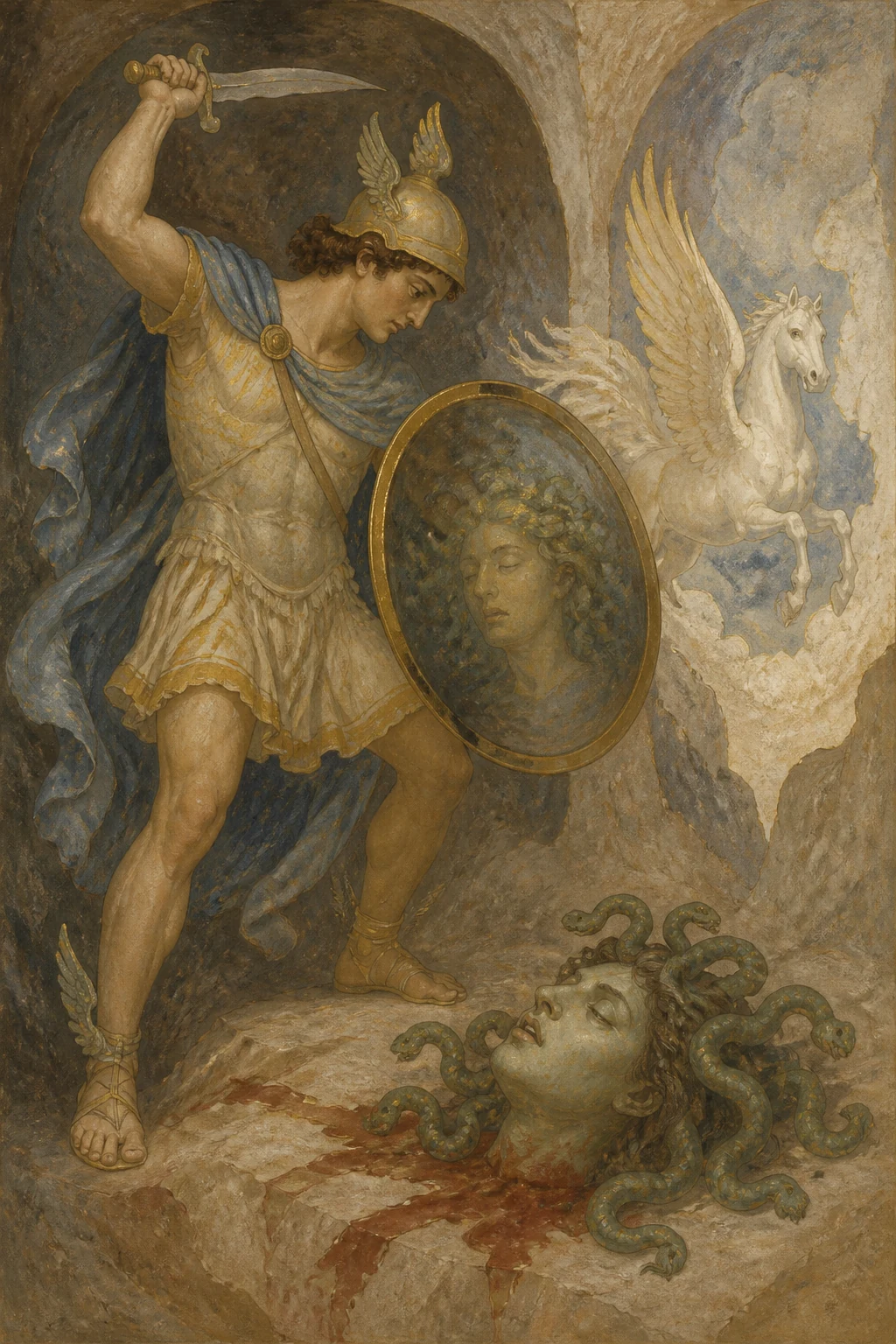
Perseus declared that he would not refuse even the Gorgon’s head. Polydectes asked the others for horses, but would not accept horses from Perseus, and ordered him instead to bring the Gorgon’s head. Guided by Hermes and Athena, Perseus went to the daughters of Phorcus: Enyo, Pephredo, and Deino. These were the daughters of Ceto and Phorcus, sisters of the Gorgons, and old women from birth. The three had only one eye and one tooth, which they passed from one to another in turn. Perseus seized these, and when they demanded them back, he said that he would return them if they showed him the way to the nymphs. These nymphs possessed winged sandals and the kibisis, which is said to be a pouch. Pindar mentions it, as does Hesiod in the Shield, speaking of Perseus: “Across his whole back lay the head of the dreadful monster, the Gorgon, and around it ran the kibisis.” Hesiod, Shield of Heracles, 223–224. It is so called because clothing and provisions are stored in it. The nymphs also possessed the cap of Hades. When the daughters of Phorcus had shown him the way, Perseus returned their tooth and eye, went to the nymphs, and obtained what he sought. He slung the pouch about him, fitted the sandals to his ankles, and put the cap on his head. Wearing it, he could see whomever he wished, but could not be seen by others. He also received an adamantine sickle from Hermes, and flew to Ocean, where he found the Gorgons asleep. They were Stheno, Euryale, and Medusa. Medusa alone was mortal, and for this reason Perseus had been sent to fetch her head. The Gorgons had heads wreathed in the scaly coils of serpents, great tusks like those of swine, bronze hands, and golden wings with which they flew. They turned those who looked upon them to stone.
Perseus stood over them as they slept. With Athena guiding his hand, he turned his face away and looked into a bronze shield, in which he could see the Gorgon’s reflection, and cut off her head. When the head was severed, Pegasus, the winged horse, sprang from the Gorgon, along with Chrysaor, the father of Geryon;
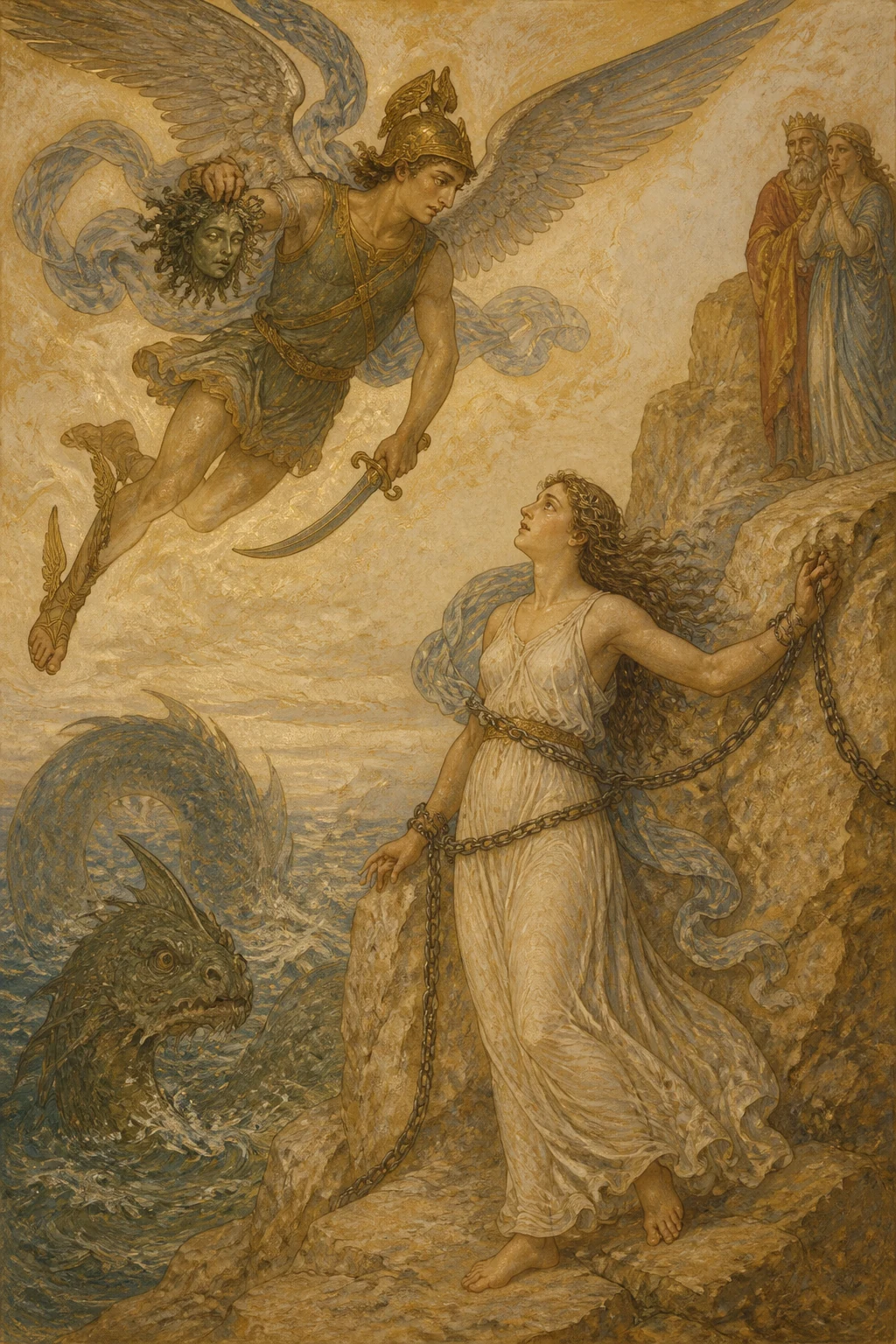
3. she had conceived them by Poseidon. Perseus put Medusa’s head into the pouch and set off on his return. The Gorgons rose from their sleep and pursued him, but could not see him because of the cap, which concealed him. On reaching Ethiopia, where Cepheus was king, he found the king’s daughter Andromeda exposed as prey for a sea monster. For Cassiopeia, the wife of Cepheus, had vied with the Nereids in beauty and boasted that she surpassed them all. The Nereids were enraged, and Poseidon, sharing their anger, sent a flood and a sea monster against the land. Ammon declared through his oracle that they would be freed from the calamity if Cassiopeia’s daughter Andromeda were exposed as prey for the monster. Compelled by the Ethiopians, Cepheus did so and bound his daughter to a rock. When Perseus saw her, he fell in love and promised Cepheus that he would kill the monster if the king would give her to him in marriage once she was saved. Oaths were sworn on these terms, and Perseus faced the monster, killed it, and freed Andromeda. But Phineus, the brother of Cepheus, to whom Andromeda had first been betrothed, plotted against him. Learning of the plot, Perseus showed him the Gorgon’s head and instantly turned him and his fellow conspirators to stone. When he reached Seriphos, he found that his mother and Dictys had taken refuge at the altars from the violence of Polydectes. He entered the palace, where Polydectes had assembled his friends, and, turning his own face away, showed them the Gorgon’s head. All who saw it were turned to stone in whatever posture they happened to be. After making Dictys king of Seriphos, he gave the sandals, pouch, and cap back to Hermes, and the Gorgon’s head to Athena. Hermes returned these objects to the nymphs, while Athena set the Gorgon’s head in the middle of her shield. Some say that Medusa was beheaded because of Athena, for they claim that the Gorgon had wished to rival her in beauty.
4. Perseus hurried to Argos with Danae and Andromeda to see Acrisius. But when Acrisius learned of this, he feared the oracle and left Argos for the land of the Pelasgians.
Teutamides, king of Larissa, was holding athletic games in honor of his dead father, and Perseus came to compete. While taking part in the pentathlon, he threw the discus and struck Acrisius on the foot, killing him instantly. Realizing that the oracle had been fulfilled, he buried Acrisius outside the city. Ashamed to return to Argos and take the inheritance of the man whose death he had caused, he went to Tiryns and exchanged kingdoms with Megapenthes, the son of Proetus, handing Argos over to him. Thus Megapenthes ruled the Argives, and Perseus ruled Tiryns, also fortifying Midea and Mycenae.
5. By Andromeda he had the following children: before he came to Greece, Perses, whom he left with Cepheus, and from whom the kings of Persia are said to descend; and in Mycenae, Alcaeus, Sthenelus, Heleius, Mestor, and Electryon, as well as a daughter, Gorgophone, whom Perieres married. Alcaeus and Astydamia, the daughter of Pelops—or, as some say, Laonome, the daughter of Guneus, or, according to others, Hipponome, the daughter of Menoeceus—had a son, Amphitryon, and a daughter, Anaxo. Mestor and Lysidice, the daughter of Pelops, had a daughter, Hippothoe. Poseidon carried her off to the Echinadian Islands and lay with her, and she bore Taphius. He founded Taphos and called its people Teleboans because he had gone far from his native land. Taphius had a son, Pterelaus. Poseidon made him immortal by placing a golden hair on his head. Pterelaus had sons: Chromius, Tyrannus, Antiochus, Chersidamas, Mestor, and Eueres. Electryon married Anaxo, the daughter of Alcaeus, and had a daughter, Alcmene, and sons: Stratobates, Gorgophonus, Phylonomus, Celaeneus, Amphimachus, Lysinomus, Cheirimachus, Anactor, and Archelaus. After these he also had an illegitimate son, Licymnius, by a Phrygian woman named Midea. Sthenelus and Nicippe, the daughter of Pelops, had Alcyone and Medusa, and later Eurystheus, who also became king of Mycenae. For when Heracles was about to be born, Zeus declared among the gods that the descendant of Perseus who was then to be born would reign over Mycenae. But Hera, out of jealousy, persuaded the Eileithyias to delay Alcmene’s delivery and arranged for Eurystheus, the son of Sthenelus, to be born at seven months.
6. While Electryon was king of Mycenae, the sons of Pterelaus came with the Taphians and laid claim to the kingdom of their maternal grandfather Mestor. When Electryon paid no heed, they drove off his cattle. Electryon’s sons fought to defend them, and in the ensuing combat they killed one another. Of Electryon’s sons, Licymnius survived because he was still young; of Pterelaus’s sons, Eueres survived because he was guarding the ships. The Taphians who escaped sailed away with the stolen cattle and entrusted them to Polyxenus, king of the Eleans. Amphitryon ransomed the cattle from Polyxenus and brought them back to Mycenae. Wishing to avenge the death of his sons, Electryon planned a campaign against the Teleboans. He entrusted his kingdom and his daughter Alcmene to Amphitryon, binding him by oath to keep her a virgin until his return. But as he was receiving the cattle back, one of them broke away, and Amphitryon hurled at it the club he held in his hand. The club glanced off its horns, struck Electryon on the head, and killed him. Seizing on this as a pretext, Sthenelus banished Amphitryon from the whole of Argos and took possession of the kingdoms of Mycenae and Tiryns himself. He summoned Atreus and Thyestes, the sons of Pelops, and entrusted Midea to them. Amphitryon went to Thebes with Alcmene and Licymnius, was purified by Creon, and gave his sister Perimede to Licymnius in marriage. Alcmene said that she would marry him when he had avenged her brothers’ death, and Amphitryon promised to do so and prepared a campaign against the Teleboans. He asked Creon to join him. Creon said that he would take part if Amphitryon first rid the land of Cadmus of the fox, for a savage fox was ravaging it. Amphitryon undertook the task, although it was fated that no one should ever catch the beast.
7. As the country was being laid waste, the Thebans exposed one citizen’s child to the fox each month, for otherwise it would carry off many. Amphitryon therefore went to Athens to see Cephalus, the son of Deioneus, and persuaded him, in return for a share of the spoils from the Teleboans, to bring to the hunt the hound that Procris had brought from Crete, having received it from Minos. This hound was destined to catch whatever it pursued. So, while the hound was chasing the fox, Zeus turned both of them to stone. With Cephalus from Thoricus in Attica, Panopeus from Phocis, Heleius the son of Perseus from Helos in Argos, and Creon from Thebes as his allies, Amphitryon ravaged the islands of the Taphians. As long as Pterelaus lived, he could not capture Taphos. But Pterelaus’s daughter Comaetho fell in love with Amphitryon and plucked the golden hair from her father’s head. Pterelaus died, and Amphitryon subdued all the islands. He killed Comaetho and sailed back to Thebes with the spoils, giving the islands to Heleius and Cephalus. They founded cities named after themselves and settled there.
8. Before Amphitryon reached Thebes, Zeus came by night, made that single night three times its normal length, and, taking the likeness of Amphitryon, lay with Alcmene and told her what had happened in the war against the Teleboans. When Amphitryon returned and saw that his wife showed him no warmth, he asked the reason. She said that he had come the night before and slept with her, and Amphitryon learned from Tiresias that Zeus had lain with her. Alcmene bore two sons: Heracles to Zeus, the elder by one night, and Iphicles to Amphitryon.
When the child was eight months old, Hera sent two enormous serpents to his bed, wishing to destroy the infant. Alcmene cried out to Amphitryon, but Heracles sat up, seized a serpent in each hand, and strangled them both. Pherecydes, however, says that Amphitryon put the serpents into the bed because he wanted to discover which of the children was his own. When Iphicles fled and Heracles stood his ground, he knew that Iphicles was his son.
9. Heracles was taught chariot-driving by Amphitryon, wrestling by Autolycus, archery by Eurytus, armed combat by Castor, and singing to the lyre by Linus. Linus was the brother of Orpheus. He came to Thebes and became a Theban citizen, but died when Heracles struck him with the lyre: Linus had reprimanded him, and Heracles killed him in anger. When some brought a charge of murder against him, he cited a law of Rhadamanthys which declared that anyone who defended himself against an unjust assault was innocent, and he was acquitted. Fearing that he might do such a thing again, Amphitryon sent him away to tend the cattle. Growing up there, he surpassed everyone in size and strength. His very appearance made it plain that he was a son of Zeus: he stood four cubits tall, and a fiery gleam shone from his eyes. He never missed his mark with either bow or javelin. While living among the herds, at the age of eighteen, he killed the lion of Cithaeron.
This lion used to come down from Cithaeron and destroy the cattle of Amphitryon and Thespius.
10. Thespius was king of Thespiae, and Heracles went to him with the intention of killing the lion. The king entertained him for fifty days, and each night gave him one of his daughters to sleep with, while he went out hunting by day. He had fifty daughters by Megamede, the daughter of Arneus, and was eager for all of them to bear children by Heracles. Heracles, believing that it was always the same daughter who slept with him, lay with them all. When he had overcome the lion, he clothed himself in its skin and used its gaping jaws as a helmet.
11. As he was returning from the hunt, he met heralds sent by Erginus to collect tribute from the Thebans. The Thebans paid Erginus tribute for the following reason. Clymenus, king of the Minyans, had been struck and wounded by a stone thrown by Perieres, the charioteer of Menoeceus, in the sacred precinct of Poseidon at Onchestus. He was carried back half-dead to Orchomenus, and as he lay dying he charged his son Erginus to avenge his death. Erginus marched against Thebes, killed many of its people, and concluded a treaty, confirmed by oaths, under which the Thebans were to send him a hundred cattle each year for twenty years. It was while these heralds were on their way to Thebes to collect this tribute that Heracles met and mutilated them. He cut off their ears and noses, bound their hands with cords and hung them from their necks, and told them to carry this tribute to Erginus and the Minyans. Outraged at this, Erginus marched against Thebes. Heracles received arms from Athena and took command of the army. He killed Erginus, routed the Minyans, and forced them to pay the Thebans twice the tribute. In the battle Amphitryon died fighting bravely. As a reward for his valor, Heracles received from Creon his eldest daughter, Megara, by whom he had three sons: Therimachus, Creontiades, and Deicoon. Creon gave his younger daughter to Iphicles, who already had a son, Iolaus, by Automedusa, the daughter of Alcathous. After Amphitryon’s death, Alcmene married Rhadamanthys, the son of Zeus, who was living in exile at Ocaleae in Boeotia. Having already learned archery from Eurytus, Heracles received a sword from Hermes, a bow from Apollo, a golden breastplate from Hephaestus, and a robe from Athena. His club he cut for himself at Nemea.
12. After the battle against the Minyans, Hera’s jealousy drove him mad, and he threw into the fire his own children by Megara, along with two of Iphicles’ children. He therefore condemned himself to exile and was purified by Thespius. Then he went to Delphi and asked the god where he should live. It was then that the Pythia first called him Heracles; until that time he had been called Alcides. She told him to live in Tiryns, serving Eurystheus for twelve years, and to perform the ten labors imposed upon him. When those labors were completed, she said, he would become immortal.