Prevod
With these words glorious Hector rushed out through the gates, and his brother Alexander went beside him, both eager at heart for war and battle. As a god sends a welcome wind to sailors who have worn themselves out driving their ship across the sea with polished oars, their limbs slack with exhaustion, so welcome was the sight of these two to the Trojans.
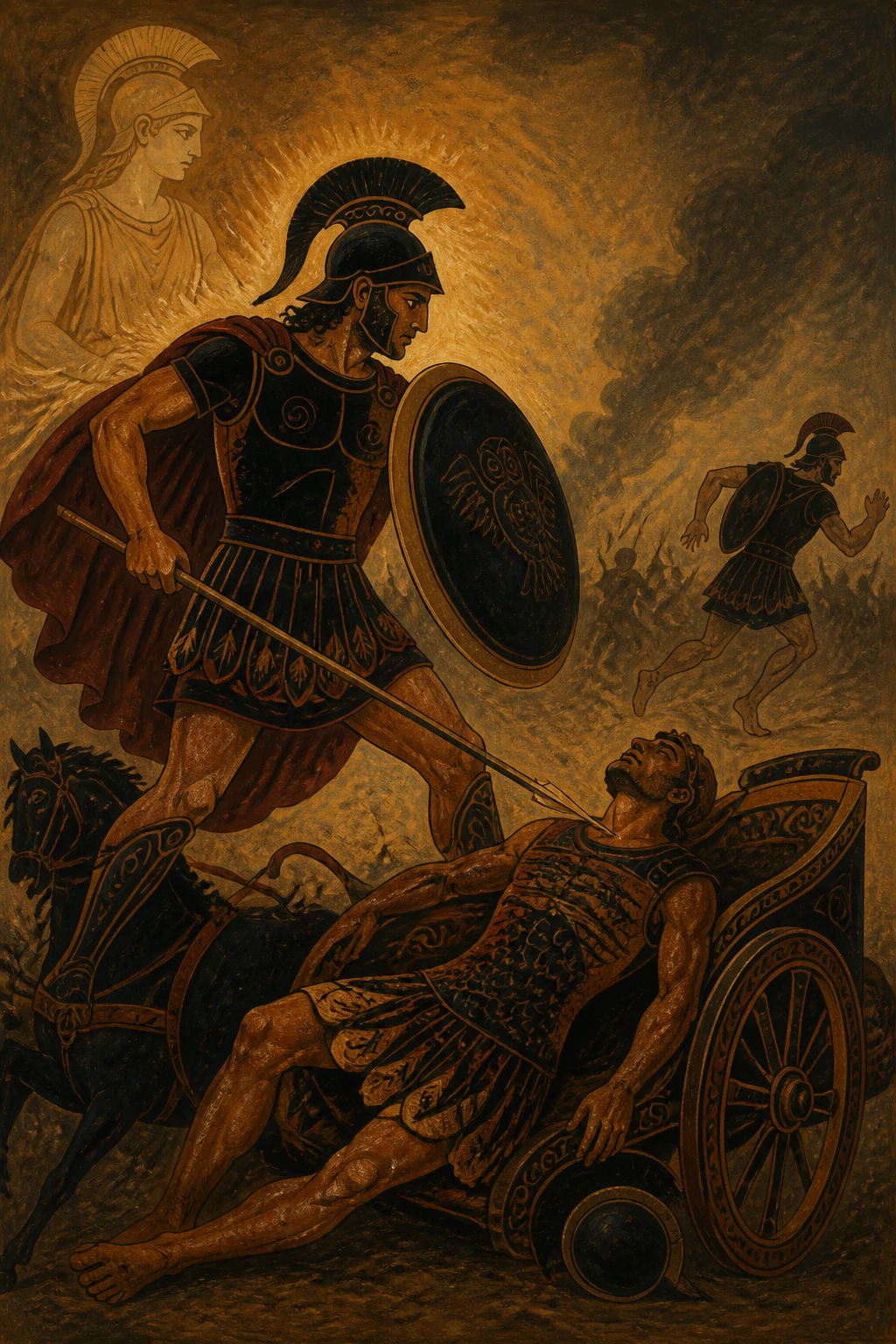
There Alexander slew Menesthius, who lived in Arne, the son of King Areithous, whom Areithous the club-bearer and ox-eyed Phylomedusa had brought into the world. Hector struck Eioneus with his sharp spear in the neck beneath his fine bronze helmet, and his limbs went slack.
Glaucus, son of Hippolochus and leader of the Lycian men, struck Iphinous, son of Dexius, in the shoulder with his spear during the fierce fighting, as he leapt into his chariot behind his swift horses. He fell from the chariot to the ground, and his limbs went slack.
When the goddess, gray-eyed Athena, saw them killing Argives in the fierce fighting, she darted down from the peaks of Olympus to sacred Ilium. Apollo, watching from Pergamus and wishing victory for the Trojans, rose to meet her. The two came face to face beside the oak.
Lord Apollo, son of Zeus, was first to speak. “Why have you come down again from Olympus, daughter of great Zeus, so eager, driven by such fierce feeling? Is it to give the Danaans victory and turn the battle their way? You have no pity at all for the Trojans dying.
“But listen to me: it would be far better if you did. Let us stop the war and slaughter for today. Later they can fight again until they bring about the doom of Ilium, since you immortal goddesses have set your hearts on destroying this city.”
The goddess, gray-eyed Athena, answered him: “So be it, far-shooter. That was my own purpose when I came down from Olympus among the Trojans and Achaeans. But tell me, how do you mean to stop the men from fighting?”
Lord Apollo, son of Zeus, replied: “Let us rouse the mighty spirit of Hector, tamer of horses, so that he challenges one of the Danaans to face him alone in deadly combat. Then the bronze-greaved Achaeans, stung by his challenge, will send out one man to fight glorious Hector.”
So he spoke, and gray-eyed Athena agreed. Helenus, Priam’s dear son, understood in his heart the plan the gods had formed together and approved. He went and stood beside Hector and said to him: “Hector, son of Priam, equal to Zeus in counsel, will you listen to me? I am your brother. Make the other Trojans and all the Achaeans sit down, and challenge the best of the Achaeans to face you alone in deadly combat. It is not yet your fate to die and meet your doom: so I have heard from the voice of the everlasting gods.”
So he spoke, and Hector was greatly pleased to hear his words. He went into the space between the armies and held back the Trojan ranks, grasping his spear by the middle, and they all sat down. Agamemnon seated the well-greaved Achaeans too. Athena and Apollo of the silver bow settled like vultures in the tall oak of their father Zeus, bearer of the aegis, delighting in the sight of the men. The ranks sat close together, bristling with shields and helmets and spears.
As a shiver spreads over the sea when the West Wind first begins to blow, and the water darkens beneath it, so the ranks of Trojans and Achaeans sat upon the plain. Hector spoke between the two armies: “Listen to me, Trojans and well-greaved Achaeans, while I say what the heart within my breast commands.
“The son of Cronus, enthroned on high, has not fulfilled our sworn agreement. Instead he devises suffering for both sides, until either you take well-towered Troy or yourselves are beaten down beside your seagoing ships.
“Among you are the champions of all the Achaeans. Let whichever of them has the heart to fight me come out here from the rest and stand against glorious Hector. These are my terms, and let Zeus be our witness: if he kills me with his long-edged bronze, let him strip off my armor and carry it to the hollow ships, but give my body back to my home, so that the Trojans and their wives may grant me my share of fire when I am dead.
“But if I kill him, and Apollo grants me glory, I will strip off his armor and carry it to sacred Ilium, and hang it in the temple of Apollo the far-shooter. His body I will return to the well-benched ships, so that the long-haired Achaeans may give him burial and heap up a mound for him beside the broad Hellespont.
“Then one day someone among the generations yet to come, sailing over the wine-dark sea in a many-oared ship, will say: ‘This is the tomb of a man who died long ago, a warrior whom glorious Hector slew in his prime.’
“So someone will say one day, and my glory will never perish.” So he spoke, and they all remained hushed and silent, ashamed to refuse, afraid to accept. At last Menelaus rose and addressed them, reproaching them bitterly, with a deep groan in his heart: “Shame on you, boastful women of Achaea, Achaean men no longer! This will be a disgrace beyond all disgrace if no Danaan now goes out to face Hector.
“May you all turn to earth and water, sitting there without heart, without honor, every one of you! I myself will arm against him. As for victory, its issue rests above with the immortal gods.”
With these words he put on his splendid armor. Then, Menelaus, your life would have ended at Hector’s hands, for he was far the stronger, had not the Achaean kings sprung up and restrained you. Agamemnon himself, Atreus’ son, whose rule extended far, took him by the right hand and addressed him by name: “You are acting foolishly, Menelaus, cherished by Zeus. There is no need for such folly. Restrain yourself, however bitterly you feel, and do not be driven by rivalry to fight a better man, Hector son of Priam, whom others too dread.
“Even Achilles shudders to meet him in battle, where men win glory, and Achilles is far better than you. Go now and sit among your comrades. The Achaeans will raise up another champion against him.
“Fearless though he is, and insatiable for battle, I think he will gladly bend his knees to rest if he escapes the deadly fighting and its terrible slaughter.” With these fitting words the warrior turned his brother’s heart, and Menelaus obeyed. His attendants joyfully took the armor from his shoulders. Then Nestor rose and spoke among the Argives: “Alas, what great sorrow has come upon the land of Achaea!
“How loudly old Peleus, the horseman, would lament, that noble counselor and speaker among the Myrmidons! Once in his own house he took such pleasure in questioning me, asking the lineage and parentage of every Argive.
“If he heard now that all of them were cowering before Hector, again and again he would lift his hands to the immortals, praying that his spirit might leave his limbs and go down into the house of Hades. Father Zeus, Athena, Apollo—if only I were young as on the day when the Pylians and the spear-fighting Arcadians gathered to battle beside swift-flowing Celadon, beneath the walls of Pheia, around the streams of Iardanus!
“Their champion was godlike Ereuthalion, who stood there with the armor of King Areithous upon his shoulders—noble Areithous, whom men and fair-girdled women called the club-bearer, because he fought neither with bow nor long spear, but shattered the ranks with an iron club.
“Lycurgus killed him by cunning, not by strength, in a narrow passage where his iron club could not save him from destruction. Lycurgus struck first, driving his spear through his waist, and he fell backward to the earth. Then Lycurgus stripped off the armor that bronze-clad Ares had given him.
“Afterward he wore it himself amid the turmoil of battle. But when Lycurgus grew old in his halls, he gave it to his dear attendant Ereuthalion to wear. Wearing that armor, Ereuthalion challenged all our champions.
“They trembled and were afraid, and none dared meet him. But my enduring heart, trusting its own courage, urged me to fight, though I was the youngest of them all. I fought him, and Athena gave me glory.
“He was the tallest and strongest man I ever killed: his huge body sprawled far and wide upon the ground. If only I were young as I was then, and my strength still firm! Hector of the flashing helmet would soon find someone to face him in battle.
“Yet you, the very best of all the Achaeans, have no eagerness to go out against Hector.” So the old man reproached them, and nine men rose. First, well before the others, rose Agamemnon, lord of men; after him rose mighty Diomedes, son of Tydeus; then the two Ajaxes, clothed in furious valor; then Idomeneus and his companion Meriones, the equal of Enyalius, slayer of men; then Eurypylus, Euaemon’s splendid son, and Thoas, son of Andraemon, and noble Odysseus. All were willing to fight glorious Hector.
Then Nestor, the Gerenian horseman, spoke again: “Now cast lots to decide who shall have the honor. He will indeed bring joy to the well-greaved Achaeans, and joy to his own heart too, if he escapes the deadly fighting and its terrible slaughter.”
So he spoke, and each man marked his lot and threw it into the helmet of Agamemnon, son of Atreus. The men prayed, lifting their hands to the gods, and one after another looked up into the broad sky and said: “Father Zeus, let the lot fall to Ajax, or the son of Tydeus, or the king himself of Mycenae rich in gold.”
So they prayed, and Nestor, the Gerenian horseman, shook the helmet. Out leapt the very lot they wished for, the lot of Ajax. A herald carried it through the gathering, showing it to all the Achaean champions in turn, from left to right.
None recognized it, and each disclaimed it. But when the herald, carrying it through the gathering, reached glorious Ajax, who had marked it and cast it into the helmet, Ajax held out his hand. The herald stood beside him and put the lot into it. He recognized his mark and rejoiced at heart.
He threw the lot to the ground beside his feet and said: “Friends, the lot is mine, and I am glad at heart, for I believe I shall defeat glorious Hector. Come now, while I put on my battle armor, pray to lord Zeus, son of Cronus, silently to yourselves, so the Trojans do not hear—or openly, for that matter, since we fear no man. No one shall drive me back against my will by strength or skill. I was not, I trust, born and bred in Salamis so ignorant of war.”
So he spoke, and they prayed to lord Zeus, son of Cronus. One after another looked up into the broad sky and said: “Father Zeus, ruling from Ida, greatest and most glorious, grant Ajax victory and splendid renown. But if you love Hector too and care for him, give both men equal strength and equal glory.”
So they prayed, while Ajax armed himself in gleaming bronze. When he had put all his armor on, he strode forward like gigantic Ares going to war among men whom the son of Cronus has brought together to fight in the fury of soul-devouring strife.
So mighty Ajax, the Achaeans’ bulwark, strode forward with a smile on his grim face. He took great strides, brandishing his long-shadowed spear. The Argives rejoiced at the sight of him, but a dreadful trembling stole through the limbs of every Trojan, and even Hector’s heart beat hard within his breast. Yet he could no longer shrink back or retreat into the throng, since he himself had issued the challenge.
Ajax came near, carrying his shield like a tower, bronze-faced and made of seven oxhides. Tychius, by far the finest of leatherworkers, who lived in Hyle, had labored to make it for him. He had fashioned the gleaming shield from seven hides of well-fed bulls, and beaten bronze over them as an eighth layer.
Holding it before his chest, Ajax son of Telamon stood close to Hector and spoke his challenge: “Hector, now you will learn face to face what champions the Danaans have besides lionhearted Achilles, breaker of men.
“He lies beside his curved seagoing ships, nursing his anger against Agamemnon, shepherd of the people. But there are others of us, and many, who can stand against you. Come, begin the battle and the fighting.”
Great Hector of the flashing helmet answered him: “Ajax, son of Telamon, descended from Zeus, leader of men, do not try me as though I were a feeble child or a woman who knows nothing of the work of war.
“I know well enough how to fight and kill men. I know how to swing my shield of seasoned hide to right and left: that is what fighting with a stout shield means to me. I know how to charge into the press of swift horses; I know how to tread the dance of deadly Ares in close combat.
“But against such a man as you, I do not wish to watch for an opening and strike unseen. I shall strike openly, if I can.” He spoke, balanced his long-shadowed spear, and hurled it. It struck Ajax’s fearsome seven-hide shield on its outermost bronze, the eighth layer.
The unyielding bronze point tore through six folds, but stopped in the seventh hide. Then Zeus-descended Ajax cast his long-shadowed spear and struck the son of Priam’s round shield.
The heavy spear passed through the shining shield and drove through his richly wrought breastplate. Straight on beside his flank it tore his tunic, but Hector swerved and escaped black death.
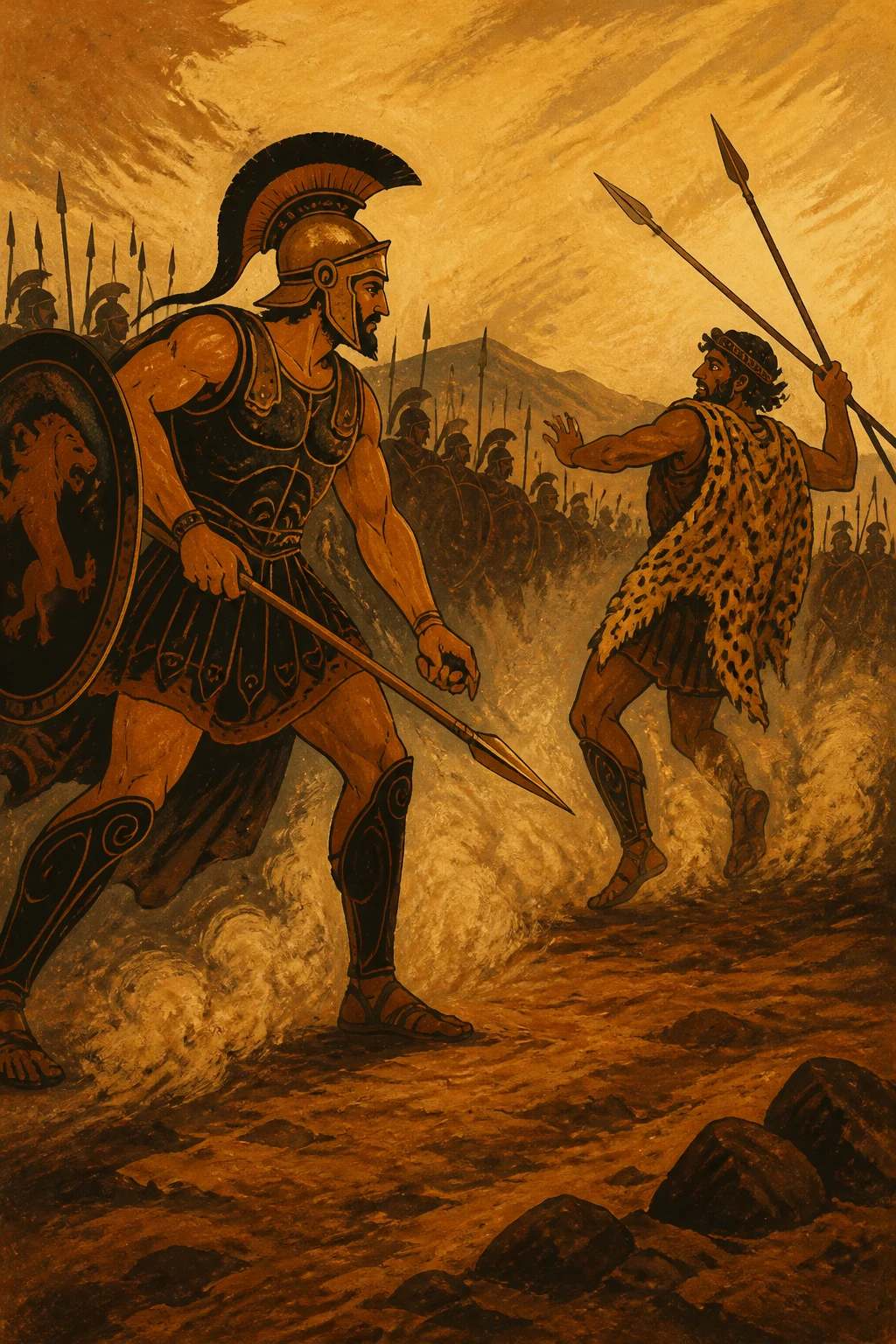
Both men pulled out their long spears and rushed together like flesh-eating lions or wild boars whose strength is not easily spent. The son of Priam thrust his spear into the middle of Ajax’s shield, but the bronze did not break through: its point bent back.
Ajax sprang forward and stabbed Hector’s shield. The spear passed clean through, drove him back in his charge, and grazed his neck, so that dark blood welled up. But even then Hector of the flashing helmet did not give up the fight. Drawing back, he took in his broad hand a stone lying on the plain, black and rough and huge. He hurled it at Ajax’s fearsome seven-hide shield, striking the central boss, and the bronze rang out.
Then Ajax lifted a far larger stone, swung it round, and hurled it with immeasurable force. The millstone-like rock smashed Hector’s shield inward and buckled his knees. He sprawled on his back, his shield crushed against him, but Apollo raised him at once.
Now they would have fought at close quarters with their swords, had not the heralds, messengers of Zeus and men, come forward, one from the Trojans and one from the bronze-clad Achaeans: Talthybius and Idaeus, both wise men. They held their staffs between the two warriors, and the herald Idaeus, a man of prudent counsel, said: “Fight no more, dear sons; cease your battle. Zeus the cloud-gatherer loves you both, and both of you are spearmen: that we all know well.
“Night is already upon us, and it is good to yield to night.” Ajax son of Telamon answered him: “Idaeus, tell Hector to say that. He was the one who challenged all our champions.
“Let him speak first, and I will gladly do as he does.” Great Hector of the flashing helmet replied: “Ajax, since a god has given you stature and strength and judgment, and with the spear you surpass all the Achaeans, let us stop the battle and slaughter for today. Later we shall fight again until a god decides between us and grants one side the victory.
“Night is already upon us, and it is good to yield to night. Then you may bring joy to all the Achaeans beside their ships, and above all to your own kinsmen and companions; and I, throughout the great city of King Priam, shall gladden the Trojans and the Trojan women in their trailing robes, who will enter the sacred gathering to pray for me.
“Come, let us exchange splendid gifts, so that some Trojan or Achaean may say: ‘They fought in soul-devouring strife, but parted reconciled in friendship.’”
With these words he gave Ajax a silver-studded sword, bringing with it the scabbard and a well-cut baldric. Ajax gave him a belt bright with crimson. Then they parted, one going to the Achaean army, the other to the Trojan throng. The Trojans rejoiced to see Hector coming back alive and sound, escaped from Ajax’s fury and invincible hands. They led him toward the city, having scarcely hoped he would return safe.
On the other side the well-greaved Achaeans led Ajax to noble Agamemnon, exulting in his victory. When they reached the hut of the son of Atreus, Agamemnon, lord of men, sacrificed a five-year-old bull for them to the almighty son of Cronus.
They flayed it and dressed it, and cut the whole carcass up. Skillfully they divided the meat, threaded it on spits, roasted it with care, and drew it all off.
When their work was done and the feast prepared, they ate, and no one’s heart went short of his fair share. The warrior Agamemnon, Atreus’ son, whose rule extended far, honored Ajax with the whole chine.
When they had satisfied their desire for food and drink, old Nestor was first to begin unfolding a plan, Nestor whose counsel had proved best before. With their welfare at heart, he addressed them: “Son of Atreus, and you other champions of all the Achaeans, many long-haired Achaeans have died. Fierce Ares has spilled their dark blood beside fair-flowing Scamander, and their souls have gone down to Hades. You must therefore stop the Achaeans’ fighting at dawn. We shall gather together and bring the dead here on wagons drawn by oxen and mules, and burn them a little way from the ships, so that each of us may take the bones home to the children when we return to our native land.
“Let us heap up one common mound around the pyre, bringing earth in from the plain without distinction, and beside it quickly build a wall with high towers to protect the ships and ourselves. In it we shall make well-fitted gates, so that there is a passage through them for chariots. Outside, close by, we shall dig a deep trench to encircle us and hold back horses and men, lest the assault of the proud Trojans overwhelm us.”
So he spoke, and all the kings approved. Meanwhile, in the citadel of Ilium, beside Priam’s doors, the Trojans held a tumultuous assembly, full of fear and confusion. Wise Antenor began to speak among them: “Listen to me, Trojans, Dardanians, and allies, while I say what the heart within my breast commands.
“Come, let us give Argive Helen and her possessions back to the sons of Atreus to take away. As things stand, we are fighting in violation of our solemn oaths. I can see no good coming to us unless we do as I say.”
With these words he sat down. Then noble Alexander, husband of fair-haired Helen, rose and answered him with winged words: “Antenor, what you say no longer pleases me. You know how to think of something better than this.
“But if you truly mean what you say, then the gods themselves have destroyed your wits. I will tell the horse-taming Trojans my decision: I declare outright that I will not give back my wife. But all the possessions I brought from Argos to our house I am willing to return, and to add more from my own stores.”
With these words he sat down. Then Priam, descendant of Dardanus, a counselor equal to the gods, rose and addressed them with their welfare at heart: “Listen to me, Trojans, Dardanians, and allies, while I say what the heart within my breast commands.
“For now, take your supper throughout the city as before, and remember the watch: let every man stay alert. At dawn let Idaeus go to the hollow ships and tell the sons of Atreus, Agamemnon and Menelaus, the proposal of Alexander, for whose sake this quarrel arose. Let him also put this prudent request to them: will they agree to stop the harsh-sounding war until we have burned our dead? Later we shall fight again until a god decides between us and grants one side the victory.”
So he spoke, and they listened closely and obeyed. Then they took supper throughout the army, each in his company. At dawn Idaeus went to the hollow ships. He found the Danaans, servants of Ares, assembled beside the stern of Agamemnon’s ship. Standing among them, the clear-voiced herald said: “Son of Atreus, and you other champions of all the Achaeans, Priam and the other noble Trojans have charged me to tell you, in the hope that it may find favor and please you, the proposal of Alexander, for whose sake this quarrel arose. All the possessions Alexander brought to Troy in his hollow ships—would that he had perished first!—he is willing to return, and to add more from his own stores. But the wedded wife of glorious Menelaus he refuses to give back, though the Trojans urge him to.
“They also charged me to ask whether you will agree to stop the harsh-sounding war until we have burned our dead. Later we shall fight again until a god decides between us and grants one side the victory.”
So he spoke, and they all remained hushed and silent. At last Diomedes, mighty in the war cry, spoke: “Let no one now accept Alexander’s possessions, or Helen either. Even a fool can see that the cords of destruction are already fastened round the Trojans.”
So he spoke, and all the sons of the Achaeans shouted their approval, admiring the words of Diomedes, tamer of horses. Then lord Agamemnon addressed Idaeus: “Idaeus, you have heard for yourself the Achaeans’ answer. It pleases me as well. But as for burning the dead, I do not begrudge you that. Once men are dead, there should be no grudging them the swift comfort of the fire.
“Let Zeus, the loud-thundering husband of Hera, witness our truce.” With these words he raised his staff to all the gods, and Idaeus went back to sacred Ilium. The Trojans and Dardanians sat assembled together, waiting for Idaeus to return. He came and stood among them and delivered his message. At once they made ready, some to bring in the dead, others to gather wood. On the other side the Argives hurried from their well-benched ships, some to bring in the dead, others to gather wood.
The sun was just striking the fields as it rose into the sky from the deep, gently flowing stream of Ocean, and the two sides met. It was hard then to recognize each man, but they washed away the clotted blood with water and lifted the bodies onto wagons, shedding hot tears.
Great Priam forbade loud lamentation. In silence, grieving at heart, they piled the bodies on the pyre, burned them in the fire, and went back to sacred Ilium. In the same way, on the other side, the well-greaved Achaeans piled their dead upon the pyre, grieving at heart, burned them in the fire, and went back to the hollow ships.
Before dawn, while night was still touched with twilight, a chosen company of Achaeans gathered around the pyre. They made one common mound about it, bringing earth in from the plain without distinction, and beside it built a wall with high towers to protect the ships and themselves.
In it they made well-fitted gates, so that there was a passage through them for chariots. Outside, close against it, they dug a deep trench, broad and great, and planted stakes within it.
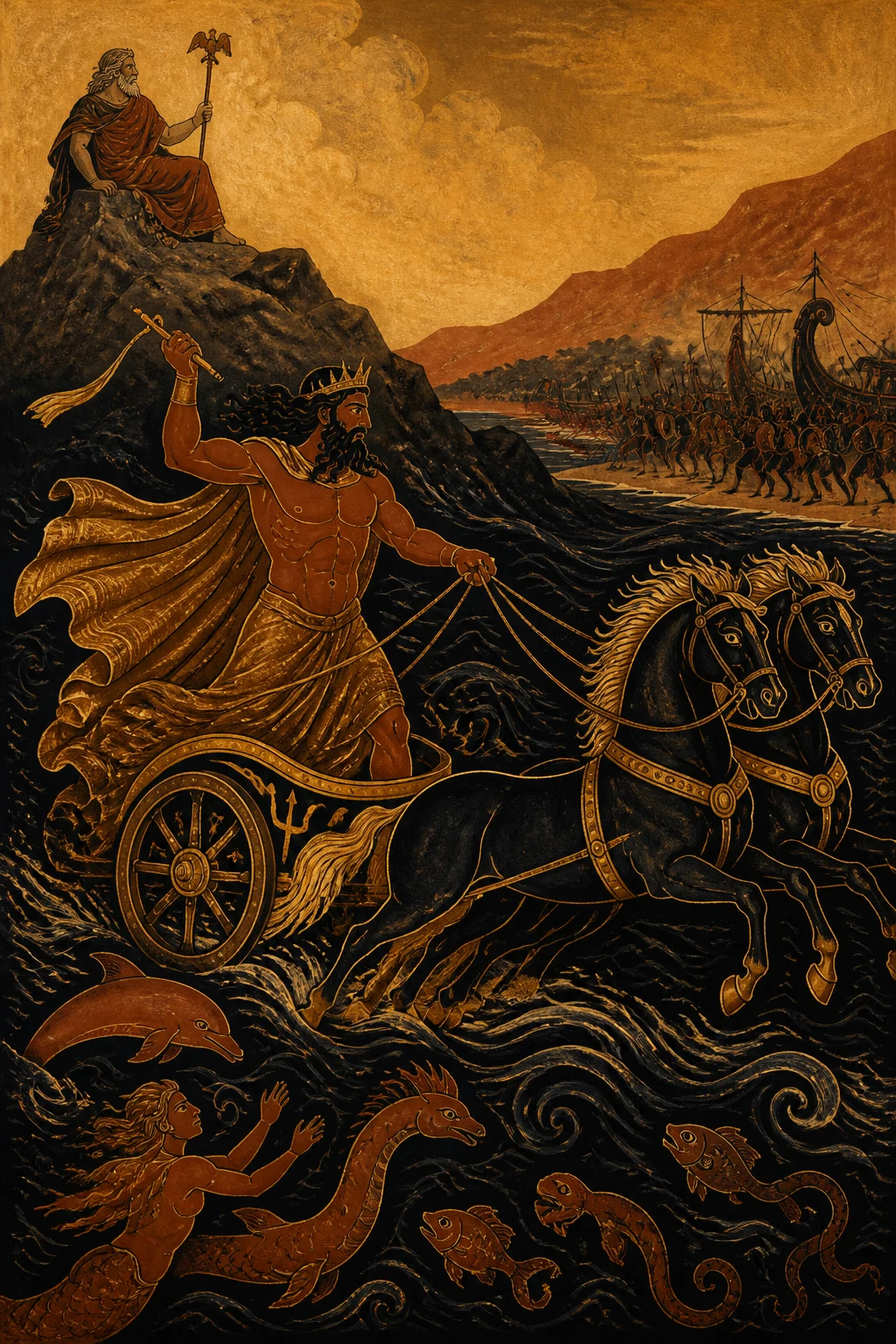
So the long-haired Achaeans labored, while the gods sat beside Zeus the lord of lightning and watched the great work of the bronze-clad Achaeans. Poseidon, shaker of the earth, was first to speak: “Father Zeus, is there anyone among mortals on the boundless earth who will still confide his thoughts and plans to the immortals?
“Do you not see that the long-haired Achaeans have built a wall to defend their ships and driven a trench around it, yet have given the gods no splendid sacrifices? Its fame will reach as far as dawn spreads her light, and men will forget the wall that Phoebus Apollo and I built with such labor for the warrior Laomedon.”
Deeply troubled, Zeus the cloud-gatherer answered him: “What a thing to say, mighty earth-shaker! Some other god might fear such a thought, one far weaker than you in strength of hand and spirit. Your fame will reach as far as dawn spreads her light.
“Come, when the long-haired Achaeans have sailed away in their ships to their own native land, break down their wall and sweep it all into the sea. Cover the great beach with sand again, and so obliterate the Achaeans’ mighty wall.”
While they spoke together, the sun went down and the Achaeans’ work was finished. They slaughtered cattle beside their huts and took their supper. Many ships had arrived from Lemnos bringing wine, sent by Euneus, son of Jason, whom Hypsipyle had borne to Jason, shepherd of the people.
For the sons of Atreus, Agamemnon and Menelaus, Jason’s son had sent a separate gift of a thousand measures of wine. From these ships the long-haired Achaeans bought their wine, some paying with bronze, some with gleaming iron, some with hides, some with live cattle, and some with slaves. Then they prepared a lavish feast.
All night the long-haired Achaeans feasted, and the Trojans and their allies feasted in the city. But all night Zeus the counselor devised evil for them, thundering terribly. Pale fear seized them, and they poured wine from their cups upon the ground. No one dared drink before pouring an offering to the almighty son of Cronus.
Then they lay down and accepted the gift of sleep.