Prevod
If you are deceived by his forbearance and assume a rank for which he does not consider you worthy, you will be like the hunter who caught wild beasts, skinned them for their hides, and threw away their flesh. A lion began coming to that place to eat the carcasses. As his visits grew frequent, he became familiar with the hunter and grew accustomed to him. The hunter began tossing meat to him and stroking his back, while the lion played with his tail. When the hunter saw how quiet the lion was in his presence, how tame and submissive he had become, he said to himself, “This lion has yielded to me, and I have mastered him. I see no reason why I should not mount him and strip off his hide as I do with the other beasts.” So the hunter grew bold, sprang onto the lion’s back, and coveted his skin. When the lion saw what the hunter had done, he flew into a terrible rage, raised a paw, and struck him, driving his claws into his entrails. Then he flung him beneath his feet and tore him to pieces. From this I have learned that a vizier should conduct himself before the king according to the disposition he observes in him, and should not presume upon the excellence of his own judgment, lest the king turn against him.” And morning overtook Shahrazad, and she ceased her permitted tale.
When it was the nine hundred and twelfth night,
She said: “It has reached me, O fortunate king, that the young son of King Jaliad said to the vizier Shammas, ‘A vizier should conduct himself before the king according to the disposition he observes in him, and should not presume upon the excellence of his own judgment, lest the king turn against him.’ Shammas said, ‘Then tell me: what commends a vizier to his king?’ The boy replied, ‘Faithfully discharging the trust committed to him, by offering sound counsel and wise judgment and carrying out his commands.’ Shammas said to him, ‘As for what you have said—that the vizier owes it to the king to avoid his displeasure, do what wins his favor, and attend to the duties entrusted to him—that is indeed obligatory. But tell me: what is to be done if the king takes pleasure only in injustice, oppression, and tyranny? What course is open to a vizier afflicted with the service of such a tyrannical king? If he wishes to turn him from his desires, appetites, and opinions, he cannot do so; yet if he indulges his desires and commends his judgment, he bears the burden of the wrong and becomes an enemy to the people. What do you say to this?’ The boy answered, ‘The burden of guilt and sin you speak of, O vizier, falls upon him only if he supports the king in his wrongdoing. When the king consults his vizier about such matters, the vizier must show him the way of justice and fairness, warn him against oppression and tyranny, explain how to govern his subjects well, encourage him with the reward this brings, and warn him of the punishment he otherwise incurs. If the king inclines to his words and accepts them, the desired end is attained. If not, he has no course but to part from him tactfully, for separation will bring relief to them both.’ The vizier said, ‘Then tell me: what does the king have a right to expect of his subjects, and what do the subjects have a right to expect of their king?’ He replied, ‘They must carry out his commands with sincere intent and obey him in what pleases him and pleases God and His Messenger. The subjects have a right to expect the king to protect their property and safeguard their womenfolk, just as the king has a right to their obedience, their readiness to give their lives in his defense, the payment of his lawful dues, and their praise for the justice and kindness he has shown them.’ Shammas said, ‘You have explained what I asked concerning the rights of king and subjects. Tell me, is there anything else the subjects may claim from the king beyond what you have mentioned?’ The boy replied, ‘Yes. The subjects’ claim upon the king is more binding than his claim upon them, for his neglect of their rights does greater harm than their neglect of his. A king’s destruction, the downfall of his kingdom, and the loss of his prosperity arise only from his failure to uphold his subjects’ rights. Whoever assumes sovereignty must therefore devote himself to three things: setting religion in order, setting his people’s affairs in order, and setting government in order. By steadfast attention to these three, his kingdom will endure.’ He asked, ‘Then tell me: how should he proceed in setting his people’s affairs in order?’ The boy replied, ‘By rendering them their due, upholding their established laws, employing learned and wise men to teach them, securing justice between them, sparing their blood, refraining from seizing their property, lightening their burdens, and strengthening their armies.’ He asked, ‘Then tell me: what does the king owe his vizier?’ The boy answered, ‘No one has a stronger claim upon the king than his vizier, for three reasons. First, because of what the vizier suffers with him when judgment fails, and the common benefit to king and subjects when judgment is sound. Second, so that the people may know the high place the vizier holds with the king, and regard him with reverence, respect, and humility. Third, because when the vizier sees such regard from king and subjects, he will ward off what they dislike and secure for them what they desire.’ Shammas said, ‘I have heard and accepted all you have told me concerning the qualities of king, vizier, and subjects. Now tell me how one should guard the tongue against lying, folly, slander, and excessive speech.’ The boy replied, ‘A man should speak only words of goodness and kindness, and say nothing about what does not concern him. He should shun tale-bearing and never repeat to a man’s enemy anything he has heard that man say. He should not seek to have harm done to either friend or enemy by his ruler. He should look to none but God Most High for the good he hopes for and the evil he fears, for in truth it is He alone who harms and benefits. He should mention no one’s faults and should not speak ignorantly, lest he incur guilt and sin before God and hatred among men. Know that speech is like an arrow: once it has flown, no one can call it back. Let him beware of entrusting his secret to someone who will reveal it, for he may suffer from its disclosure after believing it safely concealed. He should hide his secret from his friend even more carefully than from his enemy, for keeping a secret from all people is part of fulfilling a trust.’ Shammas said, ‘Then tell me about good conduct toward family and kin.’ The boy replied, ‘The children of Adam can find no peace without good conduct. Yet a man must give his family what they deserve and his friends what is due to them.’ He asked, ‘Then tell me what he should give his family.’ The boy replied, ‘To his parents he should show humility, sweetness of speech, gentleness, honor, and respect. To his friends he should offer sincere counsel, generosity with his wealth, help in their affairs, joy in their happiness, and indulgence toward their lapses. When they recognize these qualities in him, they will return his kindness with their most precious counsel and give their lives in his defense. When you are sure of your friend, bestow your affection upon him and help him in all his affairs.’ And morning overtook Shahrazad, and she ceased her permitted tale.
When it was the nine hundred and thirteenth night,
She said: “It has reached me, O fortunate king, that when the vizier Shammas had put the foregoing questions to the young son of King Jaliad and received his answers, he said to him, ‘I see that friends are of two kinds: trusted friends and companions. Trusted friends deserve what you have described, but I ask you now about the others, those who are merely companions.’ The boy replied, ‘From companions you may gain pleasure, pleasant manners, sweet words, and agreeable company. Do not deprive yourself of the enjoyment they afford you, but offer them the same as they offer you, and treat them as they treat you, with a cheerful face and a gracious tongue. Then your life will be pleasant and your words welcome among them.’
“Shammas said, ‘We have now learned all these things. Tell me about the sustenance the Creator has ordained for His creatures. Is it apportioned among men and beasts, each having his own provision until the end of his allotted life? If so, what makes a man seeking his livelihood endure hardship in pursuit of something which, as he knows, must come to him if it is ordained, even without the hardship of striving, but which he cannot obtain, however hard he strives, if it is not ordained for him? Should he therefore abandon his efforts, put his trust in his Lord, and give his body and soul repose?’ The boy replied, ‘We have indeed seen that everyone has an apportioned livelihood and an appointed end. Yet every livelihood has its own path and means. A man who strives may find relief by ceasing to strive; nevertheless, he must seek his sustenance. Those who seek are of two kinds: those who attain it and those who are denied it. The successful man finds comfort in two things: obtaining his provision and seeing his efforts come to a happy end. The unsuccessful man finds comfort in three: having made ready to seek his livelihood, having kept himself from becoming a burden upon others, and having freed himself from blame.’ Shammas said, ‘Tell me about the proper way to seek a livelihood.’ The boy replied, ‘A man must hold lawful what God has made lawful, and forbidden what God, mighty and glorious, has forbidden.’
“At this point their discussion came to an end. Shammas and all the learned men present rose, prostrated themselves before the boy, and paid him honor and reverence. His father embraced him, then seated him upon the royal throne and said, ‘Praise be to God, who has granted me a son to gladden my eyes in my lifetime!’ Then the boy said to Shammas and the scholars present, ‘O learned man, who questions me on spiritual matters, although God has granted me only a little knowledge, I have understood your intention in accepting the answers I have given to your questions, whether I was right or wrong. Perhaps you have overlooked my errors. Now I wish to ask you about something that has baffled my judgment, exceeded my powers, and defied my tongue’s attempts to describe it. It is as obscure to me as clear water in a black vessel. I would have you explain it, so that nothing of it may remain obscure to one such as I in the future, as it has been in the past. For just as God has made water the means of life, food the means of strength, and a physician’s treatment the means of healing the sick, so He has made the scholar’s learning the cure for the ignorant. Listen, then, to what I say.’ Shammas replied, ‘O you of radiant understanding, who ask worthy questions, whose excellence all the learned have acknowledged because of your fine distinctions and divisions and the accuracy of your answers to my questions, I know that you will ask me nothing of which your own interpretation is not sounder and your account more truthful. For God has given you knowledge such as He has given no other man. Tell me, then, what are these things you wish to ask me?’ The boy said, ‘Tell me about the Creator, glorious in His power: from what did He create His creatures, when nothing existed before them? In this world we see nothing that is not created from something else. The Maker, blessed and exalted, is able to create things from nothing, yet despite the perfection of His power and majesty, His will has decreed that He should create nothing except from something.’ The vizier Shammas replied, ‘Those who make vessels of earthenware and practice other crafts cannot bring anything into being except from something else, for they themselves are created. But as for the Creator, who fashioned the world with such wondrous art, if you wish to understand His power, blessed and exalted is He, to bring things into being, reflect long upon the various kinds of creation. You will find signs and proofs of His perfect power, and of His ability to create things from nothing. Indeed, He brought them into existence out of utter nonexistence, for the elements that form the substance of things were once wholly nonexistent. I have made this clear to you so that you may have no doubt. The sign of night and day illustrates it: they follow one another, and when day departs and night comes, day is hidden from us, and we know not where it abides. When night departs with its darkness and loneliness, day comes, and we know not where night abides. When the sun shines upon us, we do not know where its light is folded away; when it sets, we do not know its resting place. Many such acts of the Creator—exalted be His name and glorious His power—bewilder the minds of the most intelligent of His creatures.’
“The boy said, ‘O learned man, you have shown me things concerning the Creator’s power that cannot be denied. But tell me: how does He bring His creatures into being?’ Shammas replied, ‘Creation is made by His Word, which existed before time, and through it He created all things.’ The boy said, ‘God, exalted be His name and sublime His power, willed to bring His creatures into being before they existed.’ Shammas replied, ‘And by His will He created them through His Word. Had He not spoken and uttered a word, creation would not have existed.’ And morning overtook Shahrazad, and she ceased her permitted tale.
When it was the nine hundred and fourteenth night,
She said: “It has reached me, O fortunate king, that when the boy asked Shammas the foregoing questions, he answered them, then said to him, ‘My son, no one can tell you otherwise than I have done without distorting the words handed down in the sacred laws and twisting truths from their proper meanings. An example is your saying that the Word has power. God preserve me from such a belief! Rather, when we say of God, mighty and glorious, that He created creation by His Word, we mean that He is one in His essence and His attributes. We do not mean that God’s Word possesses power of its own. Power is an attribute of God, just as speech and the other attributes of perfection are attributes of God, exalted in His majesty and mighty in His dominion. He is not to be described apart from His Word, nor His Word apart from Him. God, exalted be His praise, created all His creatures by His Word, and without His Word He created nothing. He created all things by His true Word, and thus we are created through truth.’ The boy said, ‘I have understood what you have told me concerning the Creator and the majesty of His Word, and I have accepted it with understanding. Yet I heard you say that He created creation by His true Word. Truth is the opposite of falsehood: whence, then, did falsehood arise? How can it intrude upon truth, so as to resemble it and confuse created beings, making it necessary for them to distinguish between the two? Does the Creator, mighty and glorious, love this falsehood or hate it? If you say that He loves truth and created His creatures through it, and that He hates falsehood, how did what the Creator hates intrude upon what He loves, namely truth?’ Shammas replied, ‘When God created man through truth, man had no need of repentance until falsehood intruded upon the truth through which he was created. This happened by means of the capacity God had placed in man: the will and inclination known as acquisition. When falsehood thus intruded upon truth, the two became confused through man’s will and capacity, and through acquisition, which is the voluntary element joined to one half of man’s nature. God therefore established repentance for him, to remove that falsehood from him and establish him firmly in truth; and He established punishment for him if he persisted in embracing falsehood.
“The boy said, ‘Then tell me what caused this falsehood to intrude upon truth and become confused with it. How did man come to deserve punishment, so that he needed repentance?’ Shammas replied, ‘When God created man through truth, He made him love it, and there was neither punishment nor repentance for him. He remained thus until God placed within him the lower soul, which is part of the completeness of human nature, with its innate inclination toward desires. From this arose the intrusion of falsehood and its confusion with the truth through which man was created and which he was born to love. When man reached this state, he strayed from truth through disobedience, and whoever strays from truth falls into falsehood.’ The boy said, ‘Then falsehood intruded upon truth only through disobedience and transgression.’ Shammas replied, ‘That is so. God loves man, and out of His abundant love for him, He created man in need of Him: this is truth itself. But man may grow lax in this because his soul inclines toward desires, and he may turn toward disobedience. Thus he enters falsehood through the sin by which he disobeys his Lord and deserves punishment. By removing falsehood from himself through repentance and returning to the love of truth, he deserves reward.’
“The boy said, ‘Tell me about the beginning of disobedience. The history of mankind goes back to the coming into being of Adam, whom God created through truth. How, then, did he bring sin upon himself? After the soul had been placed within him, his sin was coupled with repentance, so that his final outcome would be reward or punishment. Yet we see some people persisting in disobedience, inclining toward what God does not love, acting contrary to the love of truth that belongs to their original nature, and deserving their Lord’s anger. We see others continuing to please and obey their Creator, deserving mercy and reward. What causes this difference between them?’ Shammas replied, ‘This disobedience first descended upon creation through Iblis, who was the noblest of all that God, glorious be His name, had created among angels, men, and jinn. He was formed to love and knew nothing else. But when he stood alone in this distinction, conceit, pride, arrogance, and disdain for faith and obedience to his Creator’s command entered him. So God cast him below all His creatures, expelled him from love, and left him to dwell within his own disobedient self. When he learned that God, glorious be His name, did not love disobedience, and saw Adam abiding in truth, love, and obedience to his Creator, envy entered him. He resorted to guile to turn Adam away from truth, so that Adam might share falsehood with him. Adam became liable to punishment because he inclined toward the disobedience his enemy had made attractive to him and yielded to his own desire, violating his Lord’s command when falsehood assailed him. When the Creator—exalted be His praise and hallowed His names—saw man’s weakness, how readily he inclined toward his enemy and abandoned truth, He mercifully granted him repentance, by which he might rise from the pitfall of yielding to sin. Armed with repentance, he could vanquish his enemy Iblis and his hosts and return to the truth for which he was made. When Iblis saw that God, exalted be His praise and hallowed His names, had granted him a long respite, he hastened to wage war upon man and assailed him with stratagems, to drive him from his Lord’s favor and make him share the wrath that he and his hosts had incurred. God, exalted be His praise, gave man the power to repent, commanded him to cleave steadfastly to truth, forbade him disobedience and rebellion, and made him aware that he had an enemy on earth who warred against him without rest by night or day. Thus man deserves reward if he remains faithful to the truth his nature was formed to love, and punishment if his lower soul overcomes him and draws him toward desires.’ And morning overtook Shahrazad, and she ceased her permitted tale.
When it was the nine hundred and fifteenth night,
She said: “It has reached me, O fortunate king, that when the boy had put the foregoing questions to Shammas and received his answers, he said, ‘Tell me: by what power were creatures able to disobey their Creator, when He is supremely great, as you have described, and nothing can overcome Him or escape His will? Do you not see that He is able to turn His creatures away from this disobedience and make them abide forever in love?’ Shammas replied, ‘God Most High, glorious be His name, is just, fair, and compassionate toward those who love Him. He has shown them the path of goodness and granted them the capacity and power to do whatever good they will. If they act otherwise, they fall into ruin and disobedience.’ The boy said, ‘If it is the Creator who has granted them this capacity, by which they are able to do as they will, why does He not intervene between them and the falsehood they desire, and so restore them to truth?’ Shammas replied, ‘That is because of His great mercy and wondrous wisdom. Just as He had already decreed wrath for Iblis and withheld mercy from him, so He had decreed mercy for Adam through repentance, and was pleased with him after having been angry with him.’ The boy said, ‘This is truth itself, for He requites everyone according to his deeds. There is no creator but God, who has power over all things.’ Then the boy asked, ‘Did God create both what He loves and what He does not love, or did He create only what He loves?’ Shammas replied, ‘He created everything, but approves only what He loves.’ The boy said, ‘What is the nature of these two things, one of which pleases God and earns its doer a reward, while the other angers God and brings punishment upon its doer?’ Shammas replied, ‘Explain these two things to me and make me understand them, so that I may speak of them.’ The boy said, ‘They are the good and evil embodied in body and spirit.’ Shammas replied, ‘O wise one, I see that you know good and evil to be deeds performed by body and spirit. Good is called good because it meets with God’s approval, and evil is called evil because it incurs His anger. It is your duty to know God and please Him by doing good, for He has commanded us to do so and forbidden us to do evil.’
“The boy said, ‘I see that these two things, good and evil, are performed through the five familiar senses in the human body: the organ of taste, from which speech also comes, hearing, sight, smell, and touch. I would have you tell me whether these five senses were all created for good or for evil.’ Shammas replied, ‘O man, understand the explanation of what you have asked, for it is a clear proof. Set it in your mind and let your heart absorb it. The Creator, blessed and exalted, created man through truth and formed him to love it. No creature has proceeded from Him except through the sublime power that brings all things into being, and to Him, blessed and exalted, are attributed only judgments of justice, fairness, and kindness. He created man for His love and placed within him the lower soul, with its innate inclination toward desires. He gave him the power to act and made these five senses a means to bliss or to hellfire.’ The boy asked, ‘How is that?’ Shammas replied, ‘He created the tongue for speech, the hands for work, the feet for walking, the eyes for seeing, and the ears for hearing. He gave each of these faculties the power to act and stirred it to action and movement, commanding each to do only what pleased Him. What pleases Him in speech is truthfulness and the rejection of its opposite, which is lying. What pleases Him in sight is looking upon what God loves and rejecting its opposite, which is looking upon what God hates, such as objects of lust. What pleases Him in hearing is listening only to truth, such as exhortations and what is written in the books of God, and rejecting its opposite, which is listening to what incurs God’s anger. What pleases Him in the hands is that they should not withhold what God has entrusted to them, but spend it in a manner pleasing to Him, and reject the opposite, which is hoarding it or spending what He has bestowed upon acts of disobedience. What pleases Him in the feet is that they should hasten toward good, as when one goes in search of learning, and reject the opposite, which is walking in a path other than God’s. All other desires to which man gives expression proceed from the body at the spirit’s command. The appetites that arise from the body are of two kinds: the desire for procreation and the appetite of the belly. What pleases God in the desire for procreation is that it should be fulfilled only lawfully; what angers Him is its unlawful fulfillment. As for the appetite of the belly, it concerns eating and drinking. What pleases God is that each person should partake only of what He has made lawful for him, whether little or much, and praise and thank Him. What angers God is that a man should take what is not rightfully his. Whatever departs from these rulings is false. You have learned that God created all things but approves only goodness, and that He commanded every member of the body to perform the duty He laid upon it, for He is the All-Knowing, the All-Wise.’
“The boy said, ‘Then tell me: was it already in the knowledge of God, glorious in His power, that Adam would be led to eat from the tree He had forbidden him, so that what happened to him would happen, and he would pass from obedience into disobedience?’ Shammas replied, ‘Yes, O learned one. This was already in God’s knowledge before He created Adam. Its proof and explanation lie in the warning He gave him beforehand against eating from it, and in His telling him that if he ate from it he would be disobedient. This was an act of justice and fairness, so that Adam would have no argument to bring against his Lord. When he fell into that predicament and committed that fault, and reproach and blame weighed heavily upon him, the same condition passed to his descendants after him. God Most High therefore sent prophets and messengers and gave them books. They taught us the sacred laws, explained their admonitions and rulings, set them out in detail, made clear the path that leads to our goal, and showed us what we must do and what we must leave undone. We have been endowed with the power to act. Whoever observes these limits acts rightly and gains; whoever oversteps them and acts contrary to these commandments disobeys and loses in both worlds. Such is the way of good and evil. You now know that God has power over all things, and that He created desires within us only with His approval and by His will. He commanded us to satisfy them lawfully, so that they might be good for us. If we indulge them unlawfully, they become evil for us. Whatever good befalls us comes from God Most High; whatever evil befalls us comes from ourselves, who are created beings, and not from the Creator. Far exalted is God above such a thing!’ And morning overtook Shahrazad, and she ceased her permitted tale.
When it was the nine hundred and sixteenth night,
She said: “It has reached me, O fortunate king, that when the young son of King Jaliad had put these questions to the vizier Shammas and received his answers, he said, ‘I have understood your account of what is to be attributed to God Most High and what is to be attributed to His creatures. Now explain something that has bewildered my mind with wonder. I marvel at the children of Adam: at their heedlessness of the world to come, their failure to remember it, and their love of this world, though they know that they must leave it and depart from it humbled.’ Shammas replied, ‘Yes. The changes you see in this world, and its treachery toward its people, prove that neither the prosperous man’s prosperity nor the afflicted man’s affliction will endure. Whoever possesses it is never safe from its changes, even if it lies within his power and he delights in it. His condition must change, and his departure will swiftly overtake him. A man can place no trust in it, nor will its splendors avail him. Knowing this, we know that the worst off among men is he who is deceived by it and forgets the world to come. The pleasures he has attained cannot outweigh the fear, hardship, and terrors that will befall him after he leaves it. We know that if a servant of God knew what would befall him at the approach of death, when he must part from his pleasures and prosperity, he would renounce the world and all it contains. We are certain that the life to come is better and more beneficial for us.’ The boy said, ‘O learned man, the darkness that lay upon my heart has been dispelled by your shining lamp. You have guided me to the path you have followed in pursuing truth and given me a light by which to see.’
“Then one of the sages present rose and said, ‘When spring comes, the hare must seek pasture alongside the elephant. I have heard from you both questions and explanations such as I never thought I should hear, and this has prompted me to ask you something. Tell me: what are the best gifts of this world?’ The boy replied, ‘A healthy body, a lawful livelihood, and a virtuous child.’ He asked, ‘Then tell me: what is great and what is small?’ The boy replied, ‘The great is that which the smaller must endure; the small is that which must endure the greater.’ He asked, ‘Tell me the four things all creatures share.’ The boy replied, ‘All creatures share food and drink, the pleasure of sleep, desire for women, and the agonies of death.’ He asked, ‘What are the three things whose ugliness no one can remove?’ The boy replied, ‘Foolishness, baseness of character, and lying.’ He asked, ‘What lie is best, though all lying is ugly?’ The boy replied, ‘The lie that wards harm off its speaker and brings benefit.’ He asked, ‘And what truth is ugly, though all truth is good?’ The boy replied, ‘A man’s boasting of what he possesses and admiring himself for it.’ He asked, ‘What is the ugliest of ugly things?’ The boy replied, ‘A man’s admiring himself for what he does not possess.’ He asked, ‘Which man is the greatest fool?’ The boy replied, ‘He whose only ambition is for something to put into his belly.’
“Shammas said, ‘O king, you are our sovereign, but we would have you appoint your son to succeed you, and we shall be his servants and subjects.’ Then the king urged the scholars and others present to remember what they had heard from his son and act upon it. He commanded them to obey the boy, for he had made him his heir, to succeed to his father’s kingdom. He took a pledge from all the people of his realm—scholars, warriors, old men, boys, and everyone else—that they would neither desert him nor break faith with his command.
“When the king’s son reached the age of seventeen, the king fell gravely ill and came close to death. When he knew that death was upon him, he said to his household, ‘This mortal illness has come upon me. Summon my kinsmen and my son, and gather the people of my kingdom, so that not one of them fails to attend.’ They went out and called to those nearby, raising their voices to summon those farther away, until all had assembled and entered the king’s presence. They said to him, ‘How are you, O king? How do you find yourself in this illness?’ The king replied, ‘This is the illness that will make an end of me. The arrow of what God Most High has decreed for me has struck home. I am now in the last of my days in this world and the first of my days in the next.’ Then he said to his son, ‘Come near me.’ The boy drew near, weeping so bitterly that he almost soaked his father’s bed. Tears filled the king’s eyes, and everyone present wept. Then the king said to his son, ‘Do not weep, my son. I am not the first to whom this inevitable fate has come, for it passes over all that God has created. Fear God, and do good deeds that will precede you to the place toward which all creatures journey. Do not obey your passions. Occupy yourself with the remembrance of God, standing or sitting, waking or sleeping, and keep truth always before your eyes. These are my last words to you. Peace be upon you.’ And morning overtook Shahrazad, and she ceased her permitted tale.
When it was the nine hundred and seventeenth night,
She said: “It has reached me, O fortunate king, that when King Jaliad had given his son this counsel and appointed him to reign after him, the boy said to his father, ‘You know, Father, that I have always obeyed you, treasured your counsel, carried out your commands, and sought your approval. You have been the best of fathers to me. How could I depart after your death from what pleases you, when, after bringing me up so well, you are leaving me, and I can no longer enjoy your loving care? If I preserve your counsel, I shall prosper through it and gain the richest share of good fortune.’ The king, now deep in the agonies of death, said to him, ‘My son, hold fast to ten qualities through which God will benefit you in this world and the next. They are these: when angered, restrain your anger; when afflicted, be patient; when you speak, speak truth; when you promise, fulfill your promise; when you judge, be just; when you have power, pardon; honor your commanders; forgive your enemies; extend kindness to your enemy; and refrain from harming him. Hold fast also to ten further qualities through which God will benefit you among the people of your kingdom: when you distribute, be fair; when you punish a rightful offense, do not exceed the bounds of justice; when you make a covenant, fulfill it; accept counsel; abandon obstinacy; require your subjects to adhere faithfully to the sacred laws and praiseworthy customs; and judge justly between people, so that young and old alike will love you, while the rebellious and corrupt will fear you.’ Then he said to the scholars and emirs present, who had witnessed his appointment of his son to succeed him, ‘Beware of disobeying your king’s command and refusing to heed your leader, for that will bring ruin upon your land, scatter your unity, harm your persons, and destroy your wealth, so that your enemies will rejoice over you. You know the pledge you have made to me: let your pledge to this boy be the same. Let the covenant between me and you stand also between you and him. Hear and obey his commands, for therein lies the well-being of your affairs. Remain steadfast with him as you have been with me, and your affairs will be rightly ordered and your condition will prosper. Behold your king and benefactor. Peace be upon you.’”
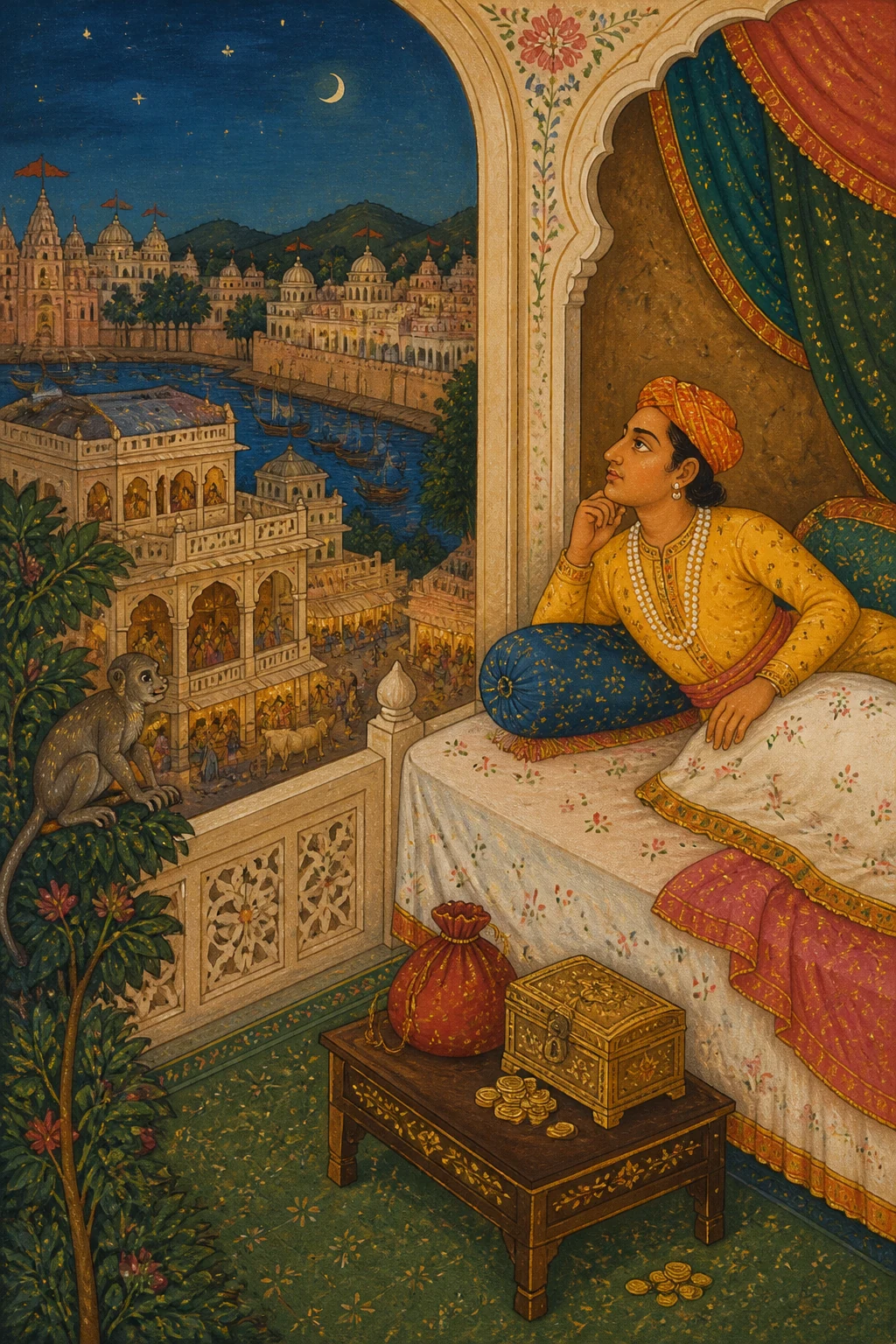
After this, the pangs of death grew fiercer upon him and his tongue fell silent. He drew his son to him, kissed him, and gave thanks to God; then his appointed hour came and his soul departed. All his subjects and the people of his kingdom mourned him. They shrouded him and buried him with honor, reverence, and great solemnity, then returned with the boy. They clothed him in royal robes, crowned him with his father’s crown, placed the ring upon his finger, and seated him on the throne. For a short while the boy ruled them as his father had done, with forbearance, justice, and kindness. Then the world presented itself to him and drew him away with its desires. He seized upon its pleasures and devoted himself to its glittering vanities, abandoning the pledges his father had laid upon him. He cast aside obedience to his father, neglected his kingdom, and set himself upon the path to ruin. His love of women grew so strong that whenever he heard of a beautiful woman, he sent for her and married her, until he had gathered more wives than Solomon son of David, king of the Children of Israel. Each day he would withdraw with a company of them, and remain a whole month with those he had chosen, never leaving them, asking nothing of his kingdom or its government, and hearing none of the grievances his subjects brought before him. When they wrote to him, he sent no reply. Seeing this, and realizing how wholly he had abandoned their affairs and neglected both his state and his subjects, they knew that calamity would soon befall them. They were sorely troubled and began reproaching one another. Some said to the others, “Let us go to Shamas, his chief minister, and tell him our plight. We will make known to him what this king is doing, so that he may counsel him; otherwise disaster will soon descend upon us. For the world has bewildered this king with its pleasures and ensnared him in its ropes.” So they rose and went to Shamas, saying, “O learned sage, the world has bewildered this king with its pleasures and ensnared him in its ropes. He has given himself over to vanity and is bringing his kingdom to ruin. When the kingdom is corrupted, the common people suffer, and our end will be destruction. A month and more goes by without our seeing him, and no command comes out from him, whether to a minister or anyone else. No petition can be brought before him; he hears no case and looks into the condition of none of his subjects, so heedless has he become of them. We have come to tell you the truth of the matter, for you are our elder and surpass us in wisdom. No calamity should befall a land in which you dwell, for no one is better able than you to set this king right. Go and speak to him; perhaps he will heed your words and return to God.”
Shamas rose and went to a place where he could meet one of those who had access to the king. He said to him, “Good lad, I ask you to obtain permission for me to enter the king’s presence. I have a matter on which I wish to see him and speak to him, and to hear his answer.” The young servant replied, “By God, my lord, for a month he has allowed no one to enter his presence, not even me. Throughout that time I have not seen his face. But I can direct you to someone who may obtain permission for you: seek out the page who waits upon him and fetches his food from the kitchen. When he comes out to the kitchen for the food, ask him whatever you wish, and he will do what you require.” Shamas went to the kitchen door and sat there for a little while. Presently the page approached and was about to enter the kitchen when Shamas spoke to him, saying, “My son, I wish to meet the king and speak to him of something that concerns him. Be so kind, when he has finished his meal and is in good spirits, as to speak to him on my behalf and obtain permission for me to enter, so that I may address him as is fitting.” “I hear and obey,” said the page. He took the food and carried it to the king, who ate of it. When the king was in a pleasant humor, the page said, “Shamas is waiting at the door and asks leave to enter your presence, to inform you of matters that concern you.” The king was startled and uneasy at this, and ordered the page to admit him. But morning overtook Shahrazad, and she fell silent, ceasing her permitted tale.
When it was the nine hundred and eighteenth night
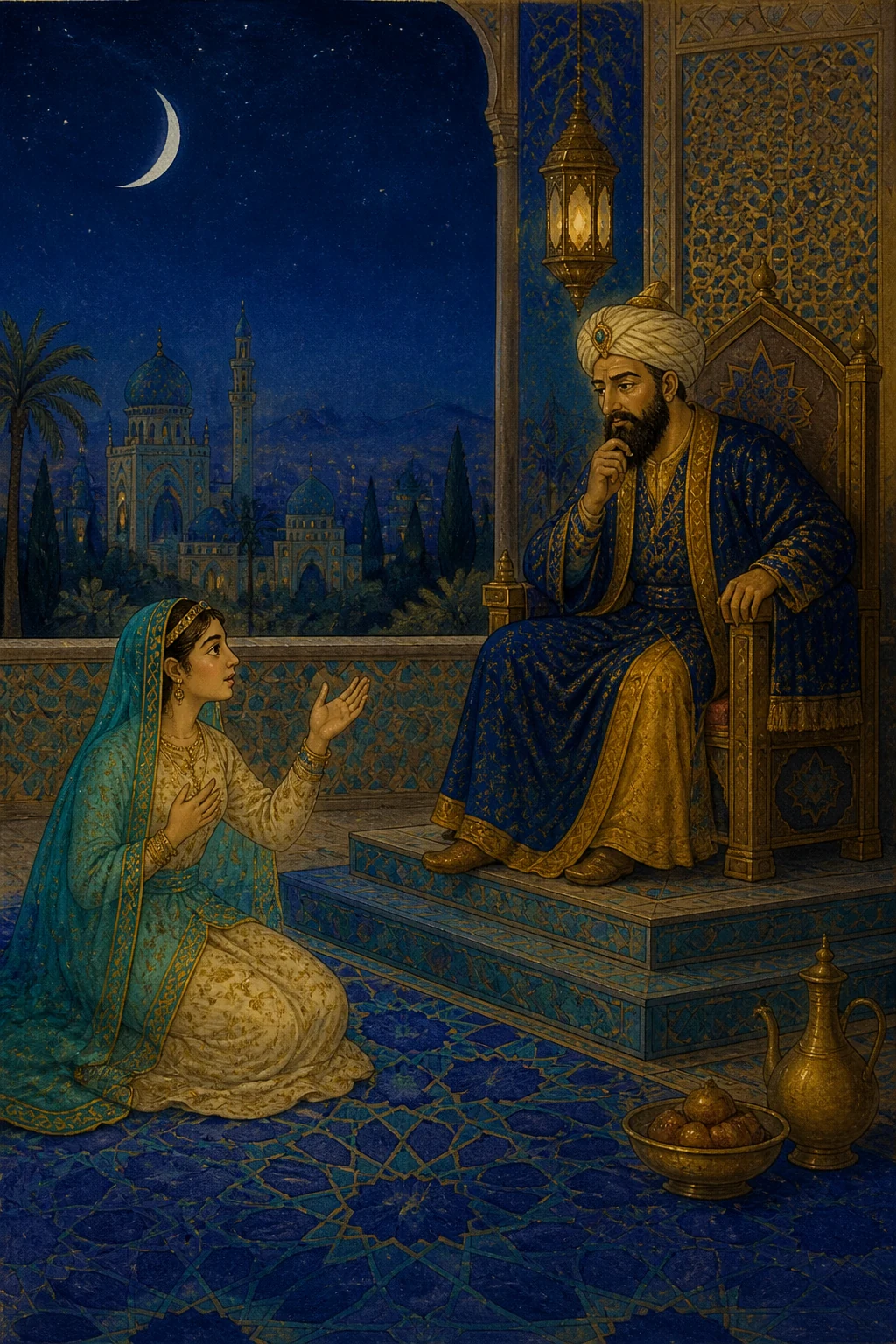
She said: It has reached me, O fortunate king, that when the king ordered the page to admit Shamas, the page went out and invited him to enter. On coming before the king, Shamas fell prostrate before God, kissed the king’s hands, and prayed for him. The king said, “What has happened to you, Shamas, that you have asked to come before me?” He replied, “It has been some time since I last saw the face of my lord the king, and I have longed greatly for you. Now I have beheld your countenance, and I have come with something to say to you, O king sustained by every blessing.” “Say what you will,” said the king. Shamas said, “Know, O king, that despite your youth, God Most High has endowed you with knowledge and wisdom such as He bestowed upon none of the kings before you, and He has crowned these gifts with kingship. God wishes you not to forsake what He has granted you for something else through disobedience to Him. Do not wage war against Him with the treasures He has given you; rather, keep His commandments and obey His decrees. For I have seen that in these few days you have forgotten your father and his counsel, rejected his covenant, thrown away his advice and words, and turned from his justice and judgments. You have neither remembered God’s blessing upon you nor secured it by giving thanks.” The king said, “How is that? What has brought it about?” Shamas replied, “It is because you have ceased to attend to the affairs of your kingdom and the concerns of your subjects which God has entrusted to you. You have yielded to your lower self and the paltry pleasures of this world that it has made alluring to you. It has been said that a king must take care to preserve the well-being of his kingdom, his faith, and his people. My counsel, O king, is that you look carefully to your end, for then you will find the clear path that leads to safety. Do not give yourself over to fleeting, trifling pleasures that lead into the abyss of destruction, lest there befall you what befell the fisherman.” “And how was that?” asked the king.
Shamas said, “I have heard that a fisherman once came to a river to fish as was his custom. When he reached the river and was walking along the bridge, he caught sight of an enormous fish. He said to himself, ‘There is no need for me to stay here. I will go after this fish wherever it goes until I catch it, and it will spare me the trouble of fishing for several days.’ He stripped off his clothes and went into the water after the fish. The current carried him along until he caught up with it and seized it. Then he looked about and found himself far from the bank. Yet when he saw what the current had done to him, he did not let go of the fish and turn back. Instead, he risked his life, holding it fast in his hand and letting his body drift with the stream. The water swept him onward until it hurled him into the midst of a whirlpool from which no one who entered ever escaped. He began to cry, ‘Save me! I am drowning!’ Some men who watched over the waters came to him and said, ‘What is the matter with you? What possessed you to cast yourself into such terrible danger?’ He answered, ‘It was I who abandoned the clear path of safety and gave myself over to desire and destruction.’ They said, ‘Man, how could you forsake the path of safety and plunge yourself into this peril? You have long known that no one who enters here comes out alive. What stopped you from throwing away what you held and saving yourself? You could have preserved your life and escaped this destruction from which there is no deliverance. Now none of us can save you.’ The man despaired of his life, lost the thing his desire had driven him to seize, and perished miserably. I have told you this parable, O king, only so that you may abandon this paltry pursuit which distracts you from your true interests, and attend to the duties laid upon you: governing your people and keeping your kingdom in good order, so that no one may find fault with you.” The king said, “What do you advise me to do?” Shamas replied, “Tomorrow, if you are well and in good health, allow the people to enter your presence. Inquire into their affairs, offer them an apology, and promise them kindness and good government.” The king said, “Shamas, you have spoken rightly. Tomorrow, God Most High willing, I shall do as you advise.”
Shamas left him and told the people all that had been said. When morning came, the king emerged from his seclusion and admitted the people to his presence. He apologized to them and promised to do as they wished. They were content with this and departed, each returning to his own home. Then one of the king’s wives, the dearest and most honored of them all, came to him. Seeing him pale and absorbed in thought over what he had heard from his chief minister, she said, “Why do I see you so troubled, O king? Are you unwell?” He replied, “No, but pleasures have distracted me from my affairs. Why should I remain so heedless of my own condition and that of my subjects? If I persist in this, my kingdom will soon slip from my hands.” She answered, “I see, O king, that your officers and ministers are deceiving you. They wish only to injure you and plot against you, so that you may gain no pleasure from your kingship and enjoy neither ease nor comfort. They want you to spend your life sparing them hardship, until all your days are consumed in toil and weariness. You would be like a man who kills himself for the benefit of others, or like the boy and the thieves.” “And how was that?” asked the king. She said, “They tell that seven thieves went out one day to steal, as was their custom. They passed an orchard where fresh walnuts grew and went into it. Finding a young boy standing among them, they said to him, ‘Lad, would you like to come into this orchard with us, climb this tree, eat your fill of its walnuts, and throw some down to us?’ The boy agreed and went in with them.” But morning overtook Shahrazad, and she fell silent, ceasing her permitted tale.
When it was the nine hundred and nineteenth night
She said: It has reached me, O fortunate king, that when the boy agreed to the thieves’ proposal and went in with them, they said to one another, “See which of us is the lightest and smallest, and send him up.” Then they said, “There is none among us more nimble than this boy.” When they had sent him up, they called, “Lad, do not touch anything on the tree, lest someone see you and harm you.” The boy asked, “What am I to do, then?” They said, “Sit in the middle of it and shake each branch hard, so that the nuts fall off and we can gather them. When the tree is empty and you come down to us, take your share of what we have collected.” So the boy climbed the tree and began shaking the branches one by one. The walnuts fell, and the thieves gathered them. While they were thus occupied, the owner of the tree suddenly appeared before them and caught them in the act. “What are you doing with this tree?” he demanded. They replied, “We have taken nothing from it. We were merely passing when we saw this boy up in it. We thought he owned it and asked him to give us something to eat. He shook some of the branches until the walnuts fell. We are not to blame.” The owner said to the boy, “And what do you say?” He answered, “These men are lying. I will tell you the truth. We all came here together, and they told me to climb this tree and shake the branches so that the walnuts would fall down to them. I did as they told me.” The owner said, “You have brought yourself into great trouble. Have you at least had the benefit of eating any of them?” “I have eaten none,” said the boy. The owner replied, “Now you know your own folly and ignorance: you have worked to bring ruin upon yourself for the benefit of others.” Then he said to the thieves, “I have no claim against you. Go your way.” But he seized the boy and punished him. “So it is with your ministers and the men of your court,” she continued. “They wish to destroy you for their own advantage, and to do to you what the thieves did to the boy.” The king said, “What you say is true, and your tale is indeed just. I will not go out to them, nor will I abandon my pleasures.” Then he passed the night with his wife in the greatest delight until morning came.
When morning came, the minister rose and gathered the officers of state, together with those of the people who had joined them. They came to the king’s door, happy and full of hope, but the door was not opened to them. The king neither came out nor gave them permission to enter. When they had lost all hope, they said to Shamas, “O worthy minister and sage, do you not see the conduct of this young and foolish boy, who has now added lying to his sins? Consider the promise he made you: he has broken it and failed to keep his word. This is another fault you must add to the rest. Yet we ask you to go in to him a second time and find out why he delays and what prevents him from coming out. Such behavior is no surprise to us, given his vile disposition, for he has reached the utmost degree of hard-heartedness.” Shamas went to the king, entered his presence, and said, “Peace be upon you, O king. Why do I see you giving yourself over to a paltry pleasure and neglecting the great matter that deserves your care? You are like a man who owned a she-camel and coveted her milk. So delighted was he by the richness of her milk that he forgot to hold her rein. One day he set about milking her and paid no heed to the rein. When the camel felt it hanging loose, she pulled away and made for the open country. Thus the man lost both the milk and the camel, and the harm he suffered far outweighed his gain. Consider, O king, what will serve your own good and that of your subjects. A man should not sit forever at the kitchen door merely because he needs food, nor should he spend too much time with women merely because he desires them. Just as he seeks enough food to still the pain of hunger and enough drink to still the pain of thirst, so should a wise man be content to spend two hours of each day’s twenty-four with women, devoting the remainder to his own concerns and those of his subjects. He should not linger with women or remain alone with them for more than two hours, for that harms both his mind and body. They neither enjoin what is good nor guide a man toward it, and he should accept neither their words nor their deeds. I have heard of many men who perished because of their wives. Among them was a man who met his death through lying with his wife, because he obeyed her command.” “And how was that?” asked the king.
Shamas said, “They tell that a man had a wife whom he loved and held in great honor. He listened to her words and acted upon her advice. He also had a garden which he had lately planted with his own hands, and every day he went there to tend and water it. One day his wife asked him, ‘What have you planted in your garden?’ He answered, ‘Everything you love and desire, and I am working hard to tend and water it.’ She said, ‘Will you take me there and show it to me, so that I may see it and offer a good prayer for you? For my prayers are answered.’ ‘Yes,’ he said. ‘Wait until tomorrow, when I shall come and take you.’ The next morning the man took his wife with him and brought her to the garden. As they entered, two young men saw them from a distance, and one said to the other, ‘That man is an adulterer and that woman an adulteress. They have entered this garden only to commit adultery.’ They followed them to see what they would do and stationed themselves at the edge of the garden. Once the man and his wife had entered and settled themselves, he said to her, ‘Offer the prayer you promised me.’ She replied, ‘I shall not pray for you until you satisfy the need women have of men.’ He said, ‘Woman, shame on you! Was what I did at home not enough? Here I fear disgrace, and you may distract me from my work. Are you not afraid someone will see us?’ She answered, ‘Why should we care? We are doing nothing shameful or forbidden. As for watering this garden, there is time enough. You can water it whenever you please.’ She would accept neither excuse nor argument, but persisted in demanding that he lie with her. At last he rose and lay with her. When the two young men saw them, they sprang upon them and seized them, saying, ‘We will not let you go, for you are adulterers. Unless we have our way with the woman, we shall report you to the magistrate.’ The man said, ‘Shame on you both! This is my wife, and I own this garden.’ But they paid no heed to his words and fell upon the woman. She screamed and called to her husband for help, saying, ‘Do not let these men dishonor me!’ He rushed toward them, crying for help. One of them turned upon him, struck him with his dagger, and killed him. Then they went to the woman and violated her.” But morning overtook Shahrazad, and she fell silent, ceasing her permitted tale.
When it was the nine hundred and twentieth night
She said: It has reached me, O fortunate king, that after the young man had killed the woman’s husband, the two returned to her and violated her. “I have told you this, O king,” Shamas continued, “so that you may know that a man should not heed a woman’s words, obey her commands, or accept her opinion in counsel. Beware of putting on the robe of ignorance after wearing that of wisdom and knowledge, or of following corrupt advice after you have known sound and useful counsel. Do not pursue a paltry pleasure whose end is corruption and whose outcome is grievous loss.” When the king heard this from Shamas, he said, “Tomorrow I shall go out to them, God Most High willing.” Shamas went out to the assembled grandees of the kingdom and told them what the king had said. The woman heard of Shamas’s words and came before the king, saying, “The subjects are but the king’s slaves, yet now I see, O king, that you are a slave to your subjects, so much do you dread them and fear their harm. They wish only to test your inner mettle. If they find you weak, they will hold you in contempt; if they find you bold, they will stand in awe of you. So do wicked ministers deal with their king, for their tricks are many. I have made the truth of their plotting plain to you. If you agree to what they want, they will turn you from your own purpose to theirs. They will keep leading you from one thing to another until they bring you to destruction, and you will be like the merchant and the thieves.” “And how was that?” asked the king.
She said, “I have heard that there was once a merchant who possessed great wealth. He set out with merchandise to sell in one of the cities, and when he arrived, he rented a house and lodged there. Some thieves who watched merchants in order to steal their goods saw him. They went to his house and sought some trick by which to gain entrance, but could find no way. Their chief said, ‘I will deal with him for you.’ He went away, dressed himself in the robes of a physician, slung over his shoulder a bag containing some medicines, and began walking about crying, ‘Who has need of a physician?’ At last he reached the merchant’s house and saw him sitting at his midday meal. ‘Do you need a physician?’ he asked. The merchant replied, ‘I have no need of a physician, but sit down and eat with me.’ The thief sat opposite him and began to eat. Now the merchant had a hearty appetite, and the thief said to himself, ‘I have found my opportunity.’ Then he turned to the merchant and said, ‘Your kindness has placed me under an obligation to advise you, and I cannot withhold my counsel. I see that you eat a great deal, and this is caused by a disease of your stomach. Unless you make haste to seek a cure, it will lead to your death.’ The merchant said, ‘My body is healthy and my stomach digests quickly. Though I eat heartily, I have no illness, praise and thanks be to God.’ The thief replied, ‘That is only how it appears to you. I have recognized a hidden illness within you. If you will heed me, have yourself treated.’ The merchant asked, ‘Where shall I find someone who knows the cure?’ The thief answered, ‘It is God alone who heals, but a physician such as I treats the sick to the best of his ability.’ The merchant said, ‘Then show me the remedy now and give me some of it.’ The thief gave him a medicinal powder containing a large quantity of aloes and said, ‘Take this tonight.’ The merchant accepted it, and when night came he took some. He found it bitter and unpleasant to the taste, but thought nothing amiss. After taking it, he felt lighter that night. On the second night the thief came with a medicine containing even more aloes than the first and gave him some. When the merchant took it, it purged him throughout the night, but he bore it patiently and raised no objection. When the thief saw that the merchant took his words to heart, had entrusted his life to him, and would not disobey him, he went away and returned with a deadly medicine. He gave it to the merchant, who accepted it and drank it. As soon as he drank the potion, his bowels emptied, his intestines were torn apart, and by morning he was dead. Then the thieves came and took everything he possessed. I have told you this, O king, only so that you will not listen to this deceiver and let him lead you into things that will destroy you.” The king said, “You have spoken truly. I shall not go out to them.”
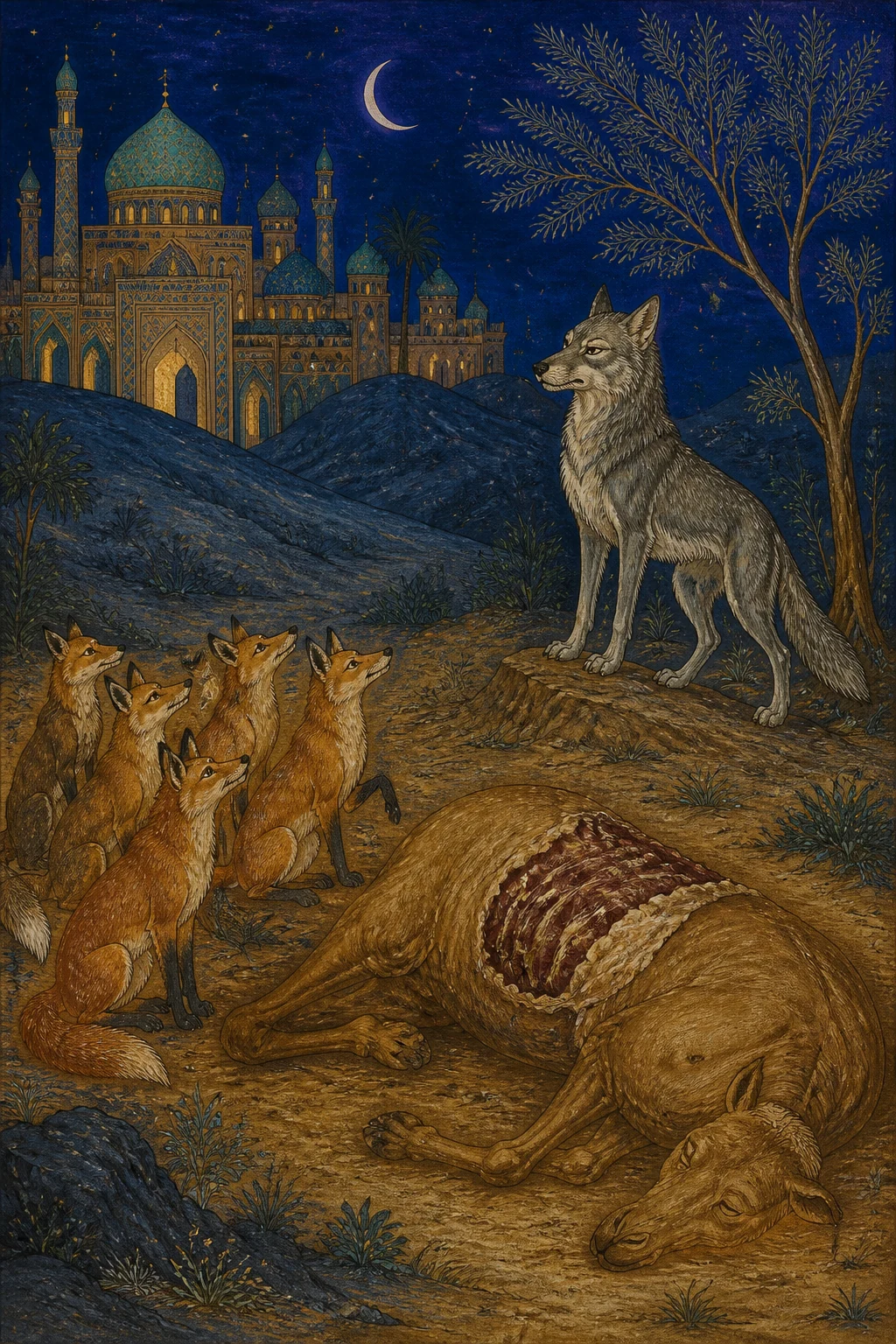
When morning came, the people assembled and went to the king’s door. They sat there for most of the day, until they despaired of his coming out. Then they returned to Shamas and said, “O wise philosopher, skilled and learned sage, do you not see that this ignorant boy does nothing but tell us more and more lies? Would it not be right to take the kingdom from him and put another in his place, so that our affairs may be put in order and our lives set straight? But go in to him a third time and tell him that nothing keeps us from rising against him and stripping him of his kingship except his father’s kindness to us and the pledges and covenants he took from us. Tomorrow we shall assemble, every last one of us, with our weapons, and break down the gate of this fortress. If he comes out and does as we wish, all will be well. Otherwise we shall enter, kill him, and place the kingdom in another’s hands.” The minister Shamas went in to the king and said, “O king, engrossed in your desires and amusements, what is this you are doing to yourself? Who, I wonder, is urging you to it? If you are bringing this upon yourself, then the virtue, wisdom, and eloquence we once knew in you have vanished. Would that I knew who has changed you, turning you from knowledge to ignorance, from faithfulness to estrangement, from gentleness to cruelty, and from heeding me to shunning me! How is it that I advise you three times and you will not accept my advice? I show you the right course, and you oppose my counsel! Tell me, what is this heedlessness, this idle indulgence? Who has enticed you into it? Know that the people of your kingdom have agreed to force their way in, kill you, and give your kingdom to someone else. Have you the strength to withstand them all and escape their hands? Can you restore your own life once they have killed you? If you have been granted all these powers and are safe from them, you have no need of my words. But if you desire this world and your kingship, rouse yourself and take firm hold of your kingdom. Show the people your strength and courage, and make your excuses known to them. They wish to wrest what you hold from your hands and deliver it to another. They have resolved upon rebellion and defiance, emboldened by what they know of your youth and your devotion to amusement and desire. Even stones that have lain long in water will strike fire when taken out and dashed against one another. Now your subjects are a great multitude. They are banding together against you and intend to transfer the kingship from you to someone else. They will achieve their purpose and bring about your destruction, and you will be like the fox and the wolf.” But morning overtook Shahrazad, and she fell silent, ceasing her permitted tale.