Prevod
1. On hearing this, Heracles came to Tiryns and carried out the commands of Eurystheus. First, Eurystheus ordered him to bring back the skin of the Nemean lion. This beast was invulnerable, an offspring of Typhon. On his way to hunt the lion, Heracles came to Cleonae, where he was entertained by a poor laborer named Molorchus. When his host wished to sacrifice an animal, Heracles told him to keep it until the thirtieth day: if he returned safely from the hunt, Molorchus was to sacrifice it to Zeus the Savior; but if he died, he was to offer it to him as to a hero. On reaching Nemea, Heracles tracked down the lion and first shot arrows at it. When he discovered that it was invulnerable, he raised his club and pursued it. The lion took refuge in a cave with two entrances. Heracles blocked up one entrance, went in after the beast through the other, and, throwing his arm around its neck, held it in a choking grip until he strangled it. Then he laid it on his shoulders and carried it to Cleonae. He found Molorchus on the last of the appointed days, about to offer the animal to him as to one dead. After sacrificing to Zeus the Savior, he brought the lion to Mycenae. Astonished at his courage, Eurystheus forbade him henceforth to enter the city and ordered him to display the fruits of his labors outside the gates. They say that in his fear he even had a bronze jar made for himself underground, in which he could hide, and that he issued his commands for the labors through the herald Copreus, son of Pelops the Elean. This man had killed Iphitus and fled to Mycenae, where Eurystheus purified him, and there he settled.
2. As his second labor, Eurystheus ordered him to kill the Lernaean hydra. Bred in the marsh of Lerna, it would come out onto the plain and ravage the livestock and the countryside. The hydra had an enormous body with nine heads, eight mortal and the middle one immortal. Heracles mounted a chariot, with Iolaus as his driver, and came to Lerna. There he halted the horses and found the hydra on a hill beside the springs of Amymone, where its lair was. By shooting flaming arrows at it, he forced it to come out, and as it emerged he seized and held it. But it coiled itself around one of his feet and clung to him. He battered its heads with his club, yet could make no progress, for whenever one head was struck off, two grew in its place. An enormous crab also came to the hydra’s aid and bit his foot. Heracles killed it and in turn called on Iolaus to help him. Iolaus set fire to part of the nearby woodland and used burning brands to sear the roots of the heads, preventing them from growing again. Having thus overcome the heads that kept springing up, Heracles cut off the immortal one, buried it, and laid a heavy rock over it beside the road that leads through Lerna to Elaeus. He then split open the hydra’s body and dipped his arrows in its gall. Eurystheus, however, said that this labor should not be counted among the ten, since Heracles had overcome the hydra not alone, but with the help of Iolaus.
3. As his third labor, Eurystheus ordered him to bring the Cerynitian hind alive to Mycenae. This hind lived at Oenoe, had golden horns, and was sacred to Artemis. Wishing neither to kill nor to wound it, Heracles pursued it for an entire year. At last, exhausted by the chase, the animal fled to the mountain called Artemisium, and from there to the river Ladon. As it was about to cross, Heracles shot it and captured it, then laid it on his shoulders and hurried through Arcadia.
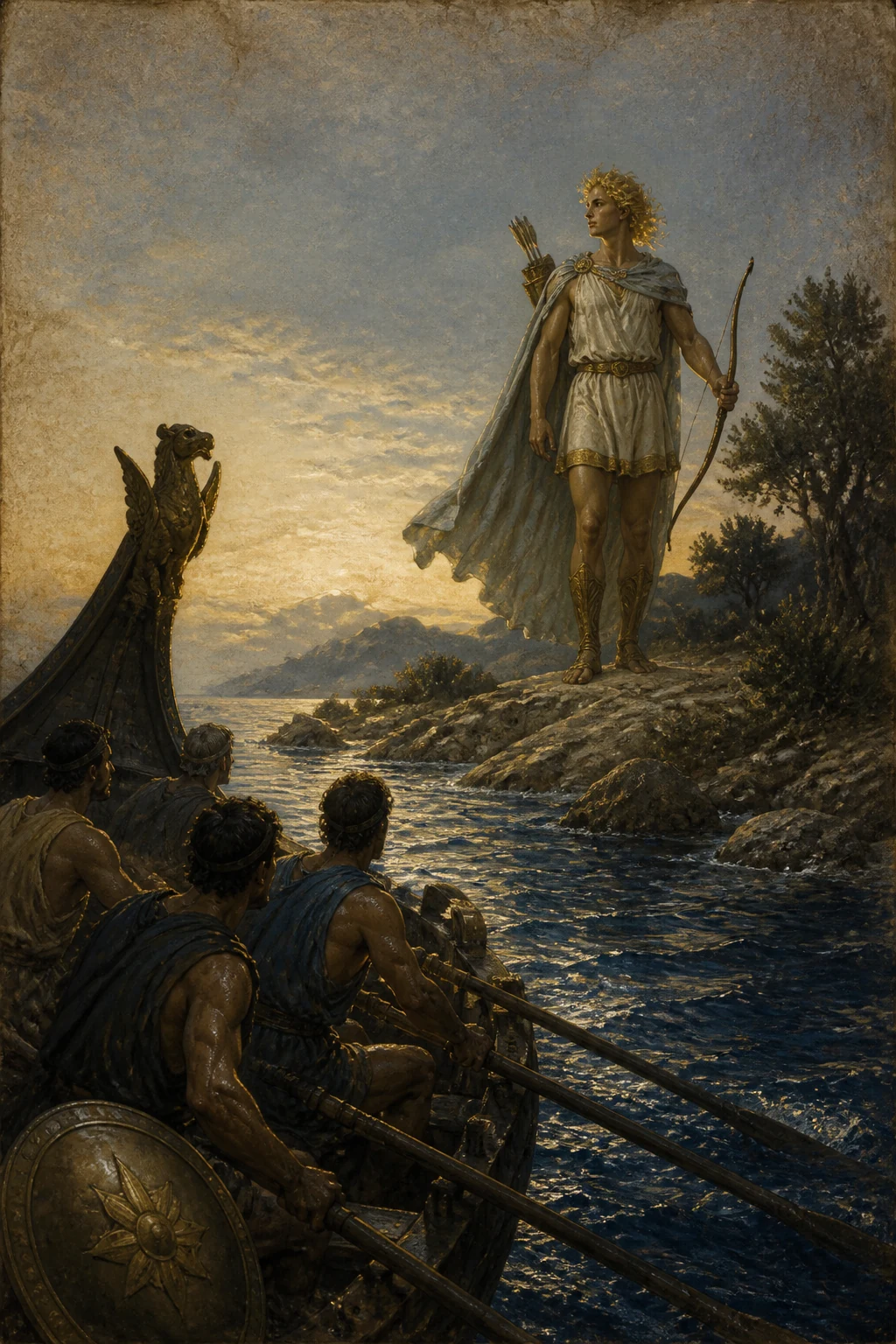
Artemis, accompanied by Apollo, met him and tried to take the hind from him, reproaching him for killing her sacred animal. But he pleaded necessity and explained that Eurystheus was responsible. Having thus soothed the goddess’s anger, he brought the beast alive to Mycenae.
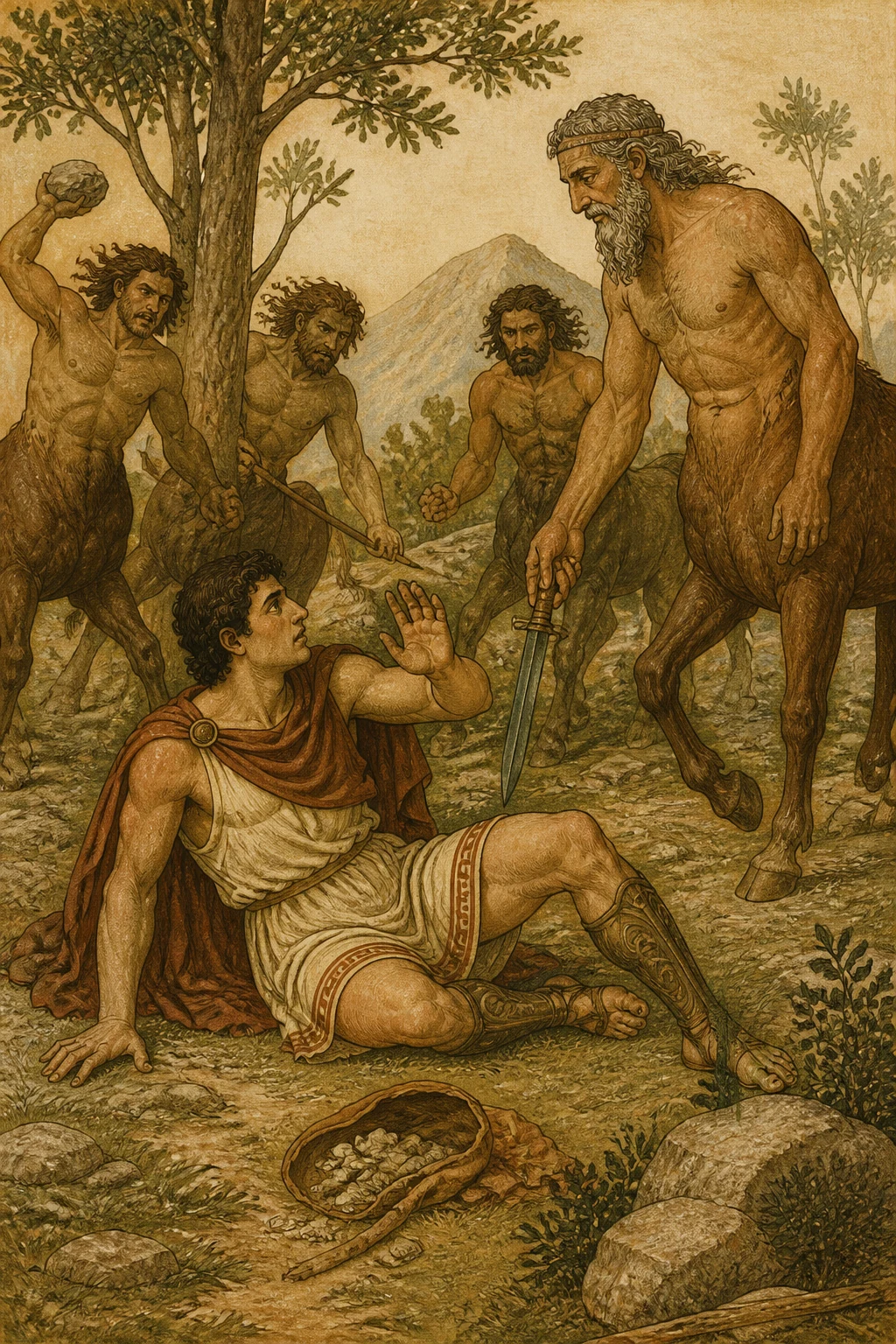
4. As his fourth labor, Eurystheus ordered him to bring back the Erymanthian boar alive. This beast ravaged Psophis, sallying out from the mountain called Erymanthus. While passing through Pholoe, Heracles was entertained by the centaur Pholus, the son of Silenus and an ash-tree nymph. Pholus served Heracles roasted meat, but ate his own raw. When Heracles asked for wine, Pholus said that he was afraid to open the jar that belonged to all the centaurs. Heracles encouraged him to take heart and opened it himself. Before long the centaurs caught the scent and came to Pholus’s cave, armed with rocks and fir trees. The first who ventured inside, Anchius and Agrius, Heracles drove back by hurling burning brands at them; the rest he pursued with his arrows as far as Malea. From there they fled to Chiron, who, after being driven from Mount Pelion by the Lapiths, had settled near Malea. As the centaurs crowded around him, Heracles shot an arrow that passed through the arm of Elatus and lodged in Chiron’s knee. Grieved, Heracles ran to him, drew out the arrow, and applied a remedy that Chiron gave him. But the wound was incurable, and Chiron withdrew to his cave. There he wished to die, but could not, since he was immortal. Only when Prometheus offered himself to Zeus to become immortal in his place was Chiron able to die. The remaining centaurs scattered in different directions: some came to Mount Malea, Eurytion to Pholoe, and Nessus to the river Evenus. Poseidon received the rest at Eleusis and concealed them beneath a mountain. Meanwhile, Pholus drew an arrow from a corpse and marveled that so small a thing could destroy creatures so great. But it slipped from his hand, fell onto his foot, and killed him instantly. Returning to Pholoe, Heracles saw that Pholus was dead and buried him. He then set out to hunt the boar. With loud cries he drove it from a thicket, forced the exhausted beast into deep snow, caught it in a noose, and brought it to Mycenae.
5. As his fifth labor, Eurystheus ordered him to clear away the dung of Augeas’s livestock in a single day. Augeas was king of Elis, said by some to be a son of Helios, by others of Poseidon, and by others of Phorbas. He owned many herds of livestock.
Heracles approached him and, without revealing Eurystheus’s command, offered to clear away the dung in one day if Augeas would give him a tenth of his livestock. Augeas, not believing it possible, agreed. Taking Augeas’s son Phyleus as a witness, Heracles broke through the foundations of the cattle yard and diverted the nearby rivers Alpheus and Peneus into it, making an outlet for the water through another opening. But when Augeas learned that the task had been performed at Eurystheus’s command, he refused to pay the reward. He even denied having promised payment and declared himself ready to submit the matter to judgment. When the judges had taken their seats, Heracles called Phyleus, who testified against his father, saying that he had agreed to pay him. Enraged, Augeas ordered both Phyleus and Heracles to leave Elis before the verdict could be delivered. Phyleus went to Dulichium and settled there, while Heracles came to Dexamenus at Olenus. He found his host about to be forced into betrothing his daughter Mnesimache to the centaur Eurytion. At Dexamenus’s appeal for help, Heracles killed Eurytion when he came for the bride. Eurystheus refused to count this labor among the ten either, saying that it had been performed for payment.
6. As his sixth labor, Eurystheus ordered him to drive away the Stymphalian birds. At Stymphalus, a city in Arcadia, there was a lake called Stymphalis, overshadowed by dense woodland. Countless birds had taken refuge there, fearing the attacks of wolves.
While Heracles was at a loss how to drive the birds out of the woods, Athena gave him bronze rattles that she had received from Hephaestus. He struck these on a mountain beside the lake and frightened the birds. Unable to endure the din, they flew up in terror, and in this way Heracles was able to shoot them.
7. As his seventh labor, Eurystheus ordered him to bring back the Cretan bull. Acusilaus says that this was the bull that carried Europa across the sea for Zeus; others say it was the one Poseidon sent up from the sea when Minos promised to sacrifice to him whatever appeared from its waters. They say that, on seeing the bull’s beauty, Minos sent it off to his herds and sacrificed another to Poseidon instead. Angered by this, the god made the bull savage. Heracles came to Crete in pursuit of it and asked Minos for help, but Minos told him to capture it by his own strength. Heracles caught it, brought it to Eurystheus, and showed it to him, then let it go free. The bull wandered to Sparta and throughout Arcadia, crossed the Isthmus, and came to Marathon in Attica, where it ravaged the country and harassed the inhabitants.
8. As his eighth labor, Eurystheus ordered him to bring the mares of Diomedes the Thracian to Mycenae. Diomedes was a son of Ares and Cyrene, and king of the Bistonians, a very warlike Thracian people. His mares ate human flesh. Heracles sailed with a company of volunteers, overpowered the men in charge of the mares’ stalls, and drove the animals down to the sea.
When the Bistonians came to the rescue in arms, he entrusted the mares to Abderus to guard. Abderus was a son of Hermes, a Locrian from Opus, and Heracles’ beloved; the mares dragged him away and killed him. Heracles fought the Bistonians, killed Diomedes, and forced the rest to flee. He founded the city of Abdera beside the tomb of the slain Abderus, then brought the mares to Eurystheus and gave them to him. Eurystheus released them, and they made their way to the mountain called Olympus, where they were killed by wild beasts.
9. As his ninth labor, Eurystheus ordered Heracles to bring back the belt of Hippolyte. She was queen of the Amazons, who lived beside the river Thermodon, a people mighty in war. They trained themselves in courage and combat, and whenever they bore children after intercourse, they reared the girls. They compressed their right breasts so that these would not hinder them in throwing the javelin, but left their left breasts intact so that they could nurse their children. Hippolyte possessed the belt of Ares as a token of her supremacy over them all. Heracles was sent to fetch this belt because Admete, the daughter of Eurystheus, wished to have it. Taking a band of volunteers as his companions in arms, he sailed in a single ship and put in at the island of Paros, where the sons of Minos—Eurymedon, Chryses, Nephalion, and Philolaus—lived. Two of the men aboard went ashore and were killed by the sons of Minos. Enraged at their deaths, Heracles killed the sons of Minos at once, then shut up the other inhabitants and besieged them. At last they sent envoys and begged him to take any two men he wished in place of those who had been killed. He lifted the siege, took Alcaeus and Sthenelus, the sons of Minos’s son Androgeus, and came to Mysia, to Lycus the son of Dascylus. While he was being entertained there, an attack was made by the king of the Bebryces. Heracles came to Lycus’s aid and killed many of them, including their king Mygdon, the brother of Amycus.
He cut off a large tract of the Bebryces’ land and gave it to Lycus, who named the whole territory Heraclea. When Heracles sailed into the harbor at Themiscyra, Hippolyte came to him, asked why he had come, and promised to give him the belt. But Hera assumed the likeness of an Amazon and went among the crowd, saying that the strangers who had arrived were carrying off their queen. The Amazons mounted their horses and charged down to the ship in arms. When Heracles saw them armed for battle, he thought it was a trap. He killed Hippolyte and took her belt, then fought the rest and sailed away, putting in at Troy. At that time the city was suffering under the wrath of Apollo and Poseidon.
For Apollo and Poseidon, wishing to put Laomedon’s arrogance to the test, had assumed human form and undertaken to fortify Pergamum for a wage. But when they had built the walls, he would not pay them. Apollo therefore sent a plague, and Poseidon a sea monster, which was carried inland by the rising tide and snatched up the people on the plain.
Oracles declared that the calamities would end if Laomedon exposed his daughter Hesione as food for the monster, so he bound her to the rocks beside the sea and left her there. Seeing her exposed, Heracles promised to save her if Laomedon would give him the mares Zeus had given as compensation for the abduction of Ganymede. Laomedon agreed, and Heracles killed the monster and rescued Hesione. But when Laomedon refused to pay the reward, Heracles threatened to make war on Troy and sailed away. He put in at Aenus, where Poltys entertained him. As he sailed from there, he shot and killed Sarpedon on the shore of Aenus, for he was a violent man. Sarpedon was a son of Poseidon and a brother of Poltys. Heracles then came to Thasos, subdued the Thracians who lived there, and gave the island to the sons of Androgeus to settle. From Thasos he sailed to Torone, where Polygonus and Telegonus, the sons of Poseidon’s son Proteus, challenged him to wrestle; he killed them in the contest. He then brought the belt to Mycenae and gave it to Eurystheus.
10. His tenth appointed labor was to bring the cattle of Geryon from Erytheia. Erytheia was an island lying near Ocean, now called Gadeira. It was inhabited by Geryon, the son of Chrysaor and Ocean’s daughter Callirrhoe. He had the joined bodies of three men, united into one at the belly, but divided into three from the flanks and thighs. He owned red cattle, whose herdsman was Eurytion and whose guardian was Orthus, a two-headed dog born of Echidna and Typhon. Traveling through Europe in pursuit of Geryon’s cattle, Heracles killed many wild beasts and entered Libya. Passing through Tartessus, he set up two pillars facing one another at the boundaries of Europe and Libya, as monuments to his journey. Scorched by Helios along the way, he drew his bow against the god. Admiring his courage, Helios gave him a golden cup, in which he crossed Ocean. On reaching Erytheia, he camped on Mount Abas. The dog became aware of him and rushed at him, but Heracles struck it with his club and killed the herdsman Eurytion when he came to its aid. Menoetes, who was pasturing the cattle of Hades there, told Geryon what had happened.
Geryon overtook Heracles beside the river Anthemus as he was driving away the cattle. He joined battle with him, but was shot dead. Heracles put the cattle into the cup, sailed across to Tartessus, and returned the cup to Helios. Passing through Abderia, he came to Liguria, where Ialebion and Dercynus, sons of Poseidon, tried to rob him of the cattle. He killed them and traveled on through Tyrrhenia. At Rhegium one bull broke away, plunged swiftly into the sea, and swam across to Sicily. After passing through the neighboring country, which was called Italy after it—for the Tyrrhenians called a bull “italus”—it reached the plain of Eryx, king of the Elymians. Eryx was a son of Poseidon, and he mingled the bull with his own herds. Entrusting the cattle to Hephaestus, Heracles hurried off in search of it. He found it among Eryx’s herds, but Eryx said he would not give it up unless Heracles defeated him in wrestling. Heracles threw him three times and killed him in the contest. Taking the bull, he drove it with the rest toward the Ionian Sea. When he reached the head of the gulf, Hera sent a gadfly upon the cattle, and they scattered among the foothills of Thrace. Heracles pursued them, caught some, and drove them to the Hellespont, but those left behind remained wild thereafter. Having gathered the cattle together only with great difficulty, he blamed the river Strymon and filled its channel with rocks, making it unnavigable, though it had formerly been navigable. He then brought the cattle to Eurystheus and gave them to him. Eurystheus sacrificed them to Hera.
11. The labors were completed in eight years and one month. But since Eurystheus refused to accept either the labor involving Augeas’s livestock or the one involving the hydra, he appointed an eleventh: to bring back the golden apples of the Hesperides. These were not in Libya, as some have said, but on Atlas among the Hyperboreans. Earth had given them to Zeus when he married Hera.
They were guarded by an immortal dragon, an offspring of Typhon and Echidna, with a hundred heads and voices of every kind. The Hesperides—Aegle, Erytheia, Hesperia, and Arethusa—kept watch over them as well. On his journey, Heracles came to the river Echedorus. There Cycnus, the son of Ares and Pyrene, challenged him to single combat. Ares took up his son’s cause and engaged in the duel, but a thunderbolt fell between the two and broke off the fight. Heracles then traveled through Illyria and hurried toward the river Eridanus, where he came to the nymphs, daughters of Zeus and Themis. They directed him to Nereus. He seized Nereus as he slept and bound him, though he changed into all manner of shapes, and would not release him until he learned where the apples and the Hesperides were. Having learned this, he traveled through Libya.
Its king was Antaeus, a son of Poseidon, who forced strangers to wrestle with him and killed them. Compelled to wrestle with him, Heracles caught him in his arms, lifted him off the ground, and crushed him to death. For whenever Antaeus touched the earth, he grew stronger, which is why some said that he was a son of Earth. After Libya, Heracles traveled through Egypt. Its king was Busiris, a son of Poseidon and Lysianassa, the daughter of Epaphus.
Busiris sacrificed strangers on an altar of Zeus in obedience to an oracle. For Egypt had suffered nine years of barrenness, and Phrasius, a seer who came from Cyprus, declared that the barrenness would end if they slaughtered a foreign man to Zeus every year. Busiris began by slaughtering the seer himself, and afterward slaughtered the strangers who arrived in his country. Heracles too was seized and brought to the altars, but he burst his bonds and killed both Busiris and his son Amphidamas. Traveling through Asia, he put in at Thermydrae, a harbor of the Lindians. There he unyoked one of the bulls from a drover’s wagon, sacrificed it, and feasted on it. Unable to defend himself, the drover stood on a mountain and cursed him. That is why, even now, sacrifices to Heracles there are accompanied by curses. Passing through Arabia, Heracles killed Emathion, the son of Tithonus. He then traveled through Libya to the outer sea and received the cup from Helios. Crossing to the opposite continent, he shot the eagle on the Caucasus that was devouring Prometheus’s liver, an offspring of Echidna and Typhon. He freed Prometheus, choosing a bond of olive in place of his chains, and offered Zeus Chiron, who was immortal but willing to die in Prometheus’s stead. When he came to Atlas among the Hyperboreans, he followed the advice of Prometheus, who had told him not to go after the apples himself, but to take over the heavens from Atlas and send him instead. Atlas plucked three apples from the Hesperides and brought them to Heracles. Unwilling to hold the heavens any longer, Heracles said that he wished to make a pad for his head. On hearing this, Atlas laid the apples on the ground and took over the heavens. Heracles thus picked up the apples and departed. Some, however, say that he did not receive them from Atlas, but plucked them himself after killing the serpent that guarded them. He brought the apples to Eurystheus and gave them to him. Eurystheus accepted them and then presented them to Heracles, from whom Athena received them and carried them back, for it was not lawful for them to be left anywhere else.
12. His twelfth appointed labor was to bring Cerberus from Hades. Cerberus had three dogs’ heads, the tail of a dragon, and heads of all kinds of snakes along his back.
Before setting out to fetch him, Heracles came to Eumolpus at Eleusis, wishing to be initiated into the mysteries. At that time foreigners were not permitted to be initiated, so he became the adopted son of Pylius and underwent initiation. But since he could not behold the mysteries without first being purified of the killing of the centaurs, Eumolpus purified him, and only then was he initiated. He came to Taenarum in Laconia, where the entrance to the descent into Hades lies, and went down through it. When the souls saw him, they fled, except for Meleager and Medusa the Gorgon. He drew his sword against the Gorgon as though she were alive, but learned from Hermes that she was only an empty shade. Near the gates of Hades he found Theseus and Pirithous, who had sought Persephone’s hand in marriage and had been bound there for that reason. When they saw Heracles, they stretched out their hands, hoping that his strength would raise them up. He took Theseus by the hand and lifted him, but when he tried to raise Pirithous, the earth shook, and he let him go.
He also rolled away the stone that lay upon Ascalaphus. Wishing to provide blood for the souls, he slaughtered one of Hades’ cattle. Their herdsman, Menoetes the son of Ceuthonymus, challenged Heracles to wrestle. Heracles caught him around the waist and broke his ribs, but spared him at Persephone’s request. When Heracles asked Pluto for Cerberus, Pluto told him that he could take the creature if he mastered it without using the weapons he carried. Finding Cerberus at the gates of Acheron, Heracles, protected by his breastplate and wrapped in the lion’s skin, threw his arms around its head. Though bitten by the dragon in its tail, he maintained his grip and choked the beast until it yielded. Having captured it, he returned to the upper world by way of Troezen. Demeter then turned Ascalaphus into a screech owl, while Heracles, after showing Cerberus to Eurystheus, carried him back to Hades.