Prevod
Now when each company had formed its ranks beside its leaders, the Trojans advanced with cries and clamor like birds, like the clamor of cranes rising before the face of heaven. When they have fled the winter and its endless rain, they fly with clamorous cries toward the streams of Ocean, bringing slaughter and death to the Pygmy men, and at dawn they open their deadly battle.
But the Achaeans came on in silence, breathing fury, their hearts intent on defending one another. As when the South Wind pours mist over the mountain peaks, unwelcome to shepherds but better than night to a thief, and a man can see no farther than he can throw a stone, so a whirling cloud of dust rose beneath their feet as they marched. Swiftly they crossed the plain.
When the armies had drawn near, advancing toward each other, godlike Alexandros stepped out before the Trojans, a leopard skin over his shoulders, with a curved bow and a sword. Brandishing two bronze-tipped spears, he challenged all the best of the Argives to meet him face to face in deadly combat.
When Menelaos, dear to Ares, saw him striding out before the ranks, he rejoiced as a hungry lion rejoices when he comes upon a great carcass, a horned stag or a wild goat. Eagerly he devours it, though swift dogs and vigorous young men rush at him. So Menelaos rejoiced at the sight of godlike Alexandros, thinking he would punish the wrongdoer. At once he leapt from his chariot to the ground in all his armor.
But when godlike Alexandros saw him appear among the foremost fighters, his heart was struck with terror, and he shrank back into the mass of his companions, avoiding death. As a man who sees a snake in a mountain hollow springs backward, trembling in every limb, and retreats with pallor on his cheeks, so godlike Alexandros slipped back into the throng of the proud Trojans, afraid of the son of Atreus.
Hector saw him and rebuked him with bitter words: “Accursed Paris, splendid to look at, woman-mad deceiver! If only you had never been born, or had died unwed! That is what I would wish; far better that than to be such a disgrace, an object of contempt to others.
“Surely the long-haired Achaeans are laughing aloud. They thought you a champion and a prince because you are handsome, but there is no strength in your heart, no courage. Was it such a man as you who gathered faithful companions, sailed the sea in seagoing ships, mingled with strangers, and carried off a beautiful woman from a distant land, a bride from a race of spearmen—a great affliction to your father, your city, and all its people, a joy to your enemies and a humiliation to yourself?
“Will you not stand your ground against Menelaos, dear to Ares? Then you would learn what sort of man it is whose lovely wife you have. Your lyre would not help you then, nor Aphrodite’s gifts, your hair or your beauty, when you lay in the dust.
“But the Trojans are far too timid. Otherwise you would already be wearing a tunic of stone for all the evil you have done.” Then godlike Alexandros answered him: “Hector, your rebuke is just, and does not go beyond justice. Your heart is always unyielding as an axe that bites through timber in the hands of a craftsman cutting ship’s planking, lending force to the man’s stroke. Just so fearless is the spirit in your breast. But do not reproach me with the lovely gifts of golden Aphrodite. The glorious gifts the gods themselves bestow are not to be cast aside; no man could win them by his own desire. Now, if you wish me to fight and do battle, make the other Trojans and all the Achaeans sit down, and bring me and Menelaos, dear to Ares, together between the armies to fight for Helen and all her possessions. Whichever of us wins and proves the stronger, let him take all the possessions and lead the woman home. Let the rest seal friendship with solemn oaths: you may dwell in fertile Troy, while they return to horse-pasturing Argos and Achaea, land of lovely women.”
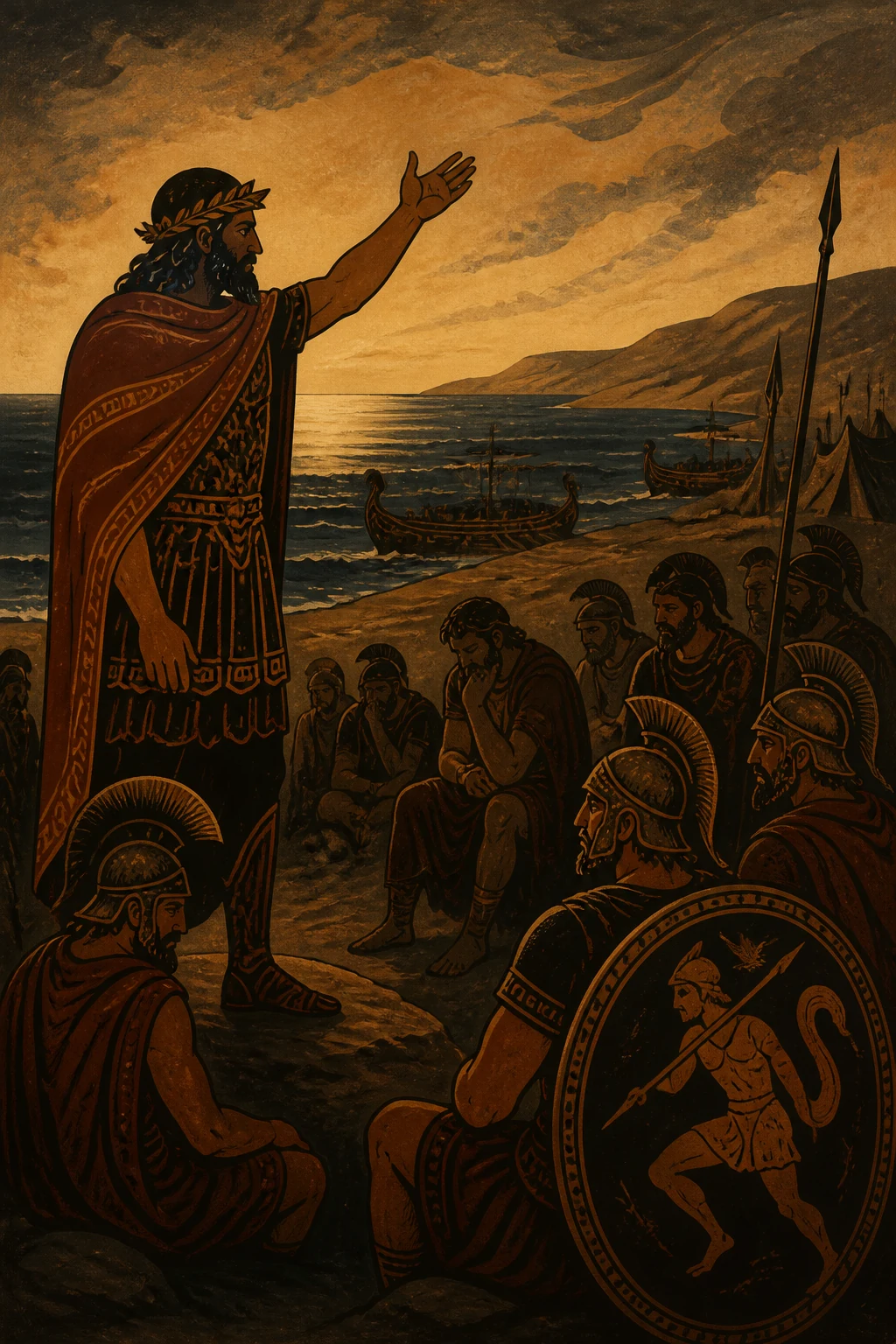
So he spoke, and Hector rejoiced greatly to hear his words. He went out between the armies and held back the Trojan ranks, grasping his spear by the middle; and they all halted. But the long-haired Achaeans aimed their bows at him, preparing to shoot, and pelted him with stones. Then Agamemnon, lord of men, shouted aloud: “Hold, Argives! Do not shoot, sons of the Achaeans! Hector of the flashing helmet means to speak.”
So he spoke, and they quickly ceased fighting and fell silent. Hector addressed both armies: “Hear from me, Trojans and well-greaved Achaeans, the proposal of Alexandros, on whose account this quarrel arose.
“He asks the other Trojans and all the Achaeans to lay their splendid arms upon the earth that feeds us all, while he and Menelaos, dear to Ares, fight alone between the armies for Helen and all her possessions.
“Whichever wins and proves the stronger, let him take all the possessions and lead the woman home. Let the rest of us seal friendship with solemn oaths.” So he spoke, and all remained silent and still. Then Menelaos of the mighty war cry addressed them: “Now hear me too, for it is my heart that feels the deepest pain. I think the time has come for Argives and Trojans to part, since you have suffered so much through my quarrel and the wrong Alexandros first committed. Whichever of us is destined to meet death, let him die; but let the rest of you part at once.
“Bring two lambs, a white male and a black female, for the Sun and Earth, and we will bring another for Zeus. Bring mighty Priam here to swear the oaths himself, since his sons are arrogant and faithless, so that no one may violate the oaths of Zeus through lawless transgression.
“Younger men’s minds are always flighty, but when an old man is among them, he looks both before and after, seeking what will be best for both sides.” So he spoke, and Achaeans and Trojans rejoiced, hoping for an end to the misery of war.
They drew up their horses in ranks, climbed down from their chariots, and stripped off their armor. They laid it on the ground, close together, with only a little space between the armies. Hector sent two heralds swiftly to the city to fetch the lambs and summon Priam. Lord Agamemnon sent Talthybios to the hollow ships with orders to bring a lamb, and he obeyed noble Agamemnon.
Meanwhile Iris came as a messenger to white-armed Helen, taking the likeness of her sister-in-law, the wife of Antenor’s son: Laodike, loveliest of Priam’s daughters, whom lord Helikaon, son of Antenor, had married.
She found Helen in the hall, weaving a great web, a double-folded purple cloth. Into it she was working the many struggles of the horse-taming Trojans and the bronze-clad Achaeans, the sufferings they endured for her sake at the hands of Ares. Swift-footed Iris stood beside her and said: “Come, dear bride, and see the wondrous doings of the horse-taming Trojans and the bronze-clad Achaeans. A little while ago they were bringing tearful war against one another on the plain, eager for deadly battle. Now they sit in silence; the fighting has ceased. They lean against their shields, and their long spears stand planted beside them.
“Alexandros and Menelaos, dear to Ares, will fight with long spears for you, and you shall be called the beloved wife of the victor.” With these words the goddess filled her heart with sweet longing for her former husband, her city, and her parents. At once she veiled herself in shining white linen and hurried from her chamber, shedding tender tears. She did not go alone: two handmaids followed her, Aithra, daughter of Pittheus, and wide-eyed Klymene. Soon they reached the Skaian Gates.
There, around Priam, sat the elders of the people: Panthoos and Thymoites, Lampos and Klytios, Hiketaon, a scion of Ares, and the two wise men, Oukalegon and Antenor. Old age had ended their fighting, but they were fine speakers still, like cicadas perched on trees in the woods, pouring out their delicate voices. Such were the Trojan leaders seated on the tower.
When they saw Helen approaching the tower, they spoke softly to one another in winged words: “No wonder the Trojans and the well-greaved Achaeans have suffered so long for such a woman. Her face is terribly like that of the immortal goddesses. Yet even so, beautiful as she is, let her sail home in the ships and not remain to bring grief upon us and our children after us.”
So they spoke, but Priam called aloud to Helen: “Come here, dear child, and sit before me, so that you may see your former husband, your kinsmen, and your friends. I do not hold you to blame; it is the gods I blame, who have brought this tearful war of the Achaeans upon me. And tell me the name of that towering man over there. Who is that tall and splendid Achaean?
“Others stand taller by a head, but never have my eyes seen a man so handsome or so majestic. He looks a king.” Helen, radiant among women, answered him: “Dear father of my husband, I revere you and stand in awe of you. If only bitter death had pleased me when I followed your son here, leaving my marriage chamber, my kin, my darling daughter, and the lovely companions of my youth.
“But that did not happen, and so I waste away in tears. Yet I will tell you what you ask and wish to know. That is the son of Atreus, wide-ruling Agamemnon, both a good king and a mighty spearman. He was once my brother-in-law—shameless creature that I am—if that life was ever real.”
So she spoke, and the old man gazed at him in wonder and said: “Blessed son of Atreus, born to good fortune, favored by fate! How many young Achaeans serve beneath your rule! Once I went to Phrygia, rich in vines, and there I saw great numbers of Phrygian warriors with their swift horses, the men of Otreus and godlike Mygdon, encamped along the banks of the Sangarios. I too was numbered among their allies on the day when the Amazons, a match for men, came against them. Yet even they were not so many as these bright-eyed Achaeans.”
Next the old man caught sight of Odysseus and asked: “Come, dear child, tell me who that man is too. He is shorter by a head than Agamemnon, son of Atreus, but broader in the shoulders and chest.
“His armor lies on the earth that feeds us all, while he moves through the ranks of men like a ram. I would liken him to a thick-fleeced ram making his way through a great flock of white sheep.”
Helen, daughter of Zeus, answered him: “That is Laertes’ son, Odysseus of the many wiles, who grew up in the land of Ithaka, rocky though it is. He knows every sort of trick and subtle counsel.”
Then wise Antenor answered her: “Lady, what you have said is true indeed. Once before noble Odysseus came here on an embassy concerning you, together with Menelaos, dear to Ares. I received them as guests and entertained them in my halls, and learned the stature and shrewd intelligence of both.
“When they came among the assembled Trojans, Menelaos, as they stood, overtopped him with his broad shoulders; but when both were seated, Odysseus was the more majestic. When they began weaving their speeches and counsels before us all, Menelaos spoke fluently, in few words but very clearly, for he was neither long-winded nor wide of the mark. He was also the younger man.
“But when Odysseus of the many wiles rose to speak, he stood with his eyes lowered, fixed upon the ground. He did not move his staff backward or forward, but held it motionless, like a man who had no skill in speaking. You might have thought him sullen or simply a fool.
“Yet when he sent his great voice out from his chest, and words like winter snowflakes, no mortal could compete with Odysseus. Then we no longer wondered at his looks as we had before.”
Third, the old man saw Ajax and asked: “Who is that other Achaean, so tall and splendid, towering above the Argives with his head and broad shoulders?” Helen in her flowing robe, radiant among women, answered: “That is mighty Ajax, the bulwark of the Achaeans. And over there among the Cretans stands Idomeneus like a god, with the Cretan leaders gathered around him.
“Often Menelaos, dear to Ares, entertained him in our house when he came from Crete. Now I can see all the other bright-eyed Achaeans, whom I could recognize and name. But there are two leaders of the host I cannot see: Kastor, tamer of horses, and Polydeukes, the skilled boxer, my own brothers, born of the same mother as I.
“Either they did not come from lovely Lakedaimon, or they did follow here in their seagoing ships, but now are unwilling to enter the battle of men, fearing the shame and the many reproaches that are mine.”
So she spoke, but already the life-giving earth held them fast in Lakedaimon, there in their beloved native land. Meanwhile the heralds carried through the city the offerings for the gods’ solemn oaths: two lambs and cheering wine, the fruit of the earth, in a goatskin bag. The herald Idaios carried a gleaming mixing bowl and golden cups. He stood beside the old man and urged him: “Rise, son of Laomedon. The leaders of the horse-taming Trojans and the bronze-clad Achaeans summon you down to the plain, to seal the solemn oaths. Alexandros and Menelaos, dear to Ares, will fight with long spears for the woman. The woman and her possessions shall go with the victor. The rest of us will seal friendship with solemn oaths and dwell in fertile Troy, while they return to horse-pasturing Argos and Achaea, land of lovely women.”
So he spoke, and the old man shuddered. He ordered his companions to harness the horses, and they obeyed at once. Priam climbed into the chariot and drew the reins back toward him. Antenor mounted the splendid chariot beside him, and they drove their swift horses through the Skaian Gates toward the plain.
When they reached the Trojans and Achaeans, they stepped down from the chariot onto the earth that feeds us all and walked into the space between the armies. At once Agamemnon, lord of men, rose, and with him Odysseus of the many wiles. The noble heralds gathered the offerings for the gods’ solemn oaths, mixed the wine in the bowl, and poured water over the kings’ hands.
The son of Atreus drew the knife that always hung beside the great sheath of his sword and cut hair from the lambs’ heads. Then the heralds distributed it among the leaders of the Trojans and Achaeans.
Raising his hands, the son of Atreus prayed aloud before them: “Father Zeus, ruling from Ida, most glorious and greatest; and you, Sun, who see all and hear all; and rivers and Earth; and you who beneath the earth punish the dead whenever any man has sworn falsely: be our witnesses and guard these solemn oaths. If Alexandros kills Menelaos, then let him keep Helen and all her possessions, while we return in our seagoing ships. But if fair-haired Menelaos kills Alexandros, then let the Trojans give back Helen and all her possessions, and pay the Argives such compensation as is fitting, an amount that shall be remembered among generations yet to come.
“But if Priam and Priam’s sons refuse to pay me compensation when Alexandros has fallen, then I will remain here and fight for the payment until I bring the war to its end.”
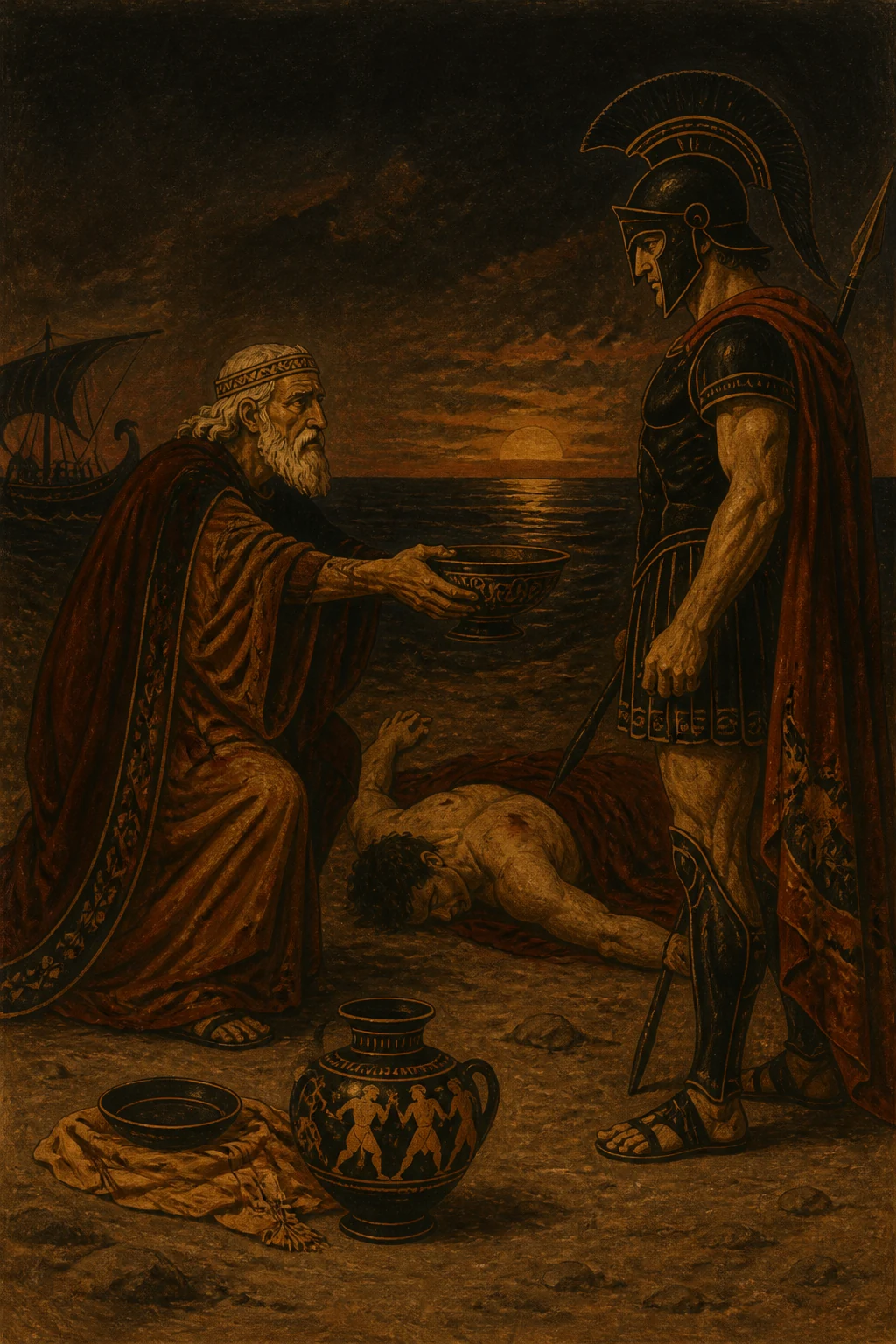
He spoke, and cut the lambs’ throats with the pitiless bronze. He laid them on the ground, gasping, their life ebbing away, for the bronze had taken their strength. Then they drew wine from the mixing bowl into cups and poured it out, praying to the everlasting gods.
And among both Achaeans and Trojans men spoke these words: “Zeus, most glorious and greatest, and all you other immortal gods: whichever side first breaks the oaths, may their brains be spilled upon the ground like this wine, theirs and their children’s, and may their wives be taken by other men.”
So they prayed, but the son of Kronos did not yet grant their prayer. Then Priam, descendant of Dardanos, addressed them: “Hear me, Trojans and well-greaved Achaeans. I will return now to windy Ilion, for I cannot bear to watch with my own eyes my beloved son fighting Menelaos, dear to Ares. Zeus and the other immortal gods alone know for which of them death is destined.”
So spoke the godlike man. He placed the lambs in the chariot, climbed in himself, and drew the reins back toward him. Antenor mounted the splendid chariot beside him, and the two set off back to Ilion. Then Hector, Priam’s son, and noble Odysseus first measured out the ground, and afterward took lots and shook them in a bronze helmet, to decide which man should cast his bronze spear first.
The people prayed and raised their hands to the gods, and among both Achaeans and Trojans men spoke these words: “Father Zeus, ruling from Ida, most glorious and greatest, whichever of these two has brought this trouble on both peoples, grant that he may die and enter the house of Hades, while friendship and solemn oaths are established between us.”
So they prayed, and great Hector of the flashing helmet shook the lots, turning his eyes away. At once the lot of Paris sprang out. Then the men sat down in their ranks, each where his high-stepping horses and richly wrought armor stood. Meanwhile noble Alexandros, husband of lovely-haired Helen, put on his splendid armor.
First he fitted fine greaves around his shins, fastened with silver clasps at the ankles. Next he put on the breastplate of his brother Lykaon, and it fitted him.
Over his shoulders he slung his bronze sword, studded with silver, and then his great, sturdy shield. On his strong head he set a well-wrought helmet with a horsehair plume, and the crest nodded fearfully above it. He took up a stout spear that fitted his grip.
In the same way warlike Menelaos armed himself. When each had put on his armor on his own side of the host, they strode into the space between the Trojans and Achaeans, glaring fiercely. Awe seized the horse-taming Trojans and the well-greaved Achaeans as they watched.
They drew near and took their stand within the measured ground, shaking their spears at each other in anger. Alexandros was first to cast his long-shadowed spear. It struck the son of Atreus’ round shield, but the bronze did not break through: its point bent back against the sturdy shield. Then Menelaos, son of Atreus, advanced in his turn with the bronze, praying to Father Zeus: “Lord Zeus, grant me vengeance on noble Alexandros, who first wronged me, and bring him down beneath my hands, so that even among men yet unborn a man may shudder to harm the host who has received him with friendship.”
He spoke, poised his long-shadowed spear, and hurled it. It struck the round shield of Priam’s son. The heavy spear passed through the gleaming shield and drove through the richly wrought breastplate. Straight on beside his flank it sliced through his tunic; but he swerved and escaped black death.
The son of Atreus drew his silver-studded sword, raised it, and struck the ridge of the helmet. But the blade shattered upon it into three or four pieces and fell from his hand. Looking up into the broad sky, the son of Atreus cried out in anguish: “Father Zeus, no other god is more cruel than you! I thought I would punish Alexandros for his wickedness, but now my sword has broken in my hands, and my spear has flown from my grasp in vain. I have not struck him down.”
He spoke and sprang forward, seizing the horsehair-crested helmet. Turning, he dragged him toward the well-greaved Achaeans. The richly embroidered strap that ran beneath his chin to hold the helmet fast was choking his tender throat.
And he would have dragged him away and won unspeakable glory, had not Aphrodite, daughter of Zeus, been quick to see. She snapped the strap, made from the hide of a slaughtered ox, and the empty helmet came away in his powerful hand.
The warrior swung it around and flung it among the well-greaved Achaeans, where his faithful companions picked it up. Then he rushed back, eager to kill his enemy with his bronze spear. But Aphrodite snatched Alexandros away, as easily as a goddess may, wrapped him in a thick mist, and set him down in his fragrant, incense-scented chamber.
Then she herself went to summon Helen. She found her on the high tower, surrounded by a crowd of Trojan women. Taking hold of her nectar-scented robe, she tugged at it and spoke in the likeness of an aged woman, a wool-worker who used to prepare fine wool for Helen when she lived in Lakedaimon, and whom she loved dearly. In her likeness divine Aphrodite said: “Come here. Alexandros calls you to return home.
“There he is in his chamber, on his richly turned bed, radiant in his beauty and his clothes. You would not think he had come from fighting a man, but that he was going to a dance, or had just left the dance and sat down.”
So she spoke, stirring Helen’s heart within her breast. But when Helen noticed the goddess’s lovely neck, her desirable breasts, and her flashing eyes, she was astonished, and spoke to her by name: “Strange goddess, why are you so eager to deceive me?
“Will you carry me farther still, to some populous city in Phrygia or lovely Maionia, if there too you have some favorite among mortal men? Now that Menelaos has defeated noble Alexandros and means to take hateful me back home, is that why you have come here with your treacherous designs?
“Go and sit beside him yourself. Abandon the paths of the gods, and never turn your feet back toward Olympos. Stay with him forever, fretting over him and guarding him, until he makes you his wife—or his slave.
“I will not go there to tend his bed. That would be shameful. All the Trojan women would reproach me afterward, and I have sorrows without end within my heart.” Then divine Aphrodite answered in anger: “Do not provoke me, wretched woman, lest in my anger I abandon you and hate you as fiercely as I have loved you until now. I will contrive bitter hatred between both peoples, Trojans and Danaans alike, and you will perish by an evil fate.”
So she spoke, and Helen, daughter of Zeus, was afraid. She wrapped herself in her shining white robe and went in silence, unnoticed by all the Trojan women, and the goddess led the way. When they reached the beautiful house of Alexandros, the handmaids quickly turned to their work, while Helen, radiant among women, went into the high-roofed chamber.
Then laughter-loving Aphrodite took a chair and carried it over, setting it before Alexandros. Helen, daughter of Zeus who bears the aegis, sat down, turning her eyes aside, and rebuked her husband: “So you have come back from battle. I wish you had died there, brought down by the mighty man who was once my husband.
“Before this you used to boast that you surpassed Menelaos, dear to Ares, in strength, in skill of hand, and with the spear. Go now and challenge him to fight you face to face again. Yet no, I urge you to stop: do not foolishly wage war and fight against fair-haired Menelaos, or you may soon fall beneath his spear.”
Paris answered her: “Wife, do not lash my heart with bitter reproaches. This time Menelaos has won with Athena’s help; another time I shall defeat him. We too have gods on our side.
“But come, let us lie down together and turn to love. Never before has desire so overwhelmed my heart, not even when I first carried you off from lovely Lakedaimon and sailed away in the seagoing ships, and on the island of Kranae lay with you in love. That was nothing to the love I feel for you now, and the sweet longing that possesses me.”
He spoke and led the way to bed, and his wife followed him. So they lay down together on the latticed bed, while the son of Atreus ranged through the host like a wild beast, looking for some glimpse of godlike Alexandros.
But none of the Trojans or their renowned allies could show Alexandros to Menelaos, dear to Ares. Nor would they have hidden him out of love, if any had seen him, for all hated him as they hated black death.
Then Agamemnon, lord of men, addressed them: “Hear me, Trojans, Dardanians, and allies. The victory clearly belongs to Menelaos, dear to Ares. Give back Argive Helen and her possessions with her, and pay such compensation as is fitting, an amount that shall be remembered among generations yet to come.”
So spoke the son of Atreus, and the other Achaeans shouted their assent.