Prevod
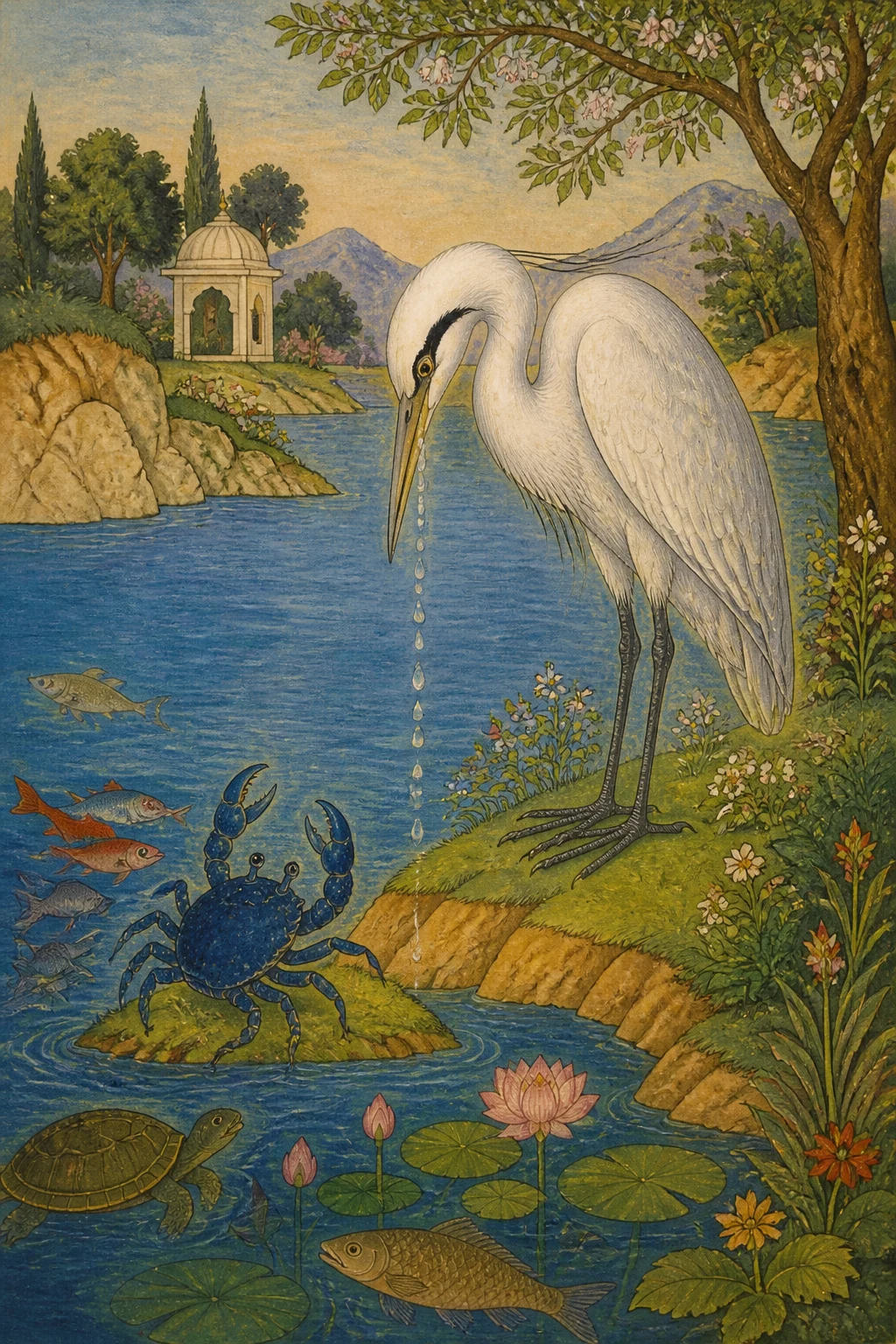
The lapwing asked, “How was that?” His wife replied: Tale 13. The Tortoise Named Kambugrīva. In a certain lake lived a tortoise named Kambugrīva. He had two dear friends, a pair of geese named Saṅkaṭa and Vikaṭa, who were devoted to him. Every day they would come to the lakeshore and spend their time with him telling stories of divine sages and great seers, returning to their nests at sunset. As time passed, however, a drought gradually dried up the lake. Distressed by their friend’s plight, the two geese said, “Dear friend, this lake has become nothing but mud. Our hearts are troubled at the thought of what will become of you.” Hearing this, Kambugrīva replied, “My friends, without water we cannot survive here now. Still, let us think of some way out. For it is said: Never abandon courage, even in adversity;
through courage a man may yet find deliverance.
Even when his ship is wrecked at sea,
the voyager still hopes to swim ashore.
And again:
A wise man always strives for friends and kinsmen
when troubles arise: this is the counsel Manu gave.
“So bring a stout rope or a light stick, and find a lake with plenty of water. I shall grip the middle of the stick with my teeth, and you two can take hold of its ends and carry me along with it to that lake.”
The two replied, “Dear friend, we shall do so. But you must keep a vow of silence; otherwise you will fall from the stick.”
They carried out this plan. As Kambugrīva was being borne along, he saw a town below. The townspeople looked up in amazement and said, “Look! Look! Two birds are carrying something round!” Hearing their clamour, Kambugrīva wanted to ask, “Hey! What is all this noise?” But he had scarcely begun to speak when he fell, and the townspeople cut him to pieces. That is why I say, “Those who wish their friends well…” And also:
Forethought and Quickwit—
these two prosper; Whatwillbe perishes.
The lapwing asked, “How was that?” His wife replied: Tale 14. The Three Fish, Forethought and His Companions. In a certain lake lived three fish named Forethought, Quickwit, and Whatwillbe. One day some fishermen passed by, saw the lake, and said, “What a lot of fish there are in this pool! We have never searched it before. We have caught enough to make our living today, and evening has come. We must certainly return here in the morning.” Hearing these words, which struck like a thunderbolt, Forethought called all the fish together and said, “You have heard what the fishermen said. We must leave for some nearby lake, even if we have to go tonight. For it is said:
Those too weak to face a powerful enemy must flee,
or take refuge in a fortress; no other course is open to them.
“The fishermen will surely come here at dawn and destroy the fish. That is what I believe. It is not wise to remain here even a moment longer. For it is said:
Wise men who can find a safe and pleasant refuge elsewhere
do not stand by and see themselves and their families destroyed.
Hearing this, Quickwit said, “You have spoken truly. I too favour this course. Let us go elsewhere. For it is said:
Fearing the dangers of foreign lands, crows, cowards, and deer—
timid, full of misgivings, and lacking spirit—meet death in their own country.
Why should one who is free to go anywhere
perish through attachment to his native land?
‘This was my father’s well,’ say the fainthearted,
and drink its brackish water.
But Whatwillbe laughed aloud when he heard this and said, “Your counsel is unsound. Is it right to abandon this lake, which belonged to our fathers and grandfathers, merely because of something those men have said? If our allotted lives have come to an end, we shall meet death even if we go elsewhere. For it is said: Unguarded, what fate protects stands safe;
well guarded, what fate strikes down is lost.
One abandoned helpless in the forest lives,
while another dies at home despite every care.
“So I shall not go. You two may do whatever seems best to you.”
Recognizing his resolve, Forethought and Quickwit departed with their households. At dawn the fishermen swept the lake with their nets and emptied it of fish, Whatwillbe among them. That is why I say, “Forethought and Quickwit…”
Hearing this, the lapwing said, “My dear, do you take me for another Whatwillbe? Just watch the power of my ingenuity: I shall dry up this wicked ocean with my own beak!”
His wife replied, “What sort of contest can there be between you and the ocean? It is unwise to be angry with him. For it is said:
The anger of the powerless brings harm upon themselves;
a pot heated beyond measure only scorches its own sides.
And again:
He who rushes eagerly against an enemy, knowing neither his own strength nor the other’s,
meets destruction like a moth flying into a flame.
The lapwing said, “My love, do not speak so. Those endowed with energy and resolve overcome the mighty, though they themselves are small. For it is said:
The indignant foe attacks his enemy even at the height of his power,
just as Rāhu still assails the moon when it is full.
And again:
The lion plants his paw upon the head of a rutting elephant, though it towers above him and dark ichor streams down its temples.
And again:
Even the newborn sun sets its rays upon the mountain peaks.
What has age to do with those born radiant with power?
The elephant is huge, yet yields to the goad—is the goad as large as he?
When a lamp is lit, darkness vanishes—is darkness only as vast as the lamp?
Mountains fall when struck by the thunderbolt—is the thunderbolt as large as a mountain?
He whose inner power shines is strong; what trust can be placed in bulk?
“With this very beak I shall drain all his water and turn him into dry land.”
His wife said, “My dear husband! The Jāhnavī flows into him every day, bringing the waters of nine hundred rivers, and so does the Sindhu. How will you dry up an ocean fed by eighteen hundred rivers with a beak that carries only a drop? Why make such an incredible boast?” The lapwing replied, “My love!
Perseverance is the root of prosperity; my beak is strong as iron.
The days and nights are long—why should the ocean not run dry?
Supremacy is hard to win until a man exerts his strength.
Even the radiant sun, on entering Libra, overcomes the banks of cloud.
His wife said, “If you are determined to make war upon the ocean, summon the other birds and undertake it with your friends beside you. For it is said:
A union of many, though each is weak, is hard to overcome:
grass twisted into a rope can bind even an elephant.
And again:
Through a sparrow, a woodpecker, a fly, and a frog,
an elephant perished, having made enemies of a united company.
The lapwing asked, “How was that?” She replied: Tale 15. The Elephant and the Sparrow Couple. In a certain part of a forest, a pair of sparrows lived in a nest they had built in a tamāla tree. In time they laid eggs. One day a wild elephant, maddened with rut and tormented by the heat, came to the tree seeking shade. In his frenzy he caught the branch on which the sparrows nested with the tip of his trunk and broke it off. All their eggs were shattered when it fell. The sparrows themselves barely escaped with their lives, for their allotted span was not yet over. Overwhelmed by the destruction of her eggs, the female sparrow lamented bitterly and could find no comfort. Hearing her cries, a woodpecker, her dearest friend, came to her, grieving at her sorrow, and said, “Dear lady, what use is this fruitless lamentation? For it is said:
The wise do not grieve for what is lost, dead, or past;
this is held to be the difference between the wise and fools.
And again:
The fool who mourns for beings beyond the reach of mourning
adds sorrow to sorrow, suffering a double misfortune.
And further:
The departed, helpless, must consume the tears and mucus shed by their kin;
therefore one should not weep, but perform the rites as best one can.
The sparrow replied, “Let that be so. But this wicked elephant, in his frenzy, has destroyed my offspring. If you are truly my friend, think of some way to kill that vile brute, so that his death may ease my grief at losing my young. For it is said:
When a man repays both one who helped him in adversity and one who laughed at his distress,
I consider him born anew.
The woodpecker said, “Dear lady, you have spoken truly. For it is said:
A friend is one who stands by you in adversity, though born of another kind;
when fortune flourishes, every creature finds friends everywhere.
A friend stands by you in trouble; a son is devoted;
a servant knows his duty; a wife brings peace and happiness.
“Now you shall see the power of my ingenuity. I have a friend, a fly named Vīṇāravā. I shall fetch her, so that we may bring about the death of this wicked elephant.”
He went with the sparrow to the fly and said, “My dear, this sparrow is a dear friend of mine. A wicked elephant has wronged her by smashing her eggs. I am devising a way to kill him, and you must help me.”
The fly replied, “My friend, what need is there to ask? For it is said:
We do kindnesses for friends in the hope of kindness in return;
but what will friends not do for a friend’s friend?
“That is indeed true. I too have a friend, a frog named Meghanāda. Let us call on him as well, and then do what is best. For it is said:
Plans devised by wise, well-meaning, upright counsellors,
learned in the sciences and sound in judgment, never go awry.
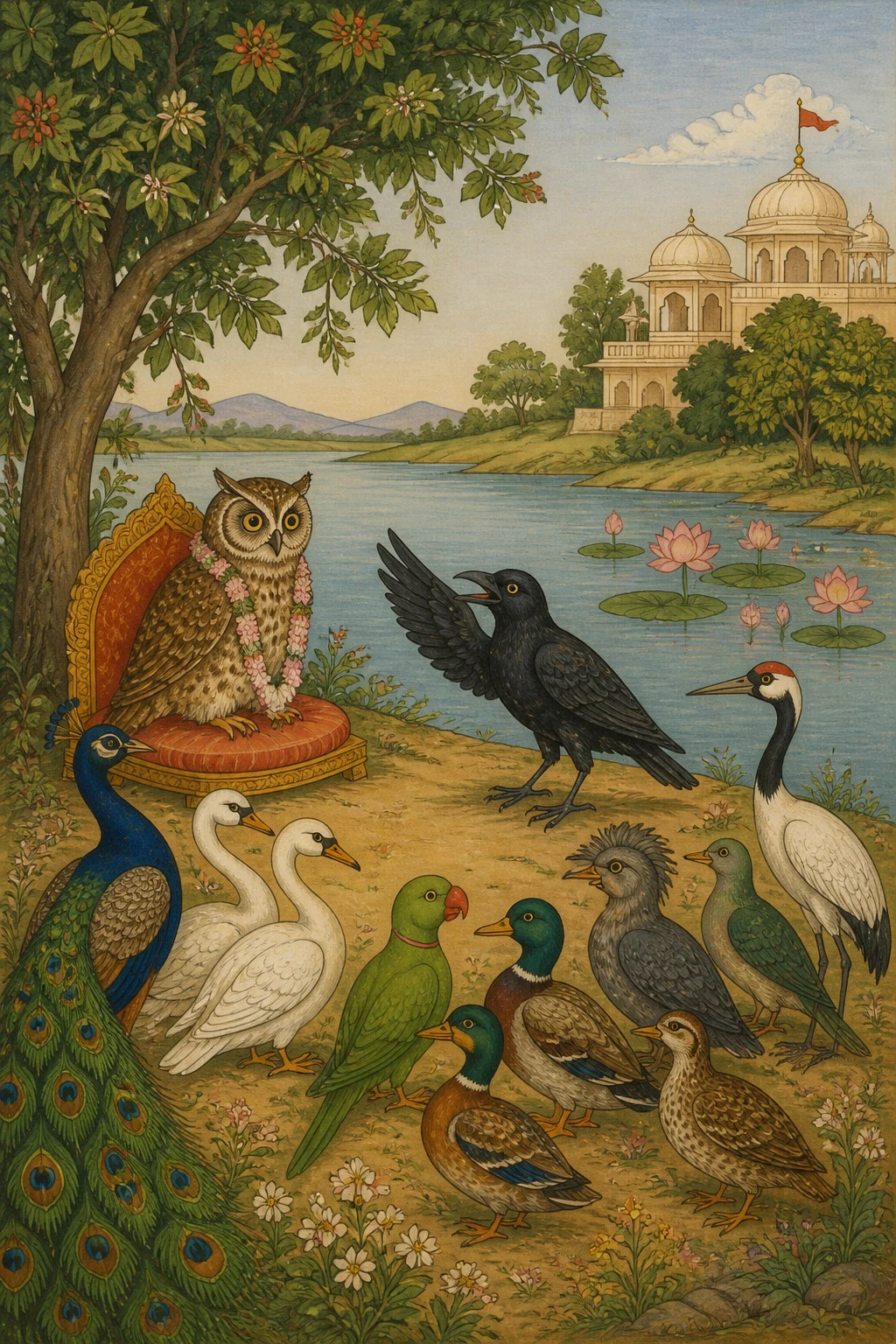
The three went to Meghanāda, told him the whole story, and waited. He said, “What is this wretched elephant against a company united in anger? Follow my plan. Fly, at midday you must go and hum in the ear of that rut-maddened elephant, making a sound like the music of a vīṇā. Enraptured by its sweetness, he will close his eyes. Then the woodpecker must peck them out with his beak. Blinded and tormented by thirst, he will hear me and my companions croaking beside a pit, and will come towards us, thinking there is a pool. When he reaches the pit, he will fall in and die. Thus we must work together to accomplish our revenge.” They carried out the plan. Delighted by the fly’s song, the rutting elephant closed his eyes, and the woodpecker tore them out. Wandering in the midday heat, he followed the croaking of the frogs, reached the great pit, fell in, and died. That is why I say, “Through a sparrow, a woodpecker…” The lapwing said, “My dear, so be it. I shall dry up the ocean with the help of my friends.” Having resolved on this, he summoned the herons, cranes, peacocks, and other birds, and said, “Friends, the ocean has wronged me by stealing my eggs. Think of some way to dry him up.” They conferred and replied, “We have not the strength to dry up the ocean. Why labour in vain? For it is said:
A weakling who, deluded by pride, goes out to battle a mighty foe
must turn back like an elephant with broken tusks.
“But Vainateya, the son of Vinatā, is our lord. Let us tell him of this outrage. Angered at the insult to his own kind, he will avenge it. Even if he shows indifference, you will at least be relieved of your burden. For it is said:
By confiding his sorrow to a steadfast friend, a worthy servant, an obedient wife,
or a powerful master, a man finds relief.
“Let us go to Vainateya, then, for he is our lord.”
So all the birds approached Vainateya, their faces downcast and their eyes filled with tears, and began to cry out pitifully: “Alas! An outrage! An outrage! Though you are here to protect us, the ocean has stolen the eggs of this worthy lapwing. Now the whole race of birds is doomed! The ocean will destroy others too, just as he pleases. For it is said:
Seeing someone commit a shameful deed, another does the same;
people follow one another’s example, rather than seeking what is right.
Subjects must be protected from oppression by cheats, thieves, evildoers,
violent men, and those who prey upon them through fraud and deception.
A king who protects his subjects receives a sixth of their merit;
one who fails to protect them receives a sixth of their sin.
The fire kindled by the anguish of oppressed subjects
does not die until it has consumed the king’s wealth, family, and life.
The king is kin to those without kin, eyes to those without sight;
he is father and mother to all who live by justice.
A king who desires a harvest must tend his people diligently,
watering them with gifts and honours as a gardener waters his seedlings.
Just as a tender shoot, carefully protected,
bears fruit in time, so do a well-protected people.
Gold, grain, jewels, and vehicles of every kind—
whatever else a king possesses comes from his subjects.
Hearing this, Garuḍa grieved at their distress and, filled with anger, thought, “These birds have spoken truly. I shall go this very day and dry up that ocean.”
As he was thinking thus, a messenger from Viṣṇu arrived and said, “Garuḍa! Lord Nārāyaṇa has sent me to you. He is going to Amarāvatī on the gods’ business. Come at once.”
Hearing this, Garuḍa answered proudly, “Messenger, what use has the Lord for such a worthless servant as I? Go and tell him to appoint another servant in my place to carry him. Convey my respects to the Lord. For it is said:
A wise man should not serve a master who fails to recognize his worth;
such service bears no fruit, like barren soil, however well tilled.
The messenger said, “Vainateya, never before have you spoken like this of the Lord. Tell me, what has he done to offend you?” Garuḍa replied, “The ocean, who enjoys the Lord’s protection, has stolen our lapwing’s eggs. Tell him this is my firm resolve: unless he punishes the ocean, I am no longer his servant. Go quickly and tell the Lord.” Learning from the messenger that Vainateya was angry with the resentment of one who feels his devotion slighted, the Lord thought, “I shall honour him and bring him back. For it is said:
He who wishes to prosper should never slight a servant who is devoted, capable, and well-born,
but should always cherish him like a son.
And further:
A king, even when pleased, gives his servants only wealth;
but when honoured, they will serve him even at the cost of their lives.”
Having reflected thus, he hurried to Vainateya in Rukmapura. When Vainateya saw the Lord come to his home, he bowed with his head lowered in shame and said, “Lord, emboldened by your protection, the ocean has stolen my servant’s eggs and thereby insulted me. Only out of reverence for you have I held back. Otherwise I would have turned him into dry land this very day. Out of respect for one’s master, one refrains even from striking his dog. For it is said:
A loyal servant of the household must never do anything that might diminish his master’s standing
or cause him pain, even if he must give up his own life.
Hearing this, the Lord said, “Vainateya, you have spoken truly. For it is said:
The punishment for a servant’s offence falls upon his master;
and the shame it brings falls more upon the master than the servant.
“Come, then. Let us recover the eggs from the ocean and make the lapwing happy. Then we shall go to Amarāvatī.”
They did so. The Lord fitted a fiery arrow to his bow and sternly addressed the ocean: “Wretch! Return the lapwing’s eggs, or I shall turn you into dry land!”
Terrified, the ocean gave back the eggs, and the lapwing returned them to his wife. That is why I say, “Without knowing the strength of an enemy…” Therefore a man must never abandon his efforts.
Hearing this, Sañjīvaka questioned him again: “My friend, how am I to know that he harbours evil intentions towards me? All this time he has regarded me with ever-increasing affection and favour. I have never seen any change in him. Tell me, then, how I may recognize it, so that I can act to kill him in self-defence.”